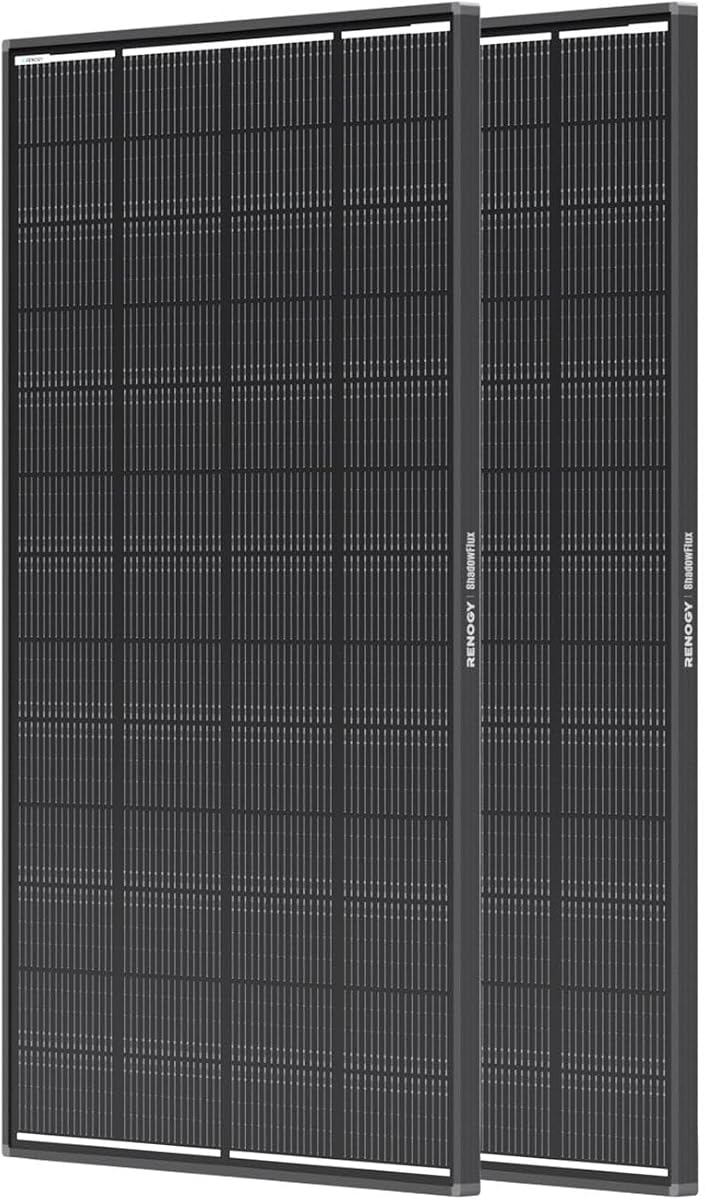
Renogy 400W ShadowFlux Solar Panel
4.6Editor score
400W combined output configuration
N-type 16BB cell construction
ShadowFlux anti-shading technology
Compact space-saving footprint
IP67 outdoor protection
Marine solar panels compared for output, efficiency, weather resistance, installation needs, and suitability for boats, RVs, and off-grid systems.
Marine solar panels give boats and off-grid vehicles a quiet, renewable way to maintain batteries, power electronics, and small appliances. A useful panel must combine reliable output with corrosion-conscious construction, secure mounting, effective weather sealing, and enough electrical compatibility for the battery and charging equipment already aboard.
This guide compares ten solar panels selected for marine, RV, trailer, and mobile-power use. We evaluated stated power ratings, cell and conversion efficiency, shading tolerance, waterproofing, temperature performance, mounting provisions, charge-control features, warranty coverage, and suitability for different battery-maintenance and energy-generation needs.
The list spans compact trickle chargers, flexible panels for curved surfaces, anti-shading rigid modules, and higher-output systems for larger installations. Each review highlights the most useful application and any important trade-offs. Product ratings and availability can change, so readers should verify current specifications, compatibility, and current prices before purchasing.
4.6Editor score

4.8Editor score

4.5Editor score
The comparison below organizes all ten options by their primary role, from low-output battery maintainers to high-output rigid and flexible generation systems. It makes it easier to distinguish integrated charge controllers, standalone modules, anti-shading designs, and the electrical or installation features each model offers.


This Callsun offering is a pair of 200W N-type monocrystalline modules designed for 12V and 24V systems, and it holds a 4.8 rating among the products in this guide. Its standout qualities are a stated 25.6% conversion efficiency, bifacial construction, and a dual-module parallel arrangement intended to reduce the effect of partial shade.
We may earn a commission when you buy through this link, at no additional cost to you.
Each 200W panel uses 16BB busbars, which the manufacturer says helps limit hot spots and microcrack risks. The transparent backsheet allows the rear face to collect direct, reflected, and diffuse light, potentially increasing energy yield when the installation exposes the back to useful light. Connecting the two panels in series provides a listed 47.48V Vmp, 54.62V Voc, and 8.43A operating current, making electrical compatibility with the intended charge equipment essential.
The anti-shade feature is especially relevant aboard boats and RVs, where antennas, vents, trees, or nearby structures can cast uneven shadows. Each module is divided into independently operating sections, allowing the unshaded section to continue producing when the other is partly obstructed. The trade-offs are that rear-side generation depends on the surroundings, and the series configuration may not suit every portable power station or controller. Buyers should also confirm adequate unobstructed sunlight and appropriate wiring.
This is the strongest all-around choice in the lineup for owners who want meaningful generation and a small number of modules rather than a single oversized panel. Each panel measures 51.3 by 30.3 by 1.4 inches and weighs 23.8 pounds, a relatively manageable combination for roof or deck installation. With pre-drilled holes, an IP68 junction box, tempered glass, a corrosion-resistant aluminum frame, and a low temperature coefficient of -0.30%/K, it is well suited to demanding mobile environments.
The divided-module design is valuable where shade is difficult to eliminate. It cannot prevent every shading loss, but it helps preserve output when only part of a module is obstructed, making the system more dependable than a conventional single-section panel in the same situation.
Bifacial construction can add rear-side generation when reflected or ambient light reaches the back. The stated low temperature coefficient also helps limit hot-weather losses, although actual yield still depends on mounting, orientation, reflectivity, and local sunlight.
We may earn a commission when you buy through this link, at no additional cost to you.
The SOLPERK 20W kit combines a monocrystalline panel, an eight-amp controller, a mounting bracket, clips, seals, and installation hardware. It carries a 4.5 rating and focuses on maintaining 12V batteries rather than serving as a substantial energy generator. That distinction makes it practical for boats, trailers, tractors, motorcycles, RVs, and stationary equipment that sit unused for extended periods.
We may earn a commission when you buy through this link, at no additional cost to you.
Its controller uses a three-stage process intended to protect against overcharging, over-voltage, and short circuits, while indicator lights reveal charging status. The panel uses low-iron tempered glass and a corrosion-resistant aluminum frame, and the manufacturer describes it as waterproof and rustproof. It also states resistance to wind pressure up to 2400Pa and snow load up to 5400Pa.
The main limitation is output. A 20W panel is useful for offsetting parasitic drain and maintaining a battery, but it is not designed to run substantial electronics, power an electric system continuously, or recharge a deeply depleted battery quickly. Some installation may also be needed because the supplied bracket is intended for a fixed surface rather than the cigarette-lighter convenience offered by smaller plug-in maintainers.
Choose this kit when the goal is inexpensive, uncomplicated battery maintenance in a 12V system. The adjustable 360-degree bracket helps maintain a favorable angle, while pre-drilled holes and plug-and-play connections simplify setup. It is less compelling for live power demands, but as a budget-oriented maintainer for a marine battery, RV house battery, or trailer battery, it covers the essentials in a complete package.
The integrated controller, bracket, cabling, clips, and mounting pieces reduce the need to source separate accessories. It is a convenient starting point for owners who want a straightforward 12V maintenance system rather than a more advanced renewable-energy installation.
Tempered glass, an aluminum frame, and the stated environmental load ratings suit outdoor use. Consistent sealing and secure bracket placement remain important, especially on vessels where spray, wind-driven rain, and constant motion can accelerate installation problems.
We may earn a commission when you buy through this link, at no additional cost to you.
This SUNER POWER maintainer combines a 20W panel with a built-in Ultra-Smart MPPT controller and holds a 4.4 rating. It is aimed at 12V batteries in boats, cars, dump trailers, RVs, campers, trucks, and other deep-cycle applications. Its strongest selling point is the combination of MPPT control, selectable battery modes, and an unusually broad list of safety protections.
We may earn a commission when you buy through this link, at no additional cost to you.
The controller is described as reaching up to 99% tracking efficiency and 98% peak conversion efficiency, with approximately 20% to 30% higher utilization than other controllers according to the manufacturer. A bulk, absorption, and float sequence manages the charge cycle, while the unit stops once the battery is full and resumes after discharge. Modes for 12V, 12V AGM, and 12V lithium allow the charging behavior to be tailored to the battery type.
The waterproof, spark-proof enclosure includes protection against overcharge, over-discharge, over-voltage, over-current, over-load, short circuit, reverse polarity, and over-temperature. These safeguards are meaningful around a boat or RV, where a loose connection or unsuitable battery setting can create problems. Indicator lights show charge levels at 25%, 50%, 75%, and 100%.
This is a good choice for a 12V battery-maintenance setup that needs clearer controls and more battery-specific settings than a basic trickle charger. The 20W rating remains modest, so it should not be expected to power continuous loads or recharge a large battery bank quickly. The included suction cups provide quick mounting, but a permanent bracket is advisable where vibration or frequent movement could dislodge them.
Three selectable modes make the controller more versatile than a fixed trickle charger. The correct setting should be confirmed from battery documentation because charging behavior differs among flooded, AGM, gel, SLA, VRLA, maintenance-free, and LiFePO4 batteries.
Reverse-polarity, short-circuit, and temperature protections add useful safeguards around marine and vehicle installations. They do not replace correct polarity, sound fusing, secure wiring, or periodic inspection, but they provide useful layers of control.
We may earn a commission when you buy through this link, at no additional cost to you.
The Renogy 100W N-Type 16BB panel offers a practical middle ground between a tiny maintainer and a high-output marine array. It has a 4.7 rating, uses grade A+ N-type cells, and has a stated conversion efficiency of 25%. Renogy says the efficiency provides 20W more output than a conventional PERC panel of comparable design.
We may earn a commission when you buy through this link, at no additional cost to you.
Its 16BB configuration is intended to improve electrical conversion while reducing hot spots and hidden cracks. A low temperature coefficient reduces losses in hot conditions, an important consideration for boats, open vehicle roofs, and unshaded installations in warm climates. The panel also carries low degradation figures of no more than 1% in the first year and 0.4% annually.
Environmental specifications include IP67 protection, 2400Pa wind-load testing, and 5400Pa snow-load testing. Low-iron tempered glass and a corrosion-resistant aluminum frame support outdoor durability. The warranty is stated as a 10-year material and workmanship commitment alongside a 25-year performance guarantee at 80% output.
This standalone module works well for owners building a modest solar system around a 12V battery bank, portable power station, or larger off-grid installation. It does not include a charge controller, so appropriate power electronics, connectors, and system protection must be added. For buyers seeking a balance of usable output, efficiency, environmental ratings, and long-term coverage, it is one of the most balanced choices in the guide.
At 100W, the panel provides meaningful daily charging potential without the bulk of a large rigid array. That balance can make it easier to find an unobstructed mounting location on a smaller boat cabin, camper roof, or vehicle canopy.
The stated IP67 protection, corrosion-resistant frame, load testing, and low degradation figures all support long service. Actual longevity still depends on installation quality, avoiding physical impact, maintaining cable connections, and cleaning the glass as dirt accumulates.
We may earn a commission when you buy through this link, at no additional cost to you.
The Renogy 200W ShadowFlux is designed for mobile installations where available area and partial shade are both important concerns. It carries a 4.5 rating and combines N-type cells with 16BB technology and a stated efficiency of 25%. Its ShadowFlux anti-shading system is intended to sustain output when buildings, vegetation, or stains cast partial shade.
We may earn a commission when you buy through this link, at no additional cost to you.
Beyond the cell design, ShadowFlux is described as reducing hot-spot risk and supporting consistent performance in shaded areas. The module is 7% smaller and 10% more compact than PERC solar panels, according to Renogy. That dimensional advantage can be meaningful on a vessel with a crowded roof, although the installer must still confirm that 200W is appropriate for the available surface and electrical system.
Environmental durability includes an IP67 rating and advanced encapsulation intended to improve resistance to water-vapor exposure. The stated coverage includes a five-year output warranty and material and workmanship commitment, plus a 25-year output warranty ensuring 80% power output. It is a standalone solar panel rather than an all-in-one maintainer, so a controller and compatible wiring remain necessary.
Choose the 200W ShadowFlux when a boat or RV has enough room for meaningful solar generation but may experience occasional partial shade. It offers a stronger output ceiling than the smaller ShadowFlux model without moving into the footprint of the 400W setup. Its limitations are ordinary for a standalone module: no integrated controller, no supplied battery wiring, and a requirement to use the panel within the electrical limits of the selected charging equipment.
ShadowFlux is intended to reduce the severe output losses that can occur when one portion of a conventional panel is shaded. It does not make a heavily obstructed panel immune to shading, but it can improve consistency around masts, vents, trees, and nearby structures.
The compact 200W format is attractive where every square foot of roof or deck space counts. Owners should prioritize an unobstructed solar area and orient the module toward available sunlight rather than treating the stated wattage as guaranteed output in every condition.
We may earn a commission when you buy through this link, at no additional cost to you.
The Renogy 200W flexible panel is the list's leading option for curved or space-constrained surfaces. It has a 4.5 rating, can bend within 240 degrees, and weighs approximately half as much as a comparable rigid panel. Those traits make it easier to store, carry, and mount on a curved cabin roof, canopy, or other irregular surface.
We may earn a commission when you buy through this link, at no additional cost to you.
The panel uses half-cut PERC cell technology to improve light capture and electrical performance. Renogy estimates an average production of 1,000 watt-hours per day based on five hours of sunlight, a useful planning figure that should be adjusted for the actual location, season, orientation, and shading. Its all-black, glare-free finish also reduces visual prominence compared with a traditional framed module.
The IP67-rated junction box and solar connectors provide weather sealing, while stated wind and snow-load ratings reach 2400Pa and 5400Pa. Pre-drilled mounting holes and a 27.6-inch 12 AWG solar connector cable support installation. Because the panel is bendable, however, mounting quality matters: it should lie against a clean, smooth surface without wrinkles, tension, or repeated flexing that could stress cells and connections.
This is a good choice for a smaller craft, RV, trailer, or mobile setup where a rigid panel cannot be mounted flat. It is not the strongest option for maximizing watts on a large open roof, where a rigid N-type module may provide a better performance-to-area ratio. Buyers should use an adhesive or compatible attachment method appropriate to the surface and confirm that cables are protected from abrasion and standing water.
The 240-degree bend range allows the module to follow a cabin roof or canopy more closely than a rigid panel. A close, smooth fit can improve available solar area and reduce the need for custom brackets, provided the installation avoids sharp bends and trapped moisture.
Its reduced weight makes this panel easier to carry, reposition, and stow than a rigid 200W module. That portability is useful for seasonal installations, but the cable and junction box still need care because mechanical movement and abrasion can be more damaging than they are to a rigid frame.
We may earn a commission when you buy through this link, at no additional cost to you.
The Renogy 120W ShadowFlux occupies the middle ground between the 100W standard module and the larger 200W or 400W panels. It has a 4.5 rating, uses N-type cells with 16BB technology, and reaches a stated 25% conversion efficiency. The result is a practical amount of generation for mobile systems that cannot support a larger rigid array.
We may earn a commission when you buy through this link, at no additional cost to you.
ShadowFlux is designed to maintain useful output under partial shade from buildings, plants, or surface contamination while reducing hot-spot risk. Renogy describes the panel as 10% smaller and 10% more compact than PERC alternatives. That compactness helps owners locate a sunnier position on a smaller cabin roof or vehicle canopy without accepting the footprint of a high-output setup.
The panel has an IP67 rating and advanced encapsulation intended to resist water-vapor exposure, supporting outdoor reliability through rain, snow, dust, and small hail. Coverage consists of a five-year materials and craftsmanship commitment and a 25-year output warranty ensuring 80% power output. As with the other standalone Renogy modules, it does not include a charge controller.
Choose the 120W ShadowFlux for a medium-scale installation that may encounter intermittent shade but does not need 200W or 400W. It can support a 12V battery bank, portable power station, or off-grid system when matched with suitable electronics. It is not a high-output panel for running large appliances continuously, so buyers with substantial daytime demand should consider a larger module or multiple-panel array.
The 120W rating is large enough to be useful for regular charging while remaining easier to accommodate on small mobile surfaces. It also gives owners a simpler single-panel option than a multi-module installation when demand and available space are moderate.
Partial shade is common around cabins, railings, antennas, and dockside structures. ShadowFlux helps reduce the disruption caused by localized obstruction, although the best installation still minimizes shade and keeps the glass clean.
We may earn a commission when you buy through this link, at no additional cost to you.
The Renogy 400W ShadowFlux is a high-output option for larger boats, RVs, and off-grid systems. It carries a 4.6 rating and is configured as two 200W sections within a 400W setup. N-type 16BB cells provide a stated efficiency of up to 25%, while ShadowFlux technology is intended to preserve output and reduce hot-spot risk when buildings, trees, plants, or stains partially shade the panel.
We may earn a commission when you buy through this link, at no additional cost to you.
Renogy describes the assembly as 7% smaller and 10% more compact than traditional PERC panels. More power in less space is valuable on a large vessel or camper, but the exact mounting footprint should still be checked. A high nominal rating does not guarantee equal output when the two sections receive different amounts of sunlight, so orientation and partial-shade planning remain important.
The panel carries an IP67 design and advanced encapsulation intended to improve water-vapor resistance and withstand rain, snow, dust, and small hail. It is backed by a five-year material and workmanship warranty and a 25-year power-output warranty guaranteeing at least 80% of rated output after 25 years. These are meaningful considerations for a permanently installed mobile system.
This is the premium choice for owners who want substantial solar generation and can provide sufficient roof or deck area plus compatible charge control. It is far beyond the needs of a simple battery maintainer and will require careful planning for wiring, fusing, grounding where applicable, and electrical limits. In return, those who have the space and system capacity gain a high-output panel with modern N-type cells and anti-shading construction.
A 400W configuration can meaningfully reduce reliance on shore power or a generator for suitable daytime loads. Actual savings depend on sunlight, system losses, battery capacity, and how the generated energy is managed throughout the day.
IP67 protection, advanced encapsulation, and long-term output coverage support use in exposed mobile environments. They complement, rather than replace, proper sealing, regular inspection, and protection from impact or sustained physical stress.
We may earn a commission when you buy through this link, at no additional cost to you.
The SUNER POWER 50W charger is a larger version of the integrated maintainer concept, with more output for 12V batteries and increased daily charging potential. It has a 4.4 rating and includes Ultra-Smart MPPT technology with stated tracking efficiency of up to 99% and peak conversion efficiency of 98%. The manufacturer claims approximately 20% to 30% better utilization than competing controllers.
We may earn a commission when you buy through this link, at no additional cost to you.
Its bulk, absorption, and float stages regulate the battery through the charging cycle. The controller stops when the battery reaches full charge and resumes after discharge, creating a largely automatic maintenance routine. Selectable 12V, 12V AGM, and 12V lithium modes support many flooded, gel, AGM, SLA, VRLA, maintenance-free, and LiFePO4 batteries used in boats, RVs, trailers, cars, and deep-cycle applications.
The listed safeguards include over-charge, over-discharge, over-voltage, over-current, over-load, short circuit, reverse polarity, and over-temperature protection. The unit is described as waterproof and spark-proof, and four-stage visual indicators display charging progress at 25%, 50%, 75%, and 100%. Pre-designed holes and included suction cups support quick mounting, while plug-and-play cables simplify connection.
This is a useful middle ground between a basic trickle charger and a larger standalone solar array. It can maintain a 12V battery bank more effectively than a 20W unit, but it still lacks the generation capacity of the 100W-to-400W modules. It is best for users who value automatic MPPT control and integrated protection more than high daytime power. For a permanent marine installation, a sturdier mechanical mount than the supplied suction cups may be necessary.
At 50W, the panel is better suited to offsetting regular parasitic loads and maintaining a battery over time. It remains a charger and maintainer rather than a large power-producing module, so continuous household-style loads are not its intended role.
The three-stage algorithm and MPPT tracking simplify unattended operation, while the indicators help users understand charging progress. The selectable battery modes also make the unit more adaptable than a basic maintainer with one fixed charging profile.
We may earn a commission when you buy through this link, at no additional cost to you.
The POWOXI 7.5W maintainer is the most compact and simplest option in the guide, with a 4.4 rating. It is designed primarily for a 12V vehicle battery but is also listed for LiFePO4 and lithium-ion batteries, motorcycles, boats, tractors, ATVs, farm equipment, and other 12V applications. Its role is preventing gradual battery drain rather than delivering usable daily power.
We may earn a commission when you buy through this link, at no additional cost to you.
A smart internal protection system and blocking-diode structure are intended to prevent overvoltage and short circuits, while the manufacturer states a conversion efficiency of 25% to 30%. The high-transparency glass surface uses an upgraded mirror photovoltaic process to improve light transmission. Installation is straightforward: the panel can plug into a car power outlet or connect directly to the battery using the included alligator clips.
The ABS and polycarbonate frame resists scratching and avoids the paint-damage concern associated with an exposed aluminum alloy frame. Red and green indicator lights show when the panel is receiving sunlight and when it is connected for charging. No separate controller box is required for this compact format, which helps keep installation simple and portable.
Choose the POWOXI when the battery is stored for weeks or months and only needs a small amount of maintenance energy. It is not appropriate for charging a deeply discharged battery, powering electronics, or meeting appreciable household energy demand. The cigarette-lighter connection also requires access to a suitable 12V outlet, so boats with constantly live sockets or limited socket access may prefer the direct alligator-clip connection.
The direct outlet or clip connection allows the panel to be placed in sunlight without a complex fixed installation. That simplicity makes it useful for seasonal vehicles and equipment, provided the connection point and battery chemistry are suitable.
A 7.5W maintainer is designed to replenish small losses slowly. It should not be relied upon for deep recovery, high starting loads, or continuous electrical use, and the battery should be checked periodically to confirm that maintenance is actually occurring.
We may earn a commission when you buy through this link, at no additional cost to you.
Choosing a marine solar panel involves balancing available space, expected energy demand, battery chemistry, exposure to shade and spray, and the electrical limits of the rest of the system. The most technically advanced panel is not automatically the most useful if it cannot be mounted safely or charged with compatible equipment.
Start by estimating how much energy the installation must produce rather than choosing solely by wattage. A small 7.5W or 20W maintainer can offset light standby drain, while a 50W or 100W panel can support a more useful charging routine. Larger 200W and 400W systems are appropriate for sizable battery banks, portable power stations, or daytime loads. Real output depends on sunlight, panel angle, temperature, shading, wiring loss, and controller efficiency, so the rated wattage should be treated as a peak figure rather than an all-day guarantee.
Most products in this guide support nominal 12V systems, but compatibility extends beyond that basic label. Check the battery chemistry, whether it is flooded, gel, AGM, SLA, VRLA, maintenance-free, or LiFePO4, and select the corresponding charging mode. Standalone modules require a separately purchased charge controller with suitable current, voltage, and battery settings. Integrated MPPT units offer convenience, while higher-output systems may need controllers designed to accept their operating voltage and current.
Measure the usable area rather than relying on a general wattage impression. Rigid N-type modules generally provide a strong power-to-area option, while a flexible Renogy panel can conform to a curved cabin roof or canopy with less weight and bulk. The Callsun and Renogy 400W configurations need enough room for their complete assemblies and safe cable routing. Leave room around vents, hatches, antennas, rails, and walkways, and avoid locations where people, ropes, branches, or loose equipment may contact the glass.
Marine and mobile installations often encounter unavoidable partial shade from masts, trees, cabins, walls, and nearby structures. The Callsun TwinCell arrangement and Renogy ShadowFlux panels are designed to reduce the output penalty when only part of a module is shaded. No anti-shading feature compensates for a completely blocked panel, so good placement remains the priority. Identify obstructions at different times of year, clean away accumulated dirt or salt, and consider whether reflected light, nearby water, or a light-colored surface could improve the installation.
Conversion efficiency expresses how effectively a panel converts incident light under specified test conditions, while real energy yield depends on the entire installation. High-efficiency N-type and PERC cells can reduce the area needed for a given rated output, which is valuable on space-limited vessels. However, temperature, soiling, orientation, partial shade, and electrical losses affect the result. A slightly lower-efficiency panel with a better location and cleaner glass may outperform a more advanced panel mounted in a poorer spot.
Look for a corrosion-resistant frame, tempered-glass surface, sealed junction box, and relevant IP protection rating. The options range from IP67-rated construction to the Callsun panel's IP68-rated junction box. A panel rating applies to specific components and test conditions, so it does not make the whole installation waterproof. Use marine-grade connectors where appropriate, protect cable entry points, ensure drainage, and avoid trapping water behind a surface-mounted panel.
Rigid panels are generally straightforward to mount, easier to shade, and often offer a stronger power-to-area ratio. They are well suited to a boat cabin roof, hard canopy, or rack with a flat mounting area. Flexible panels are lighter, less visually intrusive, and easier to fit to curved surfaces, but they require careful adhesion, smooth support, and protection from repeated bending. The Renogy flexible panel's 240-degree bendability makes it the clear choice when shape conformity is more important than maximum power density.
Long-term coverage provides useful confidence in panel materials, workmanship, and output retention. The Renogy products carry different material and output commitments, while the Callsun offering includes a 25-year performance commitment and stated long-term technical support. Warranty terms do not prevent damage from improper mounting, incorrect voltage, reverse polarity, or physical impact, so read exclusions and follow the manufacturer's installation instructions. Warranty duration should complement, not replace, sound system design and routine inspection.
Before installation, identify the battery type, system voltage, charge-controller requirements, and the panel's electrical limits. Mount the panel where it receives the strongest available sunlight without blocking access to hatches, vents, or safety equipment. Use the supplied hardware where appropriate, but verify that fasteners, brackets, adhesives, and seals are compatible with the vessel's surfaces and expected movement.
For a panel with a built-in controller, select the correct battery mode and connect the cables with the correct polarity. For a standalone module, connect it to a suitably rated controller and battery system through protected wiring and compatible connectors. Place fusing and switching where required by the system design, provide strain relief, and keep electrical connections above standing water. Allow the panel to detect the battery and follow any manufacturer-specific startup instructions before relying on it for critical loads.
Clean the glass periodically with fresh water and a soft cloth, especially in salty, dusty, or oily environments. Inspect the frame, mounting points, cable insulation, connectors, and junction box for corrosion, cracks, abrasion, or water ingress. Do not use harsh solvents or abrasive tools. During severe weather, inspect the installation for loosened hardware and damage, and remove or cover the panel only when doing so will not expose wiring or create additional hazards.
A 7.5W or 20W panel is generally suited to maintaining a lightly used 12V battery and offsetting small standby losses. A 50W or 100W module is more useful when the battery receives deeper discharge or must support regular electrical loads. The correct choice depends on the battery capacity, expected drain, available sunlight, and local weather rather than boat length alone.
They can be, but the panel and controller must both support the battery chemistry. The SUNER POWER maintainers provide a selectable lithium mode, and the SOLPERK product lists LiFePO4 compatibility. Always confirm the manufacturer's instructions, set the controller to the correct battery profile, and verify that the controller supports lithium charging before connecting the system.
Standalone solar modules require an appropriately rated charge controller to regulate battery charging. Integrated products such as the SOLPERK and SUNER POWER kits include a controller, making them easier to install. Even with an integrated controller, correct battery settings, protected wiring, and suitable current capacity remain important.
Yes, because both rigid and flexible options can be mounted to suitable fiberglass surfaces. Rigid panels generally use sealed mounting points, while flexible panels need smooth preparation and an adhesive or attachment system compatible with fiberglass. The installer should prevent water from collecting beneath the panel and avoid blocking hull drainage or deck access.
A flexible panel can conform to a curved surface more closely than a rigid module. The Renogy 200W flexible model is bendable within 240 degrees, but it should not be sharply creased, pulled taut, or repeatedly flexed. A smooth, clean surface and secure attachment help protect cells and connections.
A 20W panel has a peak rating of 20 watts under favorable conditions, but actual output changes with sunlight, temperature, angle, and losses. It is intended primarily to maintain a 12V battery or offset low standby consumption. It is not appropriate for running large appliances or rapidly restoring a deeply discharged battery bank.
No. The Callsun TwinCell and Renogy ShadowFlux designs are intended to reduce the impact of partial shading and associated hot-spot risk. A fully blocked panel still produces little or no power, and the entire installation can lose output when an obstruction covers a large area. Good placement remains the most important shading strategy.
Inspect the panel and mounting hardware regularly, with more frequent checks in salty spray, dusty conditions, or after severe weather. Clean the glass with fresh water and a soft cloth when dirt, salt, or bird droppings reduce illumination. At the same time, inspect cables, connectors, seals, and the junction box for damage or corrosion.
The Callsun N-Type 16BB 400W bifacial set is the strongest overall option for owners seeking high output, anti-shading construction, and compact rigid modules. Renogy's 400W ShadowFlux is the premium alternative for larger systems, while the SOLPERK 20W kit stands out as the best budget choice for uncomplicated 12V battery maintenance.
For smaller installations, prioritize the purpose of the system. The POWOXI 7.5W and SUNER POWER 20W products suit basic maintenance, the SUNER POWER 50W model offers more integrated charging capability, and the Renogy 100W, 120W, 200W, and flexible options serve progressively broader energy needs. Match the panel to the battery, controller, space, sunlight, and expected load before making a final decision.
Current specifications, ratings, warranty terms, availability, and prices can change, so check the latest product listing and manufacturer guidance before purchasing. Also review the complete electrical requirements and installation accessories, because a suitable panel, correct controller, protected wiring, and a secure mount all contribute to a dependable marine solar system.