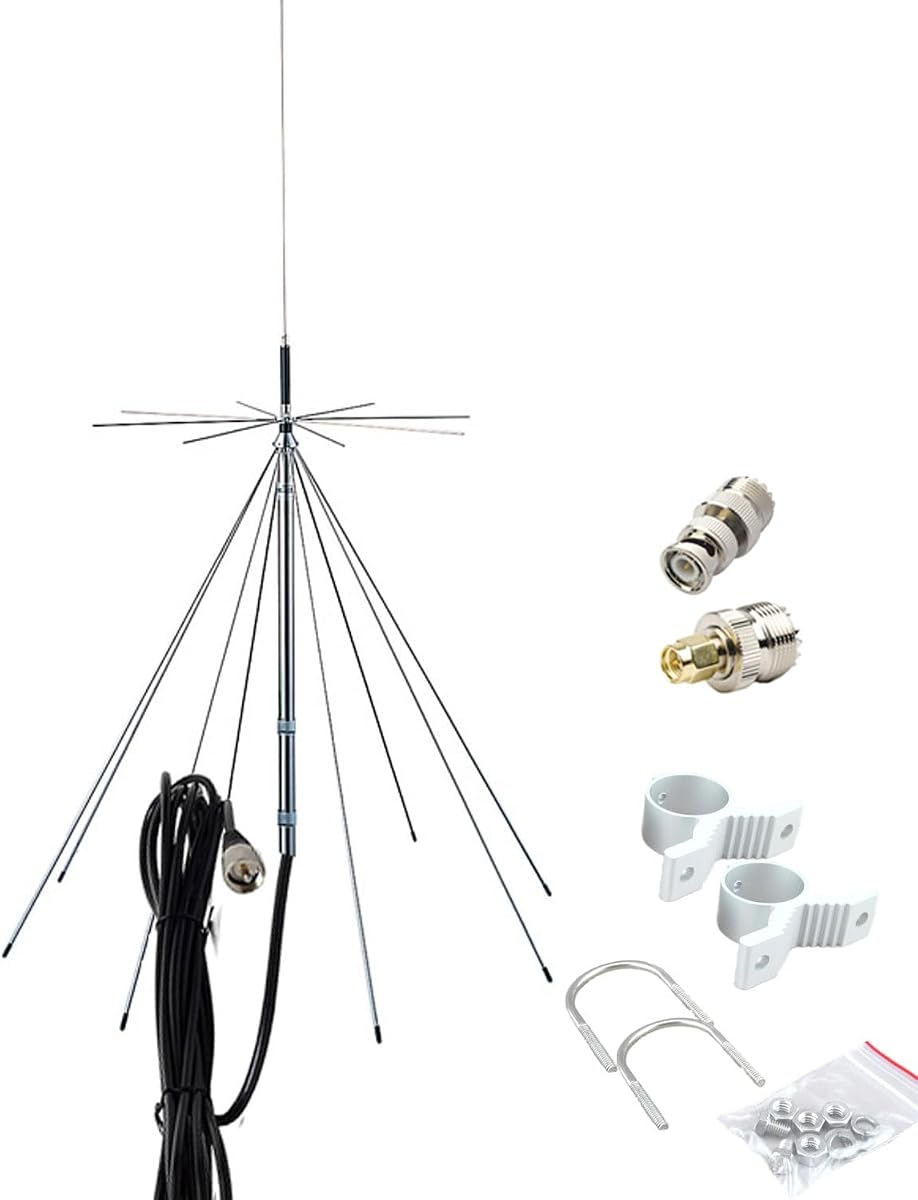
Discone 25–3000MHz Wideband Antenna
4.7Editor score
25–3000MHz broad coverage
Fixed balcony or mast installation
Includes PL-259 adapters
Our Antenna for Scanner guide compares 10 magnetic, discone, telescopic, and handheld antennas by range, mounting, connector, portability, and reception.
An antenna for scanner can materially change which stations, airband transmissions, public-safety channels, and local radio signals a receiver hears. The right choice depends on the frequencies you monitor, the connector on your scanner, available mounting space, and whether reception happens at home, in a vehicle, or while traveling with a handheld radio.
This guide compares ten scanner antennas spanning wideband magnetic mounts, adhesive glass mounts, telescopic whips, flexible handheld antennas, and large discone designs. We evaluated the supplied specifications for frequency coverage, antenna type, connector, dimensions, impedance, mounting method, transmission capability, portability, and intended radio applications.
The list shows how each product fits a different listening setup, from compact accessories to fixed installations with coax and ground-plane hardware. Ratings reflect the supplied customer feedback, while practical suitability depends on your scanner and operating environment. Prices and availability change, so confirm the current listing before purchasing.
4.7Editor score

4.2Editor score

4.5Editor score
The comparison below places every antenna by its most important practical differences: supported frequency range, physical format, mounting approach, and connection method. These specifications make it easier to identify the right option for a handheld scanner, vehicle, desktop receiver, or permanent outdoor installation.




The Bingfu 20–1300MHz Magnetic Base Scanner Antenna is a strong all-around choice for listeners who move between vehicles, radios, and fixed locations. Its supplied rating is 4.2, and its strongest attraction is the combination of very broad frequency coverage, a magnetic base, a 50-ohm BNC connection, and compatibility lists that include numerous Uniden, Whistler, and Radio Shack scanner models.
We may earn a commission when you buy through this link, at no additional cost to you.
The antenna is specified to cover 20MHz through 1300MHz with VSWR below 2.0. A 3-meter, or 10-foot, cable provides enough reach for more deliberate placement, while the magnetic base can be moved between compatible metal surfaces. The same design is also listed for public radio scanners, ham radio, two-way radio, walkie-talkies, and mobile radio use, giving it broader utility than a narrowly specialized airband accessory.
Its main limitation is that a magnetic base cannot create reception by itself. Results depend on the scanner, antenna position, vehicle construction, local terrain, and the number of active transmitters in the target band. A roof or body location may behave differently from a window edge, and users with radios fitted with other connectors should verify the required adapter before buying.
This is a practical recommendation for a scanner owner who wants one flexible antenna for a wide collection of frequencies without dealing with a permanently mounted system. The magnetic base simplifies repositioning, while the long cable and broad listed compatibility make it easier to optimize placement. Confirm the scanner's antenna connector, available metal surfaces, and local reception priorities before making the final decision.
The magnetic mounting approach allows the antenna to move between a vehicle and another suitable metal surface. The long coax also gives users some freedom to keep the radio inside while positioning the antenna externally, although best results still depend on placing the antenna as high and clear from obstructions as practical.
Coverage from 20MHz to 1300MHz makes this antenna relevant to HF, VHF, UHF, airband, public safety, and other scanner activity. Its extensive model compatibility list is useful for buyers who own more than one scanner or also operate conventional two-way radios.
We may earn a commission when you buy through this link, at no additional cost to you.
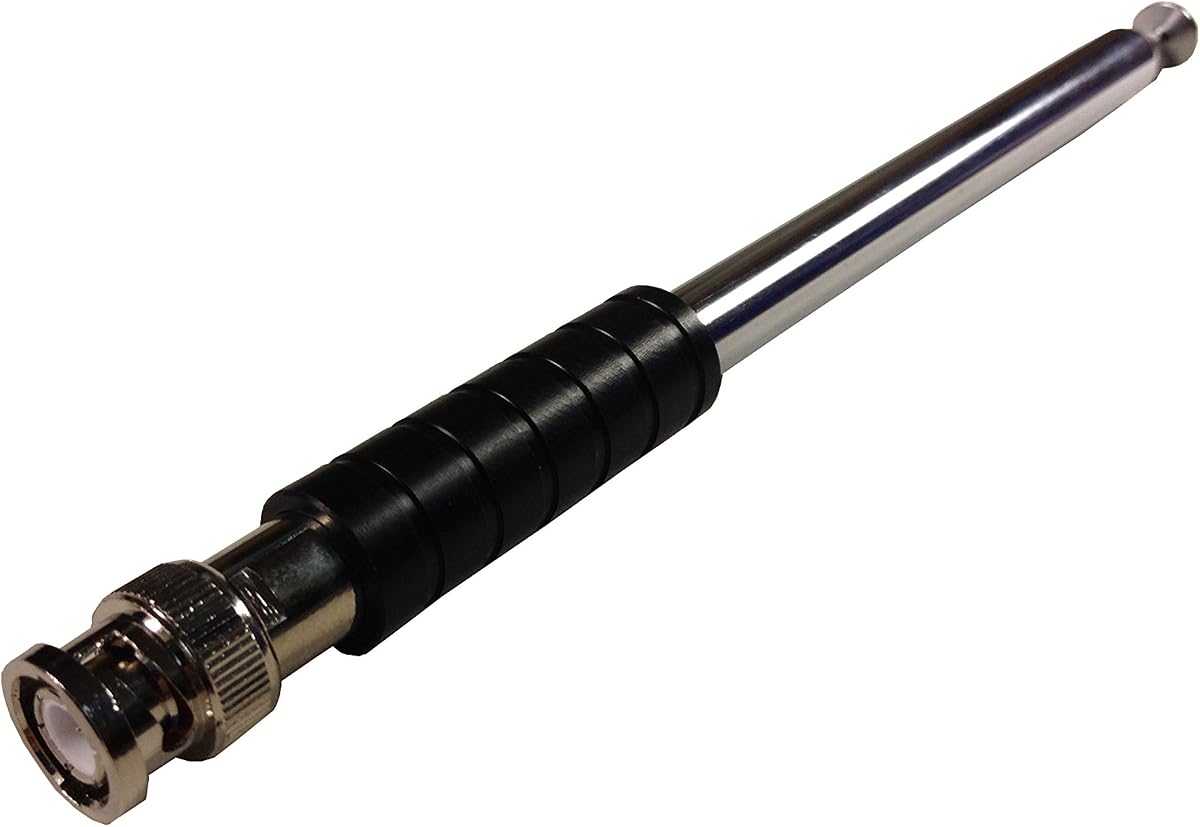
The seven-section telescopic BNC antenna is an economical and adaptable scanner accessory. It carries a supplied rating of 4.5 and is designed for CB radio, scanner, amateur radio, two-way radio, mobile scanner, transmitter, receiver, and wireless microphone applications. Its retractable format is especially convenient for people who need to pack their receiving equipment into a small space.
We may earn a commission when you buy through this link, at no additional cost to you.
The antenna measures 165mm when retracted and extends to 685mm, giving users an adjustable physical length in a familiar 50-ohm system. The listed frequency capability is DC through 12.4GHz, with a note that the semi-rigid cable component is rated from 0 to 18GHz. Those figures describe a very broad component specification, but real radio performance still depends on the antenna's design, matching, and the frequency being monitored.
The BNC male plug is straightforward to install on compatible equipment, while the telescoping sections can be shortened when maximum height is unnecessary. A user should avoid forcing the sections or creating sharp bends that could damage the conductor. The package includes one antenna and no mounting hardware, so it is not a turnkey solution for elevated, exterior installations.
This is a sensible pick for a beginner, travel-oriented listener, or anyone who wants a compact spare antenna without committing to a larger mounted assembly. It works especially well when a scanner is used close to a window, on a desk, or in another setting where a short adjustable whip is enough. Check the scanner connector and understand that extension height can affect reception.
Seven sections allow the antenna to be shortened for storage and extended when more height would help. That flexibility makes it easier to adapt the same accessory to a tabletop, travel bag, or mobile radio setup without carrying a separate fixed-mount antenna.
A male BNC plug avoids the need for a permanently mounted feed line. The stated 50-ohm characteristic impedance and wide frequency specification suit many modern scanners, although users should still verify the physical connector and the radio manufacturer's antenna guidance.
We may earn a commission when you buy through this link, at no additional cost to you.
The Taurus Desktop 25–2000MHz Scanner Antenna offers a more substantial desktop alternative to a simple telescopic whip. Its 4.5 rating reflects solid customer feedback, while the discone-style design and 25–2000MHz range make it appealing to listeners interested in broad spectrum coverage, including frequencies beyond the upper limit of many conventional scanner antennas.
We may earn a commission when you buy through this link, at no additional cost to you.
The antenna measures 70cm and includes a heavy-duty 125mm magnetic plate for stationary vehicle use when required. A 4-meter RG58 military-specification coaxial cable gives the setup more placement flexibility than a short desktop antenna, and the fitted BNC male plug simplifies connection to compatible receivers.
Despite the name, this is not necessarily a permanently installed rooftop discone. It is a desktop-oriented magnetic model, so reception will depend on the ground plane beneath the base, nearby electronics, the radio, and the location of the receiving station. Placing it near a window or higher than a desk may be more useful than leaving it immediately beside a noisy computer or power supply.
Choose this antenna when a user wants more coverage and placement flexibility than a compact whip but does not need a full outdoor mast installation. It is also a good option for stationary scanning with a BNC-equipped receiver. Buyers should treat the magnetic base as part of the system and experiment with clean, conductive mounting surfaces rather than assuming a larger antenna automatically guarantees stronger signals.
The stated 25–2000MHz range extends well beyond the 1300MHz upper boundary used by several other models. That makes the Taurus relevant for listeners whose equipment and local spectrum plan include higher-frequency services, subject to normal antenna and receiver limitations.
A 4-meter RG58 cable allows the radio to sit away from the antenna base, which can help with placement around a window, desk, or work area. The heavy-duty magnetic plate also allows the antenna to be relocated and used on a suitable vehicle surface when needed.
We may earn a commission when you buy through this link, at no additional cost to you.
The Comet BNC-W100RX is built for portable scanning and is one of the most compact entries in the guide. It has a supplied rating of 4.5, covers 25–1300MHz, and uses a six-inch flexible rubber whip. That makes it particularly useful for emergency-preparedness kits, travel, field monitoring, and users who prefer not to carry a long telescoping antenna.
We may earn a commission when you buy through this link, at no additional cost to you.
The flexible construction is designed to resist bending or breaking during transport and operation. Its listed weight is only 0.05 pounds, while the omnidirectional radiation pattern and vertical polarization are intended to receive signals from multiple directions. The product information cites compatibility with popular handheld scanners and receivers from Uniden, Whistler, AOR, and Icom.
The compact whip does not provide the elevation of a longer discone or telescopic antenna, so reception can be less effective when the radio is indoors or surrounded by obstruction. Because it is presented as a receive antenna, users should not treat it as a universal replacement for a radio's specified transmit accessory. The physical BNC connector is convenient, but the scanner must have a matching antenna socket.
This is an excellent portable pick when compactness and durability matter more than maximum passive gain. It can also serve as an easy-to-carry spare for compatible scanners. For fixed reception, a larger antenna with adjustable height may offer more opportunity to improve the signal path; for mobile and field work, the Comet's short, flexible design is the more convenient choice.
At six inches, the whip adds little bulk to a handheld scanner or portable receiver. It is easy to carry in a pocket, backpack, or equipment case and less likely to snag during transport than a fully extended multi-section antenna.
The stated omnidirectional pattern and vertical polarization are useful when the operator needs to receive signals arriving from different directions while moving. It also means the radio's position and local obstructions still play a major role in the quality of reception.
We may earn a commission when you buy through this link, at no additional cost to you.
The Bingfu Police Radio Scanner Dipole Antenna fills a specific niche: mobile scanner use where a conventional magnetic roof mount is inconvenient. It has a supplied rating of 4.2 and uses an adhesive mounting method intended for vehicle window glass, offering a non-permanent alternative to attaching hardware to a metal panel.
We may earn a commission when you buy through this link, at no additional cost to you.
Its frequency range is listed as 20–1300MHz, with 50-ohm impedance, VSWR below 2.0, and a 3-meter coax terminated in a BNC male connector. The product information includes a long list of compatible Uniden, Whistler, and Radio Shack scanner models, which makes it easier for owners of those radios to evaluate fit before ordering.
Glass-mounted antennas can be affected by the vehicle's construction, window coatings, and position. Reception may also vary more than with a roof-mounted magnetic antenna because the glass and surrounding frame are part of the antenna environment. In addition, adhesive performance depends on cleaning, temperature, and the condition of the mounting surface, so installation quality matters.
Choose this model for a scanner installed in a vehicle where clean, removable glass mounting is more important than maximum all-purpose flexibility. The long cable allows the radio to be positioned separately from the exterior element. Users should clean the glass thoroughly, keep the adhesive joint undisturbed, and compare the result with the original antenna before settling on a final location.
The adhesive glass mount avoids drilling or placing a magnetic base on the vehicle roof. It can be removed when no longer needed, although the bond may be affected by heat, dirt, or prolonged movement around the mounting point.
The 10-foot RG58 lead lets the radio remain inside while the antenna element is placed on the glass. Users can test several locations without permanently changing the vehicle, although the element's final position may still determine reception quality.
We may earn a commission when you buy through this link, at no additional cost to you.
The Discone Antennas D3000 is the most specialized permanent-installation option in this guide. Its 4.7 rating is the highest among the supplied products, and its 25–3000MHz coverage, elevated-installation design, and complete feed-line kit make it well suited to a dedicated scanning station rather than a compact handheld setup.
We may earn a commission when you buy through this link, at no additional cost to you.
This ultra-wideband discone supports amateur radio, two-way radio, air traffic control, SDR programs, CB, FM, FRS, GMRS, and conventional HF, VHF, and UHF bands. The product information also identifies 1090MHz and 978MHz applications. Installation is intended for a balcony railing, roof, or mast, allowing the antenna to operate in a clearer and higher position than a desktop model.
The included kit contains 10 meters of RG58 wire with a PL-259, or SO-239, connector plus BNC and SMA male adapters. Devices requiring a PL-259 female, BNC female, or SMA female connection can be accommodated without purchasing a separate cable and adapter. The top loading coil can also be removed when 25–50MHz reception is unnecessary, making the installation more compact.
This antenna is a strong premium choice for listeners who want one high-mounted system to cover many bands and do not mind installing hardware outdoors. Its performance still depends on a sound ground-plane arrangement, secure mounting, appropriate coax routing, and keeping the feed line as short as practical. For a lightweight travel antenna, this is excessive; for a fixed listening post, the comprehensive coverage is the reason to choose it.
The discone format is designed to balance broad frequency coverage with a practical way to receive signals from multiple directions. Mounting it on a roof, mast, or balcony can place the antenna above many obstructions and make elevation one of the main advantages of the system.
Ten meters of RG58 and the included PL-259, BNC, and SMA connection options give installers flexibility when linking the antenna to different receivers. The removable top coil also allows the installation to be streamlined when the lowest HF coverage is not required.
We may earn a commission when you buy through this link, at no additional cost to you.
The dual-whip magnetic antenna combines a 25–3000MHz range with separate elements for VHF and UHF reception. Its 4.5 rating and 5-meter RG58 cable make it appealing to users who want a portable base system for scanners, SDR receivers, CB equipment, marine VHF radios, amateur mobile radio, and other two-way applications.
We may earn a commission when you buy through this link, at no additional cost to you.
The short whip is listed as 12cm for the 400–470MHz UHF range, while the long whip measures 15cm for the 136–174MHz VHF range. The base also provides a ground plane that can enhance signal reception, an important consideration for magnetic antennas that lack a full-size radial system. The heavy-duty 9cm magnetic base is designed for desktop or travel use.
Although the 25–3000MHz headline range is extensive, users should understand that coverage does not make every service equally strong. Reception is affected by the matching of each whip, the ground plane, the radio, and the surrounding environment. This design may be less appropriate as a permanent rooftop antenna, but its portability makes it easy to compare different locations around a home, vehicle, or field setup.
Choose this model when a listener wants more than a single replaceable whip but still values a portable magnetic design. The interchangeable short and long elements make it possible to prioritize VHF or UHF activity. Verify the required radio connector, ensure the magnetic surface is suitable, and experiment with position before deciding that the antenna is underperforming.
Separate 12cm and 15cm whips give users a more targeted setup for UHF or VHF listening than a generic full-range element. Depending on the local services of greatest interest, one whip may be removed to simplify the installation.
The magnetic base incorporates a ground-plane function, which can support reception when placed on a suitable conductive surface. A large metal roof or grounded platform may produce a different result from a small desk or plastic shelf, so placement remains a decisive part of setup.
We may earn a commission when you buy through this link, at no additional cost to you.
The TW-999BNC is a purpose-labeled scanner antenna with a telescoping design that ranges from 18.6cm retracted to 127cm fully extended. It has a 4.5 rating, covers 20–1300MHz, and uses a BNC male connector. The product information specifically distinguishes it from a CB antenna and notes that it lacks a transmit function.
We may earn a commission when you buy through this link, at no additional cost to you.
This distinction makes the antenna more clearly targeted at receiving applications than some multipurpose accessories. It is listed for scanner radios and frequency counters, making it a sensible replacement or portable option for a compatible receiver. The telescoping sections let a user increase antenna height when a longer element might help, while retracting the antenna for transport or a less obstructed desktop setup.
The stated maximum power of 10 watts may sound like a transmission capability, but the description explicitly says the antenna is not for transmitting. Users should follow the receive-only designation and avoid connecting it to a transmitter without the manufacturer's guidance. Extended sections also need care because sharp angles, impact, and repeated flexing can damage a telescopic element over time.
This antenna is a good fit for a scanner listener who wants a longer adjustable whip than a short flexible model. It is also attractive for operators of frequency counters with a BNC connection. The main decision is whether a full-length telescopic antenna suits the intended mobile setup; for frequent travel, the short six-inch Comet may be easier to manage.
The 127-centimeter extended length offers more physical height than a compact rubber whip. Because the antenna is receive-focused, it should be used only with compatible receiving equipment and kept within the limits stated in its product information.
The BNC male plug directly suits many scanner and frequency-counter inputs. Its scanner-specific description also helps distinguish it from generic CB whips that may have different matching characteristics and intended applications.
We may earn a commission when you buy through this link, at no additional cost to you.
The Tram Broad-Band Super Discone is a fixed-base antenna built for listeners who want a sizable, mechanically robust receiving platform. Its 4.6 rating is the second-highest in the guide, and its 25–1300MHz reception coverage, 55-inch top whip, stainless-steel structure, and listed SWR below 1.5:1 distinguish it as a serious outdoor installation.
We may earn a commission when you buy through this link, at no additional cost to you.
The design includes six lower radials measuring 32 inches, two adjustable lower radials extending from 48 to 53 inches, and eight upper radials measuring 10.5 inches. A maximum mast diameter of 1-3/8 inches is specified. Those dimensions show that the antenna requires planning, adequate clearance, and a suitable mounting point rather than a casual placement on a small windowsill.
Unlike a receive-only scanner whip, the product lists a 300-watt maximum, 200-watt for CB, and transmit bands at 26, 27, 46, 49, 72, 144, 220, 440, 900, and 1290MHz. This expands its utility for suitable radio operation, but users must still match the antenna, feed line, radio, and operating band correctly. The supplied information does not identify the connector, so the existing system should be checked before purchase.
This is a compelling option for a dedicated home base or rooftop receiving station, particularly when mechanical durability and adjustable radial geometry are priorities. It is not the most convenient choice for handheld scanning, and the installation may require more time than a magnetic or adhesive model. Confirm mast compatibility, available space, feed-line requirements, and the exact connector arrangement before ordering.
Six shorter lower radials, two adjustable longer lower radials, and multiple upper radials provide a more elaborate radiation structure than a simple whip. The adjustable lower elements allow the installer to tune the physical geometry to the available mounting position.
Wideband reception is the central benefit for scanner users, while the listed transmit bands add value for compatible radio operators. Users should treat transmission as a separate setup requirement involving correct feed line, matching, connector, and radio compatibility.
We may earn a commission when you buy through this link, at no additional cost to you.
The Tram Glass-Mount Scanner Antenna is designed for a mobile scanner installation with the radio positioned inside a vehicle and the antenna mounted on exterior glass. Its supplied rating is 4.4, and it combines 25–1300MHz coverage, a 28-inch center-loaded whip, 17 feet of RG58/U coax, and a fitted BNC connector.
We may earn a commission when you buy through this link, at no additional cost to you.
The long cable is one of the product's most useful practical features. It provides ample length to route from the antenna through a window or vehicle trim while keeping the scanner connected in a convenient cabin location. The center-loaded design and extra-long whip are intended to provide gain and bandwidth across the broad supported range.
As with any glass-mounted antenna, reception will depend on the vehicle, window position, surrounding metal, antenna angle, and local transmitter geometry. Installation should avoid pinched coax and stressed connections, and the glass and mounting area should be properly prepared. A 17-foot cable also introduces more loss than a short lead, making correct routing and good connections important.
Choose the Tram glass-mount model when a vehicle installation is the goal and a dedicated adhesive or screw-mounted base is preferred. It is more specialized than a magnetic antenna, but it offers a long whip and long cable for users willing to position it carefully. Buyers should verify the available glass area, cable routing path, and whether the scanner's BNC connection matches the supplied lead.
Seventeen feet of RG58/U provides considerable freedom between the exterior antenna and an interior scanner. The cable can be routed along trim or upholstery, provided it is not sharply bent, pinched, or placed where it could be damaged.
The 28-inch center-loaded whip is intended to balance gain and bandwidth for scanner reception. Its final performance still depends on where it is mounted, and comparisons between different window positions can reveal large differences in received signal quality.
We may earn a commission when you buy through this link, at no additional cost to you.
A scanner antenna should be judged by radio compatibility, frequency range, mounting style, and the environment in which it will operate. The best option is not necessarily the largest or most expensive; it is the one that can be connected correctly, placed effectively, and used for the bands that matter most to the listener.
Begin with the antenna connector on the scanner or receiver. BNC is common among the products reviewed, including the magnetic, telescopic, discone, and glass-mounted designs, but the connector on the radio must physically match or be paired with the correct adapter. Connector shape alone is not enough: the antenna's impedance, intended frequency range, and transmit or receive status should also be suitable for the equipment.
Choose the antenna with a direct BNC connection for simple, reliable use, and check whether your receiver includes an adapter before ordering. For a fixed installation, match the antenna's native connector to the coax system instead of adding unnecessary adapters. Always follow the scanner manufacturer's antenna guidance.
Most scanner antennas in this guide cover widely overlapping ranges, generally from 20 or 25MHz through 1300MHz, with two models extending to 2000 or 3000MHz. Wider coverage gives a listener access to more services, but the range printed on the package does not guarantee equal sensitivity or gain on every band. Antenna design, matching, cable loss, radio performance, and the target transmission all influence results.
Prioritize the bands you monitor most, then look for margin beyond those frequencies. A broad antenna is useful for discovering new services, while a specialized VHF or UHF arrangement may be easier to optimize for a particular interest. Review the full specification rather than relying on the word wideband.
Decide where the antenna will live. A flexible rubber whip or telescopic antenna suits handheld use, travel, and quick experiments. A magnetic base works well on a vehicle or metal desktop surface. Adhesive glass mounts suit removable vehicle installations, while discone systems are intended for elevated roof, mast, or balcony placement. Matching the antenna format to the available space prevents wasted effort and makes daily use more convenient.
Choose portability when the radio moves frequently. Choose a fixed system when reception benefits from height, a larger ground plane, and an unobstructed location. The best portable accessory should still allow the user to adjust height and position, while the best permanent antenna should be mounted securely with planned cable routing.
A larger element can provide more gain and a better radiation pattern, but size is only useful when the installation supports it. Magnetic and desktop antennas depend heavily on the conductive surface beneath them. Full discone systems create their own radial structure and need adequate clearance from the roof, walls, and nearby objects. The 55-inch Tram top whip and the Discone D3000 therefore belong in very different installation categories.
For magnetic models, test a large metal roof or grounded surface before judging performance. For fixed discones, follow clearance and grounding guidance and avoid squeezing the radials into a cramped area. Choose an antenna whose dimensions can be supported without bending, touching metal, or obstructing normal activity.
Several products in this guide are expressly for reception, while the Tram Super Discone and the Discone D3000 list transmit applications or bands. A receive-focused antenna should not be assumed safe for transmission simply because its maximum-power figure appears in the specification. Radio output, operating band, feed line, connector, and antenna matching all have to work together correctly.
Scanner-only users can concentrate on reception and portability. Operators who also transmit should follow the antenna manufacturer's stated limits and use the specified connector and coax system. If transmission is important, do not infer capability from general wideband wording; look for an explicit transmit rating and matching specification.
Cable length gives a mobile or desktop antenna more freedom to reach a better location, but long runs of coax can introduce loss. The products reviewed use cable lengths ranging from a three-meter magnetic lead to 10 meters on the D3000, with the Tram glass-mount model providing 17 feet. Place the antenna where it can receive a clear signal before adding unnecessary cable.
Use the shortest practical run that still permits good placement, and route the coax without sharp bends or crushing. Inspect connectors and avoid leaving an unused length twisted on a metal surface. A longer cable is not automatically better because it may move the antenna to a better position while also adding avoidable loss.
Portable listeners need an antenna that packs easily and survives being carried. The Comet's six-inch flexible rubber whip and the seven-section telescopic model offer compact formats, while the magnet-mounted Bingfu antennas can be moved between vehicles and metal surfaces. Fixed antennas prioritize robust construction and stable mounting instead. For travel, a protected connector and antenna that will not telescope during transport are especially valuable.
Consider how the antenna will be stored, carried, and installed. Retract telescopic sections fully, avoid sharp bends in flexible whips, and protect magnetic bases from impacts that could scratch a vehicle. For a permanent system, use secure hardware and consider how the antenna will withstand weather and UV exposure.
Confirm that the antenna's connector, frequency range, impedance, and receive or transmit purpose match the scanner. Before installation, check the radio's manual for the correct antenna specification. If an adapter is required, make sure it is the correct BNC, SMA, or PL-259 configuration and that it is securely tightened without overtightening.
Choose the location with care. For a magnetic antenna, use a clean, broad metal surface and keep the cable away from sharp edges. For glass mounting, clean the glass, observe the adhesive's instructions, and route the coax so it is not pinched. For a discone installation, provide adequate clearance, secure all radials, and use the specified feed line and mounting hardware.
Compare reception with the scanner's original antenna and move the replacement through several positions. Reception can change substantially between a desk, window, rooftop, and vehicle location. For future care, inspect connectors for corrosion, keep the coax from kinking, retract telescopic sections before transporting them, and periodically confirm that mounting adhesive or hardware remains secure.
The antenna must use the connector fitted to the scanner's antenna port, unless a compatible adapter is used. BNC is the most common connector represented in this guide, while some fixed systems use PL-259 or SO-239. Also verify impedance and frequency coverage, because a physically similar connector does not guarantee electrical compatibility.
No. Wider coverage can give access to more bands, but sensitivity, gain, impedance matching, and interference control vary by frequency and design. The most useful antenna covers the services you monitor while fitting your installation and connector. A well-positioned antenna within the needed range can outperform a larger model that is poorly placed or poorly matched.
Yes, provided the magnetic base has a suitable metal surface and the coax can be routed safely. Roof and body positions may behave differently because of vehicle construction, nearby obstructions, and ground-plane effects. Test several locations, keep the magnetic base clean, and avoid placing the cable where a door or window can pinch it.
Do not do so without explicit manufacturer approval. Some receive-focused products list a maximum power value while also stating that they lack a transmit function, making that distinction important. Transmission requires correct antenna matching, feed-line capability, connector compatibility, and compliance with the radio and antenna specifications.
Choose a high, open location such as a roof, mast, or balcony with enough room for the antenna's radials and whip. Keep the structure away from nearby metal, cables, walls, and other antennas that could distort its pattern. Secure the mounting hardware and provide a suitable ground-plane arrangement as described in the installation instructions.
Not automatically. A longer cable can improve results when it allows the antenna to reach a substantially better position, but it also adds potential loss. Use the shortest practical length that provides good placement, avoid sharp bends, and inspect the connectors. Positioning the antenna well usually matters more than adding extra cable length.
Several products in the guide list compatibility with models from all three brands, but the radio's specific connector and antenna requirements must still be checked. Lists can vary by production year and model, so the scanner manual and the seller's current compatibility information should take precedence over a general brand-level match.
A discone uses a combination of disc and cone elements to provide broad coverage, while a telescopic antenna uses adjustable whip sections that can be shortened or extended. A fixed discone generally suits an elevated permanent installation; a telescopic whip is more portable and easier to reposition. Both can suit scanning, but they belong in different environments.
The Bingfu magnetic-base antenna is the most versatile all-round selection, combining 20–1300MHz coverage, a movable mount, and broad scanner compatibility. The Discone D3000 is the premium choice for a dedicated high installation, while the seven-section telescopic BNC antenna offers an inexpensive, packable option for mobile and entry-level use.
Prioritize the connector, intended radio environment, and frequencies you actually monitor before considering size or specialized features. A compact whip is often best for travel, a magnetic model for vehicles and quick repositioning, and a discone for height and broad fixed-site coverage. Proper placement and sound installation can influence results as much as the antenna's nominal specification.
Customer ratings and product configurations can change over time, and prices and availability vary by listing. Before purchasing, verify the current connector, frequency range, dimensions, mounting hardware, and return terms on the product page. The supplied affiliate links provide access to the listed products, but the live listing is the best source for current information.