
BSEED Single Outlet Power Voltage Protector
4.7Editor score
Single 1875-watt outlet
Three-minute stabilization delay
Four status indicator lights
Explore the best surge protector for washer and dryer, comparing voltage control, delay timing, outlet layouts, safety features, and appliance compatibility.
A washer and dryer demand dependable electrical protection because motors, control boards, heating elements, and sensitive electronics can all be affected by voltage spikes, brownouts, and unstable power. A purpose-built surge protector can detect abnormal conditions, delay power restoration, and help reduce the likelihood of appliance damage or unexpected shutdowns.
This guide compares ten surge protectors and voltage-protection devices for laundry appliances, focusing on electrical ratings, high and low voltage handling, delay cycles, indicator lights, plug design, outlet count, and intended application. It also distinguishes standard 125-volt appliance protectors from the four-prong, 220-volt device designed specifically for electric dryers.
Each pick highlights a different practical advantage, from a budget single-outlet model to a two-appliance bundle and a washer-specific angled design. Ratings and availability can change over time, and prices fluctuate, so compare the current listing details, outlet requirements, and appliance specifications before making a final purchase.
4.7Editor score

4.8Editor score

4.7Editor score
The table below compares all ten options by electrical configuration, protection functions, delay behavior, and convenient features. The first nine products are intended for standard 125-volt applications, while the dedicated electric-dryer protector uses a 220-volt, 30-amp, four-prong connection.



The Electronic Surge Protector for Front and Top Load Washers, Gas Dryers, LED, LCD and Plasma Tv's is a focused solution for households that want voltage monitoring around a standard laundry appliance. It carries a 4.6 rating and is expressly designed for front- and top-load washing machines as well as gas dryers. Its primary appeal is straightforward appliance protection without the complexity of a multi-outlet device.
We may earn a commission when you buy through this link, at no additional cost to you.
The protector includes indicators for normal voltage, high voltage, low voltage, and a time-delay state. It is advertised as protection against blackouts, overvoltage, and undervoltage, giving users visible feedback about the electrical condition of the connected washer. The 30-second delay allows time before the protected circuit resumes normal operation following an initial connection or power interruption.
The main limitation is its single-appliance focus. It does not offer the outlet sharing or bundled refrigerator protection seen in some competing products, and its 30-second delay is shorter than the three-minute stabilization periods emphasized by several BSEED models. That distinction may matter particularly when the connected appliance includes a compressor or other component sensitive to repeated cycling.
This is a sensible choice for someone with one standard 125-volt washer or gas dryer who values clear status indicators and a compact solution. Buyers should confirm that the outlet, plug, and appliance electrical requirements are compatible, and they should not use this unit as a substitute for a dedicated 240-volt electric-dryer protector.
Separate lights for normal, high, low, and delay conditions make it easier to understand why a washer is not receiving power. That visibility can help distinguish a protective shutdown from an unrelated appliance or household electrical problem.
The stated support for front-load and top-load washers makes this a more targeted choice than a general-purpose power strip. Its gas-dryer compatibility also separates it from devices intended only for electric dryers on 240-volt circuits.
We may earn a commission when you buy through this link, at no additional cost to you.
The Two Electronic Voltage & Surge Protector Combo combines dedicated refrigerator and washing-machine units into one practical package. It holds a 4.8 rating, the highest among the rated products in this guide, and addresses high voltage, low voltage, brownouts, spikes, instant surges, power failures, fluctuations, and load shedding. The paired format makes it especially useful for a home with both major appliances in need of protection.
We may earn a commission when you buy through this link, at no additional cost to you.
The Lavamatic component is intended for front- and top-load washing machines, while the Refrigmatic component is intended for refrigerators, ice makers, and compatible air conditioners. Both units provide normal, high, low, and delay indicators. A 30-second delay begins when the protector is first connected or after an outage, while the instructions advise waiting three minutes before plugging in the appliance for initial use.
One trade-off is that this appliance-specific bundle may not solve every outlet arrangement in a laundry room. It provides separate protectors rather than one shared multi-outlet body, and it does not suit a 240-volt electric dryer. Users also need to follow the initial waiting guidance carefully instead of assuming power can be restored immediately after every interruption.
Overall, this is the strongest all-around choice for a standard washer paired with a refrigerator or another compatible large appliance. The dual-purpose bundle, high rating, and broad voltage-event coverage offer good value without requiring shoppers to build a protection setup from separate units.
Separate refrigerator and washing-machine protectors simplify installation around appliances that benefit from individual protection. The washer unit is explicitly designed for front- and top-load models, while the refrigerator unit has its own listed uses.
The listed protections include brownouts, spikes, instant surges, fluctuations, and load shedding. This wider scope is useful in areas where appliances may experience voltage conditions beyond a brief transient spike.
We may earn a commission when you buy through this link, at no additional cost to you.
The 2 in 1 Voltage & Surge Protector for Washing Machine is a pair of washer-focused units with a 4.6 rating. Its angled outlet is designed to keep the washing machine closer to the wall, addressing the common laundry-room problem of deep appliances leaving excess space behind. It also states clear high- and low-voltage shutdown thresholds of 140 VAC and 90 VAC.
We may earn a commission when you buy through this link, at no additional cost to you.
The device covers high and low voltage, brownouts, spikes, instant surges, power failures, voltage fluctuations, and load shedding. A delay indicator illuminates after connection or a power outage, while separate lights show normal, high, and low conditions. The instructions call for a three-minute wait before initially connecting the appliance and explain that the protector cuts power for 30 seconds following a high-voltage event.
The two-pack offers useful redundancy or allows protection for two separate washers, but it is less versatile than a three-outlet product. Its explicit 90- and 140-volt thresholds are also more informative than a generic surge claim, although users should not assume those settings can be adjusted. Like the other standard-voltage options, it is not a substitute for a 220-volt electric-dryer device.
This is an especially attractive choice for a front- or top-load washer installed tightly against a wall. The combination of washer-specific guidance, a useful angled connection, and a two-unit package makes it more purpose-driven than a conventional household power strip.
The angled outlet is the defining physical feature. It changes the position of the plug relative to the wall so the washer can sit closer, which can be valuable in narrow laundry closets.
The stated 140-volt high threshold and 90-volt low threshold give users a clearer understanding of when the protector intervenes. These figures also help distinguish the product from units that mention protection without listing operating boundaries.
We may earn a commission when you buy through this link, at no additional cost to you.
The Fosmon Refrigerator Surge Protector is a pair of compact three-outlet adapters with a 4.7 rating. Each unit provides 1200 joules of surge protection, a 1875-watt capacity at 125 volts and 15 amps, and a grounded three-prong plug. The washer is one of several listed compatible appliances, alongside refrigerators, microwaves, garage-door equipment, and other household electronics.
We may earn a commission when you buy through this link, at no additional cost to you.
The three-outlet design is useful when a washer shares a wall receptacle with other low-power devices. It provides protected plug positions while avoiding a long extension cord, and the package includes two adapters for use in separate rooms. The product also conforms to UL498A and UL1449 safety standards and includes protected LED indicators.
Compared with the dedicated Lavamatic products, this unit focuses primarily on surge suppression rather than high and low voltage monitoring with an appliance delay cycle. It does not provide published high-voltage and low-voltage cutoffs, so it may be less informative in areas with sustained brownout or overvoltage conditions. Its 15-amp, 125-volt specification also rules it out for a conventional 240-volt electric dryer.
Choose this product when outlet sharing, recognized safety listings, and a 1200-joule surge rating matter more than appliance-specific voltage cutoff behavior. For a household with a washer and several smaller devices, the two-pack provides a convenient, compact, and flexible arrangement.
A wall-plug adapter with three protected outlets can reduce cord clutter around a laundry appliance. It is particularly helpful when several low-power devices need access to one nearby receptacle.
Conformance to UL498A and UL1449 gives the product a clear safety framework. The grounded 15-amp, 125-volt specification also makes the intended electrical range easy to compare before installation.
We may earn a commission when you buy through this link, at no additional cost to you.
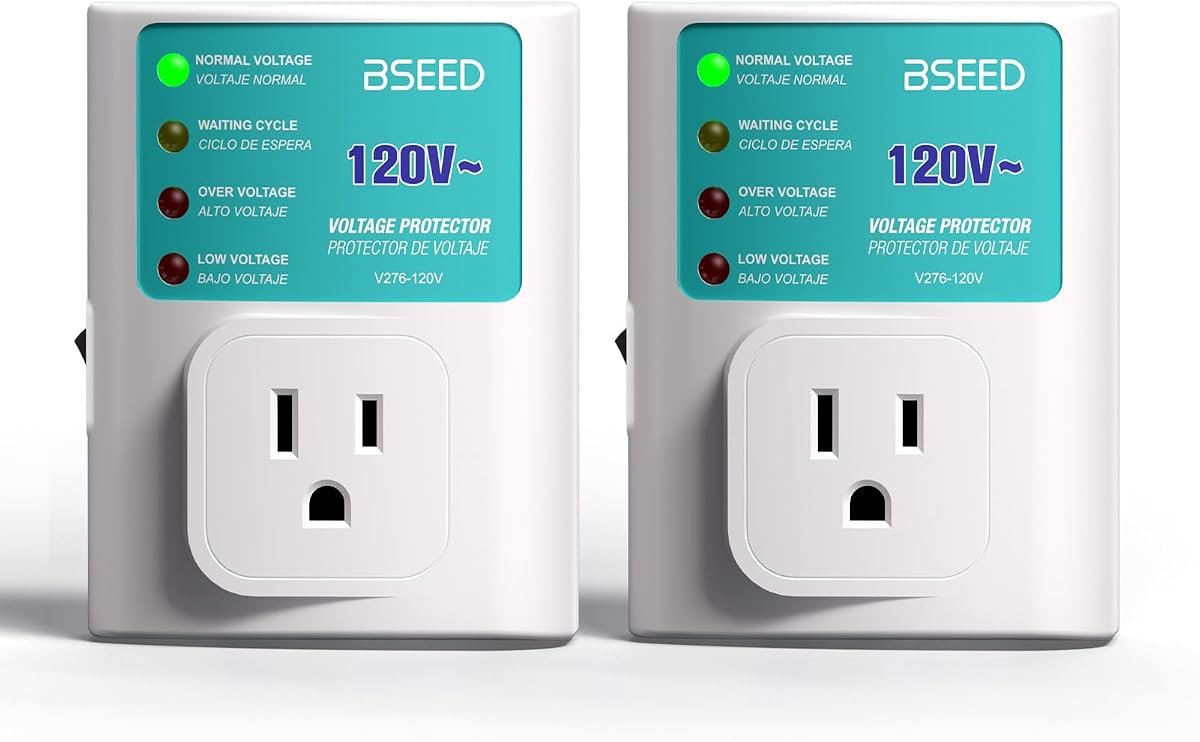
The BSEED Single Outlet Power Voltage Protector is a straightforward 125-volt, 15-amp device rated to 1875 watts. It has a 4.7 rating and is designed for washing machines, refrigerators, freezers, ice makers, air conditioners, and other large appliances. Its single-outlet format keeps the installation uncomplicated and avoids concerns about multiple appliances sharing the protection circuit.
We may earn a commission when you buy through this link, at no additional cost to you.
Automatic protection interrupts current when the device detects spikes, instant surges, fluctuations, brownouts, or voltage that is too high or too low. Its delay function waits for a stable supply before restoring output, and a dedicated delay light communicates that state. Indicators for normal output, overvoltage, undervoltage, and delay give users a clear view of operation.
The three-minute waiting period is central to the product's protection strategy and may feel lengthy after an outage. Buyers also need to provide a dedicated wall receptacle if they expect to use the protector with a washer, since there is only one outlet and no pass-through capacity. It is not designed for a 240-volt electric dryer.
This is a strong pick for someone who wants a single appliance to receive dedicated voltage protection without paying for extra outlet capacity. Its strong rating, 1875-watt specification, three-minute delay, and transparent indicator system make it a practical choice for washers and other compatible large appliances.
The protector is designed to stop current when voltage moves outside its acceptable range. That automatic response reduces the need for users to monitor the outlet continuously or manually reset a conventional surge strip.
Rather than restoring power immediately after a fluctuation, the unit allows time for the voltage to settle. The delay light makes that waiting period visible and discourages repeated switching that could stress appliance components.
We may earn a commission when you buy through this link, at no additional cost to you.
The BSEED Four Pack Voltage Protector contains four single-outlet appliance protectors, each rated at 1875 watts, 120 volts, and 15 amps. The 4.7 rating reflects a well-regarded version of the brand's voltage-protection design. While marketed broadly for large household appliances, the package is particularly useful for protecting a washer and other essential equipment across several outlets.
We may earn a commission when you buy through this link, at no additional cost to you.
Each unit detects voltage spikes, instant surges, fluctuations, brownouts, and high or low voltage. Power is interrupted during abnormal conditions, and the three-minute delay gives the electrical supply time to stabilize. Normal, overvoltage, undervoltage, and delay lights show the current operating state, making the protection process visible to the user.
Four separate single-outlet units are less convenient than one compact three- or four-outlet adapter when several devices occupy the same room. Buyers also may not need all four units, making this bundle more practical for multi-room setups than a one-appliance installation. The product remains limited to standard 120-volt equipment and cannot serve a 240-volt electric dryer.
Choose this option when a household wants dedicated voltage protection for several appliances and prefers individual units over a shared power strip. The identical protection logic across all four protectors, clear status lighting, and high electrical capacity make the set a flexible choice for kitchens, laundry rooms, basements, and utility spaces.
Four matching units allow users to place a dedicated protector at more than one receptacle. This is useful for washing machines, freezers, ice makers, and other large appliances located in different parts of the home.
Every unit provides the same three-minute stabilization period and four-light status system. Consistent behavior makes it easier to understand and monitor each installation.
We may earn a commission when you buy through this link, at no additional cost to you.
The COLL7AWS Dryer Surge Protector is the only dedicated 220-volt option in this guide. It uses a four-prong, 30-amp plug and is designed for electric dryers, washers, compressors, and other inductive motor loads. Unlike the 125-volt products, it is appropriate for a 240-volt household dryer circuit when the outlet, plug, and appliance configuration match.
We may earn a commission when you buy through this link, at no additional cost to you.
Its stated features include protection against voltage spikes and electrical stress, along with power-factor correction intended to reduce reactive power in inductive loads. A built-in switch safely discharges residual stored energy when the unit is unplugged. The manufacturer notes that this discharge control is not designed to turn the appliance on or off, so users should continue operating the dryer through its normal controls.
This product has no available customer rating in the supplied information, making it difficult to compare its proven user reception with the rated models. Its specialized electrical design is a major advantage over plugging a conventional 125-volt protector into a dryer outlet, but users should verify their dryer's plug and amperage requirements before purchasing.
For owners of a compatible electric dryer seeking motor-oriented protection, this is the most technically relevant choice. Gas-dryer households and standard 120-volt washer users will find the other options more appropriate. Installation is presented as plug-and-play, with no electrician required for a matching receptacle.
The 220-volt, four-prong, 30-amp specification is the critical feature for electric-dryer use. It should only be connected to a compatible dryer receptacle and must not be treated as a generic outlet for low-voltage electronics.
Dryers, washers, and compressors create inductive loads that can place stress on motors and associated electrical components. The protector's power-factor and motor-protection features are aimed specifically at that category of equipment.
We may earn a commission when you buy through this link, at no additional cost to you.
The BSEED Three Outlet Multi Function Plug combines surge suppression, voltage monitoring, and a three-outlet layout in one wall-mounted device. It carries a 4.7 rating and a 1875-watt capacity. The protected outlets are intended for refrigerators, washing machines, freezers, ice makers, air conditioners, televisions, computers, and other household electronics.
We may earn a commission when you buy through this link, at no additional cost to you.
The unit is advertised as protecting against high and low voltage, brownouts, spikes, instant surges, power failures, fluctuations, and load shedding. Four LEDs identify normal voltage, overvoltage, low voltage, and the waiting cycle. Its three-minute delay is deliberately longer than a brief restart pause, helping avoid repeated appliance cycling when multiple fluctuations occur close together.
Its PC flame-retardant housing and all-in-one format offer a more substantial presentation than a simple inline adapter. However, all three outlets share one 1875-watt limit, so shoppers must consider the combined load rather than assuming each socket supports the full rating independently. It is also a standard 125-volt product and should not be used with a 240-volt electric dryer.
This is the most feature-rich option for a standard laundry room where a washer and other compact appliances share one receptacle. It combines useful outlet capacity with a long delay, broad protection categories, and clear status feedback, making it a strong premium choice without requiring a separate multi-outlet strip.
The three protected positions reduce the need for a conventional extension strip when several small appliances are located near one wall outlet. The wall-plug format also keeps the cable arrangement relatively compact.
The three-minute waiting cycle is designed to reduce rapid power cycling when voltage events occur close together. That makes the protector more relevant to appliances with sensitive compressors or control systems.
We may earn a commission when you buy through this link, at no additional cost to you.
The BSEED Adjustable Single Outlet Surge Protector stands apart with a rear adjustment dial that lets users tune the protection range from 90 to 105 volts. It has a 4.4 rating, a 15-amp and 120-volt specification, and a two-pack format. The product is listed for washing machines, refrigerators, freezers, ovens, microwaves, dishwashers, and numerous other household appliances.
We may earn a commission when you buy through this link, at no additional cost to you.
Automatic protection addresses overvoltage, undervoltage, brownouts, spikes, instantaneous surges, power outages, fluctuations, and load shedding. When an irregular condition is detected, the delay indicator activates and the unit uses a three-minute cycle before restoring power to a stable supply. Ground-protected lighting provides feedback about the operating condition.
Its 4.4 rating is lower than the ratings of the other nine rated choices, so buyers may want to weigh that against the distinctive adjustment control. The dial also adds a configuration step, and incorrect settings could make the protector less suitable for a particular installation. Each unit has only one outlet despite including two protectors.
This is most useful for a household with known low-voltage conditions and a preference for adjustable undervoltage behavior. The washer compatibility, compact form, and pair of included units make it practical, but shoppers should confirm the desired range before installation and stay within the device's stated 120-volt, 15-amp limits.
The 90-to-105-volt adjustment gives this protector a level of configurability missing from most products in the guide. It can be valuable where low-voltage events occur but the appropriate cutoff should be tailored to the installation.
The unit waits three minutes and restores output only after confirming steadier voltage. This makes the delay light a useful signal that the appliance is intentionally disconnected rather than simply unplugged.
We may earn a commission when you buy through this link, at no additional cost to you.
The Three Outlet Refrigerator Surge Protector for Home Appliances with Time Delay provides a 4.5 rating and an ETL-listed wall-plug design. Its three protected outlets can serve a washing machine and other compatible appliances at the same time, including a refrigerator, microwave, water cooler, or dishwasher. The unit is rated for 125 volts, 15 amps, 60 hertz, and a maximum of 1850 watts.
We may earn a commission when you buy through this link, at no additional cost to you.
Protection is listed for high and low voltage, brownouts, spikes, instant surges, power failures, fluctuations, and load shedding. Four LEDs show normal, high, low, and waiting conditions. A three-minute delay is used to avoid rapid appliance power cycling, while the product information also states a 0.5-second voltage-change detection time.
The three outlets share a single 1850-watt capacity, so the total connected load must remain within that limit. The product does not publish a specific high-voltage cutoff in the supplied information, which makes it less transparent than the washer-specific option with stated 90- and 140-volt thresholds. It is also intended for standard 125-volt appliances rather than an electric dryer.
For users who want an ETL-listed, three-outlet device with a substantial delay and broad voltage-event protection, this is a balanced option. It is especially practical when a washer shares a receptacle with other low-power laundry-room or utility-room equipment and a compact wall adapter is preferred over a long power strip.
The ETL listing gives buyers a recognized safety designation for a device that combines appliance protection with three outlets. Its direct-plug format also helps keep the installation compact near a wall receptacle.
The stated 0.5-second detection time allows the unit to react quickly to a voltage change, while the three-minute waiting cycle delays reconnection. This combination separates event detection from safe appliance restart timing.
We may earn a commission when you buy through this link, at no additional cost to you.
The right protector depends on the appliance circuit, the kinds of voltage disturbances in the home, and how many devices need protection. Start with the washer or dryer nameplate and outlet configuration, then compare voltage handling, delay timing, capacity, and installation convenience.
A standard washing machine generally uses a 120-volt circuit, while a conventional electric dryer commonly uses a 240-volt, three- or four-prong connection depending on its design. The dryer-specific protector in this guide is listed for 220-volt, four-prong, 30-amp use, while the other products are standard 125-volt appliances. Check the appliance nameplate, the existing receptacle, and the protector's plug before ordering. A gas dryer may use a standard household-style connection, but its specific plug still needs to match. Never adapt or force a plug to fit a different circuit configuration.
Surge protection is intended to manage sudden electrical transients, while voltage protection responds to sustained high or low conditions. Several products in this guide also claim protection from brownouts, fluctuations, load shedding, and power failures. Listings that provide specific thresholds, such as the 90-volt low cutoff and 140-volt high cutoff of the washer-specific two-pack, make it easier to understand when output should stop. Wider protection language can still be useful, but it should not be treated as a substitute for a properly sized circuit, grounded outlet, or sound household wiring.
A delay cycle gives the electrical supply time to stabilize before power reaches the appliance. The featured devices use either a 30-second delay or a three-minute waiting period, with many manufacturers also recommending a three-minute wait for initial use. A longer delay is particularly relevant to refrigerators and appliances with compressors because repeated short cycling can be stressful. For a washer, the practical benefit is a controlled restart after an interruption rather than immediate power restoration. Follow the included instructions and the delay indicator instead of assuming the outlet is ready as soon as a light changes.
A single-outlet protector avoids questions about sharing a circuit, while a three-outlet model can simplify a laundry room with several low-power devices. The featured capacities range from 1850 to 1875 watts, and each multi-outlet device's outlets share the unit's total rating rather than receiving an independent limit. Add the combined operating requirements of every connected appliance and stay comfortably below the protector's maximum. The voltage and amperage of each connected appliance should also remain within the device's stated scope.
LED indicators make it possible to distinguish normal output from an overvoltage, undervoltage, or waiting condition. This is especially useful because a protector may intentionally disconnect an appliance after a fault. Most options in the guide use four indicators for normal, high, low, and delay states. The dedicated dryer protector differs by offering a residual-energy discharge control rather than the same voltage-status display. Indicator quality should complement, not replace, sound wiring and a correctly functioning wall receptacle.
Laundry-room space can make installation awkward, especially when the appliance is close to the wall. The washer-specific angled outlet is designed to let the appliance sit closer by changing the plug's orientation. Multi-outlet wall adapters can reduce cable clutter, while single-outlet models may require a dedicated receptacle. Consider cord reach, plug depth, nearby moisture, access to the indicator lights, and whether another device already occupies the outlet before selecting the format.
Safety listings and standards provide useful evidence that a product has been evaluated for specified construction and performance requirements. The Fosmon three-outlet model conforms to UL498A and UL1449, while the three-outlet time-delay model is ETL listed. The rating alone does not guarantee suitability for every installation, so the electrical specifications and intended appliance type still matter. A recognized listing is most valuable when paired with a grounded outlet, correct plug type, and adherence to the manufacturer's instructions.
A washer-only household may prefer one single-outlet protector, while a home with a washer, refrigerator, freezer, or several utility-room devices may benefit from extra positions. Separate single-outlet units can be installed in different rooms, and two-appliance bundles can provide dedicated protection without sharing one housing. Three-outlet adapters are more convenient when equipment is clustered around one receptacle. Consider whether the goal is independent circuit monitoring, simple outlet expansion, or a washer-specific angled connection rather than choosing solely by the number of outlets.
Before installation, identify the appliance's voltage, amperage, and plug type. Confirm that the protector is rated for the same standard as the washer or compatible dryer, inspect the outlet for a secure ground, and ensure the appliance cord can reach without tension. For a dedicated electric dryer, use only a protector with a matching 220-volt, four-prong, 30-amp configuration.
Plug the protector into the properly grounded wall receptacle first. Allow the full initial delay specified by the manufacturer—often three minutes—even when the normal light appears. Then connect the appliance and wait for the delay light to turn off before starting a wash or dryer cycle. After a power outage or voltage event, do not repeatedly unplug and reconnect the protector; let its protection sequence complete.
Inspect the protector periodically for cracks, heat damage, discoloration, a loose plug, or unusual odor. Keep it dry and unobstructed, and avoid extension cords unless the manufacturer specifically permits them. Unplug it before cleaning, never force a plug into an incompatible outlet, and replace the device if its housing, cord, or indicators show damage. Keep the model number and instructions for warranty or support inquiries.
They can benefit because their motors, controls, and heating components may be sensitive to voltage spikes and unstable power. Protection cannot prevent every type of appliance failure, but a properly rated voltage protector may reduce electrical stress and delay power restoration after an abnormal event. It should be used alongside proper wiring, grounding, and appliance maintenance.
Only if the dryer's plug, circuit, and appliance configuration actually match the protector's rating. Most conventional electric dryers use a 240-volt circuit and require a compatible NEMA-style configuration, so a standard 125-volt washer protector is unsuitable. The dedicated option in this guide is listed for 220-volt, four-prong, 30-amp electric-dryer use.
A surge protector is primarily designed to absorb or divert sudden voltage transients. A voltage protector also monitors sustained high or low voltage and can disconnect the appliance until conditions stabilize. Some products in this guide combine both functions, along with brownout, fluctuation, outage, and load-shedding protection.
The delay is intentional. It allows the incoming power to stabilize after an outage or voltage event and can prevent rapid appliance cycling, which may stress sensitive electronics or compressors. Follow the delay light and manufacturer instructions, and allow the full stated period before restarting the appliance.
You can connect compatible appliances as long as their combined load remains below the protector's total rating. For example, a 1875-watt unit does not provide 1875 watts independently at every outlet. Also confirm that the total current stays within the stated 15-amp limit and that the intended appliances are appropriate for that type of protector.
It depends on the electrical requirements and the number of units. A standard 120-volt washer and gas dryer may use separate single-outlet protectors, while a 240-volt electric dryer needs a matching high-voltage device. Multi-outlet models can protect compatible appliances that share one location, but each circuit and appliance rating must still be checked.
The normal light indicates that output is operating normally, while high and low lights warn of overvoltage or undervoltage conditions. The delay light shows that the protector is waiting for power to stabilize or complete a protective cycle. If a fault light remains on, unplug the appliance and check the electrical supply.
No. A surge protector is an added layer of device protection and cannot repair loose wiring, an overloaded circuit, a faulty breaker, or an improperly grounded outlet. Persistent shutdowns, buzzing, discoloration, tripping breakers, or unusual heat should be investigated by a qualified electrician rather than repeatedly resetting the protector.
The Two Electronic Voltage & Surge Protector Combo is the most versatile all-around selection because it provides dedicated refrigerator and washer protection, broad electrical-event coverage, and a high customer rating. The BSEED Single Outlet Voltage Protector stands out for a simpler installation, while the BSEED Three Outlet Multi Function Plug is a strong premium option when several compact appliances need protected connections.
Prioritize the electrical configuration before comparing features. A standard washer needs a compatible 120- or 125-volt protector, while a conventional electric dryer requires a matching 240-volt circuit device. After confirming voltage and plug type, consider delay length, shared capacity, status lights, wall clearance, and whether the protector is designed for the appliances it will serve.
Product ratings, listing details, availability, and prices can change, so check the current Amazon listing before buying. Compare the present electrical specifications and included instructions with the appliance nameplate, and choose the protector that offers the correct connection and protection level rather than focusing only on the number of outlets.