
Advance Paris A12 Classic
4.8Editor score
Hybrid Class A/AB architecture
Up to 190 watts per channel
Balanced XLR and RCA inputs
USB-B digital connection
Integrated phono stage
Our expert guide compares the best hi end amplifier for audiophiles, covering power, sound, connectivity, DAC performance, streaming, and system flexibility.
A high-end amplifier can transform a capable hi-fi system by revealing subtle dynamics, tonal differences, and spatial detail that smaller components may obscure. The right model also needs to suit your speakers, room, source components, listening habits, and preferred mix of analog purity, digital convenience, streaming, and television sound.
This guide compares ten integrated amplifiers and network receivers, along with one balanced vacuum-tube preamplifier that can serve as the center of a high-end separates system. We evaluated the supplied specifications, connectivity, amplifier architecture, DAC capabilities, phono support, power ratings, and practical features without claiming personal listening tests.
The picks show where each product stands out: the Marantz Model 50 emphasizes a pure analog path, the Advance Paris A12 Classic offers substantial power and balanced connection, and the Denon PMA-600NE provides a versatile entry point. Availability and market conditions can change, so confirm the current listing and specifications before purchasing.
4.8Editor score

4.8Editor score
4.6Editor score
The comparison below organizes the ten products by amplifier type, output capability, source support, and system flexibility, making it easier to identify the right foundation for an audiophile stereo system.


The Marantz PM6007 is a slim integrated stereo amplifier with a 4.3 rating, a versatile connection set, and a compact approach to audiophile-oriented design. Its strongest attraction is the combination of five analog inputs, one coaxial input, two optical inputs, an MM phono stage, and a reference-class AK4490 DAC. That makes it more accommodating than a minimalist integrated amplifier that expects all source work to be completed elsewhere.
We may earn a commission when you buy through this link, at no additional cost to you.
Marantz HDAM-SA3 discrete amplifier modules form the core of the amplification stage, while the high-current power supply and thermal compensation are intended to provide the required energy for more demanding speaker loads. The AK4490 supports high-resolution digital files up to 192kHz and 24-bit resolution, with two selectable digital filter modes for listeners who want a choice in tonal presentation.
The main limitation is its rated 45-watt output, which may be less persuasive with large floorstanding speakers, long cable runs, or a very large listening room than the more powerful models in this guide. Its slim dimensions may also constrain internal component volume. Even so, it offers an unusually broad feature set for a compact integrated model and can serve as the hub for a conventional two-channel system.
Choose the PM6007 when you want analog and digital sources, vinyl support, and a compact centerpiece without moving to a network receiver. It is especially attractive for smaller or medium-sized listening rooms where the amplifier's dimensions and power figure are more appropriate. For unrestricted headroom or particularly demanding speakers, look toward the Advance Paris models or another high-current design.
The PM6007's strongest case is flexibility in a compact form. It gives listeners a capable DAC, phono input, digital connections, and Marantz amplification in one enclosure, which can simplify system planning and reduce the number of boxes on a shelf.
Five analog inputs, three digital inputs, and a phono stage cover the most common source types without requiring a separate selector or converter. The physical design also supports speaker A/B switching and a subwoofer output for flexible two-channel or 2.1 arrangements.
The AK4490 DAC can process high-resolution digital material up to 192kHz and 24-bit resolution. Selectable digital filtering gives users a tonal option while preserving a direct path for analog sources.
We may earn a commission when you buy through this link, at no additional cost to you.
The Advance Paris A12 Classic combines dual Class A/AB amplification with substantial power, earning a 4.8 rating among this guide's strongest selections. It can deliver up to 190 watts per channel into eight ohms and 280 watts into four ohms, giving it the specification headroom to drive demanding speakers with authority.
We may earn a commission when you buy through this link, at no additional cost to you.
Its dual mono-style architecture, oversized toroidal transformers, and audiophile-grade components are designed to support a stable, low-noise power supply. The A12 Classic accepts balanced XLR, multiple RCA, optical, coaxial, and USB-B digital sources, while its high-quality phono stage adds turntable support. This broad input selection makes it a credible centerpiece for a comprehensive analog and digital system.
Its hybrid design is intended to combine the warmth and natural character associated with Class A amplification with the efficiency of an AB operating mode. The result is a specification that appeals to listeners seeking serious output capability, though actual tonal character will depend on the complete system, speakers, room, and source. The dual VU meters and brushed aluminum chassis also make it a visually distinctive centerpiece.
The A12 Classic is best suited to owners with power-hungry speakers, a larger listening room, or a desire for balanced connectivity. It is less compelling when a very small system needs a compact amplifier or when streaming services are a primary requirement. The substantial enclosure and extensive feature set are reasonable for a premium, enthusiast-oriented installation.
This is the pick for listeners who prioritize power, balanced operation, and a broad range of physical inputs. Its combination of current capacity, a carefully specified power supply, and a hybrid amplifier architecture makes it one of the most technically ambitious integrated amplifiers in the comparison.
Up to 190 watts per channel into eight ohms provides a useful reserve with low-impedance or less-sensitive speakers. The four-ohm rating of up to 280 watts further indicates strong current capability, although compatibility with every speaker remains important.
Balanced XLR, several RCA inputs, optical, coaxial, USB-B, and phono connectivity allow the amplifier to serve as the central component in a varied system. The balanced connections may be especially relevant to listeners using high-end source equipment.
We may earn a commission when you buy through this link, at no additional cost to you.
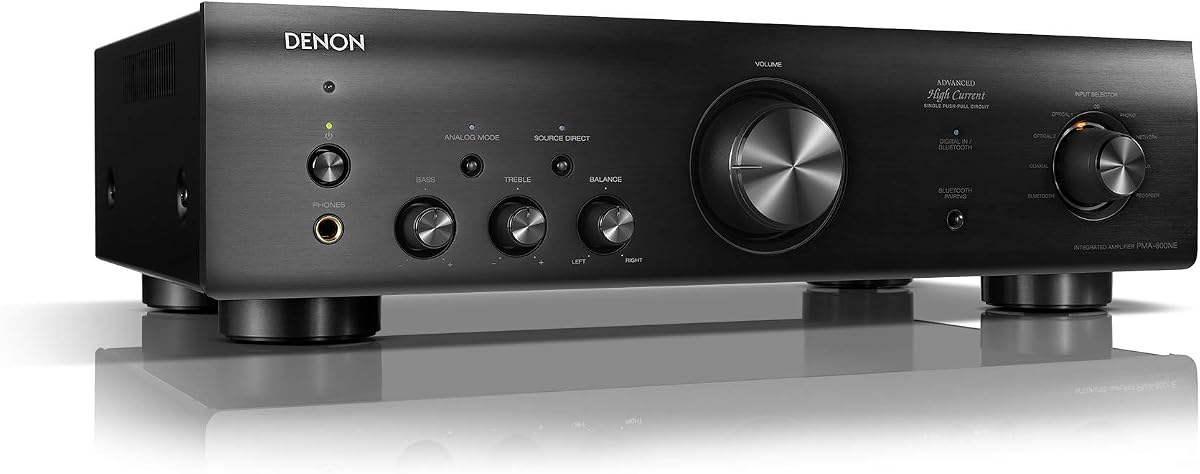
The Denon PMA-600NE is a slim two-channel amplifier with a 4.6 rating, a 70-watt four-ohm rating, and a practical mix of analog, digital, phono, and Bluetooth connectivity. It targets listeners who want a straightforward centerpiece with enough flexibility to accommodate a CD player, turntable, television, and wireless sources.
We may earn a commission when you buy through this link, at no additional cost to you.
Denon's Advanced High Current push-pull circuit is the main technical emphasis. This approach seeks to balance useful power with low distortion and music detail, while the vibration-resistant enclosure is intended to help maintain a stable operating environment. Divided circuitry allows the digital section to be disengaged, including Bluetooth, for a more analog-focused listening mode.
The amplifier includes two optical inputs, one coaxial input, a phono input, and Bluetooth with a built-in DAC. That makes it simpler to connect than a network-focused receiver, although there is no indication of built-in Wi-Fi, HEOS, MusicCast, AirPlay, or other network streaming. The design is consequently most attractive to those who prefer a local source ecosystem rather than a permanently connected network device.
Best suited to medium-sized speakers and rooms, the PMA-600NE is a practical choice for a first serious stereo system or a smaller secondary listening setup. It may not provide the connectivity or channel control expected from a modern surround receiver, but its focus keeps the listening experience direct. Buyers who require streaming services should consider a network-capable alternative instead.
The PMA-600NE stands out for combining a clean physical design with several source options and a current-capable amplifier section. It is a sensible, approachable choice when analog purity, wireless convenience, and straightforward operation matter more than an expansive smart-home feature set.
The Advanced High Current push-pull design is intended to provide clean, rich output with adequate control across a broad range of speakers. Its 70-watt four-ohm rating is especially relevant for compact and medium-sized pairs with demanding loads.
Optical, coaxial, phono, and Bluetooth connections cover common source components, while the ability to disengage digital circuitry supports a more focused analog presentation. It remains a local-system amplifier rather than a full network streaming hub.
We may earn a commission when you buy through this link, at no additional cost to you.
The Marantz Model M1 is a compact wireless streaming amplifier with a 4.4 rating and an unusually broad set of roles. It can power a conventional stereo pair, serve as the front end for a 2.1 system, stream high-resolution music, play content from a television, or join a HEOS multi-room setup.
We may earn a commission when you buy through this link, at no additional cost to you.
Its 100 watts per channel provides a useful balance of output and compactness. The amplifier is built around Marantz HDAM-derived engineering and Musical Digital Filtering, which the company says is intended to preserve warmth, detail, and spaciousness. Hi-res support extends to 24-bit and 192kHz PCM, as well as DSD through compatible services, networks, or USB sources.
The HEOS platform adds Spotify Connect, AirPlay 2, Bluetooth, and access to a broader streaming ecosystem. HDMI eARC and onboard Dolby Digital+ decoding allow television audio to benefit from the same amplification used for music, with adjustments and volume control available from an existing television remote. A dedicated subwoofer output makes the M1 a practical center for a small home-theater or music-and-TV setup.
Its most obvious audience is the listener who wants high-end ambitions in a compact, connected package rather than a rack of traditional components. The M1 is less suited to someone seeking numerous analog inputs, balanced source connections, or a separates system because its strength is wireless and network convenience. Placement is also flexible, making it appealing for secondary rooms and multi-room audio.
Choose the Model M1 for a modern system centered on streaming, television, and relatively compact living spaces. It delivers useful power and broad connectivity without asking the listener to manage separate streaming boxes, DACs, and amplifiers.
HDMI eARC and Dolby Digital+ decoding extend the amplifier beyond conventional music playback. This makes the M1 a practical option when the same system needs to handle television audio, multichannel decoding, and stereo or 2.1 speaker configurations.
HEOS built-in, Spotify Connect, AirPlay 2, Bluetooth, and high-resolution PCM and DSD support cover both networked and local listening. The same integration makes the amplifier well suited to multi-room listening and compact installations.
We may earn a commission when you buy through this link, at no additional cost to you.
The Marantz Model 50 is a pure analog integrated amplifier with a 4.8 rating, 70-watt output, and a design centered on musical presentation rather than connectivity overload. Its six analog inputs, dedicated CD and phono connections, and absence of digital circuitry make it a particularly clear expression of a traditional high-end stereo philosophy.
We may earn a commission when you buy through this link, at no additional cost to you.
High-current Class A/B architecture is used to drive demanding speaker loads, while Marantz HDAM SA-3 modules provide the discrete amplification foundation. The company describes the result as dynamic, transparent, and warm, with the amplifier tuned by its Sound Master. A high-performance MM phono stage uses HDAM technology and JFET input circuitry to provide a simplified path for vinyl playback.
The Model 50 includes stereo preamp outputs, a subwoofer output, a power amplifier input, and speaker A/B switching. Those details allow it to function as the central amplifier today and as part of a larger system later. The tradeoff is deliberate: there is no integrated DAC, network streamer, wireless protocol, television input, or digital decoding.
It is a strong recommendation for listeners who assemble their own source components and want a direct analog path. It also suits those who value a dedicated phono stage and plan to add a separate streamer or DAC. Anyone wanting one box to handle streaming, television, and wireless sources may find a network model easier to operate.
The Model 50 is the editor's choice because it combines a high rating, a coherent analog architecture, and unusually useful expansion facilities. It offers a focused foundation for a serious stereo system without attempting to be all things to every listener.
The Model 50 omits digital circuitry to maintain a pure analog signal path. That design choice avoids digital-domain interference while placing the emphasis on source quality, wiring, speaker interaction, and the performance of the analog amplification stage.
Preamp outputs, a power amplifier input, a subwoofer output, and speaker A/B switching provide routes to grow the system. The Model 50 can therefore function as a complete integrated amplifier or as the hub in a more ambitious separates-based setup.
We may earn a commission when you buy through this link, at no additional cost to you.
The Yamaha R-N2000A in silver is a network hi-fi receiver designed to combine traditional hi-fi performance with comprehensive digital playback. It supports lossless and high-resolution streaming, includes a phono stage and DAC, and uses an ESS SABRE ES9026PRO Ultra converter for high-performance digital-to-analog conversion.
We may earn a commission when you buy through this link, at no additional cost to you.
Its USB DAC function supports native DSD playback up to 11.2 MHz and PCM material up to 384kHz. These capabilities make it attractive for listeners with locally stored high-resolution libraries as well as those who prefer network sources. MusicCast provides access to familiar streaming services and connected playback throughout a compatible Yamaha ecosystem.
A toroidal power transformer is intended to support a spacious and stable presentation. While the supplied information emphasizes its digital performance and network capability, the R-N2000A is positioned as a genuine hi-fi receiver rather than a lightweight streaming box. Its enclosure and feature set will suit a dedicated listening shelf or equipment cabinet.
The main consideration is that some audiophiles may prefer a more focused integrated amplifier with a simpler signal path. A receiver can introduce additional flexibility and convenience, but it also brings a more complex control environment and potentially more functions than the listener needs. The R-N2000A is most persuasive for someone who wants one central component for streaming, local high-resolution files, and vinyl.
Choose the silver R-N2000A when high-resolution digital support and MusicCast are priorities. It offers a broad feature set centered around a serious DAC, making it a strong option for building a modern hi-fi system around locally stored or streamed digital music.
The ESS SABRE ES9026PRO Ultra DAC supports demanding file formats through the USB input, including native DSD 11.2 MHz and 384kHz playback. These specifications are particularly useful for owners of carefully curated local libraries.
MusicCast turns the receiver into a network hub for compatible services and rooms. The combination of streaming, DAC capability, and phono support allows several source types to share one central component.
We may earn a commission when you buy through this link, at no additional cost to you.
The Marantz Model 60n is a silver network integrated amplifier with a 4.4 rating, built for listeners who want Marantz amplification alongside network streaming and high-resolution playback. It supports music up to 24-bit and 192kHz, includes Roon Ready capability, and uses HEOS built-in Wi-Fi, AirPlay 2, and Bluetooth.
We may earn a commission when you buy through this link, at no additional cost to you.
Its stated versatility spans streaming, vinyl, CDs, and television, allowing the amplifier to consolidate several entertainment paths into one unit. Marantz HDAM circuits support detailed audio reproduction, while the 2.1-channel output enables a stereo pair to be supplemented with a subwoofer. This makes it relevant to both music-focused and mixed entertainment installations.
The supplied specifications do not provide a specific rated output power, so comparisons with the explicitly rated models in this guide should be made cautiously. Connectivity and platform support are clear strengths, but amplifier specification, channel configuration details, and the exact internal topology are less fully described than for several other products here.
The Model 60n is a good fit for someone who values a familiar Marantz sound and wants modern network features in a conventional stereo chassis. It is particularly suitable for listeners using compatible streaming services, a turntable, and a television. Buyers primarily seeking a large power figure, balanced inputs, or a dedicated balanced DAC should examine models where those specifications are stated more clearly.
Overall, the Model 60n offers a convenient way to combine audiophile-oriented amplification with a connected home. Its appeal lies in flexibility, HDAM implementation, and a 2.1-capable output rather than a highly specialized analog or power-amplifier role.
HEOS, AirPlay 2, Bluetooth, and Roon Ready support modern listening workflows, while the ability to handle vinyl, CDs, and television makes the amplifier more than a streaming-only device. One chassis can serve several everyday audio roles.
The 2.1-channel output allows a subwoofer to be added to the main stereo speakers. That can be useful in a media room where fuller low-frequency presentation is desired without replacing the entire stereo topology.
We may earn a commission when you buy through this link, at no additional cost to you.
The black Yamaha R-N2000A is the alternate finish of the same network receiver platform, carrying a 4.5 rating and a high-resolution feature set. It combines MusicCast streaming, a phono stage, an ESS SABRE ES9026PRO Ultra DAC, and USB playback of native DSD and high-kHz PCM files.
We may earn a commission when you buy through this link, at no additional cost to you.
The most technically distinctive capability is the USB DAC function. Support for native DSD 11.2 MHz playback and 384kHz PCM makes this receiver suitable for listeners who care about the full specification of their digital files rather than relying exclusively on compressed streaming formats. A toroidal power transformer supports the receiver's traditional hi-fi foundation.
Choosing the black finish has no apparent effect on the stated technical functions. The practical distinction is aesthetic, and some buyers may simply prefer a darker finish with darker furniture, shelves, or equipment. Because the silver and black versions share the same core specifications, the decision can be based on system aesthetics and current listing availability.
This is a broad all-in-one approach rather than a stripped-down analog integrated amplifier. It suits modern listening rooms where streaming, local files, and vinyl all need a home. Listeners who value simplicity and want only a short analog signal chain may prefer a model dedicated to that purpose, while those who want fewer boxes will find the receiver more convenient.
The black R-N2000A is a strong high-resolution network-receiver recommendation. Its principal strengths are a serious DAC, broad file-format support, MusicCast integration, and a design that accommodates both old and new sources.
The ESS ES9026PRO Ultra DAC and high-resolution USB function place digital conversion at the center of the design. Native DSD 11.2 MHz and 384kHz support appeal to listeners maintaining a dedicated local music library.
MusicCast, streaming support, and a phono stage provide a broad set of source options. The black finish lets the same technical platform blend into a darker entertainment setup without requiring a different model family.
We may earn a commission when you buy through this link, at no additional cost to you.
The FLYINSKY PRT13A-BAL is a fully balanced remote vacuum-tube preamplifier with a 5.0 rating. Unlike the integrated amplifiers in this guide, it does not include a power-amplifier stage. It is intended for listeners who already own a suitable power amplifier or plan to build a separates system around a dedicated control stage.
We may earn a commission when you buy through this link, at no additional cost to you.
Its balanced circuit is described as referencing a classic US Audio Research topology, and the supplied ECC82 6N11 tubes sit at the heart of the design. A 50VA pure copper tape-shielded R-Core transformer is used for the power supply, while left and right channel DC filaments receive independent voltage stabilization to limit crosstalk.
A capacitor array forms the high-voltage supply, offering lower internal resistance and stronger transient behavior according to the product information. A high-voltage MOS power regulator is paired with the capacitor array to provide a stable supply while maintaining the intended character of the tube stage. The aluminum chassis uses high-end sandblasting for a refined finish.
Because this is a preamplifier rather than a complete system, its ownership requirements are greater. The listener must source an appropriate power amplifier, ensure the signal chain and speaker system are suitable, and decide whether a separate phono stage or digital source component is needed. The supplied information also does not enumerate every input or control, so prospective buyers should confirm current manual specifications.
The PRT13A-BAL is most appropriate for a dedicated separates enthusiast who values balanced topology, tube circuitry, and a carefully regulated power supply. Its perfect rating is notable, but the correct decision ultimately depends on whether the listener wants a preamp-focused architecture rather than the convenience of an integrated amplifier.
The fully balanced design gives owners a dedicated control stage rather than an integrated product with a secondary preamp function. That focus can make signal organization and component matching more deliberate within a high-end separates installation.
The capacitor-array high-voltage supply is designed for low internal resistance and strong transient response. Independent left and right filament stabilization is intended to minimize crosstalk between the two channels.
We may earn a commission when you buy through this link, at no additional cost to you.
The Advance Paris A10 Classic is a two-channel hybrid integrated amplifier with a 4.5 rating. It combines Class A analog amplification with Class D efficiency, delivers up to 130 watts per channel into eight ohms, and raises that to 190 watts into four ohms. It therefore offers substantial power in a design aimed at musicality and precise control.
We may earn a commission when you buy through this link, at no additional cost to you.
Connectivity is one of its strongest attributes. The amplifier includes RCA and XLR analog inputs, optical, coaxial, and USB-B digital inputs, plus a built-in phono stage. That range lets it serve as the central hub for a mixed source system without requiring a network receiver or separate DAC.
The dual toroidal transformers and premium components are intended to provide stable operation, low noise, and controlled dynamics. Its brushed aluminum front panel and retro-inspired VU meters give it a memorable appearance, while the internal design is positioned around modern functionality. The enclosure is substantial rather than compact, which can be an advantage or a placement constraint.
The main omission is built-in network streaming. The A10 Classic can accept digital audio through its physical inputs, but it does not list Wi-Fi, HEOS, MusicCast, AirPlay, Bluetooth, or a hosted streaming platform. Listeners who want to play albums directly from a phone without a separate streamer will need to account for that limitation.
Choose the A10 Classic for a powerful, wired stereo system with balanced-capable source components and a turntable. It is a particularly compelling alternative to the larger A12 Classic when less power or a smaller feature set is sufficient, while still preserving the appealing French industrial design.
The hybrid topology is designed to combine the musical character of Class A operation with the efficiency of Class D amplification. Output reaches up to 130 watts per channel into eight ohms, providing useful headroom for a broad range of speakers.
Balanced XLR, RCA, optical, coaxial, USB-B, and phono connections create a broad physical input selection. The model is especially appropriate for listeners who prefer a dedicated wired signal path over a streaming-focused network appliance.
We may earn a commission when you buy through this link, at no additional cost to you.
The best high-end amplifier is the one that complements your speakers, sources, room, and listening priorities while providing the features you will actually use. Power, topology, conversion quality, connectivity, and expansion potential should be considered together rather than in isolation.
Begin with the manufacturer's recommended amplifier range and impedance sensitivity for your speakers, then consider room size, listening distance, and musical dynamics. A model rated at 70 watts into four ohms may be perfectly adequate for efficient compact speakers, while a larger room or less-sensitive floorstanders can call for the generous current capability of the Advance Paris A10 or A12 Classic. The figures are most meaningful when they refer to the same impedance and channel configuration, so compare like with like rather than selecting on the largest headline number.
Pure analog, Class A/B, hybrid Class A/AB, and hybrid Class A/D designs each present different priorities. The Marantz Model 50 focuses on an analog-only signal path, while the Model M1 and Model 60n integrate digital and network functions. The Advance Paris models use hybrid architectures intended to combine analog character with efficiency. These labels do not guarantee a particular sound, but they indicate how the manufacturer has balanced power, warmth, efficiency, heat, and circuit complexity.
An integrated DAC can simplify a system by accepting digital sources directly, but input type and supported resolution matter. The Marantz PM6007 includes an AK4490 DAC, the Yamaha R-N2000A uses an ESS ES9026PRO Ultra DAC, and both Marantz network models support high-resolution PCM. Compare optical, coaxial, and USB capabilities, paying particular attention to native DSD support and maximum PCM sample rates. A high specification matters most when your actual files and source hardware can deliver it.
Network integration is central to the Marantz Model M1 and Model 60n, as well as the Yamaha R-N2000A. HEOS, MusicCast, AirPlay 2, Bluetooth, Spotify Connect, and Roon Ready provide different paths for playback and control. If a separate streamer would occupy space and add another level, a network amplifier may be the cleaner solution. If you want a deliberately simple analog chain or already operate a dedicated streamer, the physical-input approach of the Model 50, PM6007, or Advance Paris models may be more appropriate.
Balanced XLR connections can reduce susceptibility to interference and are useful with compatible source components, particularly in systems with longer cable runs. The A12 Classic and A10 Classic provide XLR inputs, and the FLYINSKY PRT13A-BAL is itself a balanced tube preamplifier. Confirm that your chosen sources offer true balanced output rather than adapters. For listeners using only single-ended components, multiple RCA inputs, a good phono stage, and reliable preamp outputs may matter more.
A built-in MM phono stage provides a convenient way to connect a turntable with a moving-magnet cartridge. The PM6007, Model 50, Denon PMA-600NE, Yamaha R-N2000A, and both Advance Paris models list phono functionality. It is important to confirm input type, grounding arrangement, and level compatibility. A moving-coil cartridge or an exceptional turntable may warrant a dedicated external phono stage, while an MM cartridge can often be integrated neatly into a complete stereo system.
An amplifier that can grow with the system offers more long-term flexibility. The Marantz Model 50 includes preamp outputs, a power amplifier input, a subwoofer output, and speaker A/B switching. The Model M1 and Model 60n support 2.1-channel arrangements, while the A10 and A12 Classic offer balanced connections and multiple digital inputs. Future-proofing does not mean buying features you will never use, but identifying realistic additions can prevent an early compromise.
Amplifiers vary dramatically in size, and some high-output hybrid designs can become substantial components. The PM6007 and Model M1 suit more compact installations, while the Advance Paris models and network receivers are better suited to a dedicated shelf or cabinet. Allow ventilation around the unit, especially for high-output designs, and consider how front-panel displays, VU meters, finishes, and network connectivity will fit the room. Practical placement can matter as much as the specification list.
Place the amplifier on a stable, level surface with adequate airflow around its vents and no loose objects covering the chassis. Connect speakers with the correct impedance range and observe the manufacturer's guidance on speaker A/B switching or subwoofer output. Route power and signal cables thoughtfully, keep connectors clean, and avoid placing the unit directly beside a heat source. For network models, complete the initial Wi-Fi and service setup before moving the amplifier to its final position.
Begin with a moderate volume, verify that the selected source is correct, and confirm phase and channel assignment before raising the level. Allow the amplifier and speakers to stabilize before judging performance. Use the appropriate input for each source, especially the phono input for a turntable and the dedicated digital input for compatible files. For the FLYINSKY PRT13A-BAL, use a compatible power amplifier and follow the manufacturer's grounding and connection instructions carefully.
Keep the unit away from moisture, dust, direct sunlight, and unstable network connections. Periodically dust the exterior with a soft, dry cloth, but do not use liquid cleaners or push debris into ventilation openings. Protect the listening environment from excessive vibration, keep cables free from sharp bends, and update network software when appropriate. For tube-based equipment, follow the manufacturer's warm-up and standby guidance and allow adequate space around the tubes for ventilation.
Not necessarily. Amplifier power should be matched to speaker sensitivity, impedance, room size, and listening distance rather than chosen from a headline figure alone. Efficient speakers in a modest room may sound excellent with a well-designed 45- or 70-watt amplifier. Less-sensitive speakers, larger rooms, or demanding musical peaks generally justify more current capability and greater headroom.
No. Class A operation can be attractive for certain design priorities, but efficiency, heat, power capability, and implementation all influence the result. The Marantz Model 50 uses a high-current Class A/B architecture, while the Advance Paris models use hybrid designs. A well-executed amplifier matched to the speakers and room is more important than the label alone.
A built-in DAC can simplify the system and prevent clock or connection issues when it supports the sources you use. It is particularly convenient for optical, coaxial, or USB sources and for local high-resolution libraries. Dedicated analogists may prefer the cleaner separation offered by a pure analog amplifier and an outboard DAC or streamer.
An integrated amplifier includes preamplification and power amplification in one chassis, generally with analog inputs and sometimes digital or streaming support. A receiver adds network or broadcast-style functionality and may include more control and connection options. The Yamaha R-N2000A, for example, is positioned as a network hi-fi receiver, while the Marantz Model 50 is a focused integrated amplifier.
Balanced inputs can reduce noise and interference when used with a source that provides a true balanced output and the system is properly configured. They do not automatically guarantee better performance with every component. Cable quality, grounding, source capability, and the rest of the signal chain all remain important.
It can be for many moving-magnet cartridges, particularly when the phono stage meets the cartridge's output and impedance needs. Moving-coil cartridges often benefit from a dedicated external phono stage with more precise gain, loading, and adjustment options. Confirm cartridge type, grounding, and level matching before selecting the amplifier's phono input.
Yes, if it has the necessary input and decoding support. The Marantz Model M1 includes HDMI eARC and Dolby Digital+ decoding, allowing television audio to use its amplification. Most traditional integrated amplifiers can also be connected through an existing television or source device, although the experience and control options vary.
Not if the chosen integrated amplifier provides all the inputs, gain control, and system flexibility required. A separate preamp becomes attractive when a particularly revealing control stage, long cable runs, specialized source management, or a carefully phased separates architecture justify the extra complexity. The FLYINSKY PRT13A-BAL is designed specifically for that more elaborate role.
The Marantz Model 50 stands out for a focused analog signal path, six analog inputs, a capable phono stage, and expansion outputs, making it the editor's choice for listeners assembling a serious stereo system. The Advance Paris A12 Classic is the premium selection for substantial power, balanced connectivity, and an extensive range of physical inputs. The Denon PMA-600NE offers the most approachable route into this group with current-focused amplification and useful digital and wireless options.
The right amplifier depends on what matters most: the Model 50 and FLYINSKY preamplifier reward an analog-centered approach, the Yamaha R-N2000A and Marantz network models suit listeners who want high-resolution digital playback and streaming, and the Advance Paris A10 Classic bridges powerful amplification with broad wired connectivity. Speaker compatibility should be the first filter, followed by room requirements and the source ecosystem you genuinely intend to use.
Before finalizing a purchase, verify the amplifier's current specifications, input compatibility, dimensions, power requirements, and availability. Market conditions and product listings can change, so check the current manufacturer details and listing information. With those checks completed, the amplifier becomes the foundation around which a capable, enjoyable, and sustainable audiophile system can be built.