
SNAP CIRCUITS Beginner SCB-20
4.7Editor score
21 age-appropriate projects
Child-friendly circuit components
Best for ages five
Discover the best Circuit Boards for Kids, comparing ten STEM electronics kits by age range, project count, components, connectivity, and learning value today.
Circuit boards for kids turn electricity into a hands-on playground, helping young learners build lights, sounds, fans, alarms, games, and other working projects. A good kit balances approachable components, engaging instructions, age-appropriate challenges, and enough variety to sustain curiosity long after the first experiment is finished.
We compared the ten featured kits using the information supplied with each product, focusing on project variety, component count, connection method, age guidance, included instructions, notable modules, and the balance between guided play and independent problem-solving. The list includes broad beginner kits, expanded systems, voice-controlled options, and specialist formats for younger children.
Each review identifies the strongest features and practical limitations of its featured kit, followed by a recommendation for the learner most likely to benefit. Ratings reflect the supplied customer feedback, while availability and prices can change, so shoppers should confirm current product details before purchasing.
4.7Editor score

4.8Editor score

4.4Editor score
This side-by-side overview compares every featured kit by age guidance, project range, construction method, and standout functions, making it easier to identify the right learning experience for a particular child.




The SNAP CIRCUITS Jr. SC-100 is an excellent all-around introduction to circuit building for children aged eight and up. It carries a supplied customer rating of 4.8 and combines more than 100 projects with a simple snap-together construction method. Instead of asking children to begin with exposed wires, complex schematics, or a soldering iron, it lets them assemble working circuits on a plastic grid with numbered and color-coded pieces.
We may earn a commission when you buy through this link, at no additional cost to you.
Its strongest appeal is the balance between variety and accessibility. The kit includes 29 parts and supports projects involving moving toys, lights, sounds, alarms, and other hands-on results. The colorful instruction book provides a clear starting point, while the large number of possible combinations gives motivated learners room to move beyond simply reproducing a single design. The absence of soldering and additional tools also makes the kit approachable for families who want a low-friction introduction to electrical engineering.
The main limitation is that the listed age guidance starts at eight, so it is not designed for a younger child who needs extra safeguarding and simplified assembly steps. Batteries are also required, and some projects will be more successful with adult guidance. Another practical consideration is that the sheer number of designs can make the guide intimidating if a child is not accustomed to following a circuit sequence. A parent may need to demonstrate how to use the grid and check each connection.
Even with those caveats, this is the strongest general choice in the group. It balances an extensive project library with a well-established snap-circuit format, a high customer rating, and an easy path from guided instructions to creative experimentation. It is particularly suitable for an eight-year-old beginning the hobby, a family wanting a shared STEM activity, or a classroom looking for a reusable, screen-free learning system.
Color coding, numbered components, and the included grid reduce the initial intimidation associated with electronics. Children can see where each part belongs, make a physical connection, and immediately test the result without needing specialized tools.
With more than 100 listed projects, the kit offers different routes for young engineers. A child can begin with a guided model, then revisit familiar components in increasingly inventive combinations as confidence grows.
We may earn a commission when you buy through this link, at no additional cost to you.
This Circuit Board for Kids combines a physical electronics kit with a large QR-guided learning library. It is intended for children aged eight and up and offers more than 500 guided projects and random challenges. A supplied rating of 4.0 puts it behind several higher-rated alternatives, but its feature set makes it a compelling choice for families who want both physical circuit building and an extensive sequence of digital instructions.
We may earn a commission when you buy through this link, at no additional cost to you.
The kit includes five notable function modules: a fan, projector, bulb, RGB light, and music module. Together, they let children explore motion, projection, illumination, color, and sound rather than limiting their first experience to a simple light-and-switch circuit. The blocks lock onto the board without soldering or loose wires, allowing a child to build, test, adjust, and rebuild designs. The included battery and storage case add convenience for organized use.
Its primary drawback is the comparatively modest 4.0 rating. The supplied information does not detail the reasons behind that score, so the safest interpretation is simply that it has not achieved the same level of customer consensus as the leading products. QR-based guidance also means the full project library depends on the associated digital material, whereas a completely print-based guide can be more convenient in areas with inconsistent internet access. Adult guidance is recommended because the set contains small parts.
Overall, this kit is best for an eight-year-old who enjoys following guided challenges and wants visible, animated results from every build. The five modules make it a more interactive option than a conventional starter set, while the 500-plus activity library provides enough variety to support repeated learning. It is a practical alternative for parents who prioritize guided digital content and reusable components.
Fans, projectors, bulbs, RGB lighting, and music provide noticeably different responses to a completed circuit. This variety can make a basic lesson in conductivity feel much more entertaining and concrete.
Because the blocks can be rearranged, children do not need a new permanent setup for every attempt. Rebuilding the same circuit teaches testing, adjustment, and the idea that a failed configuration can be corrected.
We may earn a commission when you buy through this link, at no additional cost to you.
The Science STEM Kits for Kids set is built around an exceptionally large selection of possibilities. Its title identifies 66 pieces and more than 1,200 projects, while the supplied product information also emphasizes a secure, engaging introduction to electrical engineering for younger learners. It earns a 4.4 customer rating and offers a compelling combination of extensive content, colorful guidance, and tool-free assembly.
We may earn a commission when you buy through this link, at no additional cost to you.
The numbered, color-coded parts snap securely onto an included plastic grid, creating a recognizable circuit-board experience without a soldering iron or other specialized tools. The project manual provides a visual starting point for children, while the broad library allows builders to work through simple connections and more advanced combinations. Described projects include a flying saucer with an alarm, giving learners a concrete goal rather than an abstract lesson presented only through diagrams.
The most important trade-off is the unusually wide age range. Although the product title lists ages three through twelve, the accompanying information describes the set as a secure introduction for children eight to twelve and also positions it for younger children with closer supervision. Parents should therefore treat the age range as a family decision rather than assuming every listed project suits every developmental level. The enormous number of choices can also be intimidating, so an adult may need to establish a simple progression through the manual.
This is the most expansive premium-style choice in the group and a strong recommendation for families seeking long-term variety. A child who repeatedly works through electronics kits may get more value from the large component collection than from a smaller introductory set. It also works well for sibling play when an adult helps children select appropriate challenges. For the best balance of guidance and open-ended learning, begin with the illustrated projects and gradually allow more free building.
The 66-piece set gives children more physical options than a compact starter kit. Those extra modules can sustain varied builds and support children who want to create recognizable gadgets rather than repeat a small group of circuits.
Numbered and color-coded parts make it easier to follow a diagram and understand where components belong. This visual structure is especially helpful when a child is learning that each connection has a purpose.
We may earn a commission when you buy through this link, at no additional cost to you.
This 66-piece Science Kits for Kids set offers more than 1,200 experiments and a supplied rating of 4.8. It is designed for children from roughly ages five to twelve, with a simpler introduction for younger learners and more advanced STEM challenges for children eight to twelve. The set combines conventional circuit-building pieces with unusual modules such as a spray module, levitation module, hand-crank generator, RGB light, and Bluetooth speaker.
We may earn a commission when you buy through this link, at no additional cost to you.
Those advanced functions create a more ambitious learning experience than a simple introductory kit. Children can explore current flow, series and parallel circuits, and basic programming principles while working with physical outcomes. A 67-page full-color manual provides structured guidance from basic connections to advanced projects. Its plug-in components attach to an included base board without soldering, making setup more approachable while preserving the feeling of a genuine electronics workbench.
The kit requires AA batteries, which are not included, and adults should turn the power off before replacing components. Some of the specialized modules, particularly the levitation and Bluetooth speaker elements, may be less intuitive than a simple fan or light circuit. A 4.8 rating indicates strong customer reception, although ratings alone cannot show how every child will engage with the most advanced activities. Families should also consider whether they can support a child through the manual rather than expecting entirely independent exploration.
It is a particularly strong recommendation for a child who has already shown interest in electronics and wants modules beyond lights and switches. The structured manual makes it useful for home learning or classroom activities, while the parent-child bonding potential is another advantage. For beginners, start with foundational projects and add the advanced modules as confidence develops.
A hand-crank generator, RGB lighting, levitation module, and Bluetooth speaker give the set a different character from a basic resistor-and-switch collection. They create visible, dynamic results that can sustain experimentation.
The 67-page full-color guide moves from basic connections to more advanced experiments. That structure helps parents select an appropriate challenge and gives children a clear path when they are not yet ready to design from scratch.
We may earn a commission when you buy through this link, at no additional cost to you.
The SNAP CIRCUITS Beginner SCB-20 is tailored to children ages five to nine, making it one of the clearest choices for a first electronics kit. Its supplied rating is 4.7, and its 21 unique projects are more manageable than the 100-plus or 1,200-plus projects advertised by several larger systems. The set emphasizes simple problem-solving, troubleshooting, planning, and an introductory understanding of switches and circuits.
We may earn a commission when you buy through this link, at no additional cost to you.
Child-friendly pieces snap together to create real working circuits, while extra childproofing features add reassurance for younger builders. The included lighted, color-changing fan gives beginners an immediate result that is more engaging than a basic illuminated component. A colorful manual uses age-appropriate diagrams and language, which is important when a child is still learning to follow a sequence and interpret a circuit layout.
The main limitation is scale. Twenty-one projects will not provide the same long-term variety as the largest kits in this guide, and children who quickly master the basic circuits may eventually want more modules or more advanced systems. The narrow age range may also become limiting as a learner develops. Because the kit is optimized for beginners, older children looking for programming, advanced modules, or hundreds of challenges may find it less engaging.
Despite that limitation, it is an excellent first kit for a child between five and nine. It offers enough substance to teach real concepts without presenting the overwhelming breadth of a comprehensive collection. Parents looking for a compact, approachable activity that a young child can complete with some support will find that the Beginner format makes the learning process noticeably smoother.
The simplified instructions, child-oriented components, and additional safety features make this less intimidating than a broad electronics collection. It gives younger children a realistic circuit experience without asking them to manage complex assemblies immediately.
The lighted color-changing fan provides a clear payoff after a successful build. Watching a circuit activate can make cause and effect tangible for a child who is still developing an abstract understanding of electricity.
We may earn a commission when you buy through this link, at no additional cost to you.
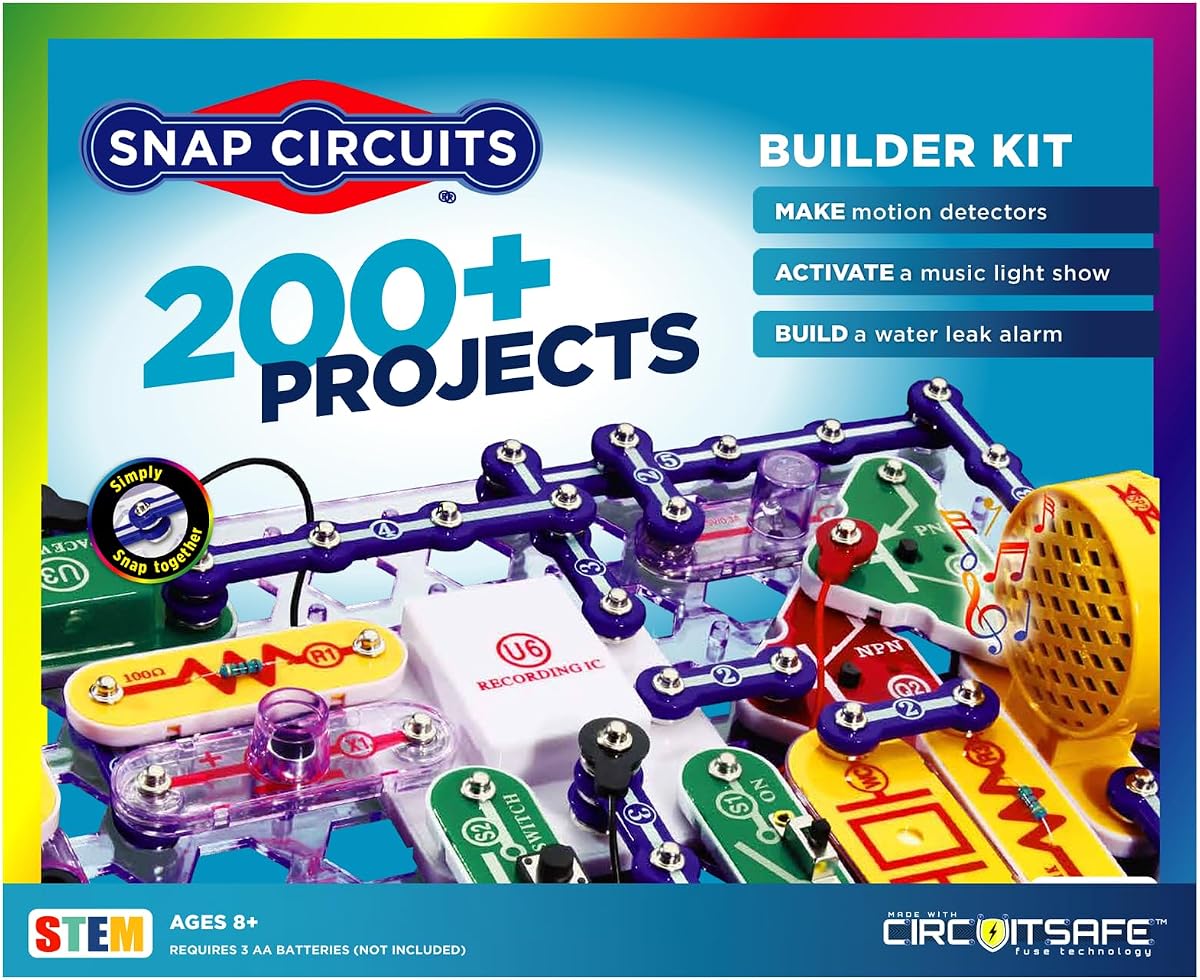
The SNAP CIRCUITS Arcade SCA-200 combines more than 200 projects with a strong focus on games, sounds, and lights. It carries a supplied rating of 4.8 and is intended for children aged eight and up. Unlike a general-purpose electronics set, its identity is built around interactive play: the listing specifically highlights 20-plus games and the ability to create a spinning LED message.
We may earn a commission when you buy through this link, at no additional cost to you.
The 36-piece kit uses numbered, color-coded components that snap onto an included plastic grid, eliminating soldering and additional tools. That familiar construction system makes it easy for a child to move between established projects and original ideas. Games can be especially effective for engagement because they provide a goal, a rule set, and often an element of friendly competition. The focus also allows electronics learning to feel like a creative activity rather than a worksheet exercise.
The trade-offs are similar to those of other Snap Circuits sets: batteries are required, and the listed age range is not aimed at younger beginners. Although the number of projects is substantial, 36 pieces are fewer than the component collections in the 66-piece kits. A child whose primary interest is advanced electronics, programming, or specialty modules may eventually need a different system. The product also centers on guided play, so independent design emerges gradually rather than being the main focus from the start.
This is a particularly good match for an eight-year-old or older child who enjoys games and likes making lights and sounds. Parents seeking a way to introduce engineering through repeated, entertaining challenges may find the arcade format more motivating than a purely instructional kit. It is also a strong birthday or holiday choice when the recipient already understands how to follow a circuit diagram.
A playable result can be more motivating than a static demonstration. The arcade focus gives children a reason to understand switches, connections, and cause and effect while competing or experimenting with electronic features.
The snap-together grid, numbered parts, and color coding reduce assembly friction. Children can move among dozens of designs without needing a soldering iron, screwdrivers, or other specialized equipment.
We may earn a commission when you buy through this link, at no additional cost to you.
The National Geographic Circuit Kit for Kids offers 120-plus electrical projects and activities with a supplied rating of 4.7. Its defining feature is a combined instruction system: an illustrated guide is supported by QR-linked video instructions. This approach can make assembly easier for children who are more comfortable following a demonstration than deciphering a static diagram.
We may earn a commission when you buy through this link, at no additional cost to you.
The project range is broad and includes a keyboard mode, light show, flying copter, and a sound system that amplifies the user's voice. Those outcomes show that a circuit kit can cover movement, illumination, sound, and communication rather than only basic on-and-off examples. Components connect with included wires that snap securely to the electrical parts, and no extra tools are needed. The kit also comes from Blue Marble, a developer recognized by the Toy Association's Toy of the Year Award.
The main limitation is dependence on digital access for the video portion, even though illustrated instructions are also included. A family that wants a completely self-contained learning experience may prefer a kit whose full course can be followed from print alone. The supplied information also does not provide a specific age range, so adults should evaluate component size and the complexity of each project before handing the set to a younger child.
This kit is a good recommendation for visual learners, families comfortable using a phone or tablet as an optional guide, and children attracted to dramatic results such as lights, music, or amplified sound. It provides a strong balance of guided instruction and creative play, while its secure wire connections reduce the need for specialized equipment. A parent can print the necessary steps, follow the videos when useful, and gradually let the child take over assembly.
The illustrated manual provides a reference while the QR videos offer a visual demonstration of each step. This combination can reduce confusion when a child is trying to understand where a wire or component should connect.
A light show, flying copter, keyboard mode, and voice-amplifying sound system make the projects feel like finished gadgets. Such outcomes can help children connect physical components with a clear, entertaining purpose.
We may earn a commission when you buy through this link, at no additional cost to you.
The SNAP CIRCUITS 203 is a classic, expanded circuit-building set for children aged eight and up. It has a supplied rating of 4.7 and supports more than 200 projects using 40-plus included pieces. The range covers burglar alarms, doorbells, electronic games, and other recognizable devices, making it a well-rounded option for a child who wants to explore beyond a small group of starter circuits.
We may earn a commission when you buy through this link, at no additional cost to you.
Its construction method is straightforward: numbered, color-coded parts snap onto the included plastic grid. This makes the set approachable without a soldering iron, while the 40-plus pieces provide enough material for substantial combinations. A colorful instruction book supports the initial builds, and the larger project count means children can move through different concepts and outputs rather than treating the kit as a single-use activity.
The chief limitation is that the set is less specialized than some newer kits. It does not emphasize QR challenge libraries, voice control, or a similarly distinctive set of advanced modules. Some families may prefer a system centered on physical construction rather than digital assistance, but others may find that the printed guide becomes repetitive after many projects are completed. Batteries are required, and the age guidance excludes children who need a specifically simplified beginner format.
The kit is a strong choice for an eight-year-old or older child who wants a substantial traditional electronics system. It works particularly well for parent-child building sessions, classroom demonstrations, and children who enjoy recreating and adapting practical devices. Compared with the smaller SNAP CIRCUITS Jr. set, it offers more components and more than twice the listed project count, making it a useful step up once basic assembly is comfortable.
More than 40 pieces support numerous combinations within the familiar Snap Circuits format. The set is a practical middle step between a compact beginner kit and one of the larger 66-piece collections.
Alarms, doorbells, and games show children that circuits can represent recognizable everyday functions. Building those examples can give abstract ideas such as switching, signaling, and activation a tangible context.
We may earn a commission when you buy through this link, at no additional cost to you.
Science Can STEM Toys for Ages 8-13 stands apart through its smart voice-control feature. The circuit board can respond to commands, allowing lights to flash, motors to run, and sounds to play. It supports more than 120 STEM projects and carries a supplied rating of 4.3. The voice interaction adds a contemporary layer to the traditional build-and-test model.
We may earn a commission when you buy through this link, at no additional cost to you.
A detailed full-color manual guides young engineers through the projects, with the 120 project instructions also available for download from the product page. The kit includes 28 snap-together parts, so children can begin building without soldering or other tools. Child-safe, low-voltage, color-coded components make the system approachable for the stated age range of eight to thirteen, although adult participation remains sensible for younger builders.
The main trade-off is that voice control adds a layer of setup and technology that may not be the main attraction for every child. Four AA batteries are required and not included. The 4.3 rating is respectable but trails the strongest alternatives, and the 28-piece collection is smaller than many competing kits. Parents should also note that the downloadable manual option may be less convenient for families with limited internet access, even though a printed guide is also described.
This kit is a distinctive recommendation for a child who is excited by responsive, voice-controlled technology. It offers a bridge between basic circuits and smart-device behavior, while 120 guided projects provide enough structure for steady learning. It may be especially effective for older children who want to experiment with commands, motor responses, and interactive systems rather than repeat simple lights-and-battery projects.
The ability to trigger lights, motors, and sounds through voice prompts makes the circuit feel more like an interactive electronic toy. Children can observe how an input instruction leads to a programmed physical response.
The color-coded snap-together parts, detailed manual, and absence of required tools make the system approachable. Children can follow a complete project first, then reuse familiar pieces in new arrangements.
We may earn a commission when you buy through this link, at no additional cost to you.
The Playz Circuit Board for Kids offers a traditional hands-on electronics center for children aged eight to twelve. It has a supplied rating of 4.6 and includes more than 25 experiments that cover lights, sounds, magnetism, and radios. Rather than focusing on a huge catalog of near-identical builds, it concentrates on varied ways that electronic components can respond to different connections.
We may earn a commission when you buy through this link, at no additional cost to you.
A 64-page illustrated manual provides assembly guidance and supports experiments ranging from simple to challenging. This is useful because a child can begin with a more manageable configuration and progress toward the radio, flying ball, and other advanced activities without changing to a completely different system. The wired construction also offers a more tangible picture of how components connect, while the sensory focus includes light, magnetic, sound, and touch controls.
Its main limitation is the comparatively compact project count. Twenty-five-plus experiments offer less variety than the 120, 500, or 1,200-plus project kits in this guide, and the wired design may demand more careful handling and adult help than a snap-together set. Younger children may need adult or parental supervision during setup, while children primarily interested in voice control, QR challenges, or advanced programmable modules may prefer another option.
The kit is best for a child who enjoys arranging real components and learning through progressively more involved experiments. It provides a useful balance of science, mechanics, physics, and electrical engineering without requiring soldering. The smaller structure also makes it easier for a family to work through every activity over time, and the 4.6 rating gives it a solid customer foundation within this category.
Unlike kits centered entirely on snap-together modules, this set asks children to connect wires to create working experiments. That physical routing can make the relationship between a component and a completed circuit easier to see.
Light, sound, touch, and magnetic controls let children compare several kinds of response. The variety supports experimentation because a small change in the circuit can produce a noticeably different sensory result.
We may earn a commission when you buy through this link, at no additional cost to you.
The right circuit board depends on the child's age, preferred learning style, and interest in independent creation. Comparing these factors before buying can prevent an overly complex kit from overwhelming a beginner or a limited set from disappointing an older child.
Age guidance is more than a formal recommendation because it reflects component complexity, instructions, and the independence expected during assembly. The SNAP CIRCUITS Beginner SCB-20 is designed for ages five to nine and uses simplified language, diagrams, and child-friendly components, making it a sensible introduction. The SNAP CIRCUITS Jr., Arcade, and 203 sets begin at age eight, while the Playz kit and Science Can set target children eight to twelve or thirteen. The 66-piece kits and the QR-guided Circuit Board for Kids also list age eight and up, although the broader Science STEM Kits title includes a wider range with varying levels of guidance.
Project counts can be useful when comparing breadth, but they are not identical across manufacturers. Some figures include guided builds, variations, or random challenges, while others emphasize unique completed experiments. The two 66-piece sets advertise more than 1,200 projects, the QR-guided system offers more than 500, and the National Geographic, Science Can, and Snap Circuits 203 sets range from 120 to more than 200. The Beginner kit offers 21 unique projects, and the Playz set includes more than 25 experiments. A smaller number of well-structured projects may be more useful than a huge catalog if the goal is steady progression, while a large library benefits repeat use.
Snap-together grids are the easiest place for many children to begin. Parts align by color and number, reduce wiring errors, and can be rearranged without tools. Reusable locking blocks and plug-in modules offer similar convenience, although each has its own connection style. Wired boards provide a more traditional electronics experience and may help children visualize how components link, but they generally demand closer supervision. All of the featured systems avoid a requirement for soldering, which is a major advantage for home use and classroom sessions.
Lights, switches, fans, buzzers, and music modules establish a basic learning foundation, but specialized components can keep a capable child engaged. The 66-piece kits include advanced choices such as RGB lighting, levitation, hand-crank generation, and Bluetooth audio. The QR-guided kit uses five defined modules: fan, projector, bulb, RGB light, and music. The Science Can system adds voice control, while the Playz kit emphasizes radio, sound, magnetic, light, and touch controls. Select modules based on the child's interests rather than assuming a higher component count automatically creates better learning.
A good manual should make the first successful build possible without adult intervention, then gradually support more independent work. Colorful diagrams, age-appropriate language, and a clear progression from simple to complex are especially helpful for beginners. The National Geographic kit adds QR-linked video instructions, and the QR-guided Circuit Board for Kids provides illustrated activities plus digital challenges and random problems. The 66-piece kits use extensive full-color manuals, while the smaller starter kits prioritize easier-to-follow sequences. Consider whether the family has reliable internet access if digital instructions are central to the experience.
Guided projects teach the basics, but creativity develops when children can combine familiar components in new ways. Reusable blocks, many standard parts, and a large component collection make independent designs more feasible. The Playz kit's wired board and the Science Can kit's voice-controlled system encourage a different form of creative experimentation, while the broad Snap Circuits and 66-piece libraries let children remix established circuits. A child who quickly follows every guide may still benefit from a kit in which the same motor, light, switch, or sensor can participate in several different designs.
Most of the featured kits require batteries, and some do not include them. The QR-guided kit explicitly includes the required battery and storage case, while the 66-piece kit and Science Can set call for AA batteries that are not included. Before buying, check which battery type the child will need, whether the compartments are easy for an adult to access, and how the kit will be stored between sessions. A dedicated case is particularly helpful for a large collection with many small modules, and fresh batteries can be necessary for dependable performance.
Begin by sorting the components and reading the recommended first project from beginning to end. Lay out the base board, required modules, and connecting pieces within easy reach, and remove unrelated components from the work area. For younger children, an adult should identify the correct parts and explain the purpose of each one before assembly begins. This makes the activity educational rather than merely a race to fit pieces together.
Build the circuit in the order shown, checking that each component is seated properly before powering the system. Some kits require a brief press of the power button after all blocks are connected, while others activate through another supplied method. Always disconnect or turn off power before removing or changing modules, and never connect or replace parts while the circuit is energized. If a project does not work, check polarity, seating, and wire placement one step at a time.
After the activity, switch off the circuit and remove the batteries if the kit will be stored for an extended period. Sort components into their original compartments, avoid pulling components from the board by the wires, and keep the set away from moisture and extreme heat. Small parts should remain out of reach of children who are below the listed age for the product. A storage case helps prevent loss and makes it easier to find the right piece for the next session.
The SNAP CIRCUITS Beginner SCB-20 is specifically designed for children ages five to nine. It uses 21 unique projects, child-friendly components, age-appropriate diagrams, and extra safety features. Its smaller project library is generally easier for a first-time builder to manage than a system offering hundreds of options.
None of the featured kits requires soldering. Most use snap-together pieces, plug-in modules, or reusable blocks placed on a base board, while the Playz kit uses wired connections. These approaches are more approachable for children and adults working together at home.
The two featured 66-piece science kits each advertise more than 1,200 projects or experiments. The QR-guided Circuit Board for Kids lists more than 500, while several other options offer 120 to more than 200. Project counts can describe slightly different types of activities, so the guide's progression and included modules also matter.
It depends on the specific product. The SNAP CIRCUITS Beginner SCB-20 is intended for ages five to nine and includes child-oriented components and instructions. Some broader kits list younger ages but may require more adult supervision. Always check the stated age range, component size, and small-parts warning before choosing.
Most require batteries for their powered projects, and batteries are not included with every set. The QR-guided kit includes the required battery, while the 66-piece science kit and Science Can STEM Toys specify AA batteries that are not included. Check the product listing for the exact battery type before use.
An older child may complete familiar projects independently, but adult supervision is sensible for young children and complex models. Adults can help with component identification, power safety, connection checks, and troubleshooting. The amount of support needed depends on the child's age, reading ability, and prior experience.
The SNAP CIRCUITS Arcade SCA-200 is the most game-focused product in the group. It supports more than 200 total projects, including 20-plus games with sounds and lights. Its familiar snap-grid system keeps assembly approachable while giving children interactive goals beyond simply lighting a bulb.
Children can practice following instructions, recognizing electrical connections, and troubleshooting a result that does not work as expected. Repeated projects also encourage planning, creativity, persistence, and communication when an adult helps troubleshoot. The strongest educational value comes from allowing children to test ideas and explain why a circuit behaves as it does.
The SNAP CIRCUITS Jr. SC-100 is the best overall option for most children aged eight and up because it combines a 4.8 rating, more than 100 projects, and a straightforward snap-together system. The SNAP CIRCUITS Beginner SCB-20 is the best fit for younger children ages five to nine, while the Science STEM Kits for Kids offer exceptional project variety through a 66-piece collection and more than 1,200 listed projects.
For families seeking specialized experiences, the right choice depends on what excites the child. Choose the QR-guided kit for a large digital challenge library, the 66-piece science kit for advanced modules, the Science Can system for voice control, the Arcade set for game-centered play, or the Playz board for traditional wired experiments. Prioritize age fit, readable instructions, reusable components, and a connection method the child can manage without frustration.
Finally, confirm the current product details and price before buying, since availability and costs can change. Check battery requirements, included accessories, storage, age guidance, and whether the available instructions match the child's preferred learning style. With those factors in mind, a circuit board can become more than a passing activity: it can provide a satisfying, screen-free way to explore engineering through building, testing, and discovery.