
iCrimp CRQ01 Disconnect Tong
4.5Editor score
Covers three common fitting sizes
Compact one-handed operation
Designed for hard-to-reach fittings
Removing a SharkBite or other push-to-connect fitting can be frustrating when the release collar sits inside a cabinet, beneath an appliance, or close to nearby pipes. A purpose-built Sharkbite Removal Tool applies controlled pressure to the fitting, helping separate it without damaging the tubing or struggling with improvised methods.
This guide compares ten tools that support different parts of a push-fit plumbing workflow, including disconnect tongs, crimp-ring removers, depth gauges, deburring tools, pipe cutters, and multi-piece kits. We evaluated the supplied product information for size coverage, material compatibility, construction, handling, and intended repair function.
Each review identifies the product's strongest use case and any practical limitations, helping distinguish true removal tools from complementary plumbing accessories. Ratings and specifications reflect the available listings, while availability, seller details, and product information can change over time and should be confirmed before purchase.
4.5Editor score

4.6Editor score

5.0Editor score
As an Amazon Associate we earn from qualifying purchases.
This side-by-side comparison organizes the ten products by their primary plumbing function, covered sizes, compatible materials, and practical design features. It includes both dedicated fitting removers and complementary tools for preparing, cutting, and installing push-to-connect pipework.



The SharkBite Pro Push-to-Connect Disconnect Tool is a dedicated removal solution with a listed 4.6 rating. Its main appeal is the combination of broad size coverage and a format designed for plumbing environments where access is limited. It is intended to remove or adjust brass push-to-connect fittings from 3/8-inch through 1-inch pipe without requiring separate faceplates or complicated setup.
We may earn a commission when you buy through this link, at no additional cost to you.
The tool is built around a straightforward operating principle. Its body is positioned around the fitting and pipe, allowing the user to depress the release collar while pulling the pipe free. Rubber grips provide a secure handhold, and the heavy-duty handle springs are intended to maintain consistent force. Compatibility extends across PEX, copper, CPVC, PE-RT, and HDPE applications, making it more broadly useful than a tool limited to one pipe type.
Its strongest qualities are practical rather than decorative. The range begins at 3/8 inch, which can be valuable for smaller push-fit connections, and extends to 1 inch for common residential and commercial lines. The no-faceplate design simplifies transitions between sizes, while the compact operating concept is useful under sinks, inside cabinets, and near crowded plumbing assemblies where a full-size wrench may be difficult to maneuver.
This is the strongest overall recommendation for someone who wants a purpose-built SharkBite removal tool rather than a general-purpose alternative. Plumbers and serious DIY users who repeatedly service multiple push-fit systems may appreciate the broad material compatibility. The product is less suitable for a user who only needs to remove an occasional small fitting and values minimal equipment above all else.
The defining benefit is the ability to apply hand pressure directly to the release collar while keeping the pipe aligned. That arrangement is particularly useful when the fitting cannot be reached easily with a wrench or ordinary pliers.
Support for PEX, copper, CPVC, PE-RT, and HDPE means the tool can remain useful across different parts of a modern repair or renovation rather than being tied to a single piping material.
We may earn a commission when you buy through this link, at no additional cost to you.
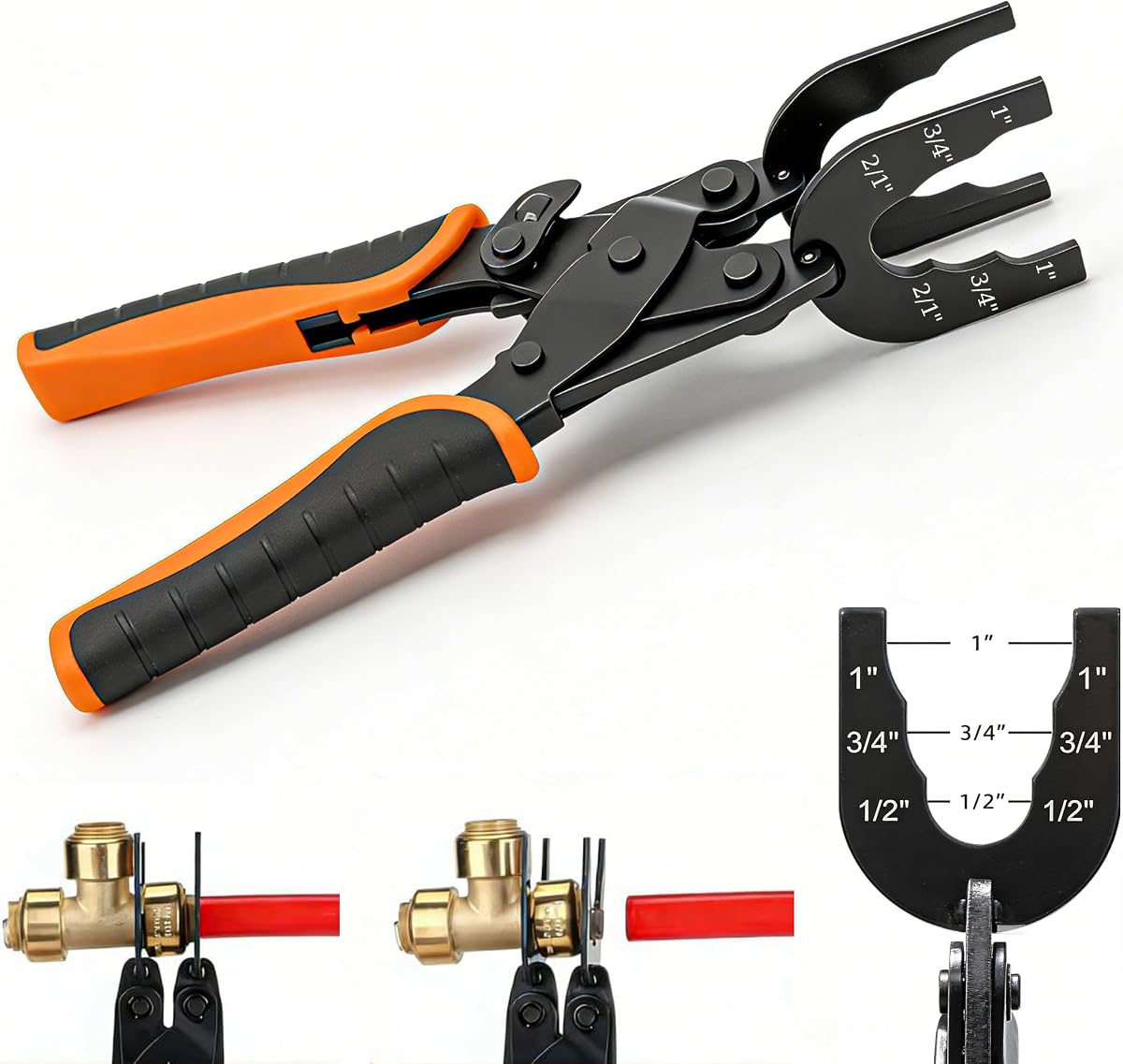
The iCrimp CRQ01 Disconnect Tong has a listed 4.5 rating and focuses on the essential task of separating brass push-to-connect fittings. It provides three tooth sizes covering 1/2-inch, 3/4-inch, and 1-inch connections. That makes it a practical option for common household plumbing repairs where a compact, dedicated removal tool is needed.
We may earn a commission when you buy through this link, at no additional cost to you.
The tong design is centered on one-handed use. The user slides the tool over the fitting and pipe, squeezes the handles to depress the fitting's release collar, and pulls the pipe free. Its wide grip handles and compact proportions can help when a user lacks room for a larger wrench. The three teeth are intended to engage different fitting sizes without requiring separate interchangeable pieces.
The principal advantage is directness. Rather than adapting a general pair of pliers, the CRQ01 is shaped specifically around the release mechanism used by brass push-fit fittings. This focused geometry can make the operation easier to understand and less dependent on finding a precise wrench position. It also reduces the chance of applying an awkwardly angled force to the pipe.
The CRQ01 is best for DIY users and service technicians who regularly encounter 1/2-inch through 1-inch brass push-fit connections. Its main limitation is that it does not include a 3/8-inch tooth and is specifically described for brass fittings. Buyers needing broader size or material coverage should consider the multi-size disconnect tools or the SharkBite Pro listed above.
Integrated teeth for 1/2-inch, 3/4-inch, and 1-inch fittings reduce the need to search for or switch between accessories. The result is a simpler tool for the most frequently encountered sizes.
Squeezing the handles applies force to the release collar while the other hand supports and pulls the pipe. The narrow shape can make this workflow more practical in confined repair areas.
We may earn a commission when you buy through this link, at no additional cost to you.
This Push Fit Disconnect Tong Tool has a listed 3.2 rating but offers a useful combination of adjustable sizing and a slim body. It is designed for 1/2-inch, 3/4-inch, and 1-inch push-fit connections used with copper, PEX, and CPVC pipe. The polished jaws are intended to release fittings without scratching, bending, or denting the tubing.
We may earn a commission when you buy through this link, at no additional cost to you.
Its adjustable jaw design allows one tool to handle three common sizes without separate inserts. The ultra-thin frame is a notable feature for plumbing installations under sinks, behind appliances, and inside crowded utility spaces. The listed construction also emphasizes one-handed operation, making the tool approachable for homeowners while retaining features relevant to professional workflows.
Correct positioning remains essential. The supplied guidance states that one end of the pliers should grip the adapter ring while the other grips the pipe, with both ends held at approximately the same height. Following that arrangement is important because the release collar must be depressed while the pipe is pulled in line. The lower listed rating gives buyers more reason to inspect fit and finish carefully before relying on it.
This option makes the most sense for users who want an adaptable plier-style tool with a narrow profile and support for several common pipe systems. It may appeal to anyone who finds the dedicated tong design awkward. However, the SharkBite Pro or iCrimp CRQ01 have stronger listed ratings and more clearly defined compatibility, making them more conservative choices for critical repairs.
The changing jaw geometry accommodates three common pipe sizes in a single tool. This can simplify a repair kit while reducing the need to carry separate single-size removers.
A slim frame can reach areas where bulky traditional wrenches cannot. The design is particularly relevant to cabinet interiors, appliance clearances, and other restricted plumbing spaces.
We may earn a commission when you buy through this link, at no additional cost to you.
The Pex Clamp Removal Tool carries a listed 5.0 rating and is designed as a three-size disconnect instrument for 1/2-inch, 3/4-inch, and 1-inch push-fit fittings. Its stated uses include SharkBite and other brass push-fit systems, residential and commercial water systems, pipe replacement, and general maintenance.
We may earn a commission when you buy through this link, at no additional cost to you.
Material compatibility is one of its strongest selling points. The listing identifies PEX, copper, and CPVC systems, allowing the tool to serve different water-line installations. Rather than relying on a single fixed insert, it combines three fitting sizes in one clamp-style design, which can reduce equipment changes during a multi-size repair.
Ergonomics are emphasized through anti-slip handles and a form intended for one-handed operation. The described leverage should make the tool easier to control when the release collar needs to be pressed and the pipe pulled in a straight line. Its heavy-duty framing is also relevant for technicians who expect to use the same implement on repeated service calls rather than for a single household task.
Based on the available rating and feature set, this is an appealing choice for serious DIYers, plumbers, and HVAC technicians who regularly work with 1/2-inch and larger brass push-fit connections. It does not cover 3/8-inch fittings, so buyers handling smaller connections should look to the SharkBite Pro. Its high rating should also be considered alongside fit, availability, and the need to follow the manufacturer's operating instructions.
The combination of three common sizes, strong grip, and heavy-duty framing targets users who expect repeated use. It can reduce tool switching during repairs involving multiple fitting dimensions.
The handle arrangement is intended to bring the fitting and pipe together while the release collar is depressed. That alignment can help a user separate the connection without pulling at an unfavorable angle.
We may earn a commission when you buy through this link, at no additional cost to you.
The SharkBite Depth Gauge and Pipe Deburring Tool is not a fitting-removal device, but it is an important companion for anyone working with SharkBite-style connections. Its listed 4.6 rating reflects a product designed to prepare pipe ends and verify insertion depth for SharkBite Max and first-generation fittings.
We may earn a commission when you buy through this link, at no additional cost to you.
The tool performs two related jobs. It deburrs the outside of copper pipe to remove sharp sections that could interfere with fitting installation, and it marks the proper insertion depth on the pipe. Depth marking is especially helpful when the connection will be hidden behind a wall, under a sink, or inside another enclosure where the insertion line will not be easy to inspect later.
Compatibility extends across 1/2-inch to 1-inch PEX, CPVC, PE-RT, SDR-9 HDPE, and copper pipe. The lightweight nylon construction and compact format are practical for mobile repair work and restricted access. Because preparation is part of creating a reliable push-fit connection, a removal-focused kit can benefit from having a dedicated depth gauge as well.
This is the right recommendation for a homeowner or professional who primarily wants to install SharkBite fittings correctly rather than take them apart. It should not be confused with a disconnect tool because it cannot depress a release collar. Users who will both remove and install fittings should consider pairing it with the SharkBite Pro or one of the multi-piece kits.
Marking insertion depth reduces the chance of inserting a pipe too far or too little. The visible mark is useful when the finished connection cannot be checked easily after installation.
Support for PEX, CPVC, PE-RT, HDPE, and copper broadens the tool's use beyond a single material. It can help prepare different pipe types according to the fitting requirements.
We may earn a commission when you buy through this link, at no additional cost to you.
This 12-piece kit has a listed 4.4 rating and combines a depth gauge, a deburring handle, five high-speed steel blades, and five fitting removal clips. Its overall size coverage runs from 1/4 inch through 1 inch, making it broader than tools limited to the most common residential push-fit dimensions.
We may earn a commission when you buy through this link, at no additional cost to you.
The central depth gauge is described as a six-in-one tool for 1/4-inch, 3/8-inch, 1/2-inch, 5/8-inch, 3/4-inch, and 1-inch pipe. It marks insertion depth for push-fit fittings and deburrs outer pipe edges. The separate metal-handled deburring tool uses five HSS blades to remove internal burrs, while lightweight plastic clips support removal of fittings in five sizes.
Its main advantage is consolidation. A homeowner building a compact plumbing toolkit or a technician seeking several functions in one purchase can keep depth marking, deburring, and basic fitting removal together. The listed materials include copper, PVC, PEX, PPR, and CPVC, giving the kit broad relevance across household plumbing and maintenance tasks.
The trade-off is that some users may never need every included component. Those who only remove one fitting may prefer a dedicated disconnect tong. However, the kit is compelling for ongoing repair work, preparation of new connections, or a compact working set. Buyers should also verify the specific clips and fittings in their plumbing system before assuming that a universally described removal tool is compatible with every connection.
The kit brings together the preparation and removal functions that often appear in separate plumbing tasks. It is especially useful for users who want a ready-to-carry set for varied repair work.
Coverage from 1/4 inch to 1 inch extends beyond the three-size disconnect tools in the guide. That range can help users working with smaller push-fit connections or mixed-diameter pipework.
We may earn a commission when you buy through this link, at no additional cost to you.
The SharkBite PEX Crimp Ring Removal Tool has a listed 4.5 rating and addresses a specific connection type: copper crimp rings around brass or poly crimp connections. Unlike a push-fit disconnect tool, it is intended to remove the ring surrounding a fitting so that the fitting can potentially be reused.
We may earn a commission when you buy through this link, at no additional cost to you.
Its force-focused design distinguishes it from the tongs and pliers in this roundup. The tool features a stated 200 pounds of crimping force and a six-inch handle, both of which are relevant when working with firmly compressed copper rings. It supports 1/2-inch, 3/4-inch, and 1-inch rings, covering common residential line sizes.
The straightforward release process is another advantage. The listing states that installation requires no separate crimping, glue, soldering, or other finishing process for removing the ring. This can make replacement and repair work less complicated, particularly where a damaged or incorrectly crimped ring must be taken off before the fitting can be repositioned.
Choose this tool if the plumbing uses crimp rings rather than press sleeves or push-to-connect release collars. It is not a substitute for a SharkBite disconnect tool, and attempting to use it on a push-fit connection would not address the correct mechanism. For mixed systems, keeping both a dedicated crimp-ring remover and a push-fit disconnect tool in the toolbox provides clearer coverage.
The tool targets the retaining ring rather than a push-fit release collar. That specialization makes it the appropriate choice when the original connection was mechanically crimped around the fitting.
Removing a copper crimp ring can make it possible to reuse the associated brass or poly fitting. That can be useful during repairs where replacing the entire fitting assembly would add unnecessary work.
We may earn a commission when you buy through this link, at no additional cost to you.
The 17-piece depth gauge and deburring kit carries a listed 4.5 rating and expands the multi-function format represented by the smaller 12-piece set. It includes a six-size depth gauge, a red ergonomic handle, ten high-speed steel blades, and five lightweight fitting removal tools, all organized around a 1/4-inch to 1-inch working range.
We may earn a commission when you buy through this link, at no additional cost to you.
The depth gauge marks insertion depth for six pipe dimensions and deburrs the outside of the pipe. The separate handle and HSS blade assembly address internal burrs, while the plastic clips provide basic means for removing push-fit fittings. This mix covers several stages of a plumbing repair: preparing the pipe, confirming insertion depth, installing the fitting, and potentially removing it later.
Compared with dedicated disconnect tongs, the kit's advantage is breadth. It includes fittings and blades for multiple sizes, which can be useful for a contractor maintaining varied plumbing systems or for a homeowner assembling a broader emergency-repair set. The listed materials include PVC, PEX, copper, brass, PE-RT, and aluminum, adding flexibility across different jobs.
Seventeen components may be excessive for a user who needs only one basic operation. Small clips and blades also need sensible storage so they are not lost or damaged. Even so, the kit is a strong option for users who value preparation and removal resources together, while a dedicated disconnect tong remains more focused and potentially easier to deploy on a single fitting.
The set addresses both installation preparation and later disconnection. That complete workflow can be useful for users who handle push-fit systems regularly rather than occasionally.
Ten replaceable-style HSS blades provide more cutting capacity than smaller bundled sets. The larger assortment may suit technicians who deburr pipes frequently and want multiple components on hand.
We may earn a commission when you buy through this link, at no additional cost to you.
The Push-Fit Disconnect Pliers has a listed 3.5 rating and offers a compact, adjustable-jaw approach to removing 1/2-inch, 3/4-inch, and 1-inch push-fit connections. The product description identifies copper, PEX, and CPVC compatibility and positions the tool for bathroom, kitchen, utility-room, and renovation work.
We may earn a commission when you buy through this link, at no additional cost to you.
Its slender ergonomic profile is designed to fit under sinks, behind appliances, and inside other confined areas. The adaptive jaws are intended to engage the fitting and pipe without scratching, bending, or denting them. This low-profile form is likely the main reason to consider the product over a conventional wrench, particularly where straight access is limited.
The tool also supports one-handed operation, which can simplify the workflow of pressing the release collar and pulling the pipe free. Its three-size design eliminates the need for separate size-specific tools. Nevertheless, the listed rating is lower than that of the leading dedicated options, so a buyer should assess the jaw fit and operating instructions carefully before using it on an important connection.
It is best suited to a homeowner or technician who prioritizes access and compactness over the highest listed rating. A dedicated disconnect tong may offer more explicit guidance for depressing the collar, while this plier-style product provides a familiar format and broad common-size coverage. Users should compare their actual pipe and fitting arrangement with the manufacturer's instructions before choosing.
The narrow body is intended to reach plumbing where larger tools cannot. It is particularly relevant to service work beneath sinks and behind household appliances.
The stated precision-guided jaws are meant to avoid scratching and deforming the pipe or fitting. Careful alignment remains necessary for that benefit to be realized.
We may earn a commission when you buy through this link, at no additional cost to you.
The SharkBite Pipe Cutter has a listed 4.4 rating and serves as a complementary tool for 1/2-inch through 1-inch PEX and PE-RT pipe. It is designed to produce a clean cut before the pipe is inserted into a fitting or after an existing section needs to be removed.
We may earn a commission when you buy through this link, at no additional cost to you.
Operation is refreshingly direct. The user pushes the pipe into the cutting chamber, rotates the cutter in the direction shown by the arrow on the tool, and squeezes the handles to release the pipe after the cut. The radial-style design supports a controlled cut while the compact body remains manageable in restricted work areas.
A clean pipe end is an essential part of a sound push-fit installation. Cutting, deburring, and depth marking are therefore closely connected tasks, even though they are separate operations. This tool complements the SharkBite depth gauge and deburring tool, which can prepare the newly cut end for insertion into a fitting.
This is not the correct choice for separating a fitting from a pipe because it has no release-collar mechanism. It is most useful for installers or repairers who also need to trim PEX or PE-RT. Buyers should ensure the pipe material and diameter match the listed specifications and should allow enough straight pipe for the cutter's chamber to operate as intended.
The radial cutting action is intended to create an even cut across the pipe. A clean end reduces preparation complications when the pipe will be inserted into a push-fit connection.
The rotating cutter and compact housing are practical in repair areas where a larger cutting tool would be cumbersome. The simple handle action also keeps the tool approachable for DIY use.
We may earn a commission when you buy through this link, at no additional cost to you.
The best tool depends on the connection type, pipe diameter, available workspace, and whether you also need to prepare or cut pipe. Use the following factors to narrow the field before making a selection.
Begin by identifying how the fitting is secured. Push-to-connect fittings typically use a release collar, and a disconnect tong or plier is designed to depress that collar while the pipe is withdrawn. Crimp-ring systems work differently and require a ring-removal tool that can cut or release the copper ring surrounding the fitting. Choosing the correct mechanism is more important than choosing a tool based only on its appearance or broad plumbing application.
A sharkbite removal tool should match the system being serviced. Select a collar-operated tool for standard SharkBite and compatible brass push-fit connections, and choose the crimp-ring remover for brass or poly connections secured with copper rings.
Diameter coverage determines whether the tool can physically engage the fitting correctly. Most dedicated options in this guide cover 1/2-inch, 3/4-inch, and 1-inch sizes, while the SharkBite Pro extends down to 3/8 inch. The multi-piece kits cover an even broader range beginning at 1/4 inch. Always compare both the nominal pipe size and the fitting size, because the tool must fit around the collar while maintaining contact with the pipe.
For a household repair involving only 1/2-inch PEX, the iCrimp CRQ01 may be sufficient. For mixed work, select a 3-in-1 disconnect tool or a broader kit that includes multiple removal sizes.
Although a fitting may be called universal, the pipe connected to it can affect the removal process. PEX, copper, CPVC, PE-RT, and HDPE each have different stiffness and surface characteristics. The SharkBite Pro supports all five listed materials, whereas many compact disconnect pliers focus on PEX, copper, and CPVC. A dedicated crimp-ring remover applies only to copper rings and should not be confused with a general push-fit release tool.
Match the tool's listed materials to the plumbing system you actually use. Broader compatibility is useful for contractors, while focused compatibility may be adequate for a homeowner with one known pipe type.
The space around a fitting can be more important than raw force. Under-sink assemblies, appliance connections, and walls with multiple nearby lines may not accept a wrench or a bulky plier. Compact tongs and low-profile adjustable-jaw tools are designed for these situations. A narrow body can reach the release collar, but it must still be wide enough to seat securely over the pipe and fitting.
If access is extremely restricted, prioritize a compact disconnect tong or slim plier over a larger generic tool. Measure the available clearance and visualize the insertion angle before ordering.
Removing a fitting requires two coordinated actions: pressing the release collar and pulling the pipe free. Rubberized grips, wide handles, and one-handed operation can make this easier, especially when one hand supports the pipe. Strong spring construction and anti-slip surfaces are useful for frequent work, while lightweight materials reduce fatigue during a long service day.
Choose a handle that feels secure in your hand and allows controlled movement. Very high force is less important than maintaining alignment, since an off-axis pull can bend or mark the pipe.
A complete plumbing toolkit often needs more than one type of tool. Depth gauges identify the correct insertion depth, deburring tools remove sharp pipe edges, and cutters create clean pipe ends. These functions improve installation quality but do not disconnect a fitting. Multi-piece kits combine several accessories, while dedicated single-purpose tools are easier to carry and use for a narrowly defined task.
If your main goal is taking apart an existing fitting, choose a disconnect tool. If you also prepare and install push-fit connections, consider a kit containing a depth gauge, deburring tools, removal clips, and suitable cutting support.
Consider whether a multi-piece kit provides genuine value or simply adds components you will never use. Small plastic removal clips are portable and simple, while metal deburring handles and multiple blades offer greater cutting capacity. Dedicated tongs occupy less bag space and are quicker to retrieve in urgent repairs. Contractors may prefer a comprehensive kit, whereas homeowners often benefit from a smaller, task-focused tool.
Review the number of pieces, replacement availability, storage needs, and weight. A complete set is useful only when its components are organized and used regularly.
Product ratings and detailed descriptions can help narrow the choices, but they should not replace compatibility checks. Some multi-size pliers include specific positioning guidance, such as gripping the adapter ring with one end and the pipe with the other. Dedicated tools often provide clearer instructions for depressing the collar and pulling the pipe. Read the available directions before operating a new tool, particularly if the fitting will be reused.
Choose a clearly documented product whose size range and fitting type match your repair. Confirm that replacement components are available if a small clip or blade is likely to be lost or worn.
Before removal, identify the fitting system, verify the pipe size, and confirm tool compatibility. Shut off the water supply and relieve pressure in the affected line. Clean the area so the pipe, fitting, and release mechanism are visible, and support the pipe to prevent it from moving when the connection separates.
For a push-fit disconnect tool, position the tong or plier over the fitting and pipe as instructed. Engage the appropriate size, grip the release collar, and maintain alignment with the pipe. Apply steady handle pressure to depress the collar while pulling the pipe in a straight line. For adjustable pliers, ensure one end grips the adapter ring and the other grips the pipe at approximately the same height. Stop if the tool slips rather than forcing it.
After removal, inspect the pipe end for flat spots, scratches, burrs, and deformation. Replace a damaged pipe section when necessary, then use a depth gauge and deburring tool before installing a new fitting. Clean the device after use, remove moisture and debris, and store it away from excessive heat or impact. Replace damaged clips or blades, and have any spring-loaded or heavily used tool inspected if operation becomes inconsistent.
A tool may release a fitting mechanically, but it still needs the correct size and the correct engagement method. Check whether the fitting uses a press sleeve or release collar and confirm that the tool is designed for that type. The iCrimp CRQ01 is specifically described for brass push-fit fittings, while other products list PEX, copper, CPVC, PE-RT, or HDPE compatibility.
Choose a tool that covers the nominal pipe and fitting size you expect to service. Dedicated tongs and pliers commonly cover 1/2-inch, 3/4-inch, and 1-inch connections. If you work with smaller 3/8-inch or 1/4-inch fittings, select the SharkBite Pro or a multi-piece kit that includes those dimensions. Verify both the pipe size and fitting size before operating.
A properly sized tool used with the correct technique should help separate a fitting without damaging the pipe or fitting. The risk increases if the tool slips, is forced, or is placed at the wrong angle. Support the pipe, depress the release collar as directed, and pull straight rather than twisting. Inspect the pipe for dents or abrasion afterward.
Ordinary pliers may work on some fittings, but they can slip, scratch the pipe, or crush the connection when seeking leverage. A dedicated disconnect tool is shaped to engage the release collar and pipe more predictably. It is also easier to control in confined spaces, making a purpose-built option preferable for repeated or important repairs.
A disconnect tool presses the release collar of a push-to-connect fitting and separates the pipe from the fitting body. A crimp-ring remover attacks the copper ring that secures a crimp connection. They address different locking mechanisms, so a crimp-ring remover cannot replace a release-collar tool on a standard push-fit fitting.
A depth gauge helps mark the required insertion depth and makes installation more repeatable, especially when the connection will be hidden. It is not a fitting-removal device, but it is a useful companion when replacing the fitting you remove. The listed SharkBite depth gauge also deburrs compatible pipe and works with 1/2-inch through 1-inch PEX, CPVC, PE-RT, HDPE, and copper.
Reuse depends on the fitting's condition and the manufacturer's guidance. Inspect the release collar, teeth, sealing surfaces, and pipe end for damage, deformation, or burrs. A crimp-ring remover is explicitly described for removing rings so the fitting can be reused, but a discarded O-ring or damaged fitting should still be replaced when necessary.
The SharkBite Pro Push-to-Connect Disconnect Tool is the strongest all-around choice because it combines 3/8-inch through 1-inch coverage with support for five pipe materials and a tight-space-oriented design. The iCrimp CRQ01 is a focused value option for three common brass fitting sizes, while the highly rated Pex Clamp Removal Tool offers multi-size coverage and a heavy-duty, ergonomic design.
Prioritize the connection mechanism first, then confirm diameter and material compatibility. For installation work, add a depth gauge, deburring tool, and appropriate cutter to the kit. Crimp-ring systems require the dedicated SharkBite ring remover rather than a release-collar tool, and the compact multi-piece sets are most useful when portability and broad function matter.
Before purchasing, check the current listing details, included accessories, compatibility statements, and seller information. Product specifications and availability can change, so confirm that the selected tool matches the exact fittings and pipes in your repair before placing an order.