
VIVO Gray 500ft Bulk Cat6 Ethernet Cable Wire
4.3Editor score
Connector-free Cat6 bulk cable
Solid 23AWG CCA conductors
Dark gray indoor jacket
Discover the best 500 foot Ethernet cable options by comparing copper, CCA, shielding, bandwidth, outdoor ratings, PoE support, and installation features.
A 500 foot Ethernet cable is a substantial networking investment, but choosing the wrong one can leave you with slow links, difficult terminations, or inadequate outdoor protection. The best cable depends on your installation, network speed, conductor material, routing environment, and whether you need Power over Ethernet.
We compared all ten options by examining their category, conductor type, gauge, shielding, listed bandwidth, environmental ratings, PoE capability, spooling system, and intended installation environment. The list covers indoor bulk cable, direct-burial runs, riser installations, and higher-category shielded alternatives without relying on hands-on testing claims.
Each review explains the cable's strongest attributes and practical limitations, helping you identify which option suits a large home, office, surveillance system, or outdoor network. Product ratings and availability can change, so verify current specifications, certifications, and prices before ordering.
4.3Editor score

4.7Editor score
4.8Editor score
This side-by-side comparison highlights conductor material, cable category, environmental suitability, bandwidth claims, and installation-oriented features so buyers can match a 500-foot spool to their network plan.




The VIVO Gray 500ft Bulk Cat6 Ethernet Cable Wire, CABLE-V006 earns a 4.3 rating and stands out as a practical budget selection for indoor installations that need considerable cable length. Its connector-free spool, solid 23AWG CCA conductors, and four-pair UTP construction provide the essentials for building custom patch leads and permanent network runs.
We may earn a commission when you buy through this link, at no additional cost to you.
The main attraction is the combination of Cat6 performance expectations and an economical bulk format. Because the cable arrives without factory-installed connectors, installers can cut it to the precise length required and terminate it with compatible keystone jacks, patch panels, or RJ45 plugs. That flexibility makes it useful for offices, large homes, workshops, and structured wiring projects where pre-made patch cables would be inconvenient.
CCA requires a realistic assessment. Copper-clad aluminum has greater electrical resistance than solid bare copper, which can matter in long runs, high-bandwidth applications, or installations carrying Power over Ethernet. The product data also positions this cable for indoor use, patch cables, and crossover cables rather than direct burial or severe outdoor exposure. It is a bulk cable first and foremost, with the user responsible for appropriate hardware and installation practices.
Choose this VIVO cable when the priority is getting a large quantity of Cat6 bulk cable without paying for finished patch leads. It is a sensible fit for ordinary indoor data networks and custom-length connections. Buyers seeking maximum conductor performance, outdoor durability, or a long-run PoE deployment should instead consider a solid bare copper option from the guide.
Because no connectors are preattached, the spool can be cut to match nearly any route. Matching the cable to a suitable keystone, coupler, patch panel, or RJ45 termination gives installers control over both length and connector style.
The dark gray jacket and connector-free spool suit indoor structured cabling, especially where cost matters. Keep the cable away from moisture, intense heat, and locations requiring a plenum, riser, or outdoor-rated jacket.
We may earn a commission when you buy through this link, at no additional cost to you.
This Lysymixs 500-foot Cat6 cable carries a 4.5 rating and is built around smooth deployment, custom termination, and standard data transmission. Its easy-pull box is particularly relevant for long routes through walls, ceilings, or office spaces where a loose coil can snag, twist, or develop frustrating bends.
We may earn a commission when you buy through this link, at no additional cost to you.
The stated construction includes 23AWG solid copper-clad aluminum conductors, four unshielded pairs, and support for data transfer with advertised 10G and 550MHz capabilities. The box design is intended to help prevent kinks and tangles, while the absence of attached connectors allows the installer to create patch leads or connect the run to compatible keystone jacks and patch panels.
Its limitation is clearly stated: this cable should not be used for PoE because the relatively high resistance of CCA can contribute to heat generation. That makes it less appealing for cameras, VoIP phones, access points, or other powered network devices. It also does not offer the outdoor jacket required for direct burial, and users should not treat its Cat6 designation as a substitute for environment-specific certification.
It is a good match for installers who prioritize a snag-resistant pull box and need flexible Cat6 bulk cable for conventional data links. Choose it for non-PoE indoor networking, particularly when keeping costs controlled. For long-distance PoE, outdoor exposure, or maximum conductivity, move up to a bare-copper cable with the appropriate environmental rating.
The easy-pull package is the defining practical feature. It helps manage the cable during long pulls, reducing the chance of snags, twists, and kinks that can make a 500-foot installation unnecessarily difficult.
The manufacturer expressly advises against PoE use with this CCA cable. Use it for standard data transmission or choose a solid bare copper model when remote power, heat management, or long-run reliability is important.
We may earn a commission when you buy through this link, at no additional cost to you.
The Cable Matters UL Listed 10Gbps 23AWG Cat 6 Bulk Cable earns a 4.7 rating and provides the strongest all-around balance in this guide. Solid bare copper, 550MHz bandwidth, PoE support, and a recognized UL listing make it suitable for a broad range of modern indoor networks without moving into the more specialized outdoor or riser categories.
We may earn a commission when you buy through this link, at no additional cost to you.
Its bare copper conductors distinguish it from many economical bulk options that use CCA. The product data states that the cable meets or exceeds TIA/EIA 568-C.2 specifications, supports 10-Gigabit Ethernet, and works with existing Cat5e networks. It also supports PoE, PoE+, and PoE++, which makes it relevant to IP cameras, VoIP equipment, access points, and other powered devices.
The CM-rated jacket and UL listing make this a disciplined choice for standard indoor commercial and residential communications cabling. However, it should not be confused with a direct-burial, outdoor, wet-location, riser, or plenum-rated cable. The foot-marked jacket and easy-pull box help installers track usage, but the absence of factory connectors also means that compatible jacks, panels, or plugs must be obtained separately.
This is the most versatile selection for someone who wants dependable copper conductors, modern network capacity, and PoE capability in one 500-foot indoor bulk cable. It suits structured office wiring, smart-home infrastructure, server rooms, and surveillance networks. Choose it when versatility and dependable construction matter more than the specialized jacket ratings of an outdoor or riser cable.
Solid bare copper provides strong conductivity and avoids the resistance concerns associated with CCA. That makes this cable more appropriate for high-speed links, PoE devices, and installations expected to remain in service for years.
The UL-listed CM jacket is intended for conventional indoor communications environments. Combined with foot markings and easy-pull packaging, it supports both professional installers and careful DIY users handling substantial cable runs.
We may earn a commission when you buy through this link, at no additional cost to you.
The VOIETOLT Outdoor Cat 6 cable earns a 4.6 rating and stands apart with a direct-burial LLDPE jacket, 30 RJ45 connectors, cable ties, and a cropping tool. It is a convenient starting point for outdoor network runs through courtyards, around shops, or between buildings where ordinary indoor bulk cable would be unsuitable.
We may earn a commission when you buy through this link, at no additional cost to you.
The jacket is described as abrasion-resistant, water-resistant, UV-resistant, and capable of tolerating temperature extremes. Its solid 24AWG CCA conductors and unshielded twisted-pair construction are advertised for 10Gbps and 550MHz performance. The included gold-plated 8P8C connectors make it possible to build several custom patch leads after measuring the route.
CCA and the absence of shielding are important qualifications. Long outdoor runs near power equipment, exterior lighting, or other potential interference sources can benefit from shielded bare copper. The product data also does not mention PoE support, so powered outdoor equipment deserves careful validation before installation. Direct burial reduces visible clutter but requires proper trenching and burial depth.
Choose this cable when you want a comprehensive outdoor kit and can work within its CCA and unshielded design. It is especially useful for connecting an exterior access point, camera location, shop, or secondary building to an existing network. For mission-critical surveillance, very long links, or noisy environments, a shielded bare copper direct-burial option offers a stronger foundation.
Thirty RJ45 connectors, 150 cable ties, and a cropping tool provide the basic materials for assembling custom outdoor patch cables. This reduces the number of separate supplies required for a straightforward installation.
The LLDPE jacket is designed for direct burial and outdoor exposure, with listed resistance to water, ultraviolet radiation, abrasion, and temperature variation. It is a more appropriate choice for exterior runs than a standard indoor spool.
We may earn a commission when you buy through this link, at no additional cost to you.
The VIVO White 500ft Bulk Cat5e Wire, CABLE-V002W has a 4.4 rating and remains a practical option for basic indoor Ethernet extensions. Its four-pair UTP construction and easy spool make it useful for connecting computers, printers, game consoles, and other standard RJ45 devices where a Cat5e network is all that is required.
We may earn a commission when you buy through this link, at no additional cost to you.
The white jacket may be especially useful in offices or homes where a discreet cable path is preferable. The cable is supplied without connectors, allowing installers to create the exact length needed for a wall jack, patch panel, or short patch lead. A 500-foot spool also provides enough length for whole-room, workshop, or small-office routing without buying several separate leads.
Cat5e and CCA both place this product below the Cat6 options for future-proofing. Although Cat5e remains functional for ordinary data networking, it does not offer the same headroom for higher-bandwidth equipment, and the aluminum-clad conductors have greater resistance than bare copper. The product information specifically identifies the cable for indoor use, patch cables, and crossover applications.
This VIVO model makes sense when extending an existing Cat5e installation economically or adding basic connectivity in an area that will not need advanced speeds. Choose it when the existing network and connected devices are Cat5e-compatible and the priority is straightforward, low-cost indoor coverage. For new high-speed networks, PoE equipment, or outdoor runs, choose a newer category with bare copper and the required jacket rating.
When a building already contains Cat5e infrastructure, matching the cable category can create a consistent installation. The connector-free format allows each new segment to be terminated at both ends with appropriate hardware.
The white jacket works well along walls, shelves, and indoor raceways where visual prominence is undesirable. It should not be installed outdoors or in wet locations because no exterior-rated jacket is specified.
We may earn a commission when you buy through this link, at no additional cost to you.
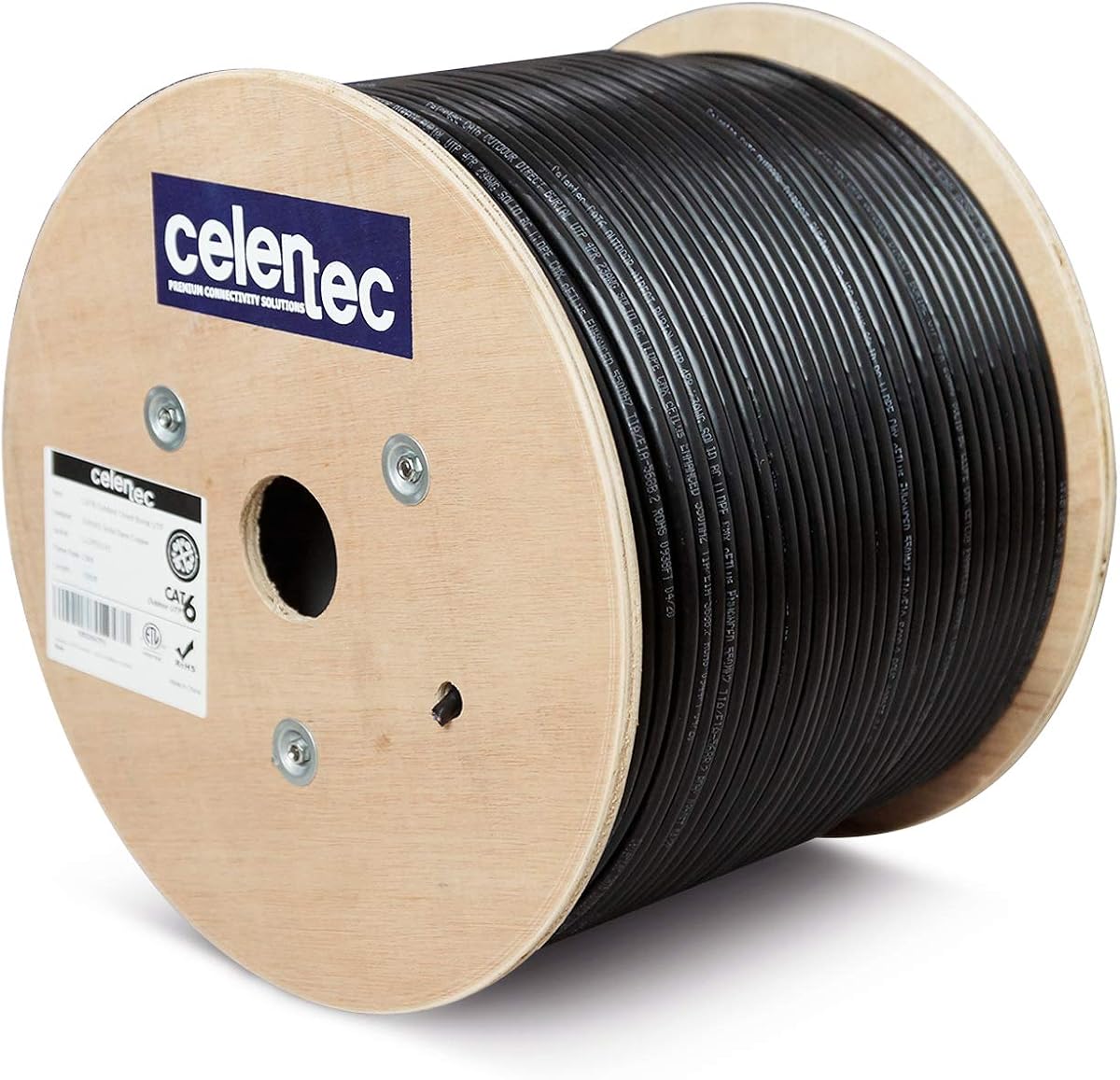
The celertec CAT6 Outdoor Cable earns a 4.7 rating and is a strong choice for an exterior installation that requires solid bare copper. Its LLDPE jacket is designed to withstand UV exposure, rain, and temperature changes, while the ETL listing and stated ANSI/TIA-568.2-D compliance add a strong installation-focused foundation.
We may earn a commission when you buy through this link, at no additional cost to you.
This cable is tested to 550MHz and is intended for 1Gb networks, with 10Gb performance available over shorter distances depending on the installation environment. It supports PoE and VoIP applications, making it more broadly useful than a data-only CCA cable. Solid bare copper also improves conductivity compared with copper-clad aluminum, which is particularly relevant over extended runs.
The cable remains unshielded, so it may not offer the same interference resistance as a shielded F/UTP or FTP product in electrically noisy locations. The 500-foot wooden spool is useful for controlled dispensing and sequential foot markings help estimate remaining length, although wood is less compact than a cardboard pull box. This is an outdoor-rated cable, but the product information does not explicitly state that it is approved for direct burial.
Choose the celertec cable for an outdoor office, courtyard, home accessory building, or surveillance installation where bare copper, certified construction, and PoE support are priorities. It offers a well-balanced alternative to both budget CCA cable and premium fully shielded cable. Verify local installation requirements and burial conditions before placing it underground.
Solid bare copper supports stronger conductivity and more dependable data or PoE transmission than CCA. It is a sensible conductor choice for runs between buildings and outdoor network endpoints.
The stated ETL listing, ANSI/TIA-568.2-D compliance, and RoHS compliance help installers evaluate more than raw cable diameter. These certifications should still be checked against the requirements of the particular building project.
We may earn a commission when you buy through this link, at no additional cost to you.
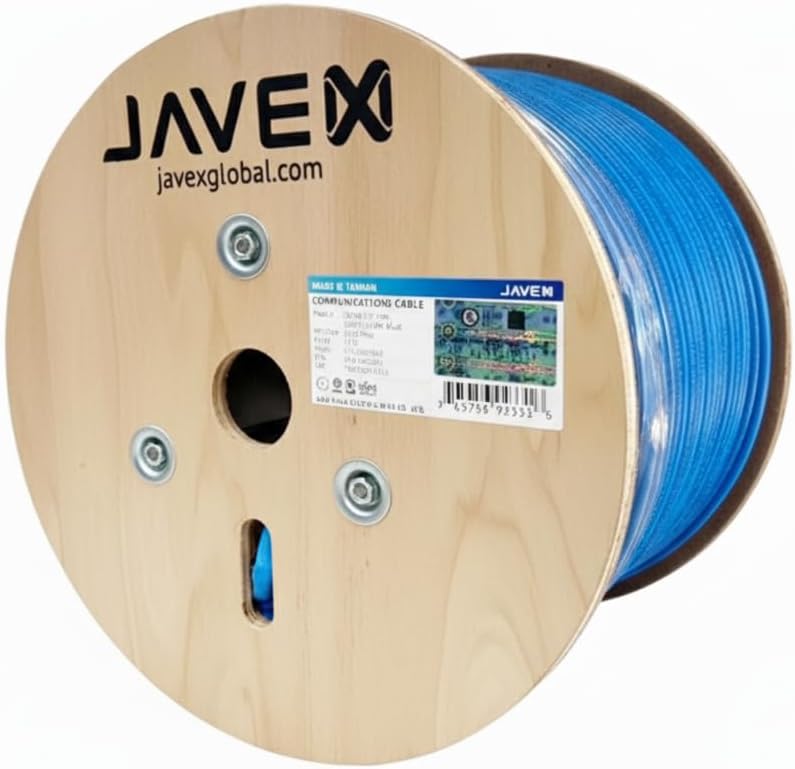
The JAVEX CAT 6A Riser CMR Ethernet Cable holds a 4.8 rating and offers the most advanced category and installation specification in the guide. Its shielded FTP construction, solid bare copper conductors, and up-to-750MHz performance make it appropriate for demanding structured cabling where future bandwidth and interference resistance justify a higher-specification option.
We may earn a commission when you buy through this link, at no additional cost to you.
The UL riser-rated jacket is designed for in-wall, between-floor, and other non-plenum spaces. Riser installation can involve vertical pathways between floors, so the jacket's mild flame-retardant characteristics are an important distinction from generic indoor cable. The stated certification information includes UL listing, ANSI/TIA references, ETL verification to TIA-568.2-D, and UL LP identification for PoE++.
Shielding requires deliberate installation. The cable should be grounded and terminated with compatible shielded connectors and hardware to realize its intended interference benefits. It is also more substantial and specialized than ordinary Cat5e or Cat6 bulk cable, and a premium specification does not remove the practical limits of a 500-foot channel or every connected device.
Choose the JAVEX cable for a modern building backbone, high-performance office, smart building, or installation where shielded pathways and riser-rated materials are required. It is our premium pick because its construction goes beyond ordinary indoor Cat6 and anticipates demanding networking environments. For a simpler indoor extension without a formal riser or shielding requirement, a standard copper Cat6 cable is more economical.
Cat6A performance and a 750MHz target provide greater headroom than ordinary Cat6. This makes the cable well suited to expanding enterprise, commercial, and connected-building infrastructure.
The UL riser-rated jacket addresses in-wall and between-floor spaces where flame-retardant cable is important. It is not presented as a plenum cable, so installations in environmental air spaces require a separately rated solution.
We may earn a commission when you buy through this link, at no additional cost to you.
This 500-foot Cat8 bulk cable carries a 4.7 rating and advertises an ambitious combination of 40Gbps transfer capability, 2000MHz bandwidth, and double-shielded construction. The 26AWG composite conductor and F/FTP-style shielded pairs are intended for high-performance data transfer with reduced electromagnetic and radio-frequency interference.
We may earn a commission when you buy through this link, at no additional cost to you.
Its easy-pull box is useful for managing a heavy, substantial cable during installation. The product information lists compatibility with routers, switches, IP cameras, modems, patch panels, NAS devices, smart TVs, game consoles, and other RJ45 equipment, while also noting backward compatibility with Cat5e, Cat6, and Cat7 cables. The UV-resistant PVC jacket is described for both indoor and outdoor use.
The highest headline specification does not mean ordinary routers or computers will run the link at 40Gbps. Network adapters, switches, patch panels, keystone jacks, and all intermediate connections must support the intended category and termination standard. The cable's composite conductor also calls for careful comparison with the established pure-copper alternatives in this guide, especially for very long runs or high-resistance power delivery.
Choose this Cat8 option for a specialized high-bandwidth installation where compatible equipment is already available and shielding is beneficial. It can also serve as a future-oriented route for compatible infrastructure, provided terminations and active devices support it. For mainstream home networks and conventional structured wiring, a certified Cat6 or Cat6A cable is usually the more practical choice.
The advertised 40Gbps and 2000MHz capabilities make this cable relevant to data centers, advanced enterprise networks, and compatible home labs. Actual throughput still depends on every component in the link, not the cable alone.
The double-shielded construction is intended to reduce EMI and RFI interference. For best results, use compatible shielded connectors, properly terminate the shield, and avoid leaving unnecessary cable exposed to severe environmental conditions.
We may earn a commission when you buy through this link, at no additional cost to you.
The TRUE CABLE Direct Burial Cat6 earns a 4.7 rating and is a robust choice for a long exterior run that combines solid bare copper, shielding, and direct-burial capability. The black OSP jacket is built for outdoor exposure and can be installed in the ground, in conduit, or above ground where its listed construction is appropriate.
We may earn a commission when you buy through this link, at no additional cost to you.
This cable supports 10Gbps over distances up to 165 feet and 1Gb or 5Gb over distances up to 328 feet, depending on the installation environment. Its listed 550MHz bandwidth and PoE, PoE+, and PoE++ support make it suitable for outdoor cameras, access points, and other remote powered endpoints. The shielded F/UTP configuration helps reduce crosstalk and electromagnetic interference.
The stated field-testing claim uses a Fluke DSX-8000 Versiv CableAnalyzer, while the cable is described as complying with ANSI/TIA 568.2-E. As with any direct-burial installation, resistance to moisture depends on correct handling, proper installation, and avoiding damage to the jacket. Shielded hardware is also important: the shield must be terminated in a way consistent with the equipment and grounding design.
Choose this cable for serious outdoor networks, long exterior building links, surveillance systems, or installations requiring 4PPoE power. It is more specialized than generic Cat6 bulk cable, but the materials directly address the environmental and electrical demands of outdoor networking. For interior or conduit-only routes, a standard copper riser cable may be sufficient.
Direct burial allows a network link to pass beneath soil, landscaping, or a driveway without leaving vulnerable surface cable. Installation still requires suitable trenching, backfill, and attention to local utility and burial requirements.
Support for PoE++, including the listed 100W 4PPoE capability, expands its usefulness for powered outdoor devices. Distance, heat, and installation quality should still be considered when calculating power delivery.
We may earn a commission when you buy through this link, at no additional cost to you.
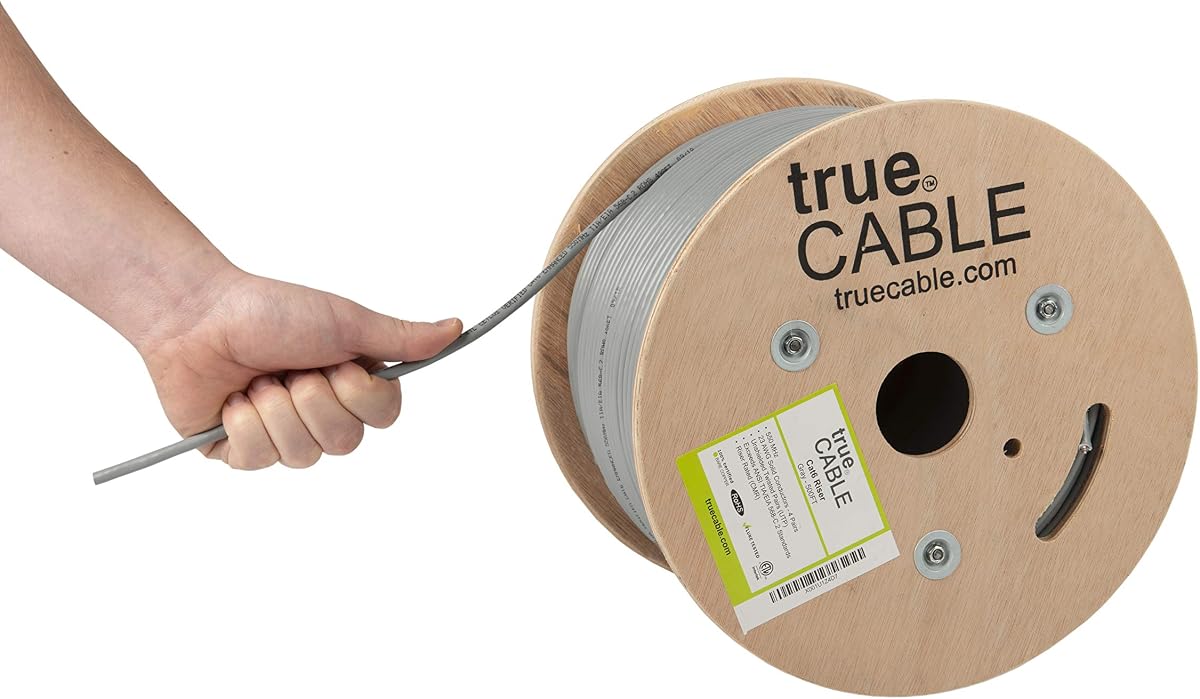
The trueCABLE Cat6 Riser earns a 4.7 rating and is a dependable indoor option for between-floor, in-wall, and non-plenum pathways. It combines solid bare copper with a gray CMR riser jacket, giving installers a more appropriate option for vertical commercial installations than a general-purpose indoor spool.
We may earn a commission when you buy through this link, at no additional cost to you.
The four-pair, 23AWG cable supports 1Gb and 5Gb networks over the stated distance of up to 328 feet and 10Gb over shorter runs up to 165 feet, subject to installation conditions. Its 550MHz bandwidth rating, PoE, PoE+, and PoE++ support make it appropriate for offices, access points, VoIP equipment, and other connected infrastructure. The pre-spooled reel is designed to reduce tangling during payout.
As an unshielded cable, it may be less effective in locations with high electrical noise. The riser jacket is appropriate for the stated indoor locations but is not a direct-burial or plenum solution. The product data also mentions testing with a DSX-8000 Versiv CableAnalyzer and compliance with ANSI/TIA 568.2-D, offering useful information for installers who need documented performance characteristics.
Choose the trueCABLE Gray Riser for a structured indoor project involving walls, floors, or non-plenum spaces and when PoE capability is needed. It is a well-rounded middle ground between economy-grade CCA cable and premium shielded Cat6A. For direct burial, wet locations, or unusually noisy sites, select a cable specifically rated and constructed for those environments.
The gray CMR jacket is designed for in-wall, between-floor, and non-plenum spaces where mild flame retardance is important. It offers a more appropriate installation rating than a basic indoor communications cable.
The tangle-free reel helps maintain control during payout, while the solid bare copper construction supports dependable data and power transmission. Compatible RJ45 and field-terminable hardware make this a practical structured-cabling option.
We may earn a commission when you buy through this link, at no additional cost to you.
The right 500-foot cable depends on more than its category label. Conductor material, installation environment, bandwidth, PoE requirements, jacket rating, shielding, and termination hardware should all influence the decision.
Bare copper is the preferred conductor for high-performance, long-run, and PoE-enabled networks because its electrical resistance is lower than that of copper-clad aluminum. CCA can reduce material costs, but it heats more readily under current and may be less dependable when links are long, power requirements are high, or future expansion is expected. The actual channel performance also depends on the complete installation, including connectors, patch panels, and terminations.
Cat5e is suitable for many conventional 1Gb networks but provides less expansion room than Cat6 and Cat6A. Cat6 cables in this guide target up to 550MHz and can support 10Gb over shorter installation-dependent distances. Cat6A raises the performance target to 750MHz, while Cat8 advertises even greater bandwidth and transfer capability. Match the category to the active equipment and realistic channel length rather than selecting only by headline speed.
Power over Ethernet carries low-voltage power and data through the same cable, making conductor resistance an important consideration. Some CCA products explicitly do not support PoE because of the greater heat generated under current. Bare copper options in the guide provide varying PoE, PoE+, and PoE++ support, including a 100W 4PPoE claim. Confirm the standard required by the device, account for cable length and heat rise, and avoid leaving PoE unsupported cables in powered runs.
A standard indoor cable should remain in a dry, protected environment. Riser-rated cable is intended for in-wall, between-floor, and non-plenum pathways, while plenum-rated cable is designed for environmental air spaces according to applicable building requirements. Outdoor and direct-burial cable use jackets designed to withstand sunlight, moisture, abrasion, and soil exposure. Do not assume that a cable marketed for outdoor use is automatically approved for every exterior pathway.
UTP is lighter and often easier to terminate, making it adequate for many ordinary homes and offices. Shielded F/UTP, FTP, or F/FTP cable can reduce electromagnetic interference and crosstalk in noisy commercial environments, near power systems, or in dense structured installations. Shielding only performs as intended when compatible shielded connectors are used, the shield is properly terminated, and the installation follows the relevant grounding design. Extra shielding is not automatically necessary for every route.
A 500-foot spool must pay out smoothly. Easy-pull boxes, wooden reels, and tangle-free reels are intended to reduce snags, kinks, and installation time. Sequential foot markings let installers track remaining cable and help avoid cutting more than necessary. Packaging does not affect signal performance directly, but a damaged or tightly bent cable can. Plan the route, preserve the manufacturer's bend radius, and inspect the jacket as the cable is pulled.
Most bulk Ethernet cables arrive without connectors, so jacks, keystone inserts, patch panels, couplers, or RJ45 plugs must be selected separately. Confirm that the hardware is rated for the same category, conductor construction, shielding style, and environmental location as the cable. Outdoor installations require weather-appropriate terminations, while shielded systems require compatible shielded components. Poor or mismatched terminations can undermine an otherwise capable spool.
UL, ETL, ANSI/TIA, CM, CMR, CMX, and OSP designations communicate different aspects of safety, listing, flame rating, and intended environment. A higher-frequency claim alone does not establish suitability for a particular installation. Review the listed cable type, operating environment, and applicable standards alongside your local electrical and building requirements. Commercial projects may require documentation that the supplied cable and installation system meet the engineer's specifications.
Plan the complete route before opening the spool. Measure wall runs, ceiling paths, service routes, and outdoor trenches, then add a reasonable amount of service slack without creating sharp bends. Pull from the reel in a controlled manner, maintain the minimum bend radius recommended for the cable, and avoid using cable ties so tightly that they deform the jacket. For a reel-fed installation, keep the reel stable and let the cable rotate rather than dragging it across the floor.
Terminate the cable with hardware matched to its category and installation type. Use the specified conductor arrangement at each jack, keep untwisted copper pairs as short as practical, and inspect each termination for damaged conductors or uneven seating. Shielded cable requires compatible shielded connectors and appropriate shield handling. Outdoor terminations should be installed with the weather-rated components and entry methods appropriate to the location, while direct-burial cable should be installed without compromising its jacket.
After installation, test the complete channel rather than assuming the cable is the only variable. Verify wire mapping, length, data rate, and PoE operation with suitable certification or network test equipment. Keep the cable away from standing water, high heat, and physical damage, and inspect exterior or underground routes after significant weather or landscaping work. If performance is unstable, check terminations, damaged cable sections, grounding for shielded systems, and the compatibility of connected active equipment.
It can be suitable, but speed depends on cable category, conductor quality, installation, and interference. Cat6 can support 10Gbps over shorter runs, generally around 165 feet under favorable conditions, while 1Gb and 2.5Gb networks commonly accommodate longer runs. A 500-foot path may require a Cat6A or higher-category design for maximum bandwidth, especially when PoE is also in use.
CCA can work for shorter, ordinary indoor data connections, particularly when cost is the main concern. Its higher resistance becomes more significant over long routes, with PoE, or in installations expected to support future upgrades. Solid bare copper is the safer choice for a 500-foot installation intended for demanding or long-term use.
Yes, an outdoor-rated cable is generally suitable for a dry indoor route, although its tougher jacket and construction may cost more than necessary. The reverse is not recommended: an indoor-only cable can fail when exposed to moisture, ultraviolet radiation, abrasion, temperature changes, or soil. Always verify the exact environmental rating.
Riser cable is designed for pathways such as in walls and between floors, while plenum cable is designed for environmental air spaces and carries different flame-performance requirements. A riser cable should not automatically be installed in a plenum space. Check building codes and the available space before selecting the jacket rating.
It is not required for most ordinary home networks, especially when the cable remains away from noisy electrical equipment. Shielded cable can help in offices, installations near power systems, or runs through harsh electromagnetic environments. When using shielded cable, compatible shielded connectors and correct shield termination are important to achieve the intended benefit.
Yes, connector-free bulk cable is intended to be cut to length and terminated with compatible hardware. Follow the correct wiring order for the standard and equipment involved, maintain pair twist as closely as possible near the contacts, and test each completed run. Outdoor or shielded cable requires appropriately rated connectors rather than ordinary indoor plugs.
Some Cat6 cables support PoE while others do not, particularly when they use CCA or lack appropriate testing. Check the product specifications for PoE, PoE+, or PoE++ support and consider distance-related heat rise. Solid bare copper is generally the preferred choice for long or high-power runs.
Choose connectors and keystone jacks that match the cable category, shielding, conductor type, and installation environment. Standard shielded cable needs shielded hardware, outdoor routes need suitable weather-resistant terminations, and plenum or riser installations may have additional component requirements. Compatible, properly installed terminations are essential for reliable performance.
The three leading choices serve distinct needs. VIVO's gray Cat6 is the budget option for ordinary indoor custom-length cabling, Cable Matters' blue Cat6 is the overall selection for its bare copper conductors and broad PoE support, and JAVEX's blue Cat6A is the premium choice for shielded, riser-rated performance.
Prioritize the installation environment and electrical demands before focusing on the fastest headline specification. Use direct-burial or outdoor-rated cable for exposed routes, riser-rated material for vertical indoor pathways, and solid bare copper whenever long runs or PoE are involved. Match terminations to the cable and test the completed channel before considering the job finished.
Current prices, ratings, stock status, and product details can change, so check the listing at the time of purchase. Confirm the category, conductor material, jacket rating, PoE capability, and included hardware against the requirements of your particular network.