
EVAPLUS 54.6V Safe Charger
4.4Editor score
UL-certified safety design
Red and green status lights
100-240V universal input
Our expert guide compares the best electric bike chargers for 48V ebikes, covering connector fit, charging speed, safety, and battery compatibility for riders.
A charger for a 48V e-bike must do more than fit the charging port. It must match the battery chemistry, provide the correct 54.6V output, regulate current properly, and include dependable protection against overheating, short circuits, and reverse connection. The best electric bike chargers for 48V ebikes combine those essentials with clear status lights and broad connector support.
This guide compares ten replacement chargers using the specifications supplied for each listing. We focus on battery compatibility, output voltage and current, connector options, safety certification, charging controls, portability, and the practical details that affect daily use. We also identify products with unusually broad fit and one listing whose description contains important inconsistencies.
Each review explains who the charger best suits, from riders seeking a straightforward replacement to owners who want several interchangeable tips and faster charging. Ratings and product details can change, and marketplace listings may be updated, so readers should verify their battery label and charging port before buying. Prices and availability also change over time.
4.4Editor score

4.4Editor score
4.3Editor score
The table below compares the supplied output, connector coverage, safety features, and intended battery type for all ten chargers. The strongest all-around options combine verified 48V lithium compatibility with multiple tips and regulated charging, while the highest-current model offers the fastest stated charging cycle.




The EVAPLUS 54.6V Safe Charger is a straightforward replacement option for riders with a 48V lithium e-bike or scooter battery. It carries a 4.4 rating and distinguishes itself with UL certification, automatic shutoff, and a compact selection of commonly used DC barrel connectors. Its output is designed for 48V lithium batteries rather than lead-acid packs.
We may earn a commission when you buy through this link, at no additional cost to you.
Its strongest qualities are practical rather than elaborate. The charger supports 100-240V AC input, so it can be used in many regions without a separate voltage converter. Red and green LEDs provide an immediate indication of charging and completion status. Built-in over-voltage, over-current, and short-circuit protection add practical safeguards, while auto shutoff helps avoid continued charging after the battery is full.
The supplied information says a typical 48V 13S lithium battery can charge from empty to full in approximately four to six hours, although actual timing depends on battery size and starting charge level. The main limitation is connector breadth. It supports 5.5 by 2.5mm and 5.5 by 2.1mm DC plugs, but it does not offer the aviation, RCA, or XLR tips found on several competing models.
This is a sensible choice for a rider whose bike uses one of the two supported barrel connectors and who wants certification, simple status lights, and automatic shutdown without a large accessory kit. Buyers should still inspect the charging socket before ordering and confirm that the battery is labeled for 48V lithium use. For owners with less common ports, a model with interchangeable adapters will be more convenient.
UL certification, protection against over-voltage, over-current, and short circuits, and automatic shutoff create a sound foundation for routine charging. The separate red and green indicators make the charger easier to understand than one that relies only on a single light.
The included support for both common DC barrel sizes covers many 48V e-bikes, but it is less versatile than seven-plug alternatives. Measuring the port before ordering is essential.
We may earn a commission when you buy through this link, at no additional cost to you.
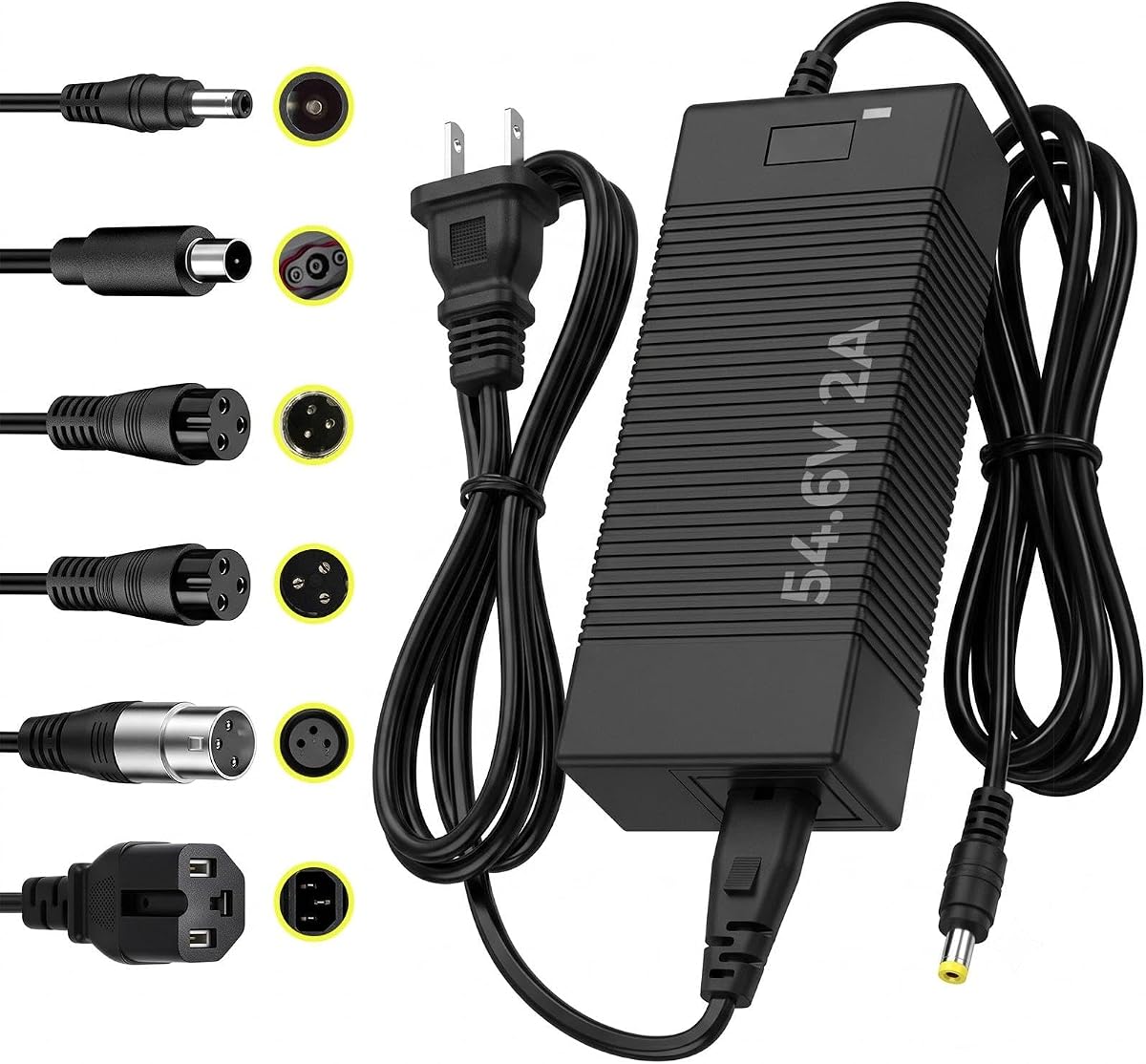
The 54.6V 2A Universal Charger offers a practical middle ground between a basic barrel-plug model and a larger adapter kit. It has a 4.2 rating and supplies 54.6V at 2A for 48V lithium e-bike batteries. Its stated compatibility includes several popular models from Lectric, Ecotric, and Evercross, which gives it useful appeal for owners of those brands.
We may earn a commission when you buy through this link, at no additional cost to you.
Five connector types are listed, including 5.5mm barrel configurations, a 12mm aviation plug, and a Cannon-style option. That wider selection is valuable when the original charger has been lost or its connector style is uncertain. The charger uses a CC-CV working mode and stops automatically when the battery reaches full charge. Over-voltage, over-current, short-circuit, over-temperature, reverse-connection, and fuse protections are also listed.
There are some caveats. The listing does not provide the same detailed breakdown of connector dimensions as some alternatives, so buyers should compare the port with the available tips and product imagery. It is expressly intended for lithium batteries and should not be used with lead-acid packs. The listed 100-240V input is convenient, but the 2A output is a moderate choice rather than the fastest option in this guide.
It is best suited to riders who want more plug flexibility than a two-tip charger while retaining a relatively conventional 54.6V 2A output. Confirm the battery chemistry and voltage, inspect the original charger label, and compare the connector shape before ordering. For riders with a known standard DC barrel port, this remains a capable general-purpose replacement.
Five listed connector types reduce the risk of buying the wrong replacement for common e-bike charging ports. They do not eliminate the need to measure and compare the socket.
CC-CV control and automatic shutdown provide the core charging behavior, while the listed protection suite adds useful layers of defense against wiring or operating errors.
We may earn a commission when you buy through this link, at no additional cost to you.
The Hyleton 48V Lithium Battery Charger is the strongest all-around option in this guide. It combines a 4.4 rating with a 54.6V 2A output, UL certification, three connector formats, and a fanless temperature-control design. The supplied information also provides unusually detailed battery and brand compatibility guidance, which helps reduce the risk of choosing the wrong replacement.
We may earn a commission when you buy through this link, at no additional cost to you.
Its three-in-one connector system includes a 5.5 by 2.5mm or 2.1mm DC plug, a 12mm three-pin plug, and an 18mm XLR plug. That covers several popular e-bike charging formats while keeping the accessory set manageable. The charger is stated to be 30 percent faster than a standard 54.6V 1.5A model, with intelligent temperature control lowering peak temperature. It also includes a storage bag for travel or organized storage.
The charger is strictly for 48V lithium-ion e-bike batteries and is not listed for scooters, hoverboards, electric motorcycles, lead-acid, or LiFePO4 chemistry. That strict boundary is appropriate because using an incorrect chemistry profile can damage a battery. The fanless design is a notable advantage for riders who charge overnight in a bedroom, office, or shared space, although charging speed will still vary with capacity and battery condition.
This is the most balanced recommendation for someone who values a compact charger, quiet operation, certification, and broad enough connector coverage. Check the charging port and battery label, and do not assume that a similar-looking connector is electrically compatible. Subject to those checks, it combines the most useful features without requiring the highest-current setup.
The listed 2A output shortens charging time compared with a 1.5A charger, while fanless temperature control keeps operation quiet. It offers a practical middle ground between basic and high-current alternatives.
Three connector formats cover many mainstream 48V e-bikes, and the listing calls out numerous compatible brands. The explicit lithium-only restriction is an advantage when matched to the right pack.
We may earn a commission when you buy through this link, at no additional cost to you.
The QKIIP 54.6V 2A Charger leads the guide in adapter variety, supplying seven tips for several common barrel, three-pin, RCA, and XLR charging formats. It has a 4.4 rating and targets 48V 13S lithium-ion e-bike and scooter batteries. For a household with several battery-powered devices, that makes one charger more likely to cover the equipment it owns.
We may earn a commission when you buy through this link, at no additional cost to you.
The listed tips include 5.5 by 2.1mm and 5.5 by 2.5mm barrel plugs, a 12mm three-prong connector, a 9mm mini three-prong, an 8mm RCA, a three-pin XLR, and a female universal-style plug. The listing names models from Lectric, Ecotric, Rad Power, Aventon, Ancheer, Jetson, Evercross, Jasion, Velotric, Ridstar, Yozma, and Ninebot among possible matches.
Its smart CC-CV three-stage charging approach is designed to regulate current as the battery fills, and the charger includes protection against over-voltage, over-load, over-current, over-temperature, and short circuits. Red and green lights communicate charging and completion. This is a feature-rich package, but the seven-tip approach may be unnecessary for a rider whose bicycle uses one standard barrel connector.
The QKIIP is best for people who want a single charger for multiple 48V lithium devices or whose e-bike has a less common charging connector. Follow the listing's three checks: confirm the battery says 48V Li-ion, verify that the original charger output is 54.6V, and match the physical port to an included tip. That disciplined approach makes the broad compatibility more useful and less risky.
Seven tips cover an unusually broad range of e-bike and scooter ports. Riders with one common barrel connector may still appreciate having the others available for household use.
The supplied three-step checklist focuses on battery voltage, original charger output, and physical port shape. Following all three steps is more reliable than matching by appearance alone.
We may earn a commission when you buy through this link, at no additional cost to you.
The SGS Certified 54.6V 2A Fast Electric Bicycle Charger combines a seven-plug system with a stated 2A output for 48V 13S lithium batteries. Its 3.9 rating is the lowest among the ten products, but the supplied specification still presents a useful package for riders who value adapter breadth and multiple layers of charging protection.
We may earn a commission when you buy through this link, at no additional cost to you.
The connector set includes 5.5 by 2.1mm and 5.5 by 2.5mm barrel plugs, a 9mm mini three-pin, a 12mm standard three-pin, an 8mm RCA, a three-pin male XLR, and a universal IEC option. Over-voltage, over-current, short-circuit, and temperature protection are listed, together with a flame-retardant V-0 enclosure. The charger also uses clear LEDs, with red during charging and green at completion.
Compared with the QKIIP, this product offers a broadly similar connector concept and output. Its differentiators are the stated SGS certification, inclusion of the IEC-style plug, and a listing that says the units undergo aging tests. The lower rating may reflect a smaller volume of customer feedback or differences in overall customer experience, but ratings alone should not be treated as a complete measure of charger quality.
This charger is most appropriate for someone who has checked the original charger label, confirmed a 54.6V 2A output, and identified the matching port. It should not be selected for 24V, 25V, 29.4V, 36V, 42V, or lead-acid batteries. With the correct battery and connector, its certified construction and comprehensive protections make it a credible general-purpose replacement.
The stated SGS certification and flame-retardant V-0 enclosure complement the charger's electrical protections. These features are especially relevant for prolonged indoor charging sessions.
Seven listed plug formats cover common e-bike and scooter connections. The IEC option further increases usefulness across household charging equipment.
We may earn a commission when you buy through this link, at no additional cost to you.
The 54.6V 2A Five-Plug Charger is designed as a replacement for 48V lithium e-bike and scooter batteries, including models associated with Rad Power Bikes, Velotric, Heybike, Juiced, and Ecotric. Its 4.3 rating reflects a generally positive customer history, while the five-adapter format offers practical flexibility without the larger accessory count of the seven-tip alternatives.
We may earn a commission when you buy through this link, at no additional cost to you.
Its 54.6V 2A output is positioned as faster than a standard charger, and the five included adapters increase the chance of matching common e-bike ports. The listing highlights protection against overcharging, short circuits, over-voltage, and over-current. A multicolor LED indicator uses solid red while charging and solid green once the battery is fully charged, removing ambiguity about the charging state.
The supplied information is less detailed than that of several competitors. It does not provide a specific battery-capacity charging estimate, a detailed breakdown of every plug dimension, or an explanation of the precise charge algorithm. For a replacement purchase, those omissions make it especially important to compare the listing photographs with the original charger and confirm the required output.
This is a good option for a rider who wants a compact, UL-listed charger with several adapter choices and straightforward status lights. It may be less suitable for someone who needs very broad cross-device compatibility or detailed technical guidance. As with the other chargers, it should only be used with a compatible 48V lithium-ion battery after the connector and output have been verified.
A 2A output provides a reasonable improvement over lower-current chargers while remaining broadly conventional for 48V lithium e-bike packs. The five adapters add flexibility without making the kit excessive.
The listed safeguards cover the common electrical failure modes relevant to routine charging. Distinct red and green lights help riders recognize when the cycle is active or complete.
We may earn a commission when you buy through this link, at no additional cost to you.
The six-in-one charger carries a 4.4 rating and its title presents it as a 54.6V 2A unit for 48V lithium e-bike and scooter batteries. However, the supplied product description contains major contradictions that make the listing unsuitable for an unqualified recommendation. This caution matters because charger voltage and chemistry settings should never be inferred from the product title alone.
We may earn a commission when you buy through this link, at no additional cost to you.
The detailed description instead describes a dedicated 12.8V nominal four-cell LiFePO4 charger with a 14.6V output and a stated 20A constant current. It discusses Anderson connectors, M8 ring terminals, a 300W continuous output, and large cooling fans for industrial applications. These are not interchangeable specifications with a compact 54.6V 2A e-bike charger, so the description appears to belong to a substantially different product.
The listing also mentions six-in-one plugs, clear red and green LEDs, and several standard protection functions, but those claims cannot resolve the central output contradiction. Connecting the wrong charger to a battery can cause damage even when a plug appears to fit. The listed description also expressly discusses LiFePO4 charging rather than the 13S lithium-ion chemistry normally associated with a nominal 48V e-bike battery.
As a result, this charger should not be bought by a 48V e-bike owner without obtaining clear confirmation from the seller or manufacturer that the physical item and label match the title. Ask for photographs of the output label, charging lead, connector dimensions, and certification mark. The conflicting information makes this the least straightforward selection in the guide despite its attractive rating and six-tip claim.
A charger labeled 54.6V is not interchangeable with one labeled 14.6V, regardless of whether a connector appears to fit. Voltage, current, and battery chemistry must all be confirmed before connection.
Request clear output-label photographs and connector measurements from the seller. If those details cannot reconcile the listing title and description, choosing a clearly specified alternative is the safer course.
We may earn a commission when you buy through this link, at no additional cost to you.
The 48V 54.6V 2A Five-Plug Charger has the highest customer rating in this comparison at 4.6. It supplies the standard 54.6V output at 2A for 13S 48V lithium battery packs, and its interchangeable tips are intended to cover common e-bike connectors. The same unit is positioned for electric bicycles, scooters, one-wheel devices, and Rad Power Bike models.
We may earn a commission when you buy through this link, at no additional cost to you.
Its most attractive feature is the combination of portability and compatibility. Five interchangeable plugs offer meaningful adaptability, while the compact, low-noise design is well suited to home, travel, or backup use. Safety protections against over-voltage, over-current, short circuits, and overheating are listed. A stable DC output is also claimed to help protect battery health, and the housing is described as durable, wear-resistant, and resistant to drops.
The charger does not claim UL, ETL, or SGS certification in the supplied information, so buyers who place a high priority on independent certification may prefer another model. Its heat-dissipation structure and low-noise operation are useful qualities, but the listing provides fewer quantified details about the cooling system than the fanless Hyleton listing does. Connector dimensions are also not broken down, so a close visual and physical comparison remains important.
For riders who want a well-rounded replacement with a strong customer rating, broad device use, and several connector choices, this is a compelling selection. Its five plugs should cover more ports than a standard single-tip charger without requiring a seven-piece kit. Confirm that the battery is 48V 13S lithium, compare the charging socket to the available tips, and use a grounded outlet on a surface that can dissipate heat.
The 4.6 rating leads the guide, while the compact and low-noise design supports convenient charging in several environments. It is especially appealing as a shared or travel backup charger.
The listed protection features cover common electrical risks, but no named safety certification appears in the supplied data. Riders prioritizing documented certification should consider the UL- or ETL-listed alternatives.
We may earn a commission when you buy through this link, at no additional cost to you.
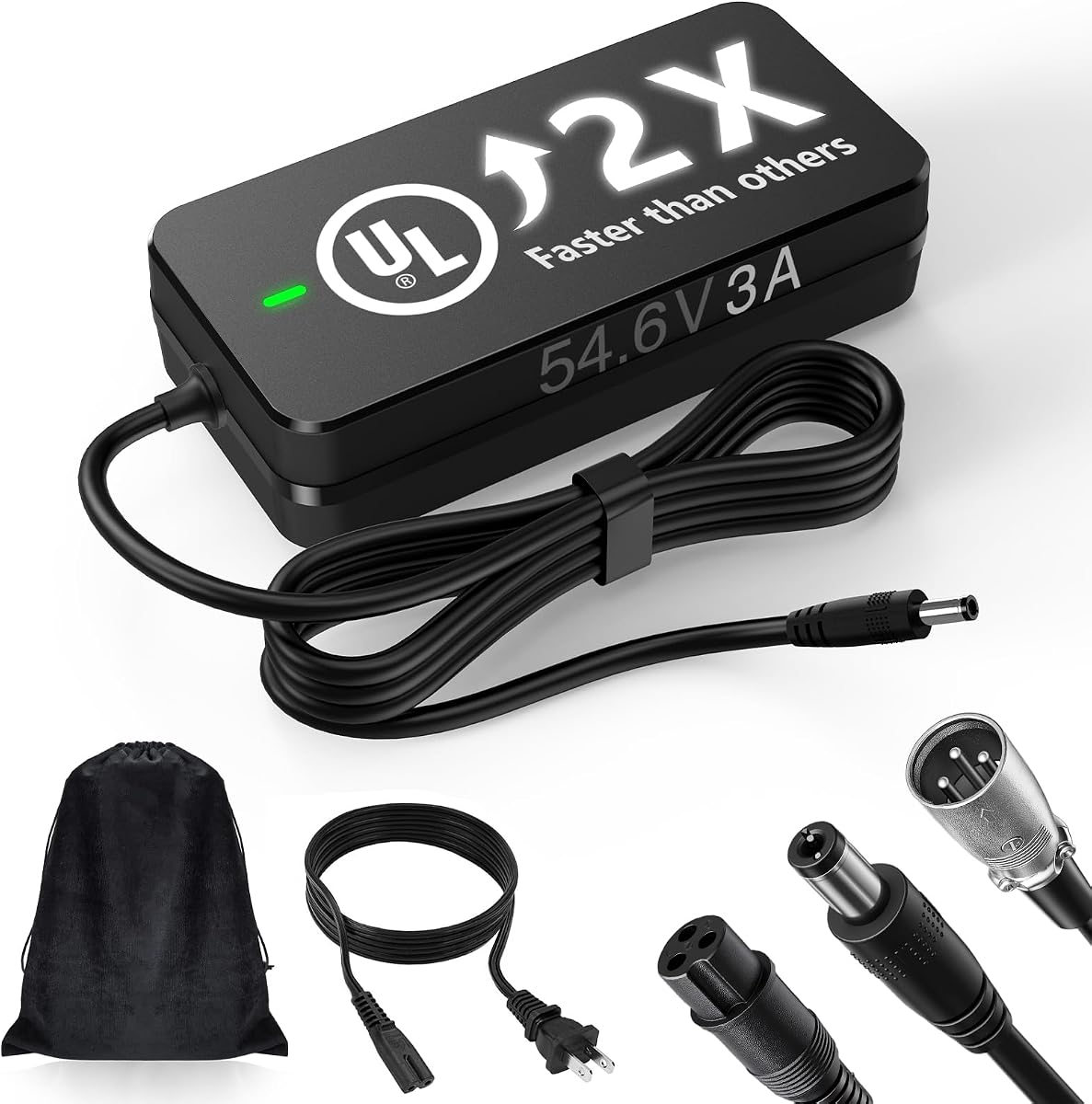
The Hyleton 54.6V 3A Fast Charger is the premium, high-current choice in this guide. It has a 4.3 rating and supplies 54.6V at 3A for 48V lithium-ion e-bike batteries. The listing states that a 15Ah battery can charge fully in about five hours, placing it ahead of the 2A models when shorter downtime is important.
We may earn a commission when you buy through this link, at no additional cost to you.
Intelligent temperature control is the defining technical feature. It is intended to reduce heat stress during the higher-current charge, while a V0 fire-resistant enclosure and UL certification support safe operation. The charger also provides over-voltage, over-current, short-circuit, and over-temperature protection. Red and green LEDs indicate charging and completion, and automatic shutoff or transition to trickle current helps avoid overcharging.
The connector system includes a built-in 5.5 by 2.5mm or 2.1mm DC plug, a 12mm three-pin adapter, and an 18mm XLR adapter. The listing names a broad range of compatible brands and specific Lectric XP, XPremium, XPedition, XPeak, XPress, ONE, and trike models, plus several Ecotric bicycles. Its stated battery capacity range extends from 13Ah through 30Ah, giving it broad relevance for larger packs.
This model makes the most sense for riders who prioritize charging speed, have a compatible 13S lithium-ion pack, and want recognized certification alongside active temperature management. It is explicitly unsuitable for other voltages, lead-acid, LiFePO4, scooters, hoverboards, and golf carts. Also note the warning that a battery unused for more than 12 months may be damaged and may not activate, regardless of charger quality.
The 3A output is the highest current listed in the guide, with a stated five-hour full charge for a 15Ah battery. Actual results can vary with battery capacity, condition, and the pack's built-in charging limits.
Intelligent temperature control seeks to limit heat during charging, while the V0-rated case and electrical protections add further safeguards. The higher output still requires a properly matched battery and sound ventilation around the charger.
We may earn a commission when you buy through this link, at no additional cost to you.
The ETL Certified 48V Electric Bike Charger provides a 54.6V 2A output for 13S lithium-ion batteries and combines that specification with seven interchangeable plugs. Its 4.4 rating and ETL certification make it an appealing option for riders who want broad connector coverage and recognized electrical standards at the same time.
We may earn a commission when you buy through this link, at no additional cost to you.
The included plug set covers 5.5 by 2.1mm and 5.5 by 2.5mm barrel connections, 9mm and 12mm three-pin formats, an 8mm RCA, a three-pin XLR, and an IEC connection. The listing identifies Razor, Gotrax, Xiaomi, Jetson, and Ninebot among compatible brands. Over-voltage, over-current, short-circuit, and temperature protection are included, and the charger uses 100-240V, 50/60Hz input.
Construction details emphasize aviation aluminum plugs and high-density wires intended to resist rust and oxidation. Intelligent temperature control is also stated, helping the charger maintain stable output during fast charging. A red light shows active charging and a green light signals a full battery. However, the listing's description of fast charging does not provide a specific capacity-based time, so buyers cannot compare its real-world timing as precisely as with the 15Ah estimate supplied for the 3A model.
This charger is best for a rider who wants one certified unit to serve several 48V e-bikes, scooters, or hoverboards. It remains limited to 48V 13S lithium-ion batteries and must not be used with 24V, 25V, 36V, 42V, or lead-acid packs. Confirm both the battery label and connector before ordering, and select this model when ETL certification and seven-tip flexibility matter more than a published charge-time estimate.
ETL certification distinguishes the charger from listings that only describe protective features, while seven tips make it useful for households with multiple compatible devices.
Aluminum plug components and high-density wiring are designed for repeated connections and resistance to corrosion. Care should still include keeping the socket and connector clean and dry.
We may earn a commission when you buy through this link, at no additional cost to you.
Choosing an e-bike charger starts with the battery label, not the brand or connector photograph. Confirm the chemistry, nominal voltage, required charger output, current rating, and physical port before comparing features such as certification, adapter coverage, cooling, or charging speed.
Most batteries marketed as 48V e-bike packs are 13S lithium-ion systems that require a 54.6V charger during the final charging stage. That does not mean every device labeled 48V accepts the same charger. Lead-acid and lithium iron phosphate chemistries use different voltage and charge profiles, and several listings expressly exclude them. The safest method is to read the battery label and compare it with the output information printed on the original charger.
A connector that appears similar may have a different barrel diameter, pin arrangement, or center polarity. Chargers in this guide include common DC barrel plugs, three-pin aviation-style connectors, RCA-style tips, XLR connectors, and other options. Measure the port, count the pins, and compare the tip with the original charger. Do not force a connector or rely solely on its outer diameter.
Most chargers in this comparison deliver 2A, while the Hyleton 3A model targets faster charging. Higher current can shorten downtime, but it also places more demand on the charger and battery-management system. Actual charge time depends on amp-hour capacity, starting charge level, battery age, temperature, and the pack's internal balancing and charging limits. Published estimates are useful comparisons, not guarantees.
A quality charger should regulate current as the battery approaches full charge and stop or reduce output when the battery is full. CC-CV control is mentioned by several products, while automatic shutoff or trickle behavior is common across the list. Red and green LEDs are also useful because they let the owner distinguish an active charge from a completed session without repeatedly connecting or disconnecting the battery.
UL, ETL, and SGS certification provide useful evidence that a product has been evaluated against recognized standards. They should be considered alongside protection circuitry rather than as a replacement for correct compatibility. Features such as over-voltage, over-current, short-circuit, over-temperature, reverse-connection, and flame-resistant housings add further layers of safety, especially during unattended overnight charging.
A seven-tip charger is useful for owners of several e-bikes, scooters, or other 48V devices, or for a less common charging port. A two- or three-tip model is often simpler for one bike with a known connector. More tips do not automatically mean better charging; they only increase physical compatibility. The selected tip must still match the battery and device correctly.
Charging generates heat, and a charger used for long periods or at higher current needs effective heat dissipation. Some listings mention passive cooling and low noise, while others describe fans or industrial thermal systems. Consider where the charger will be used: a quiet fanless model is convenient in a bedroom or office, but any charger should still have ventilation and rest on a nonflammable surface.
A compact charger is easier to store and carry as a backup, while durable cables and corrosion-resistant plugs help it withstand frequent connection changes. Some listings include a storage bag, which can keep adapters organized in a trunk, garage, or travel case. Build claims are most valuable when supported by recognized certification, clear specifications, and protection against common charging faults.
Begin by verifying the battery label, original charger output, connector type, and center polarity. Confirm that the replacement is intended for 48V 13S lithium-ion chemistry. If the battery uses lead-acid or LiFePO4 chemistry, do not substitute a standard 54.6V lithium-ion charger, and do not rely on the charging plug being the only visual difference.
Place the charger on a stable, dry, nonflammable surface with ventilation on every side. Connect the charger to the charging port before plugging it into the wall when the manufacturer's instructions call for that sequence. Never use the charger outdoors in wet conditions, around combustible materials, or with a damaged cable, dirty socket, discolored connector, or unusual odor. Do not leave the bike battery connected indefinitely after a full charge unless the battery manufacturer specifically permits it.
Use the LEDs to monitor the session: red generally indicates charging and green indicates completion, standby, or disconnection. Unplug the wall plug before removing the battery connector, then inspect the charger and port for dust, corrosion, or heat damage. Store tips in the supplied bag or another organized case, and avoid pulling the charger out by the cable. If the battery has been unused for an extended period or will not charge, have the battery assessed rather than repeatedly using a higher-current charger to force activation.
Most 48V e-bike batteries use a 13S lithium-ion pack and are charged with a 54.6V charger. The amperage can vary, with 2A being common and 3A providing a faster stated charge cycle. Confirm the output printed on the original charger and the battery label before purchasing, because visual connector compatibility does not guarantee electrical compatibility.
No. A 54.6V charger is intended for a compatible 48V 13S lithium-ion battery and can overcharge a lower-voltage pack. A 36V battery normally uses a different nominal voltage and corresponding charger output. Always follow the voltage and chemistry printed on the battery or shown in the original charger's label.
A properly matched 3A charger can be suitable for many 48V e-bike batteries, but it should not be selected solely because it is faster. The battery's charging specification, capacity, age, internal BMS, and manufacturer guidance all matter. The Hyleton 3A model in this guide is stated for compatible 48V lithium-ion batteries and includes temperature and electrical protections.
Measure the charging port and compare its diameter, pin count, and shape with the available tips. Common formats include 5.5 by 2.1mm and 5.5 by 2.5mm barrel plugs, three-pin aviation-style plugs, RCA-style plugs, and XLR connectors. When uncertain, send the seller clear photographs and measurements of both the port and original charger.
No. Although some e-bikes share the same nominal 48V rating, their battery chemistry, capacity, internal charging limits, connector, and polarity can differ. A replacement should match the required 54.6V lithium-ion output and provide a connector that fits both physically and electrically. Compare the original charger label before ordering.
Across the listed chargers, a red LED generally means the battery is charging, while green indicates that the battery is full, the charger is in standby, or it has been disconnected. Because indicator meanings can vary by model, confirm the specific charger's instructions. If a light behaves unexpectedly, stop using it and check the connections and battery condition.
A charger with regulated CC-CV control and automatic cutoff is designed for unattended charging, but ventilation and correct compatibility remain essential. Use a sound outlet, keep the charger uncovered on a nonflammable surface, and follow the battery manufacturer's charging guidance. Disconnect the battery if it becomes unusually hot, the charger smells odd, or charging behavior appears abnormal.
More tips are useful if you own several compatible devices or if your bike uses an uncommon connector. For one e-bike with a standard barrel port, a two- or three-tip charger may be more convenient. The number of tips does not affect charging speed by itself; output voltage, current, battery condition, and internal charging controls determine that.
The EVAPLUS 54.6V Safe Charger is the straightforward budget selection for riders with a common DC barrel connector, UL certification, and uncomplicated red-and-green status lights. The Hyleton 48V 54.6V 2A charger is the best overall choice because it balances certification, silent temperature control, three connector formats, and detailed compatibility guidance. For riders who prioritize speed, the Hyleton 54.6V 3A model provides the highest listed output and a stated five-hour charge for a 15Ah battery.
Compatibility should always take priority over convenience. Begin with the battery chemistry and voltage, then confirm the original charger's output, measure the port, and verify connector polarity. If you need the broadest device coverage, the QKIIP, SGS, and ETL models each offer seven tips, but their included protections and certification details differ. The six-in-one listing should be purchased only after the seller resolves its major internal specification conflict.
Finally, remember that marketplace ratings, certifications, product descriptions, and availability can change, while prices fluctuate over time. Review the current listing before ordering, compare the output label with the battery requirements, and use the buyer's product images as confirmation rather than relying on connector appearance alone. That careful check is the best protection for both the battery and the charger.