
Xenvo Pro Lens Kit
4.1Editor score
0.45X wide-angle lens
15X macro lens
Rechargeable LED light
Travel case included
Our guide compares the best smartphone for manual photography options, including stabilizers, lenses, apps, books, and a dedicated mirrorless body today.
Smartphone for manual photography does not necessarily mean a conventional dedicated camera. It can describe a phone paired with physical controls, external optics, a stabilizer, or software that gives you deliberate control over focus, exposure, color, and recording. A capable setup can still be compact, affordable, and ready for spontaneous shoots.
We compared ten options based on their photographic utility, control, compatibility, portability, and learning value. The list covers stabilizers, wide-angle, macro, telephoto, and zoom lenses, a professional video guide, a photography handbook, and a dedicated mirrorless camera body. These products serve different parts of a mobile or travel photography workflow.
Each pick reveals what it contributes, from smoother handheld clips and more natural framing to dedicated lessons and greater photographic control. Product ratings and availability can change, and prices fluctuate frequently, so readers should confirm current details before purchasing. Our recommendations focus on the supplied specifications rather than unsupported testing claims.
4.1Editor score

5.0Editor score

This side-by-side comparison shows that the ideal mobile photography setup depends on the shooting problem. Stabilizers prioritize steadiness, lens kits expand framing and focus options, telephoto products bring distant subjects closer, while guides and dedicated cameras provide deeper manual-control workflows.
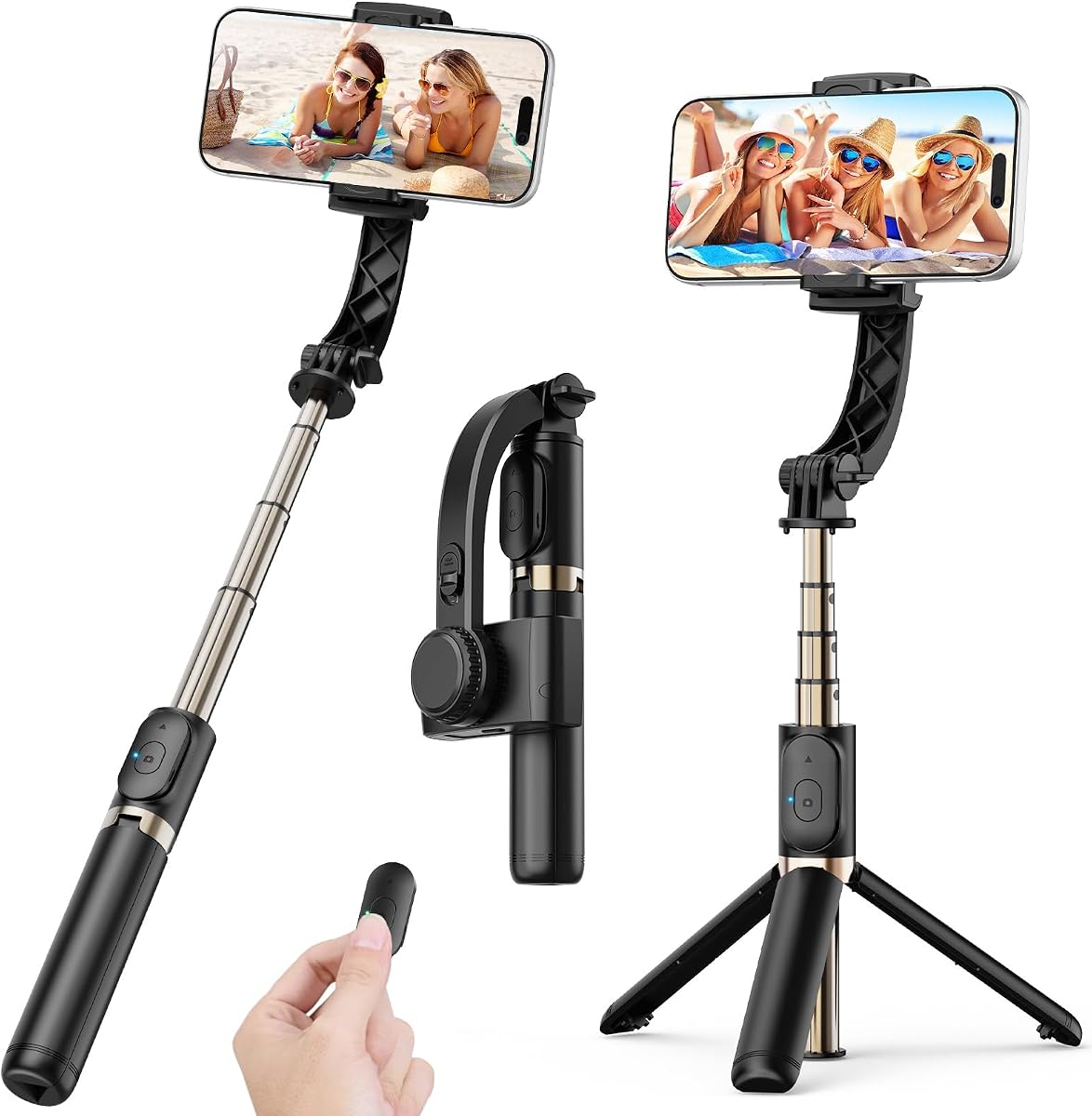


The COOVOAMAE 1-Axis Gimbal is a compact phone stabilizer built around the needs of everyday shooters. It carries a 4.5 rating and distinguishes itself with app-free operation, automatic horizon leveling, and a self-contained tripod and selfie-stick format. It is especially useful for family recordings, group selfies, vacation clips, and hands-free video calls where visual steadiness matters more than maximum lens power.
We may earn a commission when you buy through this link, at no additional cost to you.
Its gyroscope corrects tilt while the user pans, walks, or holds the phone outward. A folding aluminum rod extends to 31.5 inches, and the 360-degree rotating holder accommodates horizontal or vertical composition. Opening the grip creates a stable tabletop stance, while the included Bluetooth remote allows the photographer to start recording or take a group image from up to 32 feet away. The 450mAh battery is rated for up to two hours of use after a 1.5-hour charge.
The important limitation is explicit: this is not a three-axis gimbal. It cannot neutralize the up-and-down bounce produced while running or moving energetically. It also accommodates phones from 4.0 to 6.2 inches, which means unusually large devices or phones in bulky cases may not fit comfortably. The remote and tripod modes are useful, but the stabilization system is best suited to moderate movement.
This is a sensible choice for someone who wants more stability than a bare phone without learning a complicated stabilization app. It is particularly effective for trips, family gatherings, tutorials, and casual group shots. Buyers who need cinematic stabilization during running, skating, or vigorous action should save their money for a true multi-axis system or a camera with stronger built-in stabilization.
The built-in gyroscope and one-button orientation control make the stabilizer approachable for beginners. A user can frame and record without navigating menus, which is valuable when the camera is already extended or the shot requires immediate attention.
The extendable grip, rotating holder, and folding tripod legs let the same device support handheld footage, wide selfies, and hands-free recording. The detachable Bluetooth remote adds another useful option for group photography and unattended video.
We may earn a commission when you buy through this link, at no additional cost to you.
The Xenvo Pro Lens Kit combines a 0.45X wide-angle lens, a 15X macro lens, a rechargeable fill light, a grip clip, and a travel case. Its 4.1 rating reflects a practical package for mobile photographers who want to move beyond the fixed cameras built into a phone. It is a strong choice for architecture, travel scenery, family groups, pets, food details, and close-up observations.
We may earn a commission when you buy through this link, at no additional cost to you.
The wide-angle accessory is designed to bring more scenery into the frame while minimizing dark corners associated with poor auxiliary lenses. Its multi-element coated glass is intended to reduce ghosting, reflections, and flare. The macro lens provides a different kind of creative reach, revealing small details when positioned approximately half an inch from the subject. The included TruGrip clip improves handling when either lens is attached.
The GlowClip LED is another reason this kit feels more complete than a simple two-lens package. It attaches to the phone and offers low, medium, and high continuous illumination, giving photographers a softer alternative to the harsh burst from a built-in flash. The kit also includes a quick-release lanyard, charging cable, protective case, alternate clip, and cleaning cloth.
The set is best for creators who need two distinct optical perspectives rather than extreme reach. The 15X macro is not designed to photograph distant subjects, and compatibility with a specific phone should be checked against the clip and camera placement. Even so, this is a practical, travel-friendly option for anyone building a manual smartphone photography kit around wide views, close details, and controlled fill light.
The wide-angle lens expands environmental compositions, while the macro lens reveals details that are invisible at normal camera distance. Together they cover two widely used creative techniques without requiring separate purchases.
The detachable LED can remain on during an exposure, helping illuminate small subjects in darker settings. Three brightness levels make it easier to adjust the light to the scene without relying on a short, intense flash burst.
We may earn a commission when you buy through this link, at no additional cost to you.
The MIAO LAB 28X Telephoto Lens earned a 5.0 rating and provides a notably natural way to bring distant subjects closer. Rather than presenting an extremely narrow field of view, the 28X design is intended to help new users locate and frame birds, boats, landmarks, and sports participants. Its suggested working range extends from approximately 49 to 262 feet, or 15 to 80 meters.
We may earn a commission when you buy through this link, at no additional cost to you.
Manual focus provides meaningful photographic control. The user rotates the focus ring slowly until the subject appears sharp, a process that rewards patience and a deliberate shooting rhythm. The aluminum body also functions as a compact handheld monocular, so it can be useful for travel observation even when a phone is not attached. A universal clip supports many iPhone, Samsung, Google Pixel, and Android devices.
There are technical trade-offs. At 28X magnification, small hand movements become clearly visible, so bracing the arms or using a tripod is advisable. Phone camera positions differ, and some newer multi-camera models may display slight dark edges at 1X. The lens should be centered over the main camera, automatic macro switching should be disabled when possible, and a small amount of phone zoom can sometimes improve the result.
This is the strongest option in the list for someone who wants direct, hands-on control over distant framing. It is particularly compelling for wildlife, outdoor sports, scenic travel details, and event photography. The combination of a relatively wide telephoto view and manual focusing makes it easier to learn than a more restrictive extreme telephoto design, although a separate tripod is recommended for the sharpest results.
The stated emphasis on a wider field of view makes distant subjects easier to locate before magnification is increased. This is especially helpful for beginners learning the relationship between subject movement, framing, and focus.
Focusing before action begins creates a repeatable method for distant scenes. Bracing the phone, choosing a stable position, and making small focus adjustments can produce more consistent results than repeatedly refocusing during movement.
We may earn a commission when you buy through this link, at no additional cost to you.
The Blackmagic Camera App Complete Guide is a software-focused manual for filmmakers, YouTubers, and content creators. With a 4.5 rating, it offers a structured route through the app's professional controls, including ISO, shutter angle, white balance, manual focus pulls, histograms, zebras, and false color. It is particularly relevant to photographers who want their phone treated as a production tool rather than a point-and-shoot device.
We may earn a commission when you buy through this link, at no additional cost to you.
The guide also explains advanced recording options such as Apple ProRes, ProRes RAW, and Apple Log. It covers direct recording to external SSDs, anamorphic lenses with de-squeeze, real-time collaboration through Blackmagic Cloud, Remote Camera Control, multi-device synchronization, and streaming to YouTube or Twitch. That breadth makes it useful for readers who want to understand not just individual settings but how those settings fit into a complete workflow.
Because it is a guide rather than a physical accessory, it does not directly improve image quality. Its value depends on the reader applying the concepts and having access to compatible software and hardware. Beginners may find the breadth of professional terminology challenging, although the structured format allows them to proceed at their own pace and return to specific tools as their skills improve.
This is the best learning-focused pick for anyone committed to manual smartphone videography. It will be most useful to creators who already understand basic composition and exposure but want greater control over recording, monitoring, codecs, and output. Buyers seeking an immediate physical improvement should choose a lens or stabilizer instead, while future-oriented creators can use this guide as a comprehensive technical reference.
Histograms, zebras, and false color give users visual feedback that can be difficult to interpret alone. The guide explains how these monitoring aids fit into manual exposure decisions and help keep highlights and shadows under control.
Lessons on ProRes, external SSDs, anamorphic capture, and multi-camera control move beyond isolated app features. They show how a phone can participate in a more deliberate, production-oriented shooting system.
We may earn a commission when you buy through this link, at no additional cost to you.
The OM SYSTEM Pen Body is a dedicated compact mirrorless camera rather than a smartphone accessory, making it an important alternative for photographers who interpret manual photography broadly. Its compact body weighs 393 grams and includes a viewfinder, shutter button, dials, and interchangeable lens support. These physical characteristics provide a more traditional shooting experience with the portability associated with small camera systems.
We may earn a commission when you buy through this link, at no additional cost to you.
Its controls support deliberate image-making. Color, monochrome, and Creative Profile options allow the photographer to shape the look in-camera instead of relying entirely on later editing. Image stabilization supports steadier handheld work, while AI Human and Pet Detection AF can keep attention on people and animals when the scene requires a responsive autofocus point. The stated 4K video capability also makes it relevant to creators moving between photographs and moving images.
Weather sealing adds confidence for outdoor and travel use, although the complete protection depends on the lens and other system components being used appropriately. As a mirrorless body, it also introduces costs and considerations absent from a phone-based setup: photographers need a suitable lens, may need additional accessories, and should verify the complete kit before heading into the field. It does not support a phone directly.
This pick is ideal for a photographer ready to move beyond mobile hardware and gain physical control over a camera system. It is particularly attractive for travel, everyday documentary work, family portraits, and creative video. The decision is straightforward: stay with the list if a phone is essential, but consider the Pen Body if dedicated dials, optical flexibility, and a full photographic system matter more than carrying a phone.
A viewfinder, shutter button, and dial-based interface make core settings easier to adjust without navigating a touchscreen. That directness can support a more deliberate approach to exposure and composition.
The 393-gram body is designed to be carried without the bulk of a larger interchangeable-lens system. Weather sealing, stabilization, and interchangeable lenses support a versatile outdoor shooting setup.
We may earn a commission when you buy through this link, at no additional cost to you.
National Geographic Photo Basics is an approachable guide written by renowned photographer and Photo Ark founder Joel Sartore. Its 4.8 rating makes it one of the strongest-rated selections in this roundup. Although it is not a physical accessory, it addresses the most important part of manual photography: understanding how light, focus, framing, exposure, composition, and editing work together.
We may earn a commission when you buy through this link, at no additional cost to you.
The book explains camera and gear choices before moving into practical techniques for family, pet, travel, nature, and street photography. It includes professional tips, behind-the-lens stories, and quick assignments designed to turn concepts into practice. Dedicated smartphone advice helps mobile photographers translate familiar photographic principles into a device that is always within reach.
Because the book covers both phones and digital cameras, it is not narrowly optimized for a particular mobile workflow. Readers interested in advanced codecs, external recording, or specific app controls will need more specialized material. The broad foundation remains valuable, though, because manual control cannot compensate for weak composition, poor focus placement, or overlooked lighting.
This is the best pick for a beginner who wants to improve the thinking behind the photograph rather than immediately buy more hardware. It works well alongside any phone accessory in this guide. Read one chapter, complete its assignment, and then test the principle on the next shoot. That repeated cycle is a more reliable path to improvement than collecting accessories without understanding how they change an image.
Focus, exposure, composition, and lighting determine image quality regardless of whether the camera is a phone or a DSLR. Learning these fundamentals makes every accessory more useful because the photographer understands what the tool is changing.
Quick exercises turn abstract guidance into deliberate practice. Completing them during ordinary family, travel, pet, and street outings can reveal which concepts need more attention.
We may earn a commission when you buy through this link, at no additional cost to you.
The Zeadio Camera Stabilizer is a modular camera grip for smartphones, action cameras, DSLRs, and camcorders that use a standard 1/4-20 thread. Its 4.4 rating reflects a flexible approach to manual filming. Two side handles and one removable handle can be arranged for different movement patterns, while the design supports low-angle images and video that would be difficult to frame with a standard phone grip.
We may earn a commission when you buy through this link, at no additional cost to you.
The defining feature is the triple cold-shoe mounting system. It allows lights, flashes, LED panels, and microphones to be attached at the same time, creating a more capable production rig without requiring a large cinema-style cage. A detachable wireless shutter provides simple remote operation for compatible smartphones, while the threaded connections make the system easier to combine with other standard camera equipment.
The supplied information does not claim electronic stabilization, so buyers should not confuse a physical grip with a motorized gimbal. Stability comes from hand placement, grip configuration, and keeping the camera balanced. The more equipment added to the rig, the more care is required to prevent awkward weight distribution. It is better suited to controlled shoots and planned movement than quick handheld recording without setup.
This stabilizer makes sense for mobile filmmakers who want physical handles, multiple accessory mounts, and a more cinematic configuration. It is useful for interviews, tutorials, action-oriented sequences, and low-angle work. It is not the first choice for a photographer seeking automatic horizon correction, but it offers greater physical control and expands the phone into a configurable camera rig.
The side grips provide two points of support, while the removable handle can be repositioned or taken out for a lighter setup. This flexibility allows the operator to adapt the rig to the shot rather than using one fixed grip for every scene.
Three cold-shoe mounts create room for microphones and lights without requiring unrelated clamps. The result is a more integrated filming setup for creators who need audio and illumination as well as a stable camera position.
We may earn a commission when you buy through this link, at no additional cost to you.
The APEXEL 4-in-1 Phone Photography Kit offers an 18X telephoto lens, a 198-degree fisheye, a 15X macro lens, and a 0.63X wide-angle attachment. It also includes a flexible tripod, holder, clips, an eyecup, a cleaning cloth, and a zipped case. This variety gives mobile photographers numerous ways to experiment, although the kit's 3.3 rating calls for a more measured buying decision.
We may earn a commission when you buy through this link, at no additional cost to you.
The telephoto can make distant subjects appear larger, the fisheye creates circular and exaggerated perspectives, the macro opens up close observation, and the wide angle broadens the field of view. The included eyecup allows the telephoto attachment to operate as a monocular, while the flexible tripod can reduce movement during static shots. The wide-angle and macro lenses arrive connected and must be separated to use the macro alone.
The adjustment mechanism is designed to accommodate different camera positions on multi-camera phones. The kit lists compatibility with iPhone, Samsung, Google Pixel, and most other smartphones, but users should align the lens with the intended camera rather than assuming every model will behave identically. Thick cases may also interfere with the clip or optical alignment. Cleaning the glass before and after use is important because fingerprints and dust can visibly affect results.
This kit is most appropriate for creative experimentation, social content, and photographers who want multiple effects rather than one specialized optical tool. Its fisheye and wide-angle options can introduce strong perspective effects that are not suitable for every subject. The flexible tripod adds useful support, but it does not replace a more rigid stand for demanding telephoto work. Consider this an accessible, broad-purpose creative kit rather than a specialist long-range optic.
Telephoto, fisheye, macro, and wide-angle views create meaningfully different results from the same phone camera. Switching among them encourages experimentation with compression, perspective, detail, and spatial context.
The included tripod gives the user another way to stabilize composed images and videos. It is particularly handy for close-up work, timed group photos, and stationary wide compositions.
We may earn a commission when you buy through this link, at no additional cost to you.
The MIAO LAB 28X HD Telephoto Lens is a universal clip-on optic designed for long-distance observation and mobile photography. Its 3.9 rating places it below the more highly rated 28X option in this list, but its stated wide field of view is useful for users who find narrow telescopes difficult to aim. It targets concerts, sports, birds, wildlife, travel, and other subjects beyond ordinary phone-camera reach.
We may earn a commission when you buy through this link, at no additional cost to you.
Its light-path design is intended to improve light intake and reduce edge darkening, producing a cleaner image with fewer dark corners. The result will still vary by phone because camera location, sensor design, and digital cropping differ. The aluminum body and high-quality glass are designed to balance durability with portability, while the universal clip allows the accessory to be removed and carried independently.
At 28X magnification, small movements can cause noticeable blur or loss of detail. A monopod, tripod, or firm support point is advisable even though the accessory is described as portable. The lens should be aligned carefully with the main camera, and the phone should be positioned before the subject moves. The monocular function provides a quick way to find wildlife or scenery before attaching the clip for imaging.
This is a worthwhile option for travel-oriented phone photographers who want optical reach and a relatively easy way to locate distant subjects. It is not as strong a match as the 5.0-rated 28X model in this roundup, so careful attention to alignment and stability is important. It is best for planned outdoor shooting rather than spontaneous action at extreme magnification.
A wider field of view reduces the search area and makes it easier to place a distant subject within the frame. Finding the subject first also creates a more repeatable process when working at substantial magnification.
The same optic can serve as a handheld monocular for landscape, bird, or wildlife viewing. This dual purpose makes it useful before the phone is attached and when recording images is not the immediate priority.
We may earn a commission when you buy through this link, at no additional cost to you.
The MIAO LAB 20–60X Zoom Telephoto Lens is the most specialized and premium-oriented mobile optic in the list. Its 4.0 rating accompanies a wide magnification range, a 13-element and 10-group optical design, multilayer coatings, and a substantial aluminum body. It is built for photographers who want to move from moderate magnification to very tight views without swapping accessories.
We may earn a commission when you buy through this link, at no additional cost to you.
A 45mm objective and 58mm filter thread support light gathering and compatibility with UV, variable-density, circular-polarization, star, and other filters. The included aluminum tripod extends from 34 to 88 centimeters, uses three anti-slip locks, supports up to 3 kilograms, and includes a 360-degree pan-tilt head. Those features are particularly relevant at 60X, where minute camera movement can undermine detail.
The universal clamp uses a locking slider across a 7-to-10-centimeter range, with the lens opening positioned over the main camera. It is listed for current iPhone, Google Pixel, Samsung Galaxy, and OnePlus devices, while explicitly excluding several older iPhone models. The clamp's size and the full optical assembly are less convenient for pocket carrying than a small clip-on wide-angle lens, so transport and quick deployment need to be considered.
This is the pick for a dedicated mobile wildlife, sports, concert, or long-distance landscape workflow. The zoom range offers more flexibility than a fixed 28X optic, while the tripod and filter thread support more advanced use. It is less appropriate for everyday pocket photography or fast-moving events where rapid framing matters more than maximum reach.
The 20–60X range allows the photographer to start with a wider view and tighten the framing as needed. That flexibility is valuable when the distance to a subject is changing or its scale within the image needs adjustment.
The included four-section tripod, adjustable head, and anti-slip locks provide a much more stable foundation than a handheld phone. This support becomes increasingly important as magnification rises and the image circle covers a smaller part of the phone sensor.
The 58mm thread accepts common specialty filters, allowing photographers to control glare, polarization, density, or star effects. This makes the telephoto more adaptable than a simple fixed-purpose smartphone telescope.
We may earn a commission when you buy through this link, at no additional cost to you.
The right choice depends on whether your priority is steadiness, wider framing, close detail, distant reach, software control, or a transition to a dedicated camera. Compatibility, alignment, support, and the learning involved in each system matter as much as the headline specification.
Begin by identifying the subjects and compositions you struggle to capture with an ordinary phone. A stabilizer addresses movement, a wide-angle lens helps with constrained spaces, a macro lens reveals small details, and a telephoto brings distant subjects closer. Choosing a tool for a recurring problem is more valuable than collecting several accessories that duplicate functions the phone already performs well.
Prioritize the limitation you encounter most often, then choose a product that directly solves it. Add secondary tools only after the primary setup becomes consistent.
External telephoto optics generally require deliberate focus adjustments, and stability becomes increasingly important as magnification rises. A manual focus ring gives a photographer more precise control, but it also creates a repeatable sequence: find the subject, stabilize the phone, focus, compose, and capture. If that process is uncomfortable, start with a less extreme optic or spend time mastering the basics.
Choose a manual accessory when precision and subject isolation matter more than instant, automatic results.
Auxiliary lenses must align accurately with a phone's selected camera. Phone models differ in camera position, number of cameras, case thickness, and behavior when they automatically switch between wide, ultra-wide, macro, and telephoto functions. Some guides recommend removing a thick case, identifying the main 1X camera, centering the lens, and disabling automatic macro or lens switching when possible.
Check the precise model and operating system before buying, and expect to adjust alignment rather than assuming every phone behaves identically.
A one-axis stabilizer can level tilt and is useful for family videos, trips, group selfies, tutorials, and moderate handheld movement. It does not remove the vertical bounce associated with running. A multi-axis gimbal or dedicated camera system is more appropriate for rapid movement, while a rigid grip and tripod help when the camera remains stationary.
Match the support method to the shot: leveling for casual clips, motorized stabilization for movement, and a tripod for long-range or close-up work.
Auxiliary optics vary in element count, coating quality, light intake, distortion, and edge-darkening behavior. Multi-element coated glass can reduce ghosting, reflections, and flare, while a wider field of view makes distant subjects easier to find. However, digital phone zoom is not interchangeable with optical magnification, and a high magnification number does not guarantee a sharp image when the camera or subject is moving.
Look for clear optical specifications, not just an impressive magnification figure, and prioritize designs that are easy to align and focus.
A small folding stabilizer or pocketable lens can be deployed in seconds, while a larger telephoto body and tripod require more planning. Accessories that support several shooting styles can be worthwhile, but a kit with many components may be cumbersome if only one or two are regularly used. A carrying case, secure clip, and simple storage plan are especially important for complete mobile kits.
Favor the setup you will carry consistently rather than the most elaborate collection that might remain at home.
Manual photography is not simply turning on an app labeled professional. It involves understanding focus, shutter behavior, exposure compensation, white balance, color profiles, codecs, and monitoring tools. A structured guide can help users connect app features with photographic intent, while a general photography book builds the underlying foundation of light and composition.
Choose education that matches your experience and use exercises to test each concept during real shoots.
A smartphone system is convenient, connected, and ready for rapid sharing, but external lenses introduce alignment limits and manual focus demands. A dedicated mirrorless camera provides physical controls, interchangeable lenses, a viewfinder, and more conventional handling, but it is a separate investment that must be carried. Some photographers use both rather than expecting one device to replace every use case.
If a phone remains essential for work and communication, choose mobile accessories. If dedicated photographic control is the priority, consider a compact interchangeable-lens body.
Begin with a clean, unmounted phone, confirm the intended lens or support accessory fits, and learn the alignment procedure for the specific model. Center the attachment over the selected camera, remove a case if it prevents the clip from seating correctly, and disable automatic lens switching when the phone offers such a control. Make a test frame before the important shot and inspect the corners for vignetting or dark edges.
For telephoto work, locate the subject before attaching or raising the phone, brace the device against a stable support, and rotate the focus ring slowly until the subject appears sharp. For wide-angle and macro photography, move closer or farther in small steps to refine the composition. A fill light should remain on for the exposure when the subject benefits from continuous illumination. Stabilizers should be balanced, held with relaxed hands, and moved at a controlled pace.
After the shoot, detach optical accessories and store them in a protective case. Clean the phone camera and accessory glass with a soft microfiber cloth, remove fingerprints and dust, and check the clip for looseness. Charge the stabilizer battery, collapse the rod and tripod legs for transport, and review the manual for the device's specific controls. Periodically practice focus, exposure, and composition so manual operation becomes automatic rather than experimental.
Manual smartphone photography requires a way to control focus, exposure, and sometimes white balance or recording settings. Depending on the device, these controls may be built into the camera app or available through professional video applications. A physical lens, stabilizer, or camera can help, but technique remains essential: stabilize the phone, focus deliberately, inspect the frame, and adjust exposure before capturing.
An external telephoto lens generally provides true optical magnification, while digital zoom enlarges and crops the image captured by the camera. Optical reach generally preserves more potential detail and produces a more natural view of distant subjects. Even with an external optic, the image can blur from movement, missed focus, poor alignment, or digital cropping, so a tripod and careful setup remain important.
A stabilizer is useful when handheld movement appears in the recording, but the right type depends on the motion. A one-axis model corrects tilt and suits slow walking, family clips, and everyday recording, while it will not remove running bounce. A multi-axis system is more capable for active footage, and a rigid tripod works well when the phone remains stationary.
Most universal clips support many popular phone brands, but compatibility does not guarantee perfect optical alignment. Camera placement, lens size, case thickness, and automatic camera switching vary by model. Remove a bulky case if necessary, align the attachment with the intended camera, and make a test photograph to check for vignetting, dark edges, or focus problems.
Beginners often benefit first from a clear learning resource, such as a photography fundamentals book or a guide to a professional camera application. Those options explain focus, exposure, composition, and monitoring before adding hardware complexity. A compact stabilizer or versatile lens kit can follow once the photographer understands the problems the accessory is intended to solve.
Practical magnification depends on optical quality, alignment, support, lighting, and subject movement. A fixed 28X optic is already highly sensitive to small movements, while a zoom system that reaches 60X requires especially stable support. For wildlife, sports, and concerts, the best results generally come from finding the subject, focusing, and locking the camera onto a tripod before the action peaks.
A dedicated camera makes sense if physical controls, interchangeable lenses, a viewfinder, and conventional handling are priorities. A phone-based system is often more convenient for communication, rapid sharing, and spontaneous shooting, especially when paired with compact stabilizers and lenses. Many photographers use a phone as the primary capture tool while also carrying a dedicated body for demanding work.
Dark corners often result from poor alignment or vignetting from the auxiliary optic. Center the lens precisely over the selected camera, remove the case if it shifts the phone, and use a clip that allows fine adjustment. If the model still shows dark edges, apply a small amount of phone zoom, as the instructions for some telephoto lenses suggest, and avoid widening the camera beyond its natural field of view.
The MIAO LAB 28X Telephoto stands out for natural framing and manual focus, while the Xenvo Pro Lens Kit provides the most versatile compact package with wide-angle, macro, and continuous LED options. The OM SYSTEM Pen Body represents the strongest dedicated-camera alternative for photographers ready to use physical controls and interchangeable lenses. Each serves a different part of the creative workflow rather than competing for the same exact purpose.
Prioritize the constraint that appears in your photographs most often. Choose leveling for casual video, a wide lens for constrained spaces, a macro for small details, and a telephoto for distant subjects. Before shopping, verify phone-model compatibility, test camera alignment, and plan how you will stabilize the device. Learning focus and exposure will make every accessory more effective.
Ratings, product availability, and prices can change, so confirm current listing details before making a purchase. Compare the supplied specifications with the exact phone and subjects you intend to photograph, and choose the portable system you will use consistently. That practical approach is more likely to improve your photography than selecting an accessory solely for its headline magnification or feature count.