
Gardner Bender DS-110N Compound
4.7Editor score
Thumb-applied dough consistency
Blocks drafts dust and noise
Protects electrical components
Duct seal putty compound is a moldable sealant used to close air, dust, moisture, and noise around ducts, conduit entries, electrical boxes, pipes, and wall penetrations. The right compound should conform to irregular gaps, remain workable where movement is possible, and suit the surface and installation conditions without creating maintenance problems.
This guide compares ten duct seal options across HVAC, electrical, plumbing, metal fabrication, and general home-repair uses. The analysis considers consistency, adhesion, intended applications, indoor or outdoor suitability, paintability, packaging, reusability, and special limitations, while distinguishing traditional putty compounds from roll-format and liquid duct sealants.
Each review explains the strongest reason to choose the product, along with practical trade-offs and the jobs for which it is best suited. Ratings and product details reflect the supplied information, while availability and prices can change, so readers should verify current product pages before making a purchase.
4.7Editor score

4.7Editor score
4.7Editor score
As an Amazon Associate we earn from qualifying purchases.
This side-by-side comparison covers ten moldable putties, block compounds, multipurpose seal clays, and one liquid fiber-reinforced duct sealant, highlighting format, core uses, curing behavior, and application limits.


RectorSeal Duct Seal 81880 combines a soft, putty-like consistency with an unusually broad list of practical applications. Its 4.7 rating reflects favorable customer feedback, and the supplied information identifies it as gray, non-toxic, asbestos-free, and suitable for clean, dry surfaces. It can be molded by hand into the shape of a joint, making it approachable for technicians, repairers, and homeowners dealing with small openings.
We may earn a commission when you buy through this link, at no additional cost to you.
The compound is particularly versatile because it applies to HVAC and HVAC/R work, plumbing, electrical conduit ends and boxes, flashings, service mast entries, and metal fabrication. According to the product data, it forms an air- and water-tight seal while resisting water, alcohol, and mild acids and bases. It is also described as non-corrosive, non-irritant, safe around plastic, and suitable for painting immediately after application without bleeding through dry paint film.
The main trade-off is that one-pound block packaging may provide more material than a homeowner needs for a single repair, although reusable putty can reduce waste. It is also a putty-style product rather than a brushable liquid sealant, so it is better suited to filling discrete gaps and transitions than covering a broad sheet-metal joint. The product information also recommends application within a stated temperature range of 25°F to 120°F.
RectorSeal is the strongest general recommendation in this guide for users who want one compound capable of handling several trade categories. It is especially appealing when a visible installation needs to be painted after sealing. Choose it for conduit entry points, service entries, flashings, small duct penetrations, and other irregular gaps where a hand-molded, non-corrosive putty offers practical advantages.
The standout benefit is its cross-category usability. The supplied data specifically identifies HVAC/R, plumbing, electrical, metal fabrication, and general household applications, giving it more value for a mixed repair toolkit than a product limited to a single system.
It may be painted immediately after application, which helps conceal visible repairs. Its non-corrosive and plastics-safe formulation also makes it a practical choice when the gap touches metal conduit, sheet metal, or plastic components.
We may earn a commission when you buy through this link, at no additional cost to you.
Gardner Bender DS-110N is a straightforward, dough-like duct seal compound designed for quick repairs around electrical systems. It carries a 4.7 rating and places second in this comparison because it focuses on a clear set of practical functions: sealing conduit openings, reducing drafts, dust, moisture, and noise, protecting terminal boxes, and dampening switchgear panel noise.
We may earn a commission when you buy through this link, at no additional cost to you.
Its most useful feature is the consistency of the material. The product data describes it as easily thumbed over holes and gaps, removing the need for mixing, dispensing equipment, or shaping tools. This makes it convenient for electrical technicians working around conduit openings, pot heads, bushings, and terminal boxes, as well as for general household gaps that permit unwanted air movement.
A trade-off is that the supplied information does not elaborate on curing behavior, surface compatibility, paintability, or outdoor exposure as extensively as some competing listings do. It should therefore be selected primarily for the applications explicitly described, rather than assumed to serve as a universal structural adhesive. It is a gap sealer and protective compound, not a repair product for damaged ductwork.
This is an appealing choice for a straightforward duct-sealing task, especially when the priority is easy hand application and sealing electrical openings against drafts and dust. Users who need a broad list of certified surfaces or immediate painting should review products with more detailed specifications. For the intended electrical sealing jobs, however, Gardner Bender remains a capable and economical pick.
The dough-like format is the central advantage. Because the compound can be pressed directly over holes and gaps with a thumb, it reduces application time and simplifies jobs where precision tools would be unnecessary.
Beyond air sealing, the product is listed for reducing dust, moisture, noise, and exposure to corrosive elements around terminal boxes, pot heads, and bushings, making it relevant to several electrical maintenance tasks.
We may earn a commission when you buy through this link, at no additional cost to you.
This 12-pack of 30-gram duct seal putty blocks is designed for small, repeatable gap-sealing jobs throughout the home. Its 4.6 rating reflects solid customer feedback, and the core proposition is convenience: soft putty can be pressed and shaped without tools to reduce drafts around pipes, wall penetrations, electrical boxes, HVAC openings, cable entries, and outlet edges.
We may earn a commission when you buy through this link, at no additional cost to you.
Individual packaging gives it a distinct advantage over a large block. Each portion remains clean and ready to use, while the set provides enough material for multiple locations in kitchens, bathrooms, utility rooms, and other indoor or covered areas. The stated non-hardening behavior is also useful because the material remains flexible after application instead of cracking or shrinking.
Its limitations are clearly defined. The product is intended for indoor gap sealing and is not a solution for plumbing leaks or pressurized water leaks. Users should not confuse its draft-blocking purpose with repairing a failed pipe joint, repairing duct sheet metal, or restoring damaged structural components. It also does not claim the same broad paintability or outdoor weather resistance as some alternatives.
Choose this pack when a household has numerous small penetrations and the priority is convenient portion control. It is particularly useful around sink pipes, HVAC line openings, outlet edges, cable entry points, and wall openings. For a single major project, one larger block may be more efficient, but for maintenance, repairs spread across a property, or organized storage, the individually packed format is especially practical.
Twelve individually packed 30-gram blocks are convenient for jobsites and households with multiple small openings. Each piece can be used as needed while unused material remains clean and separate.
The non-hardening texture is intended to remain flexible after placement. That characteristic makes it useful where minor movement or reshaping may be needed, while the material helps seal irregular gaps without cracking or shrinking.
We may earn a commission when you buy through this link, at no additional cost to you.
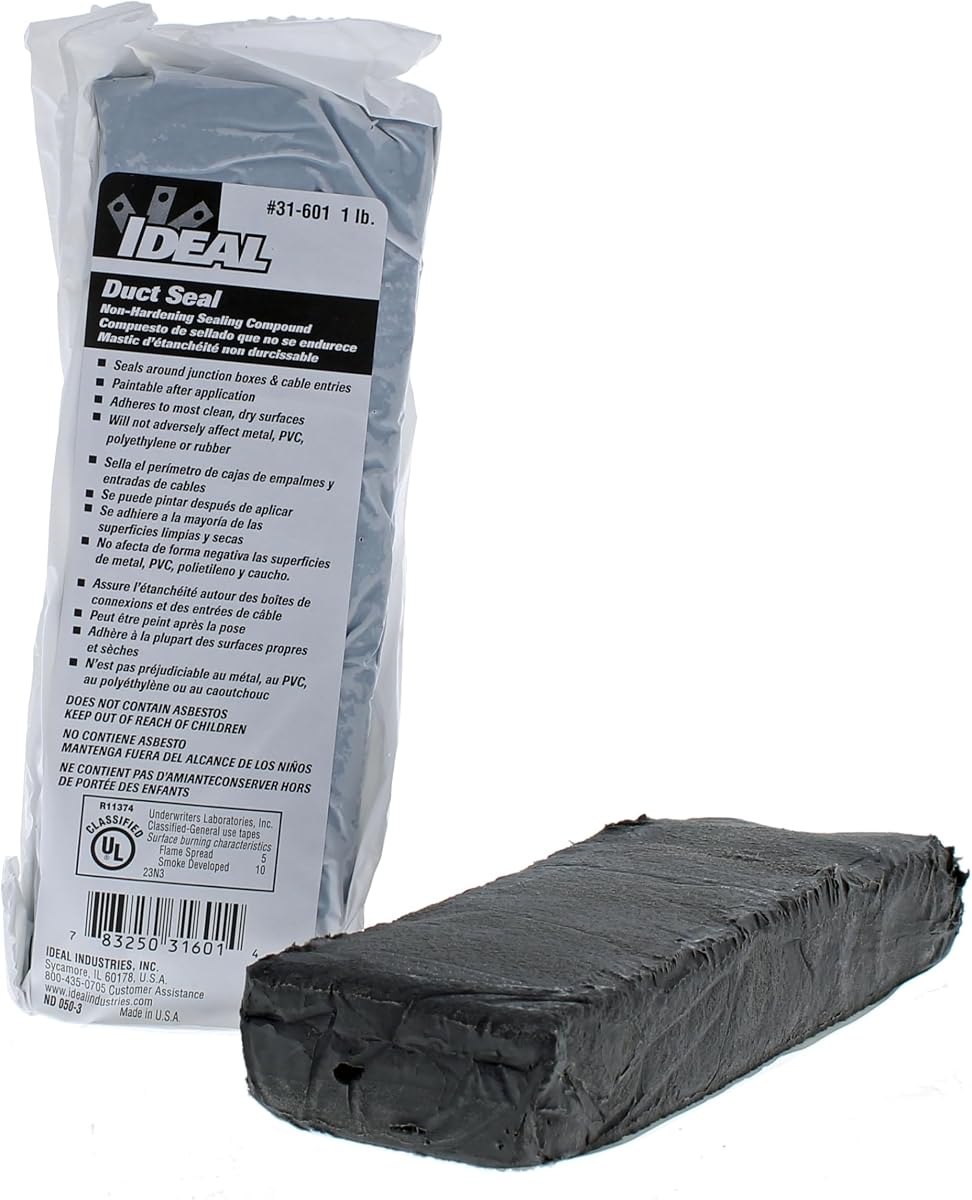
IDEAL Industries 31-601 is a gray, putty-style compound built for junction boxes, service entrances, HVAC penetrations, and other visible or concealed openings. It has a 4.7 rating and one of the most comprehensive specifications in the group, including permanent flexibility, adhesion to metal, masonry, wood, and plastic, immediate paintability, and indoor or outdoor use.
We may earn a commission when you buy through this link, at no additional cost to you.
Its non-hardening consistency is central to the product's appeal. The supplied information says the putty remains flexible over time instead of hardening, cracking, or shrinking, and it can be applied, removed, and reworked as needed. That makes it useful for installations that may require later adjustment rather than a permanent, rigid fill. The compound is also described as safe and non-corrosive around plastics and metals.
As with any putty selected for a penetration, application limitations still matter. It is a barrier against air leaks, moisture, dust, and drafts, not a substitute for repairing a broken pipe, damaged duct, or structural opening. The one-pound block may be more than a small homeowner repair requires, and removing excess material from visible joints can require care.
This is the best premium-oriented choice for electricians and installers who need flexibility, broad surface compatibility, and a paintable result. It is particularly well suited to service entrances, junction boxes, conduit passages, and HVAC openings. Buyers who require permanent softness and reworkability will find that combination more valuable than a product that cures into a rigid seal.
A permanently soft compound can be removed, reshaped, and reapplied more easily than a rigid cured seal. This makes 31-601 suitable when alignment or access may change and when a clean removal is preferable.
The ability to paint immediately after application is especially useful in occupied or finished spaces. It allows junction boxes and service-entry details to blend more closely with surrounding surfaces after the gap has been sealed.
We may earn a commission when you buy through this link, at no additional cost to you.
This five-foot roll of moldable duct seal putty stands out for its continuous format and a supplied rating of 4.8, the highest among the ten products. It is intended to seal air gaps around HVAC openings, pipes, electrical conduit, cables, ducts, vents, and wall penetrations, with particular emphasis on fast, consistent installation.
We may earn a commission when you buy through this link, at no additional cost to you.
The roll is three-eighths of an inch thick and is designed to be cut, kneaded, and pressed into a gap. A continuous format can reduce waste compared with dividing a bulk block into many small pieces, which is useful for linear openings, multiple nearby penetrations, or a series of similar repairs. Once worked, the material conforms to irregular surfaces and forms a flexible seal that helps block air, moisture, and dust.
The listing explicitly separates gap sealing from repair work. It is not intended for structural repairs or active leaks, so it should not be used to compensate for damaged ductwork, cracked pipework, or a failed building element. Clean, dry surfaces are recommended for best adhesion, and slight deformation in transit is stated not to affect performance.
This is a strong selection for installers who want convenient continuous material and straightforward hand application. Its weather-resistant, flexible construction is useful for both indoor and outdoor penetrations, while the explicit restriction against leak repair keeps expectations appropriate. The main decision is whether a roll format fits the job better than a compact block or individually wrapped portions.
A five-foot roll lets the installer cut only the length needed for each detail. That makes it convenient for a run of small penetrations or an irregular opening where several separate putty pieces might otherwise be required.
The product is used by cutting it to length, kneading the piece until soft, and pressing it firmly into the gap. This uncomplicated process supports fast repairs without dispensing tools or complicated curing equipment.
We may earn a commission when you buy through this link, at no additional cost to you.
Red Devil 0841DX F-Seal 181 is the only liquid, fiber-reinforced sealant in the group, giving it a different role from the soft putties and moldable clays. It carries a 4.5 rating and is formulated for HVAC ductwork, with UL 181 A-M and B-M certification stated for metal, fiberglass, and flexible duct applications.
We may earn a commission when you buy through this link, at no additional cost to you.
Its fiber-reinforced, water-based formula is intended to create a leak-free seal while improving HVAC system performance. The product data says it dries quickly, has low volatile organic compounds, and is suitable for both interior and exterior conditions. That combination may be useful for technicians who need a brushable sealant for duct seams rather than a putty for a discrete opening.
It is not interchangeable with hand-moldable duct seal compound. It requires a liquid application and appropriate drying rather than kneading and pressing, and its one-gallon format can be excessive for a household hole or a single small penetration. It also should be viewed as a duct sealant, not a substitute for repairing damaged structural components or active plumbing leaks.
Choose F-Seal 181 for professional or serious HVAC duct-sealing work where certification, fast drying, and compatibility with several duct materials matter. It is a specialized alternative to putty, offering broader seam coverage in liquid form. For small electrical entries, irregular voids that need hand shaping, or minor household gaps, one of the moldable compounds will usually be more convenient.
UL 181 A-M and B-M certification is the defining feature for buyers who need a sealant specifically intended for HVAC duct systems. The stated compatibility with metal, fiberglass, and flexible ductwork gives it a broader system focus than a general gap putty.
The water-based formula is described as quick drying and low VOC, helping reduce the time and airborne impact associated with application. It remains a brushable sealant and should not be selected solely for the hand-molding convenience shared by the other products.
We may earn a commission when you buy through this link, at no additional cost to you.
This eight-pack of waterproof sealing clay is designed for wall holes, drain connections, AC-unit gaps, pipe connections, and other general household repairs. Its 4.3 rating is lower than those of most moldable products in the list, but its supplied specifications distinguish it through a curing clay format, an airtight and waterproof barrier, and an odor-blocking use case.
We may earn a commission when you buy through this link, at no additional cost to you.
The material is soft and flexible at the start, allowing it to be kneaded and shaped without mixing or special tools. It is then expected to cure for three to five days into a hard, durable seal. Each order contains eight individually wrapped 30-gram portions, helping keep unused material fresh and making the pack suitable for several small projects around a home.
The curing requirement is the most important trade-off. Although the material is marketed as waterproof, users are advised not to expose it to moisture during the stated drying period. It therefore may not be appropriate where a leak must be stopped immediately, and the final rigid consistency differs from the permanently soft putties. The lower rating also suggests less customer consensus than the leading products.
Buy this pack when the job is a small void that can remain dry during curing, especially around a drain or wall opening where a hard, durable barrier is desired. It is also relevant to odor-control applications and isolated AC-unit gaps. For a live plumbing leak, pressurized line, or repair that must be watertight immediately, choose a product expressly designed for that condition instead.
Unlike non-hardening putty, this clay is intended to cure for three to five days into a rock-hard, durable barrier. That makes it better suited to permanent, isolated repairs than to areas that must remain removable or readily reshaped.
Eight separate 30-gram bags preserve the unused portions until needed. This packaging is convenient for storage, service kits, and a series of small household sealing jobs.
We may earn a commission when you buy through this link, at no additional cost to you.
The three-pack of silicone putty offers a reusable, non-hardening approach to small household gaps. Its supplied rating of 3.8 is the lowest in the comparison, which is worth considering, but the listed material behavior is clear: the putty remains soft and pliable, can be removed and reshaped, and does not require mixing, curing, or special tools.
We may earn a commission when you buy through this link, at no additional cost to you.
It is intended to reduce the entry of water, air, dust, and moisture around pipes, wall openings, sinks, bathtubs, conduit entries, cable holes, cracks, and other small openings. The supplied information lists compatibility with metal, glass, wood, ceramic, plastic, and masonry, making it a versatile choice when different materials appear in the same repair area.
The primary concern is that it is described as water-resistant and suited to indoor and covered outdoor projects, rather than as a universally waterproof outdoor sealant. Its low rating may reflect ambiguity in performance or packaging, so buyers should ensure that the softness and reusability are desirable before choosing it. It is also more suited to gaps than structural or pressure-bearing repairs.
This putty is most useful for a homeowner who wants a removable seal that can be adjusted without scraping or starting over. It works well for small penetrations, repairable openings, and covered locations. However, a higher-rated non-hardening block from a recognized duct-seal brand may be a more confident choice for critical trade applications or exposed outdoor details.
The ability to remove, reshape, and reapply the putty makes mistakes less costly. It is particularly useful where access may change or where a temporary, adjustable barrier is preferable to a rigid cure.
Metal, glass, wood, ceramic, plastic, and masonry are all listed, giving the product flexibility for household repair kits. Users should still confirm that each surface is clean and suitable before forming an airtight seal.
We may earn a commission when you buy through this link, at no additional cost to you.
This gray silicone putty roll is a continuous, multipurpose gap sealer for voids, cracks, seams, conduit entries, and other openings. Its 4.4 rating reflects moderate customer approval, while the supplied specifications emphasize hand molding, heat and weather resistance, dielectric strength, and compatibility with a wide range of materials.
We may earn a commission when you buy through this link, at no additional cost to you.
The roll measures one and a half feet long by one inch wide and can be shaped into custom barriers or used to block air, water, or wildlife entry. The product data also identifies electrical conduit ends and boxes, flashings, and service mast entrances as suitable applications. Its stated dielectric properties may appeal to electricians working around suitable electrical penetrations, although the material should never be treated as a substitute for code-required insulation.
There is some tension between the description of the putty as hand-moldable and reusable and the statement that it provides a lasting bond once cured. Buyers should understand that the material can change shape during use and that a well-finished piece is less likely to be repeatedly reshaped. A continuous roll is convenient, but the one-inch width may be broader than necessary for a small cable entry.
Choose this roll when a single length needs to cover several nearby penetrations or when a custom-shaped barrier is needed. It is suited to indoor and outdoor gaps, electrical details, flashings, and service mast entrances, with strong material compatibility. It is less attractive for a small repair where a compact reusable block would be easier to store and handle.
The flexible roll can be molded into forms that match unusual openings or used to create a custom barrier. A continuous length also allows one package to service several small penetrations without opening separate containers.
Heat resistance, weather resistance, and stated dielectric strength broaden the use cases for electrical entries and service details. These claims make the material relevant to suitable electrical and outdoor sealing jobs, not just household draft blocking.
We may earn a commission when you buy through this link, at no additional cost to you.
This two-pack of gray moldable silicone putty is designed as a reusable alternative to regular caulk and conventional rigid sealants. Its 4.0 rating is among the lower scores in the group, but the supplied feature set is focused: the material remains soft, can be removed and reshaped, and can be reused without scraping, sanding, or extensive cleanup.
We may earn a commission when you buy through this link, at no additional cost to you.
Its applications include filling voids, cracks, and seams where air, water, or wildlife may enter. The product data also identifies pipe sealing, custom barriers, custom gaskets, mold sealing, electrical insulation, and leak-stopping tasks. It is compatible with plastic, metal, masonry, wood, ceramic, and glass, and can be hand-applied around conduit ends, boxes, flashings, and service mast entrances.
Because the product's description mixes general gap sealing with terms such as waterproofing and leak stopping, users should separate gap-filling uses from active or pressurized leak repair. A putty can block a void, but it should not be treated as a substitute for repairing a failed pipe or pressure system without confirming the manufacturer's suitability. Its lower rating also makes it wise to test adhesion and compatibility on a discreet area when appearance matters.
The two-roll format is practical for people who want spare material available without sharing a single working piece. It is best for small, repeatable household gaps, custom gaskets, and electrical or service-entry details where reworking may be needed. For a critical professional duct seal, a higher-rated specialized compound may offer more confidence, while for a removable household barrier this pack offers useful convenience.
Because the putty remains soft, it can be removed and reshaped instead of requiring scraping, sanding, or replacement. This is a meaningful advantage when alignment is imperfect or when an installation may need adjustment.
The material can be hand-molded to fit irregular spaces and create custom barriers or gaskets. That versatility makes it relevant to plumbing, electrical, and general maintenance tasks where a precisely shaped soft seal is useful.
We may earn a commission when you buy through this link, at no additional cost to you.
The best duct seal putty compound depends on the opening being sealed, the materials involved, whether the seal must remain flexible, and how quickly the repair can be exposed to moisture or weather. These factors narrow the field before package size or brand preference enters the decision.
Most products in this guide are soft putties, clays, or continuous rolls that are pressed by hand into a gap. This format is effective for conduit entries, small duct penetrations, pipe openings, and irregular voids because the material conforms without special tools. A liquid sealant, such as Red Devil F-Seal 181, is better suited to broader duct seams where a brushable coating and fast drying are more important than hand shaping.
Choose moldable material for discrete holes and irregular transitions. Choose a liquid duct sealant for continuous seams and HVAC surfaces requiring a certified coating.
A non-hardening putty remains workable after placement and can often be removed or reshaped. That is useful for service entrances, accessible junction boxes, and installations that might later need adjustment. A curing clay becomes hard after several days and may provide a more rigid barrier, but it cannot be repositioned as easily and should be protected from moisture while curing.
Prioritize permanent flexibility for reworkable installations. Choose a curing formula only when a firm final seal and uninterrupted drying time are acceptable.
Not every compound is intended for the same exposure. Some products are limited to indoor or covered areas, while others explicitly claim weather-resistant indoor and outdoor performance. Uncovered penetrations should be matched to a product that states suitable outdoor use. A water-resistant product should also be distinguished from one that is fully waterproof and suitable for direct moisture exposure after application.
For exposed exterior joints, prioritize verified weather resistance and check whether the surface must remain dry during curing. For interior repairs, indoor coverage may be sufficient.
The gap may involve sheet metal, conduit, plastic, masonry, wood, ceramic, or glass. Some products are explicitly described as non-corrosive and safe around plastics, while others list broad compatibility across common materials. The surface should be clean and dry for the best bond, and the product should not be expected to adhere to damp, dirty, loose, or contaminated material.
Identify every material in the repair area before purchasing. Choose a compound that explicitly suits both the substrate and the surrounding components, especially where corrosion or plastic damage would be costly.
General-purpose putty and certified HVAC sealant serve different professional needs. General compounds are convenient around electrical boxes, conduit, pipes, wall openings, and service entries. A fiber-reinforced liquid sealant with stated UL 181 A-M and B-M certification is more purpose-built for metal, fiberglass, and flexible HVAC ductwork. Match the product to the system rather than treating every opening as the same repair.
Use general putty for miscellaneous penetrations. Use a certified duct sealant for HVAC duct seams when the system specification calls for it.
Visible installations may require a finished appearance. RectorSeal 81880 and IDEAL 31-601 are listed as paintable immediately after application, making them more convenient when a repair will remain in view. A putty that is not listed as paintable may need additional finishing, and a cured material may accept paint differently from a permanently soft one. Paintability does not change the underlying sealing purpose.
Choose an immediately paintable compound for visible junctions. For hidden repairs, prioritize adhesion, flexibility, and exposure suitability instead.
A one-pound block offers useful material for repeated trade jobs and can be molded and reused when necessary. Individually wrapped 30-gram portions are more convenient for a household with several small repairs, because unused material stays clean and fresh. Continuous rolls reduce waste when many nearby penetrations need sealing, while a gallon-sized liquid container is most appropriate when a larger HVAC project can use the product.
Match packaging to the number and size of jobs. Use portions for scattered household repairs, blocks for recurring work, and rolls for continuous runs.
Most of these products are gap sealers, not pipe repair systems, structural adhesives, or guaranteed active-leak solutions. Several listings explicitly warn against using them for plumbing leaks, pressurized water lines, or structural repair. Electrical applications also require sensible limits: dielectric properties do not replace approved insulation, enclosures, or electrical-code requirements. Users should work in suitable conditions and follow all supplied instructions.
Never use a general putty to disguise a damaged pressure system or structural component. Verify the application is within the product's stated purpose before applying it.
Begin by identifying the gap and confirming that the compound is appropriate for the surface, exposure, and intended use. Remove loose debris, dust, moisture, and loose material from the joint, then wipe the area clean and allow it to dry. For removable non-hardening putty, keep a little extra material nearby so the installation can be adjusted and the surface remains neat.
For a moldable compound, cut or pinch off the needed amount and knead it until uniform. Press the material firmly into the opening with a thumb or finger, working from the center toward the edges so the putty fills irregular spaces without leaving voids. Roll the exposed face smooth and remove excess material. For a roll-format product, cut the desired length before kneading. For a liquid sealant, apply it over the prepared surface and allow the stated drying period to elapse.
After application, keep the repair free of moving parts and avoid disturbing the seal while it sets or cures. Products described as permanently soft can be removed and reshaped when an installation changes, while curing clays should remain dry for the full stated period. Touch up visible finishes only with a compatible paint, and check the current manufacturer instructions before using any product around electrical equipment, pressure-bearing lines, or active leaks.
Duct seal putty compound is used to close small openings around ducts, conduit entries, electrical boxes, pipes, wall penetrations, flashings, and service entries. Depending on the product, it can reduce drafts, dust, moisture, noise, odor, or wildlife entry. It is generally intended for gap sealing rather than repairing damaged ducts, structural openings, or pressurized plumbing systems.
It depends on the formula. Many products in this guide remain permanently soft and can be removed, reshaped, and reused, which is useful for accessible service entries. The eight-pack curing clay becomes hard after three to five days, and liquid duct sealants form a dried coating. Check the product description before planning to remove or rework the seal.
RectorSeal Duct Seal 81880 and IDEAL Industries 31-601 are specifically listed as paintable immediately after application. Paintability is not mentioned for every option, so buyers should verify the current instructions for other products. Paint can improve the appearance of a visible repair, but the underlying material still needs to be suitable for the sealing job.
Most of the products described are intended for gaps and openings rather than active or pressurized leaks. Several listings explicitly warn against using them for plumbing leaks, active leak fixing, or structural repair. If a pipe, pressure line, or duct is damaged, the underlying defect should be repaired with an appropriate product rather than simply covered with general-purpose putty.
Compatibility varies by product. Listed surfaces include metal, masonry, wood, plastic, ceramic, and glass, with some products specifically described as non-corrosive and safe around metals and plastics. Surfaces should generally be clean and dry. A material that blocks water is not necessarily suitable for adhesion to damp or contaminated surfaces.
Moldable putty is usually more convenient for small, irregular openings because it can be pressed into the gap without mixing or dispensing. A liquid sealant is generally more appropriate for broader HVAC duct seams, especially when a specialized, fiber-reinforced product with stated certification is required. The better choice depends on the shape and purpose of the repair.
Only choose a product whose listing specifically supports outdoor use. The five-foot roll, IDEAL Industries 31-601, and Red Devil F-Seal 181 are listed for indoor and outdoor applications, while the 12-pack is intended for indoor or covered areas. Outdoor suitability also depends on curing, adhesion, and the conditions at the joint.
A clean, dry surface generally provides the best adhesion. Remove loose, crumbling, contaminated, or incompatible material before applying the new compound, especially if the old sealant is loose or oily. Avoid removing material that is structurally necessary, and follow the current product instructions when working around finished or delicate surfaces.
RectorSeal Duct Seal 81880 is the strongest all-around recommendation because it combines moldable handling with HVAC, plumbing, electrical, metal-fabrication, and household uses, plus immediate paintability. Gardner Bender DS-110N is a straightforward budget option for electrical openings, while IDEAL Industries 31-601 is the premium pick for permanent flexibility, broad material compatibility, and neat visible installations.
The right choice for other situations may differ. A continuous roll suits repeated nearby penetrations, the 12-pack is convenient for small household gaps, and Red Devil F-Seal 181 is the specialized liquid option for HVAC duct seams. The curing clay should be chosen only when a rigid final seal and three-to-five-day drying period work for the repair.
Prioritize the application type, exposure, surface compatibility, and required flexibility before focusing on packaging or brand. Always distinguish a gap sealer from a pressure-system or structural repair product, and verify the current listing for detailed instructions. Product availability, ratings, and prices can change, so check the latest product page before ordering.

