
DS18 PRO-CFX
4.6Editor score
Up to 300 watts RMS
Compact installation-friendly enclosure
Two-crossover pack
Discover the best 2 way speaker crossovers, comparing power ratings, impedance support, filter design, installation features, and ideal applications.
A 2 way speaker crossover divides an amplifier signal between a woofer and a high-frequency driver, helping each reproduce the range suited to its design. A useful crossover balances filter slope, crossover point, impedance compatibility, power handling, and termination quality rather than relying on a single headline specification.
The products in this guide were compared using the supplied descriptions, ratings, technical claims, and intended applications. The list covers passive car-audio and home-speaker crossovers, including models with screw terminals, solderless blocks, adjustable frequency divisions, mixed filter slopes, protection features, and compatibility with 4-, 8-, or 12-ohm speakers.
Each review explains the crossover's strongest qualities, practical limitations, and likely audience. Rankings reflect the information available for this guide, not laboratory testing or a universal replacement for matching a crossover to a particular speaker system. Prices and availability can change, so confirm the current listing and specifications before buying.
4.6Editor score

4.8Editor score

5.0Editor score
This side-by-side comparison highlights each crossover's rated power, speaker-impedance support, filter approach, and installation features, making it easier to identify the model that best fits a car or home-audio system.




The Dayton Audio XO2W-2.5K is a purpose-built passive crossover with a 4.8 rating and an unusually clear technical proposition. It separates a woofer from a high-frequency driver at 2,500 Hz, making it most relevant to existing speaker sets whose manufacturer recommends a nearby crossover point. Its defining feature is the 12 dB/octave Linkwitz-Riley alignment, which produces a deliberate transition between drivers rather than the abrupt handoff associated with a basic first-order network.
We may earn a commission when you buy through this link, at no additional cost to you.
The 18-gauge inductors are intended to minimize DC resistance, a meaningful detail because excess resistance can waste amplifier power and reduce available output. The low-pass section can operate with either 4- or 8-ohm woofers, giving the model more flexibility than a crossover hardwired for one impedance. That compatibility is particularly useful for installers who may change woofers while retaining a reasonably matched tweeter or midrange driver. The design is aimed at clarity and repeatable electrical behavior rather than decorative features.
Its main trade-off is immovability. The 2,500 Hz division is appropriate for many conventional two-way systems, but it cannot accommodate a driver combination that needs a noticeably lower or higher transition point. There are also no listed adjustment controls or protection features, so the user must ensure that both the amplifier's output and the connected tweeter can handle the high-frequency signal. Those limitations simplify the design and make correct speaker pairing more important.
This is our top overall recommendation for a buyer who wants a recognizable crossover architecture, a fixed 2,500 Hz division, and compatibility with common 4- or 8-ohm woofers. It is especially sensible for home-audio builders and experienced car-audio installers who can match the crossover to the driver manufacturer's recommendations. Less experienced users should confirm their required crossover frequency and wiring configuration before ordering.
A 12 dB/octave Linkwitz-Riley network is the central technical strength of this model. The alignment is designed to provide a smooth, acoustically even transition between the low- and high-frequency sections when the network is properly matched to the drivers.
Using 18-gauge inductors keeps DC resistance low, which helps preserve amplifier efficiency. The choice also reduces one common source of unnecessary power loss in passive speaker networks.
We may earn a commission when you buy through this link, at no additional cost to you.
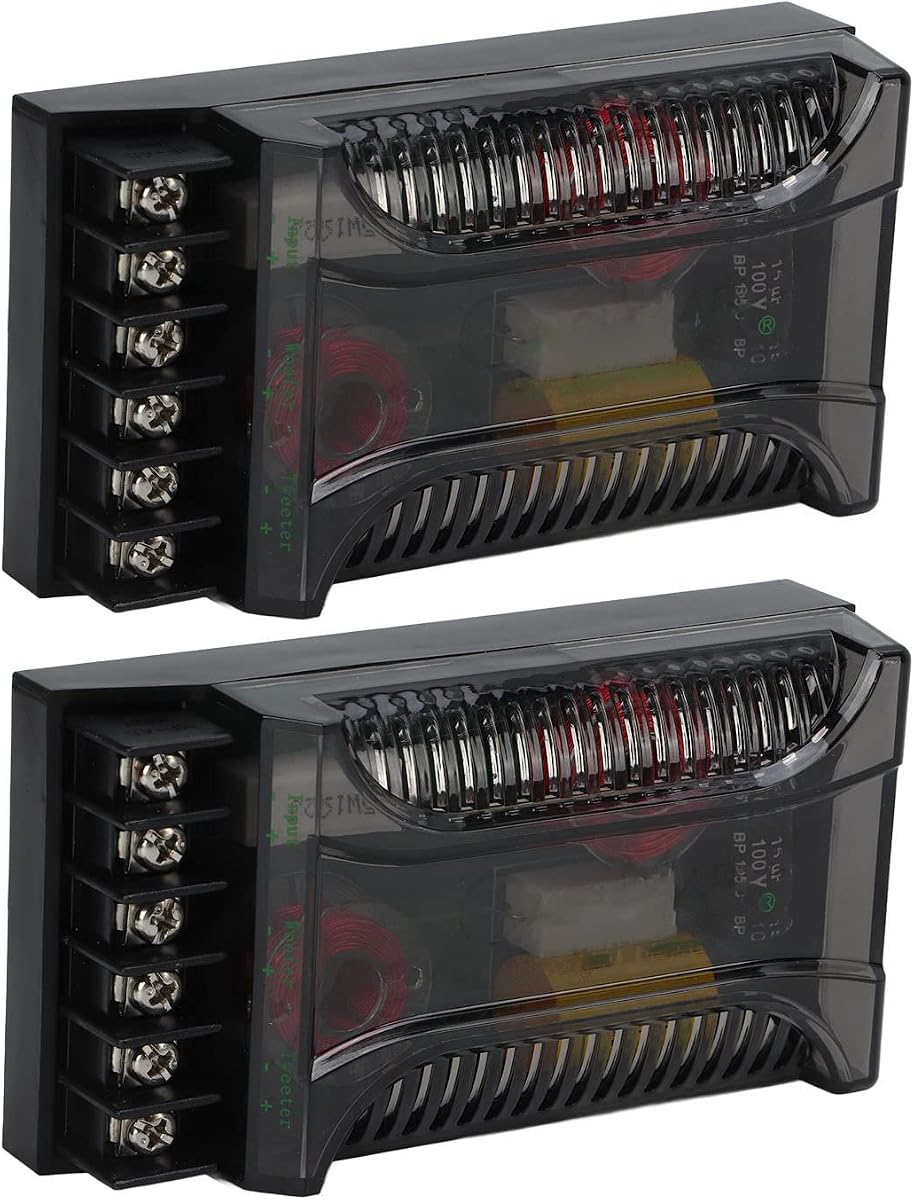
The DS18 PRO-CFX is a two-pack of passive car-audio crossovers with a 4.6 rating. Its strongest selling point is substantial stated power handling: up to 300 watts RMS. That makes it a compelling candidate for high-output car-audio installations where a small crossover must accept considerable amplifier power while splitting the signal for tweeters and midrange speakers. The supplied information does not state a crossover frequency or explicit impedance range, so drivers still require careful compatibility checks.
We may earn a commission when you buy through this link, at no additional cost to you.
The enclosure measures 6.3 by 3.5 by 1.5 inches, which is compact enough for installation planning in a door, rear panel, or other constrained vehicle area. DS18 emphasizes efficient amplifier utilization: a single amplifier channel can feed the crossover and reach both connected speakers after frequency division. Two units are included, conveniently covering a common left-and-right installation without requiring a separate second purchase.
The absence of a published crossover point in the supplied listing is the main limitation. Without that figure, users cannot confidently match the network to a particular tweeter's power or dispersion requirements. The 300-watt rating describes the crossover's handling rather than a guarantee that every connected driver is safe at that level. Installers should also verify the terminal arrangement and input impedance against their existing wiring before installation.
Choose the PRO-CFX when power handling, compact packaging, and a two-crossover pack are the priorities for a car installation. It is a better fit for experienced installers than for someone who needs a simple, explicitly specified impedance range and crossover frequency. The hardware is best paired with a driver set that the manufacturer has already matched to this type of passive network.
A stated 300-watt RMS capability gives this crossover more headroom than many basic units. That headroom is valuable in car audio, where compact amplifiers and high-excursion woofers can place meaningful demands on passive networks.
Two crossovers and a compact 1.5-inch-deep enclosure make the package practical for a two-channel vehicle installation. The dimensions also leave more room for wiring and mounting than a deep, oversized network.
We may earn a commission when you buy through this link, at no additional cost to you.
This integrated-panel crossover carries a 5.0 rating and combines a 300-watt maximum power claim with support for 4- to 8-ohm speakers. It is positioned as a practical high-low frequency divider for builders who want straightforward installation and a ready-made junction box. The integrated panel and dual connection methods are more distinctive than a loose crossover with exposed screw terminals alone.
We may earn a commission when you buy through this link, at no additional cost to you.
The package can be connected using either ohmic screw-down terminals or banana-plug ports, depending on the available wiring. This flexibility can speed temporary testing, simplify custom wiring, or make it easier to connect a finished system. Audio-grade capacitors are used to minimize high-frequency response loss, while the stated overload and short-circuit protection is intended to reduce the chance of speaker or amplifier damage during demanding operation.
The main question is how much technical information is not provided. The supplied description does not identify the crossover frequency, filter slopes, or whether the 300 watts represents peak handling rather than continuous RMS power. Those omissions make it less suitable for a carefully engineered installation unless the seller provides additional documentation. A single crossover is also included, so a stereo system may require two units.
This model is our budget-friendly choice for a straightforward two-way passive setup, especially when the integrated panel and quick-connect options matter. It suits DIY users who value a tidy installation and a broad 4- or 8-ohm range. Before installation, verify the crossover frequency, continuous power rating, and speaker-level requirements with the current product documentation.
The preinstalled junction box gives the crossover a more finished, organized installation. It can be mounted on the speaker exterior, making the network easier to position and reducing the loose wiring associated with an unboxed unit.
Screw terminals suit permanent wiring, while banana-plug ports offer convenient testing or rapid connection. The two approaches let users work with different cable and connector arrangements without modifying the crossover.
We may earn a commission when you buy through this link, at no additional cost to you.
The CRX-203 is a two-pack of passive car-audio crossovers rated 4.5, aimed at splitting a signal between mids, highs, and a low-frequency section. The supplied specifications are unusually explicit about the filter ranges: the tweeter section covers 3.39 to 20 kHz, while the woofer section covers 20 to 4.3 kHz. These figures describe frequency allocation rather than a single adjustable crossover point.
We may earn a commission when you buy through this link, at no additional cost to you.
Each unit is rated for 150 watts RMS and 300 watts peak. Gold-plated screw terminals provide a secure mechanical and electrical connection, while high-grade polymer capacitors support the filtering network. The two-pack format is useful for a stereo vehicle installation and gives the installer matched units for left and right channels. The product is passive, so it requires an amplifier output and does not add amplification.
The specifications do not list supported speaker impedance or an explicit crossover frequency. That makes it difficult to evaluate impedance matching from the supplied data alone. The stated peak figure should also not be treated as the continuous power that every connected tweeter can safely receive. Users should confirm the network's crossover point and the high-frequency driver's limits in the associated documentation.
The CRX-203 is a solid general-purpose choice for a passive car system that needs two crossovers, secure terminals, and clearly separated frequency bands. It is best for installers who already know the desired wiring and driver pairing. Prospective buyers should not choose it solely by its 300-watt peak claim; the missing impedance and crossover-point information must be verified first.
The listed 3.39-to-20-kHz tweeter range and 20-to-4.3-kHz woofer range clarify the network's intended division. That makes it easier to compare this model with other passive units when planning a two-way system.
Gold-plated screw terminals offer a straightforward way to maintain firm wire connections. The construction is particularly relevant in vehicles, where vibration and changing temperatures can challenge less secure terminations.
We may earn a commission when you buy through this link, at no additional cost to you.
This 450-watt two-pack is a flexible 4- to 8-ohm crossover with a 4.5 rating. It divides a speaker signal into low- and high-frequency paths and offers two selectable frequency-division positions, 2850 and 2900 Hz. Although the adjustment range is narrow, it can help a builder align the network more closely with a particular midrange or tweeter than a completely fixed crossover would allow.
We may earn a commission when you buy through this link, at no additional cost to you.
A notable characteristic is the mixed filter slope: the low-pass section is described as second-order 12 dB, while the high-pass section is third-order 18 dB. This combination can provide stronger high-frequency attenuation and phase compensation than a basic symmetric divider. The tweeter capacitor is polypropylene, and the package also includes a capacitor-plus-self-recovering-fuse protection arrangement intended to guard the treble section during high-power operation.
The protection claim is attractive but should not be mistaken for unlimited safety. The supplied information does not explain the fuse's exact current rating, reset behavior, or whether it protects against every possible wiring fault. Likewise, a 450-watt label does not establish the safe continuous level for the connected high-frequency driver. A crossover's input rating and each driver's own power limit are separate constraints.
This product is most attractive to users who want a higher-power passive unit, 4- or 8-ohm compatibility, and a small amount of setup flexibility. It is a sensible option for car or home audio where the tweeter needs more protection than a simple capacitor network provides. Pair it with properly rated drivers and verify terminal labeling before installation.
The 2850 and 2900 Hz settings provide a modest but useful optimization opportunity. They are not a broad tuning range, but they can help accommodate slight differences in midrange output or crossover recommendations.
A polypropylene coupling capacitor and self-recovering fuse are used in the high-frequency path. Together they are intended to improve treble protection and reduce the consequences of sustained high-power operation.
We may earn a commission when you buy through this link, at no additional cost to you.
The 400W adjustable crossover is a two-unit package designed for treble-and-bass frequency division across several configurations. Its 4.0 rating is the lowest among the ten products, but the feature set is relevant for installers seeking an adjustment-based approach. The listing says the network can be used for 2.1 systems, small satellite speakers, and automotive loudspeakers, giving it broader potential than a car-only crossover.
We may earn a commission when you buy through this link, at no additional cost to you.
The inductors use anaerobic copper winding and pure copper wire, while the overall design provides user-accessible frequency controls. This allows a builder to adjust the balance between bass and treble while listening rather than relying entirely on a factory preset. The supplied description also emphasizes a straightforward overall debugging process, which is helpful when the crossover is being integrated into an existing cabinet or vehicle.
Specification gaps make the model harder to compare confidently. The listing does not provide a supported impedance range, exact filter slopes, or a clearly stated crossover-frequency range. The 400-watt power claim also needs to be interpreted according to the seller's test conditions. These omissions are more significant for professional installers than for a temporary experiment, particularly if the connected speakers depend on accurate attenuation and phase behavior.
This crossover is a reasonable choice for a tunable DIY build involving a 2.1 arrangement, satellites, or automotive speakers. Its strongest qualities are access to adjustment, a two-pack format, and broad application potential. Buyers seeking precise engineering data should request the manual first, while experimenters can appreciate the ability to tune the transition by ear.
User-accessible frequency controls make it possible to balance the output of the two driver sections while listening. That is useful when cabinet placement, driver sensitivity, or personal preference shifts the ideal balance.
The network can serve 2.1 arrangements, high-and-small satellite systems, and automotive loudspeakers. This makes it more versatile than components marketed exclusively for one enclosure or installation style.
We may earn a commission when you buy through this link, at no additional cost to you.
This 250-watt crossover is sold as a two-pack and supports nominal speaker impedances from 4 to 12 ohms. That broad range makes it a flexible option for projects that include a conventional 4-ohm woofer, an 8-ohm midrange, or a higher-impedance driver. The frequency division can be switched between 2750 and 2800 Hz, and the network uses 12 dB low-pass and 18 dB high-pass sections.
We may earn a commission when you buy through this link, at no additional cost to you.
The high-pass side uses a polypropylene audio coupling capacitor, while the low-pass inductor uses 1.0 mm high-temperature-resistant copper-clad aluminum wire. The mixed filter orders are intended to provide clean separation and phase compensation. A solderless terminal block avoids the need to solder connections, making the unit more approachable for first-time passive-crossover installers.
The supplied information does not describe the total adjustment range, attenuation detail, or continuous-versus-peak power conditions. Its 250-watt claim should therefore be checked against the manufacturer's instructions. Copper-clad aluminum is also a practical conductor, but users should pay attention to terminal torque and wire gauge to avoid connection issues. The package includes two networks, though the exact contents should be confirmed on the listing.
This model is best for a DIY home or car speaker build where a wide impedance range and solderless connections matter more than maximum amplifier power. It provides a more carefully described filter architecture than many generic dividers. Confirm the crossover recommendation for the selected driver and ensure the amplifier's load remains compatible with the complete passive network.
The stated impedance range is unusually broad for a basic two-way network. It offers greater freedom when pairing a crossover with different passive driver loads, subject to correct wiring and amplifier compatibility.
A solderless terminal block lets users complete the wiring with ordinary hand tools. This is especially helpful for DIY builders who want to revise connections or move the crossover during setup.
We may earn a commission when you buy through this link, at no additional cost to you.
The universal 300-watt car-audio crossover combines a 4.5 rating with an emphasis on heat management and simple wiring. Its high-gloss, double-layer ABS housing is designed to dissipate heat, a relevant consideration because passive filters carry real current at high output levels. A solderless socket connection allows the amplifier and speaker leads to be attached without a soldering iron.
We may earn a commission when you buy through this link, at no additional cost to you.
The low-frequency section includes a bass inductor and magnet intended to improve bass response and reduce sag. High-quality components and careful wiring are presented as supporting better sound accuracy. The product also includes overcurrent protection, adding a layer of safeguarding for the connected system, although the supplied description does not specify its exact trigger or reset behavior.
The listing's main weakness is incomplete system data. It does not state a crossover frequency, supported impedance, or filter slope. Those are essential details when selecting a passive network because they influence power distribution, driver safety, and impedance as seen by the amplifier. The 300-watt figure also should not be interpreted as a guarantee that an inadequately rated tweeter will survive maximum output.
Choose this model for a car-audio build where quick connections, heat-conscious housing, and bass-focused low-frequency filtering are priorities. It is convenient for installers who value a ready-made universal module over a kit assembled from individual components. Verify the technical specifications and terminal mapping with the seller before connecting expensive drivers.
A double-layer ABS enclosure is intended to manage heat generated during sustained high-power operation. Effective thermal control supports component longevity and makes the unit practical for a vehicle environment.
The plug-in socket allows users to connect the appropriate amplifier and speaker wires quickly. This reduces installation work and makes temporary comparisons between wiring arrangements easier.
We may earn a commission when you buy through this link, at no additional cost to you.
This 4- to 12-ohm crossover has a 4.3 rating and is designed for two-way home or vehicle speaker projects. It provides a 2750 or 2800 Hz frequency-division choice, with a second-order 12 dB low-pass section and a third-order 18 dB high-pass section. The asymmetrical slopes are intended to improve separation and phase compensation between the low- and high-frequency drivers.
We may earn a commission when you buy through this link, at no additional cost to you.
The inductor uses 1.0 mm, high-temperature-resistant copper-clad aluminum wire, while a polypropylene audio capacitor handles the high-frequency coupling. A solderless terminal block makes the unit accessible for DIY wiring. The stated impedance range also allows more flexibility than a fixed-load network, particularly when a builder is combining a high-impedance midrange with a 4-ohm woofer.
The two frequency settings differ by only 50 Hz, so this should not be confused with a continuously variable crossover. A meaningful tonal change may require a different network rather than a small switch movement. The supplied data also does not state the power-rating test method, crossover attenuation, or exact enclosure dimensions. Those details should be confirmed before installation in a permanent high-output system.
The product is a practical option for a straightforward DIY passive speaker where a solderless block and broad impedance range are valuable. It is more transparent about its filter architecture than many generic dividers, making it easier to compare with established designs. Match the selected crossover to the driver manufacturer's recommended point and verify the amplifier's stable load.
The 12 dB low-pass and 18 dB high-pass sections provide a stronger attenuation rate on the tweeter side. This is intended to reduce overlap and phase issues around the transition region.
Supporting 4- through 12-ohm drivers provides useful flexibility for mixed passive systems. It also reduces the need to search for a separate network whenever a common speaker impedance is involved.
We may earn a commission when you buy through this link, at no additional cost to you.
The Dayton Audio XO2W-3K is a fixed 3,000 Hz passive crossover with a 4.8 rating. It is a logical alternative to the 2,500 Hz model in this guide for systems whose tweeter or midrange driver is intended to take over around 3 kHz. The low-pass section supports both 4- and 8-ohm woofers, making the unit practical for common passive speaker configurations.
We may earn a commission when you buy through this link, at no additional cost to you.
Its construction details are particularly useful for long-term reliability. The 18-gauge inductors minimize DC resistance, while components are glued or fastened down to reduce buzzing and vibration. The blue printed circuit board includes a back plate for added rigidity. These features address practical problems common in portable, vehicle, or loosely mounted speaker systems where component movement can produce unwanted noise.
As with any fixed crossover, compatibility is the principal limitation. A driver designed to cross near 2,500 Hz will not automatically sound better with this 3,000 Hz version. The choice must be based on the speaker manufacturer or measured system behavior rather than a general assumption that a higher crossover point creates more treble. The supplied information does not list a power rating, so amplifier output must be handled cautiously.
The XO2W-3K is a strong choice for builders who want a fixed 3 kHz network, rigid component support, and flexible woofer impedance. It can serve car, home, or stage-style passive projects when the driver set is designed around that crossover frequency. The lack of adjustment is acceptable when a well-matched system is the goal and tuning is not required.
Glue or fasteners secure the components rather than leaving them relying only on solder joints. This helps minimize buzzing and movement in a cabinet or vehicle that may experience vibration.
The blue PC board is supported by a back plate for rigidity. A sturdier base can help preserve component alignment and reduce the effects of flexing or accidental handling.
We may earn a commission when you buy through this link, at no additional cost to you.
A suitable crossover should match the electrical limits of the connected drivers, reproduce the manufacturer's intended transition, and fit the available space. The most important factors are impedance, power handling, filter behavior, crossover point, connection quality, and installation environment.
Impedance determines whether a crossover is electrically suitable for the complete passive speaker network. A unit that explicitly supports 4 through 8 ohms may work with several common drivers, while a 4- through 12-ohm model offers even broader flexibility. The relevant figure must describe the intended woofer or driver load, not merely the amplifier's accepted range. Incorrect matching can produce an excessively heavy load, inadequate attenuation, or premature thermal stress on the amplifier.
Also verify whether the listed impedance is nominal or a permitted range, and whether both the low- and high-frequency sides have the same requirement. Some networks accommodate different impedances on each side. Use the manufacturer's wiring diagram and calculate the total load before connecting the speakers.
Pay attention to how power is stated. RMS or continuous handling is generally more informative than a peak figure because a passive crossover must tolerate sustained amplifier output, not just brief transients. The rating should cover the amplifier's maximum clean power at the crossover's impedance. A crossover claiming 300 or 450 watts does not make the connected tweeter safe at the same level; tweeters often have much lower limits.
For practical selection, choose a crossover with comfortable headroom above the system's normal output. Verify whether the rating applies per unit or to the package, and compare it with the manufacturer-documentated test conditions.
The crossover point is the frequency where the low- and high-pass networks meet. It should follow the driver manufacturer's recommendation because tweeter sensitivity, power response, impedance, and directivity all influence the ideal transition. A fixed 2,500 or 3,000 Hz crossover is appropriate when it matches the intended driver pairing. A switch offering 2,850 versus 2,900 Hz provides limited adjustment and may help with fine matching, but it is not equivalent to broad tuning.
Filter slope tells you how quickly each section attenuates unwanted frequencies. A 12 dB/octave network is moderate, while an 18 dB/octave high-pass section provides stronger treble protection. Linkwitz-Riley alignment is often favored because it aims for an acoustically smooth transition.
A two-way crossover normally sends low frequencies to the woofer and high frequencies to a tweeter or midrange driver, but some designs target a woofer-plus-midrange configuration. Compare the stated low-pass and high-pass frequency ranges with the drivers in the system. A crossover that emphasizes mids and highs may be more appropriate for a three-way car system with a separate subwoofer than for a conventional bookshelf speaker.
Make sure each section's output is appropriate for the driver's frequency range. A crossover cannot correct a driver that is poorly suited to the frequency band assigned to it.
Screw terminals, solderless blocks, and plug-in sockets affect both installation speed and long-term reliability. Gold-plated screw terminals are useful in vehicles, while solderless blocks are convenient for DIY projects and repeated testing. A crossover with an integrated junction-box panel can simplify mounting near a speaker enclosure. Banana sockets may be convenient for temporary testing but are less common in permanent professional wiring.
Consider wire size, terminal spacing, and strain relief as well. Secure every connection, route cables away from moving mechanisms, and test the complete network before mounting it permanently.
Protection features can include polypropylene capacitors, high-temperature-resistant wire, fuses, self-recovering devices, and overcurrent mechanisms. These can improve reliability, but their presence does not replace correct speaker pairing. A quality housing with effective heat dissipation also matters because inductors and capacitors can warm during sustained high-power use.
Look for construction methods that suppress noise, such as secured components and reinforced circuit boards. Avoid choosing a crossover solely by elaborate claims when the underlying specifications remain unclear.
A crossover must fit the available space without compromising airflow, wiring access, or mounting security. The DS18 PRO-CFX is explicitly described as 6.3 by 3.5 by 1.5 inches, while many competing listings do not provide dimensions. Measure the installation area and account for terminal depth, cable bend radius, and nearby vehicle or cabinet surfaces.
Compactness is particularly valuable in cars where a crossover competes with structural panels, air bags, trim, and other wiring. For home systems, a slightly larger module may be acceptable if it is securely mounted and ventilated.
Adjustable crossover controls are useful when cabinet placement, driver sensitivity, or listening preferences alter the ideal balance. They are less essential when the speaker manufacturer has tested a specific crossover and driver combination. An adjustable unit should still be matched to the correct impedance and crossover range, because a control cannot rescue a fundamentally incompatible network.
For fine-tuning, use familiar music, make small changes, and listen for volume imbalance, abrupt handoff, or excessive harshness. Reset controls after comparisons so the final installation is reproducible.
Begin by disconnecting amplifier power and identifying the amplifier input, low-frequency output, and high-frequency output on the crossover. Connect the amplifier input to the correct input terminal, then wire the low-pass section to the woofer and the high-pass section to the tweeter or midrange driver. Observe polarity consistently and consult the crossover's terminal markings rather than guessing.
Check the total speaker impedance and confirm that it remains within the amplifier's safe operating range. Start with the amplifier at low volume, then increase it gradually while listening for clean bass, smooth treble, and a natural transition. If the crossover is adjustable, make small changes one at a time and return the control to a neutral position before beginning a new comparison.
Mount the crossover away from moisture, direct sunlight, and moving vehicle parts, while allowing heat to dissipate. Periodically inspect terminal tightness and listen for buzzing, crackling, or a sudden loss of output. If protection activates or a driver sounds distorted, reduce amplifier output and check speaker compatibility, polarity, wiring, and the crossover's ratings.
A 2 way speaker crossover divides an amplifier signal into low- and high-frequency bands. The low-pass section sends bass to the woofer, while the high-pass section sends treble or upper midrange frequencies to a tweeter or midrange driver. This lets each driver operate within its most effective range and can reduce distortion caused by asking a small driver to reproduce low frequencies.
A passive crossover is simpler because it sits between the amplifier and speakers and requires no separate power. An active crossover is generally more flexible and can provide steeper filters, individual level controls, and sometimes time alignment, but it requires more equipment and configuration. The right choice depends on the system, installation complexity, and how much tuning control is needed.
Start with the crossover point recommended for the tweeter or midrange driver, because directivity and power-response characteristics can change sharply near that limit. Also follow the woofer manufacturer's guidance and consider the enclosure's response. If a component offers only two close settings, choose the one that best matches those recommendations rather than treating it as a broad tuning control.
It should support the nominal impedance of the intended driver and the total load presented to the amplifier. Common passive systems use 4- or 8-ohm drivers, while some projects involve higher-impedance units. Confirm both sides of the network, calculate the final load, and verify that the amplifier remains stable with that configuration.
A higher handling rating mainly provides more headroom and reduces the risk of overheating or distortion under sustained high output. It does not automatically improve frequency response. Driver matching, filter design, crossover point, installation, and correct amplifier gain are equally important, and the connected tweeter may have a much lower power limit than the crossover.
A single passive crossover normally handles one amplifier channel feeding one low-frequency driver and one high-frequency driver. A stereo system typically requires two crossovers, one for each channel. Some dual-channel crossover boards combine both networks in one enclosure, so buyers should check the product description and terminal layout rather than assuming the number of included boards.
An imbalance can result from mismatched driver sensitivity, an unsuitable crossover point, loose wiring, incorrect polarity, or amplifier gain settings that are too low for one channel. First verify all connections and the crossover's compatibility with the speakers. Then compare amplifier channel gains and make small, deliberate adjustments while using the same music and volume level.
An adjustable divider is helpful when the driver pairing, enclosure, or placement requires fine-tuning. It is less necessary when a manufacturer has tested and recommends a fixed crossover for the exact speakers. Adjustability cannot compensate for incorrect impedance, unsuitable drivers, or a filter whose available range does not include the needed crossover point.
The Dayton Audio XO2W-2.5K is the strongest overall choice for its documented Linkwitz-Riley alignment, low-resistance inductors, and support for 4- or 8-ohm woofers. The DS18 PRO-CFX stands out for premium car-audio power handling and compact packaging, while the integrated-panel crossover is a convenient budget pick with a 5.0 rating and flexible connection methods.
The remaining models offer distinct choices for specific needs: the 450-watt adjustable unit emphasizes power and treble protection, the 400-watt model supports several system formats, and the 4- to 12-ohm options widen driver compatibility. Prioritize electrical compatibility, the manufacturer-recommended crossover point, continuous power handling, and secure connections before focusing on secondary features.
Finally, confirm the latest specifications, included components, and current price directly on the product listing, as both can change. Ensure every connected speaker and amplifier is within the crossover's stated limits, follow the wiring diagram, and listen at moderate levels before final installation. Those checks will help turn a technically suitable crossover into a reliable system component.