
Rapid Radios G1
4.2Editor score
Nationwide cellular coverage
Large private talk groups
Five-day battery life
256-bit AES encryption
Long Range Two Way Radios for Rural Areas compared for range, battery life, durability, weather alerts, and reliable communication.
Long range two way radios for rural areas must work where cell coverage disappears, roads divide friends and neighbors, and changing terrain makes ordinary consumer radios frustrating to use. The most useful models combine dependable transmission, strong batteries, rugged construction, weather alerts, and controls that remain understandable after a long day outdoors.
This guide compares ten traditional FRS and GMRS radios alongside cellular push-to-talk models that use 4G LTE networks. We evaluated the supplied specifications, focusing on practical distinctions such as direct radio-to-radio range, nationwide connectivity, battery life, noise cancellation, water resistance, location tracking, charging options, and suitability for farms, ranches, work crews, and backcountry travel.
Each pick offers a different balance for rural users: conventional radios provide dependable local communication without network dependence, while cellular models bridge large distances where usable towers exist. The reviews explain where each model shines, where terrain or network limitations matter, and who should consider it. Availability and pricing can change, so confirm current details before buying.
4.2Editor score

4.6Editor score

4.4Editor score
The comparison below separates conventional FRS and GMRS radios from cellular push-to-talk systems, then compares the most important distinctions for remote properties, large farms, backcountry trips, and rural work teams.


The Midland GXT1000VP4 is a two-radio GMRS set with a 4.4 rating and a broad collection of practical features. It gives rural households, hunters, and small crews 50 channels and 142 privacy codes, while the included headsets make private or lower-volume communication more convenient. Its appeal comes from the useful combination of local radio operation, rechargeable batteries, AA backup power, and NOAA weather alerts.
We may earn a commission when you buy through this link, at no additional cost to you.
The most important strength is flexibility. Dual-power operation means the radios can use their rechargeable battery packs when outlets are inconvenient and switch to AA cells when that is more practical. Whisper-clear EVOX permits hands-free voice activation, which helps drivers, hikers, and workers keep their attention on the task. The built-in NOAA scan also provides advance warning when dangerous weather approaches.
There are important limitations. This is a conventional GMRS system, so it does not provide the broad geographic reach associated with cellular push-to-talk products, and it cannot display a teammate's location. The package includes two units rather than a larger fleet, and range will still depend on terrain, antenna height, obstacles, and line of sight. These constraints keep it from being ideal for communication across widely separated properties.
Despite those limits, the GXT1000VP4 is an attractive choice for a family, farm, hunting trip, or compact work crew that wants a complete two-person setup. It is particularly useful for users who value weather warnings, hands-free operation, and the ability to continue working with disposable batteries. For this audience, it provides the most balanced traditional-radio package in the list.
The built-in NOAA scan can alert users to dangerous conditions without requiring a phone connection. That makes it particularly valuable on remote land, during hunting seasons, and in areas where severe-weather warnings may arrive faster than a user can check a forecast.
Rechargeable packs are convenient for regular use, while AA compatibility adds resilience when charging access is limited. The dual-power arrangement is especially helpful for rural trips where carrying spare cells is easier than bringing a charger or generator.
We may earn a commission when you buy through this link, at no additional cost to you.
The Rapid GPS G09 2-Pack is a cellular push-to-talk radio system with a 4.5 rating and a different purpose from conventional FRS or GMRS equipment. It uses 4G LTE networks to provide nationwide communication, GPS tracking for team coordination, and a preinstalled SIM with no contract or monthly data fee according to the supplied product information. It is aimed at users who need distance and location awareness rather than only local line-of-sight radio contact.
We may earn a commission when you buy through this link, at no additional cost to you.
Real-time GPS monitoring is the defining feature. Farm managers, construction supervisors, security personnel, and emergency coordinators can see where participating radios are located, which reduces the need for repeated check-ins. AI noise cancellation filters up to 95 percent of background noise, while 256-bit AES encryption adds a security layer. The battery provides up to 18 hours of continuous talk time and 72 hours of standby.
The central trade-off is dependence on cellular infrastructure. A tower can extend communication far beyond ordinary radio range, but it cannot provide service where no usable LTE network reaches. Its IP65 rating offers dust and light-rain resistance, and the Type-C charging port is convenient, but this is still an electronic device whose screen, controls, and internal components require sensible care. Group setup also requires IMEI-based assistance from the seller.
The G09 is a strong match for organizations that can confirm network coverage across their operating area and need GPS coordination. It also suits long-distance family or convoy communication where participants move between towns rather than remain within radio line of sight. Those who need guaranteed local communication without cellular coverage should choose a conventional radio instead.
GPS tracking lets authorized users monitor the position of participating devices, which can help a rancher, contractor, or event lead direct people more efficiently. It is particularly useful when workers spread across large properties or travel on roads that are difficult to navigate by radio alone.
Before committing to cellular radios, check LTE service at the places where the team will actually work. Network-based distance is exceptionally useful when coverage is continuous, but it cannot overcome a missing tower or a dead-zone along a remote route.
We may earn a commission when you buy through this link, at no additional cost to you.
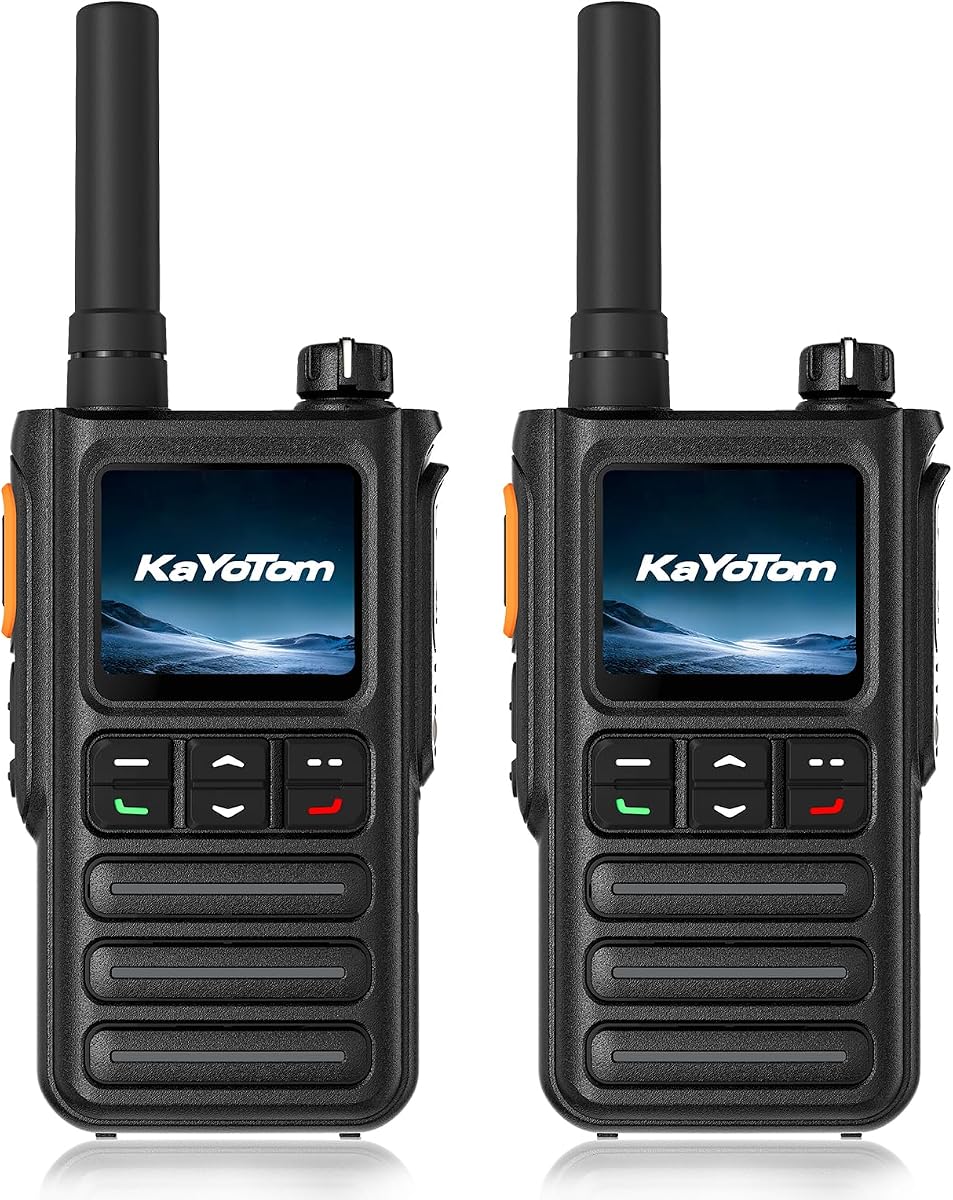
The Kayotom G5 is a three-pack of cellular 4G LTE push-to-talk radios with a 4.4 rating. Its advertised 5,000-plus-mile reach comes from using cellular networks rather than transmitting directly across the landscape. The package also includes SIM service and is designed for construction crews, truck fleets, families, and other groups that need to connect across substantial distances.
We may earn a commission when you buy through this link, at no additional cost to you.
The supplied specifications highlight several work-oriented details. A sensitive microphone and noise filtering can improve intelligibility around engines, machinery, and busy environments. The 3000mAh battery offers more than 80 hours of standby time and approximately 15 days on standby, while USB-C charging can restore 50 percent of capacity in about 20 minutes. A headset connection, belt clip, and emergency light add practical field functions.
Durability claims include resistance to fine dust, drops from two meters, heat, and cold, although the precise test conditions and ongoing protection should be understood before exposure to severe weather. The radios also require compatible network service, and seller-assisted IMEI configuration is needed to link devices into groups. The 5,000-mile figure describes potential service reach rather than guaranteed radio-to-radio transmission across every landscape.
This three-pack is a compelling option for small fleets that want cellular reach without purchasing three unrelated devices. It is especially attractive where road distance separates family members or workers and LTE coverage is strong. Users seeking a self-contained local system with no network dependency should favor an FRS radio, while those who value larger group coordination and rapid charging may appreciate the G5's cellular approach.
Three units make it easier to establish communication among a family, a small crew, or several vehicles without mixing brands. Once configured into a group, the radios allow a user to press the push-to-talk control rather than rely on individual phone calls.
The USB-C charging specification is convenient for teams already using modern charging equipment. Its stated rapid recharge capability is useful between shifts, although users should still plan around battery life and avoid assuming a radio can operate indefinitely without charging.
We may earn a commission when you buy through this link, at no additional cost to you.
The Retevis RB48 is a rugged FRS radio with a 4.5 rating, designed for people who need direct communication without depending on a mobile network. It supports coverage claimed at up to 300,000 square feet or 25 floors, making it relevant to large farms, warehouses, construction sites, and rural properties where local terrain is relatively manageable.
We may earn a commission when you buy through this link, at no additional cost to you.
Its strongest selling point is physical durability. The radio is tested to MIL-STD-810H and carries an IP67 waterproof and dustproof rating. The supplied information also cites testing against dense dust and repeated two-meter drops. A 2000mAh rechargeable battery supports up to 20 hours of use, while USB-C charging and a charging station provide more than one charging method.
Range claims should be interpreted carefully. A direct radio signal can be reduced by hills, dense trees, buildings, and distance, even when a model has a strong advertised specification. The bright yellow shell improves visibility, silicone button covers help protect controls in harsh conditions, and the optional roger beep gives the speaker an audible confirmation that a transmission ended. No GPS is included.
The RB48 is a sensible choice for work crews and families that need a self-contained radio system in an area without reliable cellular service. It may not span a remote ranch as readily as a cellular product, but it avoids coverage subscriptions and can function wherever compatible units have a usable path between them. Its rugged construction and moderate battery specification make it a versatile traditional option.
The combination of IP67 sealing, MIL-STD-810H testing, and protected buttons is valuable on farms, job sites, and outdoor trips. It is better suited to users who regularly expose radios to rain, dirt, vibration, and accidental falls than to a desk-only communications task.
Direct FRS operation keeps communication independent of towers, contracts, and data service. That makes the RB48 useful in remote areas, although users should still test the actual property because terrain determines how far a conventional radio signal travels.
We may earn a commission when you buy through this link, at no additional cost to you.
The Retevis RB48 Military-Standard and IP67 Waterproof model is a rugged FRS radio with a 4.5 rating. It emphasizes structural strength, environmental testing, and dependable operation across demanding properties and workplaces. Claimed coverage reaches up to 300,000 square feet or 25 floors, providing a useful communication footprint for large rural or industrial environments.
We may earn a commission when you buy through this link, at no additional cost to you.
The model passed 19 tests involving temperature shock, rain, salt fog, humidity, sand and dust, vibration, shock, and immersion. Beyond the exterior shell, the product information describes industrial-grade components and a reinforced internal structure. Operational features include a large front push-to-talk button, vibration alerts, NOAA weather alerts, and a 2000mAh battery rated for up to 20 hours of use.
As with other conventional radios, the most meaningful limitation is that maximum range is not guaranteed in every rural environment. Tree cover, ridges, metal structures, and distance can interfere with a line-of-sight signal. The weather alerts and vibration notices improve awareness, but there is no cellular bridging, GPS mapping, or team location display. A five-year warranty and stated 30-day return window add ownership confidence.
This RB48 variant is an excellent recommendation for users who value rugged construction and expect radios to endure frequent handling. It fits construction supervisors, security teams, hunters, and property managers who need dependable local voice communication. Buyers seeking a radio with a simple operating model and broad environmental resistance will find it more practical than a cellular subscription model.
The stated use of industrial-grade components and a reinforced internal structure is important because a rugged exterior alone does not protect sensitive electronics. For demanding work environments, internal design can matter as much as the visible housing.
Vibration notifications help users notice a call when a speaker is not immediately audible, and NOAA alerts add useful emergency information. Together they make the radio more practical during work shifts and outdoor activities where regular attention is divided.
We may earn a commission when you buy through this link, at no additional cost to you.
The Rapid Radios G1 is a two-radio cellular push-to-talk set with a 4.2 rating and the most extensive group-communication specification in this guide. It uses nationwide US cellular coverage, supports one-to-one private calls, and allows group conversations with as many as 200 participants per talk group. That makes it well suited to organizations coordinating a large remote team.
We may earn a commission when you buy through this link, at no additional cost to you.
Sound clarity is supported by advanced noise-cancellation technology, while 256-bit AES encryption is designed to secure conversations. Battery life is listed at up to five days, and the set includes two radios, a charger, a belt clip, and the battery. The product is positioned for outdoor events, work sites, and communication across widely separated locations where conventional radio propagation would be difficult.
The key condition is network access. Nationwide service means a radio can communicate over a broad area when a compatible cellular network is available, but remote valleys, shielded buildings, and uncovered road segments can still interrupt service. The package includes one year of service per radio, with later years available for an additional fee. The manufacturer specifically instructs users to use the supplied charger, making charger compatibility an important care consideration.
The G1 is the premium choice when group size, long operating time, and nationwide reach outweigh the need for a license-free traditional radio. It is a natural fit for sizable farms, logistics operations, event teams, and families spread across different towns. Buyers who require guaranteed communication in places without cellular coverage should pair a different strategy rather than assume a tower is always present.
A talk group of up to 200 people allows a dispatch-style message to reach many participants at once. This is a major advantage over placing a series of individual cellular calls, particularly for organizations responsible for many workers.
AES-256 encryption is a meaningful feature for private business or family discussions. It should be paired with sensible radio handling practices, since physical access to a device and weak account practices can undermine otherwise strong technical protection.
We may earn a commission when you buy through this link, at no additional cost to you.
The Rocky Talkie Mountain Radio is a two-pack of FRS radios with a 4.6 rating, the highest customer rating among the listed products. It is built for hikers, hunters, skiers, and rural users who need a simple, dependable radio with unusually long battery life. Its most unusual strength is the specialized rechargeable lithium-ion battery, which the manufacturer states can provide more than four days of operation, even in cold weather.
We may earn a commission when you buy through this link, at no additional cost to you.
The radio transmits at the maximum power legally allowed for license-free FRS use, with a maximum range stated at more than 35 miles. Rocky Talkie is appropriately clear that one to five miles is more typical in backcountry terrain, which makes the specification more credible than treating the maximum as a guaranteed everyday distance. The radio also has a shatterproof LED screen, a thermoplastic protective covering, and an IP56 rating for splashes and snow.
Attachment design is another practical strength. Instead of relying only on a fragile plastic clip, the Mountain Radio includes an ultra-light climbing-rated carabiner and a metal-reinforced backup leash. It is ready to use without configuration and operates through five easy-to-understand buttons, reducing the learning curve for family members, visitors, or occasional users.
This is the strongest overall recommendation for backcountry and rural outdoor communication. The combination of strong legal power, exceptional battery life, cold-focused design, secure attachment, and straightforward controls addresses problems that many conventional radios handle poorly. It is less appropriate for teams that need cellular bridging across enormous distances, but for camps, farms, trail groups, and isolated properties it is unusually well considered.
The specialized lithium-ion battery is the Mountain Radio's defining advantage. Long endurance reduces the risk of being stranded by a flat battery, which is especially important on multi-day trips where freezing temperatures and limited daylight increase the consequences of power loss.
A climbing-rated carabiner and reinforced backup leash reduce the chance of losing a radio while moving over trails or working near rough ground. The approach is more dependable than depending on a conventional belt clip alone, particularly during scrambles, climbing, or busy outdoor work.
We may earn a commission when you buy through this link, at no additional cost to you.
The Intercom Global 2-Pack is a cellular push-to-talk radio set with a 4.3 rating. It combines 4G LTE connectivity with a 5000mAh battery, making it a strong option for families, logistics teams, and businesses that want radio-style group communication over long road distances without depending on conventional radio line of sight.
We may earn a commission when you buy through this link, at no additional cost to you.
Noise filtering is designed to eliminate up to 95 percent of environmental noise, which can improve intelligibility around industrial equipment, traffic, and busy worksites. The large battery supports a stated full day of talk time and seven days of standby. Group configuration is available through the seller's support team using each device's IMEI, allowing users to link units or establish custom groups.
The lifetime-free data offer is an important feature but needs careful interpretation. The supplied information states that there are no monthly bills or activation charges and no renewal costs after the first year, with the data cycle handled through the seller using the SIM ID. This may be attractive, but buyers should confirm the current terms before relying on the service for a critical operation. The radio also remains subject to cellular dead zones.
The Intercom Global set works best for users who need long-distance push-to-talk, generous battery capacity, and simple group coordination. It is particularly useful where family members or coworkers travel across different states and have dependable LTE service. For isolated land where no network reaches, a conventional radio with sufficient battery endurance is the safer primary tool.
A 5000mAh battery gives the radios meaningful endurance for road trips and multi-day outdoor use. The stated talk and standby figures make the set appealing to people who want more operating time than a compact cellular handset typically provides.
The service model appears simple, but users should verify coverage and current data-cycle handling before depending on it. Cellular radios are strongest where LTE service is consistent and weakest in precisely the isolated locations where conventional radios may be preferable.
We may earn a commission when you buy through this link, at no additional cost to you.
The Retevis RB48 2 Way Radio is a rugged FRS model with a 4.6 rating, tying for the highest rating in this guide. It shares the RB48 family's emphasis on environmental testing, reinforced construction, and practical field operation. Its stated range of up to 300,000 square feet and 25 floors is relevant to warehouses, campuses, industrial sites, and large rural properties.
We may earn a commission when you buy through this link, at no additional cost to you.
The radio passed 19 tests covering temperature shock, rain, salt fog, humidity, sand and dust, vibration, shock, and immersion. A large front push-to-talk button can be operated with gloves, vibration alerts reduce missed communications, and NOAA weather alerts help users monitor hazardous conditions. Its 2000mAh battery delivers up to 20 hours of use, making it a balanced option for full work shifts.
Its limitations are the same ones that apply to many direct FRS systems. It has no cellular expansion, no real-time GPS display, and no assurance that a stated maximum will be achieved over wooded ridges or across a sprawling ranch. It is also primarily a rugged two-way radio rather than a full-featured cellular dispatch platform. The five-year warranty and stated 30-day return period help address some ownership concerns.
For users who prefer simple local radios but want substantial durability, this is one of the strongest selections. It suits security personnel, farmers, construction workers, and outdoor groups who value recognizable controls, long battery life, and resistance to harsh conditions. A buyer needing continent-scale communication should examine a cellular model instead.
Testing across rain, salt fog, dust, shock, vibration, and temperature extremes gives the RB48 a persuasive ruggedness profile. These conditions closely resemble the daily exposure found on farms, industrial sites, and outdoor properties.
A five-year warranty complements the stated return period and can be useful when radios are used intensively. The warranty does not change the need to prevent avoidable damage, but it adds support for buyers choosing equipment for long-term work.
We may earn a commission when you buy through this link, at no additional cost to you.
The Retevis RT86 4-Pack is a high-power traditional radio set with a 4.3 rating, aimed especially at warehouses, construction teams, campuses, property managers, and security operations. Four radios make it a more complete fleet package than most two-unit sets, while high-gain antennas and long wavelengths support a claimed range of up to 700,000 square feet and as many as 50 floors.
We may earn a commission when you buy through this link, at no additional cost to you.
The hardware is designed for demanding work. A concealed display is more resistant to damage from falls than a conventional exposed screen, and the ABS body resists impact and friction. The 2600mAh lithium battery provides up to 130 hours of standby time and more than 16 hours of continuous use. Emergency alarms, hands-free VOX, a simplified layout, and an oversized orange push-to-talk button support fast operation.
Every radio includes a shoulder microphone with a rotating clip and 3.5mm audio connection, allowing users to keep the radio on their body while speaking through the mic. This is useful for forklift operators, loaders, dispatchers, and security personnel. The charging dock uses a USB interface, but the supplied instructions caution against fast-charging or high-power USB-C PD adapters, which limits some charging flexibility.
The RT86 is a compelling choice for an organization ready to deploy four robust radios across a large working area. It offers more immediate fleet capacity than most competing packages and prioritizes a large push button, durable construction, and long standby time. The trade-offs are its weight, conventional-radio range conditions, and restricted charging-device compatibility.
Long antennas and high-gain signal characteristics can help communications inside large structures, where metal walls and shelving weaken ordinary radio signals. The hidden display and impact-resistant body also protect components commonly exposed to accidental drops on busy worksites.
The four-pack can support a supervisor and three workers, divide a property into zones, or keep one unit in each vehicle. Shoulder microphones and gloved-operation controls make the set particularly practical for warehouse and industrial environments.
We may earn a commission when you buy through this link, at no additional cost to you.
The right radio depends on where the users will be, how far apart they will travel, what conditions the equipment must withstand, and whether cellular infrastructure is dependable across the intended area.
Traditional FRS and GMRS radios communicate directly with one another, making them dependable when no cell tower is available. Their practical range changes with hills, vegetation, buildings, antenna height, and whether users have clear line of sight. Cellular push-to-talk radios can connect people across towns, states, or broader regions, but they can fail in exactly the remote locations where a conventional radio remains useful. Buyers should map where communication must work rather than treating a maximum advertised distance as a guarantee.
Choose conventional radios for local properties, backcountry trips, and areas with weak coverage. Choose cellular models for long-distance family, fleet, and work-team communication where LTE service is continuous.
Rural communication often means long hours away from an outlet, so standby and talk-time figures deserve close attention. Rechargeable lithium-ion systems are convenient for regular use, while dual-power radios that accept AA cells add resilience. Cellular models with large batteries can support all-day or multi-day use, although screen time, group calls, signal searching, and cold weather can affect actual results. Check the included charging equipment and whether the manufacturer permits third-party fast chargers.
Match battery endurance to the length of the outing. For multi-day trips, prioritize a stated multi-day runtime; for scheduled shifts, verify continuous-use time and charging speed.
Rural radios are exposed to rain, snow, dust, mud, vibration, and accidental drops. An IP rating provides a standardized indication of ingress protection, while military-standard testing can indicate resistance to a broader set of environmental stresses. Features such as protected push-to-talk buttons, shatterproof displays, reinforced internal structures, and secure attachment points add practical protection beyond the formal rating. A waterproof label should not be interpreted as permission to submerge a radio unless the manufacturer specifically permits it.
For farms and job sites, prioritize IP67 or similarly robust construction, protected controls, and a drop-tested housing. For recreational hiking, lighter weight and secure attachment may matter more than maximum ruggedness.
A radio that reaches an intended listener is not enough if machinery, wind, livestock, traffic, or crowds make the message impossible to understand. Noise filtering, sensitive microphones, accessible volume controls, and speakers designed for clear playback can improve real-world usefulness. Cellular models often emphasize digital noise cancellation, while conventional radios benefit from careful channel selection and proper microphone technique. Remote work groups should test communication in their loudest normal environment.
Choose strong noise reduction for construction, trucking, warehouses, and crowded events. In quiet settings, basic clarity and battery endurance may matter more than advanced audio processing.
GPS tracking can help dispatchers monitor team members across large farms, construction projects, or roadside operations. Real-time location is especially useful when workers move independently, but it introduces privacy and security considerations that should be addressed before deployment. Large talk groups also improve coordination compared with placing a sequence of calls. Group configuration may require seller assistance, device identifiers, or an online management process, so buyers should evaluate setup complexity as well as headline features.
Choose GPS and large talk groups when dispatching people across broad areas. Skip both when a small group only needs nearby voice contact and minimal setup.
FRS and GMRS operations have different regulatory rules, and users should understand the requirements for the model and intended use. Privacy codes can reduce casual interference but are not a guarantee of security. Cellular radio services depend on network coverage, activation, included service periods, and possible renewal procedures. If communications will carry sensitive business or family information, evaluate encryption claims, account controls, and physical device security. Do not rely on a privacy code or encryption feature without understanding how the complete system is configured.
Verify license rules, service terms, and encryption options before deployment. Simple radios are straightforward for local family use; managed cellular plans suit organizations that can support ongoing configuration.
Large push-to-talk buttons are easier to locate and operate with gloves, while simple interfaces help occasional users respond quickly. Headset or shoulder-microphone support can be valuable for people who work alone, drive noisy vehicles, or need discreet communication. The supplied accessories matter: a desktop charger is different from individual USB-C cables, and a charging dock may not support rapid-charge protocols. A radio that clips securely to a belt, harness, or backpack is more likely to remain available when needed.
Prioritize large controls, supported audio accessories, and the correct included charger. Check mounting options and connector types before assembling a multi-radio fleet.
A two-pack suits a couple or small family, a three-pack works for a small crew, and a four-pack is easier to deploy across a farm, warehouse, or vehicle fleet. Individual radio range does not guarantee that every member of a group can reach a central base station, especially across large farms or deeply rolling terrain. Test communication between likely endpoints, identify obstructed areas, and decide whether a conventional system, cellular system, or combination of both is most appropriate.
Buy enough radios for a complete group and test them at the farthest operational points. Coverage planning is more reliable than relying on a single maximum-distance claim.
Before putting radios into service, read the included instructions, charge each battery as directed, and install any required cellular SIM or service components. Match channels and privacy settings on every unit, then have the group make a test call. For conventional models, test from the remote end of the property and the places where the team actually works; for cellular models, verify LTE coverage and complete group configuration before leaving the farm, job site, or trailhead.
Create a simple communication plan that identifies a primary channel, emergency procedures, and what users should do when a message does not arrive. Keep the push-to-talk button clear, use short factual transmissions, and avoid squeezing the control continuously. On cellular models, confirm that team membership and permissions are correct. Schedule battery checks before long shifts or trips, carry the approved charging equipment, and treat weather alerts as important information that should be shared promptly.
Protect the radios from avoidable damage even when they are rugged. Keep charging contacts clean and dry, use the correct supplied charger, and do not charge a wet radio unless the manufacturer permits it. After exposure to mud, dust, salt, or dirty water, remove loose material and dry the unit before storage. Use secure belt clips, carabiners, or cases to prevent loss, and replace damaged clips, cables, or batteries promptly.
A conventional FRS or GMRS radio is usually more dependable where cellular coverage is absent because it communicates directly with nearby radios. A cellular push-to-talk model can be better when users are spread across different towns and LTE service remains available. The strongest approach is often to compare actual coverage and test the intended operating locations before choosing.
Several cellular models use nationwide or broad network coverage, but their reach depends on compatible LTE service being available. That is different from a conventional radio, whose signal depends on terrain, obstacles, antenna height, and line of sight. Advertised maximum ranges should therefore be treated as potential limits rather than guaranteed communication distances.
The answer varies with terrain and placement. Flat ground and elevated radios can perform better than the same radios placed in valleys or among dense trees. Buildings, metal fences, and heavily wooded terrain can reduce signal quality. Test the actual endpoints used by your team before relying on a model for safety-critical or work-critical communication.
Yes, provided the radios are used within applicable regulations and paired with compatible channels. Their direct operation is useful around barns, fields, and remote work areas where cellular service may be weak. Rubberized or IP-rated models are especially practical when radios will be exposed to dust, rain, vibration, and frequent drops.
Battery life depends on radio type, use, temperature, signal quality, and how often the device is transmitting. The listed products range from approximately 20-hour conventional-radio use to multi-day cellular or outdoor-focused endurance. Users should evaluate continuous-use and standby figures separately, then carry spare power when operating far from a charger.
Only if reliable cellular service covers every place the team needs to communicate. Cellular radios are excellent across populated regions and can bridge large distances, yet coverage gaps are common in valleys, canyons, and remote properties. Keeping a rugged conventional radio as a backup can provide valuable continuity when a tower or network becomes unavailable.
The most valuable features vary by crew, but large push-to-talk buttons, protected controls, noise cancellation, vibration alerts, weather warnings, long battery life, and secure belt attachments are consistently helpful. Headset or shoulder-microphone support can also reduce the need to hold a radio while working. Charging compatibility and the availability of replacement parts deserve attention for larger fleets.
Privacy codes reduce the chance that other users on the same channel will hear a conversation, but they are not equivalent to modern encryption. Sensitive professional discussions are better handled with a system that provides verified encryption, controlled access, and secure account practices. Users should also physically protect the radios and follow all applicable radio regulations.
The Rocky Talkie Mountain Radio is the strongest overall choice for backcountry and outdoor users because it combines maximum legal FRS power, exceptional stated battery endurance, secure attachment, and simple controls. The Rapid Radios G1 is the premium option for large groups that need cellular distance, generous talk groups, and multi-day battery life. The Midland GXT1000VP4 stands out as the best budget-oriented traditional set, offering weather alerts, dual power, privacy codes, and included headsets.
Prioritize the communication method that matches the actual environment. Choose a conventional radio when coverage must work without a tower, choose cellular push-to-talk when teams are separated across large populated areas, and confirm the service and group setup before deployment. For any model, check battery life, water resistance, drop protection, controls, included accessories, and compatibility with the chargers already in the field.
Product availability, service terms, and pricing can change, so verify the current listing and manufacturer instructions before ordering. Compare the number of radios included with the size of the group, and test the equipment at the farthest point of routine use whenever possible. A model that works reliably in the intended terrain is more valuable than one with a larger headline range but unsuitable conditions.