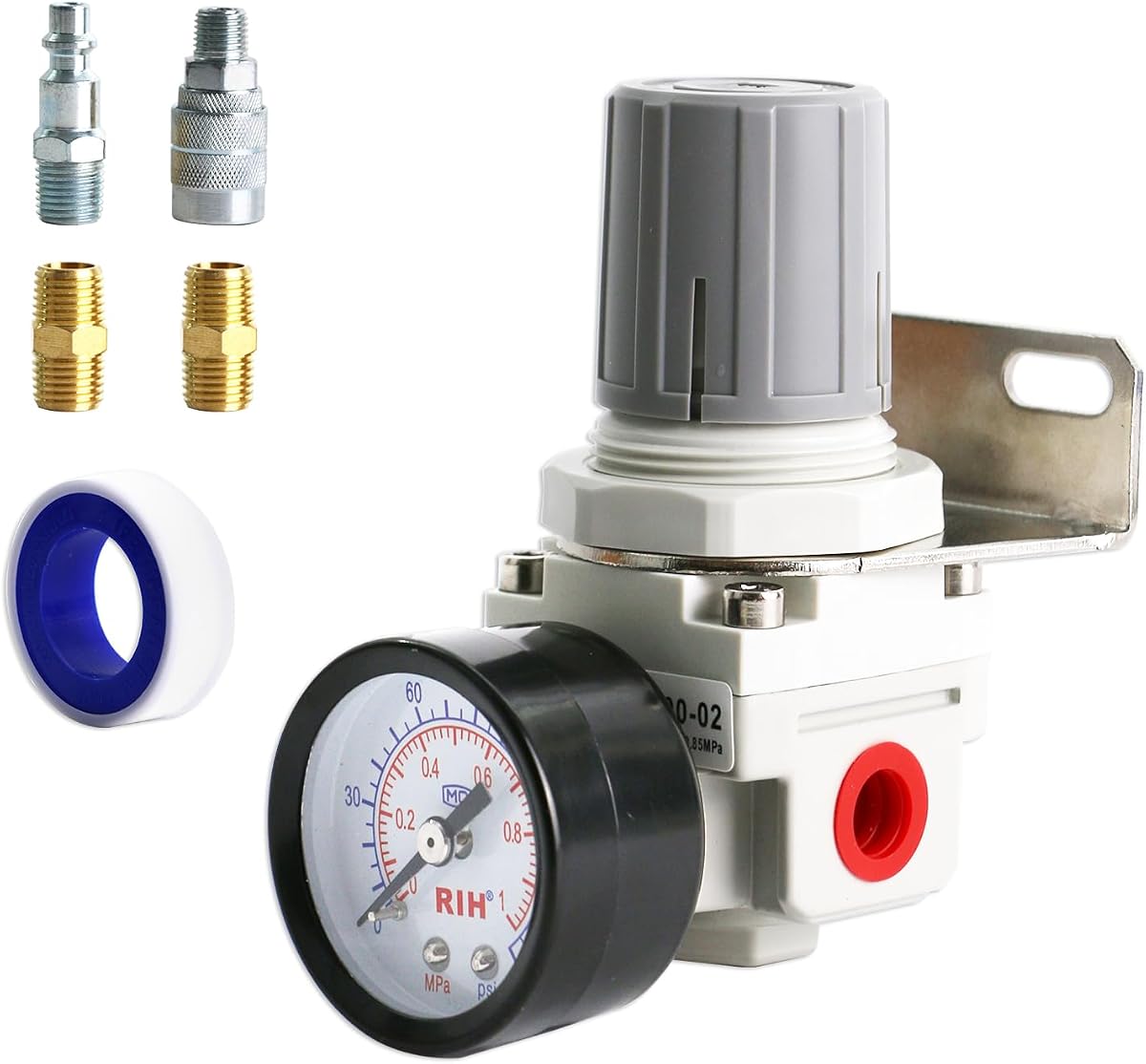
RIH AR2000-02
4.7Editor score
0-150 PSI gauge included
1/4-inch NPT connection
20 SCFM rated flow
Bracket and fittings included
An air pressure regulator helps maintain steady downstream pressure from a compressed-air source, giving pneumatic tools, paint guns, actuators, and workshop equipment a more dependable operating environment. A useful regulator should match line size, airflow, and required pressure rather than simply look impressive on the shelf.
This guide compares ten regulators using the specifications available for each model: thread size, adjustment range, maximum pressure, rated flow, gauge and bracket inclusion, flow direction, construction, and intended application. It covers compact 1/4-inch units, higher-capacity 1/2- and 3/4-inch models, and an FRL-style option for broader pneumatic setups.
The selections show why the PneumaticPlus SAR200-N02BG is a strong all-around choice, why the RIH AR2000-02 stands out for value, and why the heavy-duty 3/4-inch model suits demanding compressed-air lines. Ratings and specifications can change, as can product prices, so readers should verify current details before purchasing.
4.7Editor score

4.5Editor score

4.5Editor score
As an Amazon Associate we earn from qualifying purchases.
The comparison below highlights the major differences in port size, pressure capacity, rated airflow, included components, and adjustment mechanisms, helping you narrow the field before comparing the full reviews.


The SNS AR2000-N02 is a compact 1/4-inch NPT air regulator built for general compressed-air lines. It carries a 4.2 rating and stands out for including a mounting bracket and gauge, reducing the need to source those accessories separately. Its pull-up rotary knob provides a straightforward way to increase or decrease downstream pressure.
We may earn a commission when you buy through this link, at no additional cost to you.
The regulator has an aluminum alloy body, a 19.4 SCFM rated flow, and a stated operating range of 41 to 140 degrees Fahrenheit. That capacity is meaningful for many pneumatic tools and moderate workshop tasks, although it is lower than the 39, 59, 60, 80, 140 SCFM, and comparable figures offered by other selections.
The main trade-off is therefore capacity. If one small tool, a spray gun, or a modest collection of pneumatic accessories draws air, the SNS may be entirely appropriate. But a workshop with several simultaneously operating tools should look for a regulator with more headroom. The specified temperature range also deserves attention in unusually cold or hot working environments.
This is a sensible choice for a straightforward installation where a 1/4-inch connection, visible pressure monitoring, and compact construction matter more than maximum flow. It also makes sense as an accessible regulator for a home shop or individual tool branch. Buyers needing a larger system should choose a higher-capacity model instead of stretching this unit beyond its rating.
Pulling up the rotary knob unlocks the adjustment, after which clockwise rotation raises the setting and anticlockwise rotation lowers it. Pushing the knob back down should secure the chosen pressure and reduce the chance of accidental changes.
A pressure gauge and bracket give the regulator a more complete installation package. The gauge helps with setup and routine checks, while the bracket provides a way to secure the unit near a compressor or air-line assembly.
We may earn a commission when you buy through this link, at no additional cost to you.
The heavy-duty 3/4-inch inline regulator is the strongest high-capacity option in this group. It has a 4.5 rating, a listed flow rate of 140 SCFM, and a maximum input pressure of 250 PSI. Those figures distinguish it from the 1/4-inch models and make it more appropriate for workshops with substantial compressed-air demand.
We may earn a commission when you buy through this link, at no additional cost to you.
Its adjustment range extends from 7 to 215 PSI, giving users room to serve both lower-pressure equipment and demanding pneumatic applications. A high-impact locking composite knob helps preserve the selected setting, while the included wall-mounting bracket and gauge support installation and monitoring. The main connections are 3/4-inch female NPT.
That capacity comes with installation demands. A buyer must have compatible 3/4-inch air lines, and using this regulator for a single small device may add unnecessary bulk or complexity. The model is also less convenient for portable tool setups than a compact 1/4-inch unit. Nevertheless, none of the other listed regulators advertises a 140 SCFM flow rate.
This regulator is a compelling option for a busy shop, production environment, or multi-tool air system where pressure stability and adequate flow are priorities. It is particularly relevant when several pneumatic devices may operate together. For a compact home setup, one of the smaller 1/4-inch models will usually be easier to accommodate.
A 140 SCFM rated flow provides substantially more capacity than the smaller regulators in this guide. That extra headroom can help maintain pressure when multiple tools or equipment demands are connected, subject to the compressor and the rest of the air system keeping pace.
The locking composite knob is designed to resist accidental changes after adjustment. Combined with the broad 7-to-215-PSI range, it offers flexibility for varied workshop pressure requirements.
We may earn a commission when you buy through this link, at no additional cost to you.
The PneumaticPlus SAR200-N02BG is the most versatile all-around selection in this roundup. Its 4.5 rating reflects a well-rounded feature set: a relieving design, locking adjustment knob, 39 SCFM flow rating, 0-to-150-PSI adjustment range, and an included gauge and mounting bracket. It fits numerous general-purpose pneumatic uses.
We may earn a commission when you buy through this link, at no additional cost to you.
Its relieving configuration automatically vents excess downstream pressure when the setting is exceeded, helping protect connected tools and equipment. The push-to-lock knob is intended to hold the chosen setting under vibration and reduce accidental adjustments. Rated flow of 39 SCFM at 90 PSI gives it more capacity than many compact 1/4-inch alternatives.
Its main limitation is that it is still a 1/4-inch NPT regulator, so it cannot directly replace a 3/4-inch system component. The 250 PSI maximum supply pressure also needs to remain above the downstream setting. These are normal sizing conditions rather than serious flaws, but they should be confirmed against the compressor and receiving equipment.
For air tools, actuators, spray guns, and pneumatic machinery, this model offers the strongest balance of control features, capacity, included components, and installation convenience in the group. The one-year limited manufacturer warranty and stated compliance with ISO 6953 standards add confidence. It is our leading recommendation for a broad range of shop applications.
When downstream pressure rises above the setpoint, a relieving regulator vents the excess. That behavior helps guard sensitive equipment and makes this model suitable for lines where pressure consistency is more important than trapping every bit of downstream air.
The push-to-lock control helps maintain the selected pressure when nearby equipment creates vibration. This is particularly useful in workshops where a loose adjustment could alter tool performance or create inconsistent results.
We may earn a commission when you buy through this link, at no additional cost to you.
The Ingersoll Rand ARO R37121-600-VS combines an established industrial name with a useful 59 CFM flow capacity. It has a 4.3 rating, 1/4-inch NPT connection, and a 0-to-140-PSI pressure range. These characteristics make it a credible choice for professional workshops and pneumatic systems with moderate-to-high demand.
We may earn a commission when you buy through this link, at no additional cost to you.
The regulator uses relieving operation with a standard knob for control. Its flush-mounted gauge offers at-a-glance pressure visibility while keeping the assembly relatively compact, which can be useful where panel space is limited. The 59 CFM figure is among the stronger capacities in the 1/4-inch group.
Buyers should note that the 140-PSI maximum adjustment range is slightly below the 150-PSI range offered by several alternatives. The flush-mount gauge also may not be as easy to read at a distance as a standard projecting gauge. Neither issue is a major concern unless a connected tool specifically requires a higher setpoint or highly visible remote reading.
This model fits well for installers who recognize ARO equipment or want a compact regulator with more flow than typical light-duty units. It is a strong option for multi-tool workshop lines, provided 1/4-inch NPT matches the system and 140 PSI meets the required downstream pressure.
At 59 CFM, the unit offers considerably more flow capability than smaller 1/4-inch regulators. That makes it more suitable for several moderate pneumatic loads than a basic single-tool installation.
The flush-mount gauge keeps the regulator profile restrained while still providing pressure visibility. It can be a good fit in compact panel layouts where a large projecting gauge would interfere with surrounding equipment.
We may earn a commission when you buy through this link, at no additional cost to you.
The LE LEMATEC regulator is tailored to spray painting, airbrushing, pneumatic tools, and other applications where controllable airflow can affect the finish. It has a 4.4 rating, an integrated 0-to-150-PSI gauge, and standard 1/4-inch NPT male and female connections.
We may earn a commission when you buy through this link, at no additional cost to you.
Its solid brass body and robust adjustment knob are useful qualities for workshop use. The gauge allows the operator to monitor and fine-tune pressure while working, while the inline body can connect between a compressor, hose, or spray gun. The stated versatility is particularly relevant for automotive refinishing and detailed projects.
The supplied information does not list a rated airflow figure, so buyers needing a documented capacity for multiple devices should compare it with a model that publishes SCFM or CFM. A bracket is also not listed among the included components. Its strongest appeal is therefore the straightforward, finish-focused configuration rather than maximum documented flow or a complete mounting package.
This is a compelling option for a painter or detail user who wants a dedicated pressure-control point near the spray gun. It may be less attractive for large production systems where high flow, panel mounting, and formal capacity ratings are more important than quick inline adjustment.
A visible pressure gauge helps an operator maintain a repeatable setting while coating. Stable, appropriate pressure can support smoother application and reduce overspray, particularly during automotive or fine-finish work.
The solid brass body gives the regulator a substantial feel and is intended for dependable workshop operation. Standard 1/4-inch NPT threads also make it familiar to users who already maintain pneumatic spray equipment.
We may earn a commission when you buy through this link, at no additional cost to you.
The Primefit CR1401G is a replacement-style regulator with a strong 4.5 rating and 60 SCFM flow capacity at 100 PSI. Its 1/4-inch NPT ports, 1-to-150-PSI adjustment range, high-impact composite knob, and steel-protected gauge make it a versatile component for shop air lines.
We may earn a commission when you buy through this link, at no additional cost to you.
A particularly important detail is the stated directional airflow. As pictured with the knob on top, the unit supports right-to-left flow. It can be configured for left-to-right flow with the knob on the bottom, but the correct orientation must be established for it to operate properly.
That requirement adds installation complexity compared with models that use clearly marked IN and OUT ports. The 200-PSI maximum inlet pressure also sits below the 250-PSI maximum supply figures of some alternatives. Despite those caveats, the high 60 SCFM rating makes this a capable choice for moderate-to-high pneumatic demand.
The CR1401G makes sense for replacing a failed regulator or expanding a 1/4-inch workshop line that needs more capacity than compact models offer. Installers should follow the flow-direction configuration carefully and verify that source pressure remains within the stated inlet limit.
The 60 SCFM rating at 100 PSI gives the regulator meaningful capacity while retaining the common 1/4-inch NPT connection. That combination can simplify a retrofit where line size cannot easily change.
The steel-protected gauge is designed to withstand workshop conditions while displaying regulated pressure. The composite adjustment knob offers straightforward control without requiring a separate locking mechanism.
We may earn a commission when you buy through this link, at no additional cost to you.
The Milton 1114-8 is a 3/8-inch NPT FRL regulator with an 80 SCFM maximum flow rating at 100 PSI. Its 4.3 rating and distinctive FRL positioning make it relevant for pneumatic systems that sit between lightweight hoses and larger 1/2- or 3/4-inch infrastructure.
We may earn a commission when you buy through this link, at no additional cost to you.
Its 80 SCFM capacity is more than adequate for many workshop tools, and the 3/8-inch connection can bridge the gap between 1/4-inch branches and larger main lines. A stated operating range of 40 to 120 degrees Fahrenheit provides useful guidance for normal indoor and controlled workshop environments.
The available product information does not describe a gauge or adjustment range, so those details should be confirmed before buying. Its temperature limits are also narrower than those of the SNS model. Most importantly, consumers should clarify exactly what functions and accessories are included with this FRL configuration, since the supplied listing emphasizes the regulator and flow rating rather than a complete gauge-and-bracket package.
This model is best for a user who specifically wants a 3/8-inch high-flow regulator and understands the FRL format. It can be a good fit in a compact industrial or workshop pneumatic assembly where 80 SCFM is useful and the operating environment stays within its stated temperature range.
The 3/8-inch NPT thread offers a useful middle size between 1/4-inch regulators and larger main-line units. That can make it easier to build a branch system without moving immediately to heavier pipe sizes.
An 80 SCFM maximum at 100 PSI gives the model more flow capacity than most 1/4-inch competitors. The headroom can be valuable when connected equipment has significant or variable air demand.
We may earn a commission when you buy through this link, at no additional cost to you.
The 3/4-inch compressed-air regulator offers a wide 7-to-225-PSI adjustment range and a maximum pressure of 225 PSI. It has a 4.4 rating, clear IN and OUT labels, directional arrows, two gauge ports, and a free wall-mounting bracket, making it a practical choice for a larger compressor installation.
We may earn a commission when you buy through this link, at no additional cost to you.
The flexible gauge arrangement is a useful distinction. Each side has a 1/4-inch gauge connection, while the unused port can be closed with the supplied plug. This allows a builder to position the gauge in the direction most convenient for the installation. The pull-to-unlock, push-to-lock knob also helps secure the selected pressure.
Its main limitation is size. A 3/4-inch main-line regulator may be excessive for a single pneumatic tool and can require more space and plumbing than a 1/4-inch model. The 225-PSI maximum also deserves attention when paired with equipment that has a different input or output rating. Proper identification of inlet and outlet is essential.
This regulator suits installers building a main compressed-air branch where high adjustment range and flexible gauge placement are priorities. It is especially convenient for workshop layouts where a wall bracket is useful and the line can accommodate 3/4-inch female NPT connections.
Two gauge ports and an included plug let the installer choose the most accessible side for monitoring. This is useful in crowded compressor areas where visibility and service access matter.
The 7-to-225-PSI range gives substantial latitude for different pneumatic requirements. The locking adjustment mechanism helps keep the selected setting stable after the regulator is tuned.
We may earn a commission when you buy through this link, at no additional cost to you.
The 1/2-inch compressed-air regulator is a practical middle-ground option for workshop systems that have outgrown 1/4-inch branches but do not need the largest 3/4-inch configuration. It carries a 4.4 rating, a 7-to-225-PSI adjustment range, and an aluminum body.
We may earn a commission when you buy through this link, at no additional cost to you.
The package includes a 0-to-230-PSI gauge, a steel wall-mount bracket, a plug for the unused gauge port, and clearly marked IN and OUT positions. Two gauge ports offer placement flexibility, while the pull-to-unlock and push-to-lock knob provides controlled adjustment. These features support a ready-to-install branch arrangement.
A notable gap in the supplied specifications is the lack of a published airflow rating. While the 1/2-inch body suggests more capacity than a 1/4-inch unit, buyers should not assume a specific SCFM figure without confirmation. The regulator is also larger and heavier than compact models, which may be unnecessary for a small portable setup.
This product is best for a permanent home-shop or professional air branch where a 1/2-inch connection fits the existing layout. Its included gauge, bracket, and plug simplify assembly, while the wide pressure range and clear flow markings make installation less ambiguous.
The 1/2-inch body occupies a practical middle ground in line sizing. It can serve as a central branch without requiring the footprint and piping demands of a 3/4-inch main-line regulator.
A steel bracket, gauge, and unused-port plug are included, which reduces the need for extra installation pieces. Clear IN and OUT labels and flow arrows help reduce orientation errors.
We may earn a commission when you buy through this link, at no additional cost to you.
The RIH AR2000-02 is the strongest budget-oriented choice in this guide, carrying the highest listed product rating at 4.7. It uses a 1/4-inch NPT connection, offers a 0-to-150-PSI gauge, and has a rated flow of 20 SCFM at 90 PSI. The package also includes a bracket, couplers, a plug kit, thread seal tape, and two NPT fittings.
We may earn a commission when you buy through this link, at no additional cost to you.
That unusually complete accessory set makes setup easier for buyers who want the regulator and basic installation pieces together. The pull-up rotary knob controls pressure, with clockwise rotation increasing output and anticlockwise rotation decreasing it. An aluminum body keeps the unit compact for inline installation near a compressor, hose, or pneumatic accessory.
The 20 SCFM flow rating is modest, and the stated maximum pressure of 145 PSI is lower than several alternatives. It is therefore better suited to lighter loads and applications that do not need maximum line capacity. Buyers should also follow the sealing instructions carefully, particularly if leakage appears at a joint.
This is a good choice for a home workshop, individual pneumatic tool, spray-gun branch, or straightforward air-line repair. Its excellent rating, useful 0-to-150-PSI gauge, and included installation hardware make it an attractive value-oriented pick without requiring a large main-line installation.
The package includes a gauge, bracket, air couplers, a plug kit, thread seal tape, and two 1/4-inch NPT fittings. These extras can streamline a basic setup and reduce separate accessory shopping.
A 20 SCFM rated flow at 90 PSI suits a controlled branch with moderate demand. The pull-up knob and aluminum body keep the unit straightforward to install and operate in a compact setup.
We may earn a commission when you buy through this link, at no additional cost to you.
The right regulator depends on line size, airflow, pressure requirements, and installation conditions. Consider the compressor and connected equipment together, because a regulator cannot create more airflow or safely control pressure beyond the capabilities of the surrounding system.
Thread size is the first compatibility check because it determines whether the regulator can physically connect to the compressor, hose, manifold, and equipment. Most compact models use 1/4-inch NPT, while larger workshop systems may use 1/2-inch, 3/8-inch, or 3/4-inch connections. The main body ports and gauge threads may differ, so a regulator can have 1/4-inch gauge openings even when its inline ports are larger. Verify every connection rather than assuming all openings share the same size.
Rated flow indicates how much compressed air the regulator can handle under the stated test conditions. A unit rated at 20 or 19.4 SCFM may suit one small tool, while models rated from 39 to 80 SCFM offer more room for several devices. The 140 SCFM heavy-duty model is the most appropriate when many pneumatic loads may run together. Always compare the regulator's rating with the combined demand of connected tools, allowing additional margin for demanding cycles and future expansion.
Both maximum inlet pressure and maximum outlet pressure matter. A regulator cannot control supply pressure above its maximum input rating, and downstream equipment may have a lower safe working pressure than the regulator can produce. The listed choices span adjustment ranges from 0-to-150 PSI, 7-to-215 PSI, 7-to-225 PSI, 0-to-140 PSI, and narrower limits. The gauge range should also cover the desired working pressure without making useful readings difficult to see.
A relieving regulator vents excess downstream pressure when the setpoint is exceeded, which can protect connected equipment and help maintain a more stable setting. A non-relieving design may conserve downstream air but can require a different relief strategy. The PneumaticPlus and Ingersoll Rand ARO models are specifically described as relieving, while the Primefit configuration is described by its directional flow setup. If the application includes delicate pneumatic equipment, the operating consequences of both designs should be understood.
The adjustment mechanism affects both setup and day-to-day stability. Some regulators use a pull-up rotary knob that increases or decreases pressure in the indicated direction, while others use a push-to-lock control that helps prevent accidental changes. Workshop environments benefit from a positive lock because vibration and nearby contact can otherwise alter the setting. A clearly readable gauge also makes it easier to confirm the setting before operating a tool.
Inline installation is convenient near a hose or portable tool, while a wall or panel bracket is valuable beside a fixed compressor. Some models include a bracket, while others do not. Flush-mounted gauges can save space but may be harder to read from a distance, whereas projecting gauges are often more visible. Consider where the unit will be serviced, whether the knob needs to remain accessible, and whether the gauge should face the operator.
Body material and operating-temperature specifications can influence long-term suitability. Aluminum offers a lightweight, compact design, while brass provides a substantial alternative for finish-focused pneumatic work. Temperature ratings vary substantially, with some models specified up to 140 degrees Fahrenheit and the Milton unit operating from 40 to 120 degrees Fahrenheit. Outdoor, mobile, and unheated installations deserve particularly careful review because compressor heat and winter conditions can exceed comfortable indoor ranges.
A regulator with a gauge, bracket, plugs, and fittings can be easier to install than a bare body, but packages differ. The RIH model includes a broad installation kit, while the PneumaticPlus, SNS, and heavy-duty 3/4-inch model include gauges and brackets. The LE LEMATEC unit is configured for inline spray-gun use, and the Milton listing does not provide a gauge specification. Compare the full package rather than assuming every regulator includes the same accessories.
Begin with the compressor off and the system depressurized. Confirm the regulator's IN and OUT markings, flow arrows, thread sizes, and maximum pressure ratings. If the model allows two flow orientations, configure it in the direction specified by the manufacturer. Use suitable thread sealant on NPT connections, tighten fittings carefully, and check for leaks before restoring pressure. A regulator should be placed where it is not exposed to impact, excessive heat, or moving machinery.
Once the installation is secure, open the air supply gradually and allow pressure to build. Pull up or unlock the adjustment knob, then turn it in the direction indicated for increasing or decreasing pressure. Watch the gauge while approaching the setting required by the connected tool. Do not exceed the equipment's working pressure or the regulator's rated range. After setting the desired pressure, push or lock the knob as directed and verify that the reading remains stable.
For maintenance, follow the compressor and equipment manufacturers' draining procedures and never loosen a fitting under pressure. Inspect threads, seals, hoses, and the gauge periodically for damage or leakage. If the regulator does not hold pressure, check the setup, flow direction, and connected equipment before assuming the unit has failed. Replace damaged components and avoid painting or coating adjustment mechanisms, which can change friction and make precise control harder.
The correct size depends on both line connection size and airflow demand. A 1/4-inch NPT regulator is common for individual tools and small branches, while 1/2-inch or 3/4-inch models suit more demanding workshop systems. Compare the regulator's rated SCFM with the combined air demand of connected equipment and verify that the existing hose and fittings match its ports.
Use the pressure specified by the tool manufacturer rather than choosing the highest available setting. Some tools perform inconsistently with too much pressure, while too little pressure can reduce performance or prevent operation. Set the regulator while watching the included gauge, then confirm that the tool operates normally and the regulated pressure remains stable.
No. The gauge situation varies by model and package. In this guide, several regulators include a gauge and bracket, while the Milton 1114-8 listing does not identify one among the provided features. Check the package contents before installation and plan to source a compatible gauge separately if it is not included.
A relieving regulator vents excess downstream air when pressure rises above its setpoint. That behavior can help protect connected equipment and maintain a stable working pressure. A non-relieving regulator does not automatically discharge that excess air, so the surrounding system may need another form of pressure relief. Select the design that matches the equipment and overall air-line configuration.
Some regulators are directional and must be installed with the correct orientation. The Primefit CR1401G is described as configurable for either left-to-right or right-to-left flow, but the proper setup must be followed. Other units use IN and OUT markings or arrows. If pressure behaves incorrectly, depressurize the system and verify the orientation before operating connected equipment.
No. Check the compressor's maximum output pressure, the regulator's maximum input pressure, and the connected tool's required pressure. Also verify thread size and airflow requirements. A regulator may fit physically but still be unable to provide adequate flow, which can cause pressure instability under load.
First confirm that the system is off and fully depressurized. Check whether the fitting threads have adequate sealant and whether the connection is properly tightened without over-torquing. The RIH product specifically advises applying additional PTFE tape if leakage occurs at a joint. Leaking valves or damaged threads should be replaced rather than simply tightened repeatedly.
Inspect it whenever connections are disturbed and during routine compressor maintenance. Check the gauge reading, adjustment knob, threads, seals, mounting hardware, and nearby hoses for damage or leakage. A regulator that cannot maintain a stable setting should be inspected before connected tools are used.
The PneumaticPlus SAR200-N02BG is the strongest all-around choice because it combines relieving operation, a locking knob, 39 SCFM flow, a 0-to-150-PSI range, and an included gauge and bracket. The RIH AR2000-02 is the value-oriented selection with a strong rating and a comprehensive installation package, while the heavy-duty 3/4-inch model is the clear choice for maximum listed airflow and major workshop lines.
Port size should remain the first filter, followed by flow capacity and pressure limits. A regulator cannot compensate for undersized supply lines or a compressor that cannot deliver the required volume. The Ingersoll Rand, Primefit, and Milton models also warrant attention when a 1/4-inch or 3/8-inch connection with high documented flow is more useful than a larger installation.
Before making a final purchase, verify current specifications, included components, compatibility, and available product details, since manufacturer information and prices can change. For most well-equipped workshops, the PneumaticPlus model offers the most balanced package; for lighter-duty use, the RIH provides a practical starting point.