
ASUS RT-AX3000
4.5Editor score
WiFi 6 with 160MHz bandwidth
Five Gigabit Ethernet ports
AiProtection Pro security
AiMesh expansion support
Our ASUS WiFi Routers guide compares ten models across WiFi generation, speed, coverage, security, gaming features, mesh support, wired connectivity, and ease
Choosing an ASUS WiFi router means balancing wireless generation, coverage, wired performance, security, and the size of your home. The right model can improve everyday browsing, gaming, streaming, remote work, and smart-home reliability, but premium features are not equally important to every household.
We compared ten ASUS routers using the supplied specifications, covering WiFi 6 and WiFi 7 models, standalone and mesh systems, gaming-focused options, business tools, port configurations, security features, and expansion options. The list includes inexpensive entry devices, premium WiFi 7 models, and specialized routers.
Each review explains where the router stands out, what trade-offs come with it, and which types of homes are most likely to benefit. Product ratings reflect the supplied customer feedback, while availability and pricing change over time, so readers should confirm current details before purchasing.
4.5Editor score
4.0Editor score
4.3Editor score
This side-by-side comparison highlights each router's wireless generation, maximum advertised speed, coverage approach, and standout connectivity features, making it easier to match a model to your home, devices, and networking priorities.




The ASUS RT-AX1800S is a straightforward dual-band WiFi 6 router aimed at households that want modern wireless standards, useful security, and room to expand without moving to a premium mesh system. Its supplied rating is 4.3 out of 5, which reflects a generally positive reception while still leaving room for differences among homes, internet connections, and client devices.
We may earn a commission when you buy through this link, at no additional cost to you.
Its headline capability is 1024-QAM support, combined with MU-MIMO and OFDMA to improve efficiency when several devices are connected. The router also includes one Gigabit WAN port and four Gigabit LAN ports, which makes it more flexible for wired devices than a basic model with only a few Ethernet connections. AiMesh compatibility gives owners a practical route toward broader coverage later.
The security proposition is unusually complete for a budget-oriented router. AiProtection Classic is powered by Trend Micro, while ASUS Instant Guard provides a one-click secure VPN experience when users are away from home. Parental controls and a built-in VPN add further utility. As with any wireless router, actual throughput and range will depend on the internet plan, traffic volume, building materials, layout, and network overhead.
This is a compelling choice for apartments, smaller homes, offices, and users who need a dependable upgrade from older wireless equipment. It may not satisfy someone seeking multi-gigabit wired connections, extensive 6 GHz coverage, or a dedicated gaming feature set, but its combination of WiFi 6, five Gigabit ports, VPN tools, and mesh expansion makes it an adaptable budget recommendation.
MU-MIMO and OFDMA let the RT-AX1800S serve multiple clients more efficiently, while 1024-QAM can improve throughput on compatible connections. These features are particularly relevant in homes where phones, televisions, computers, and connected appliances are active at the same time.
AiProtection Classic supplies core network protection, and Instant Guard offers a simple way to access the home network securely while away. Parental controls and built-in VPN support add useful control without requiring a separate router for every basic security function.
We may earn a commission when you buy through this link, at no additional cost to you.
The ASUS RT-BE58U is a well-rounded WiFi 7 router for users who want current wireless technology without moving directly into a high-end quad-band or multi-node system. Its 4.0 rating reflects the promise of WiFi 7, although actual results will depend heavily on the client devices, internet service, and whether the home has demanding high-speed wired equipment.
We may earn a commission when you buy through this link, at no additional cost to you.
WiFi 7 capabilities distinguish it from the WiFi 6 models in this guide. The router supports 802.11be, 4096-QAM, and Multi-link Operation, allowing compatible devices to use multiple bands for steadier connections and more efficient data transfer. Its advertised speed reaches 3.6 Gbps, giving compatible WiFi 7 clients considerably more theoretical headroom than conventional dual-band WiFi 6 systems.
Network flexibility is another major strength. Dual-WAN configuration allows users to consider more than one internet connection, while AI WAN detection is designed to support always-on service. A USB port can also be used with 4G LTE or 5G mobile tethering, adding another possible resilience path. Smart Home Master supports up to three SSIDs, helping separate IoT devices, create instant VPN connections, and apply parental controls.
This model is best suited to households with several WiFi 7 devices, a fast internet plan, and a need for strong management features without a premium multi-band chassis. It is less compelling for users whose devices are limited to WiFi 6 or whose main requirement is seamless coverage across a very large home. Even so, its balance of speed, security, VPN support, and WAN options makes it our overall WiFi 7 pick.
The RT-BE58U delivers WiFi 7 features in a dual-band format, making it a practical option for compatible devices that benefit from 4096-QAM and Multi-link Operation. It also remains a useful foundation for a mixed environment where some clients still use older standards.
Dual-WAN, AI WAN detection, and USB tethering provide more ways to structure and maintain service. Smart Home Master adds isolated SSIDs for IoT equipment, giving connected devices a simpler path onto the network without mixing every category together.
We may earn a commission when you buy through this link, at no additional cost to you.
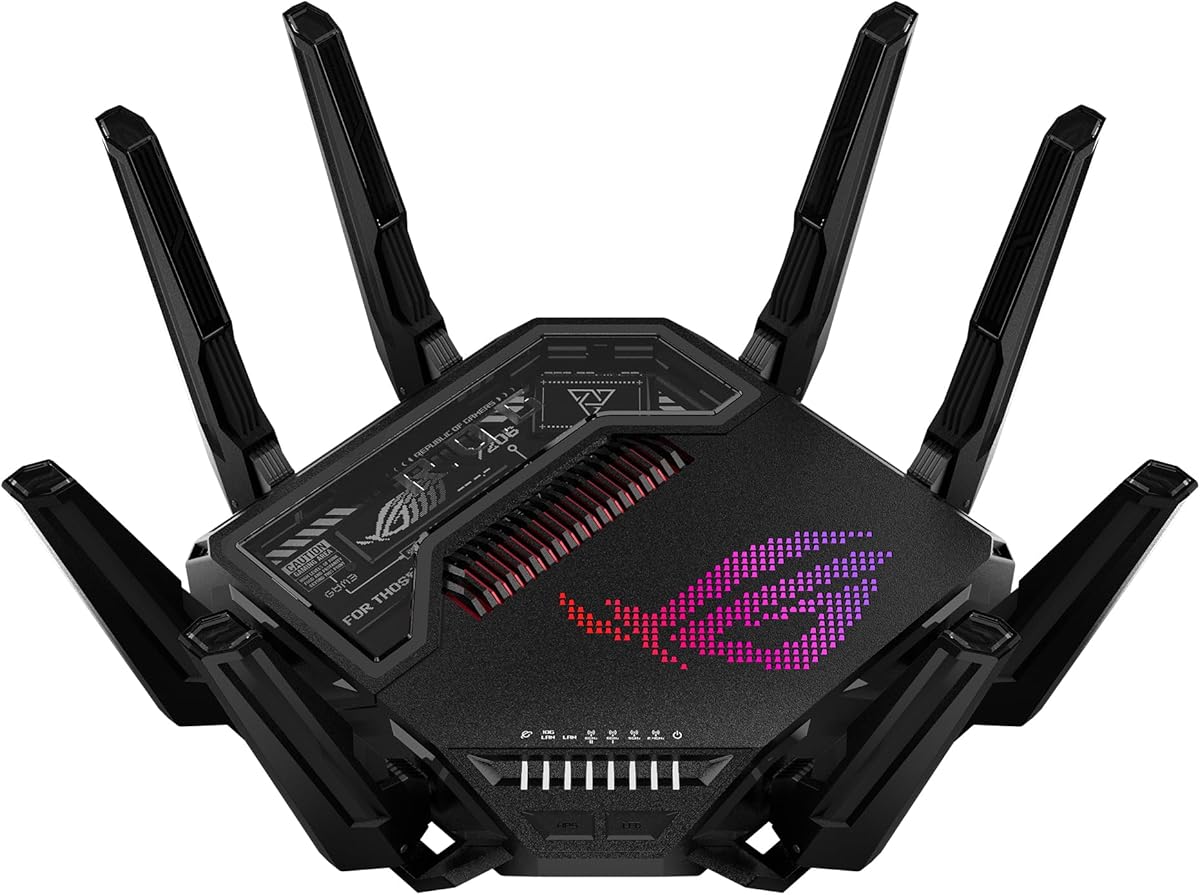
The ASUS ROG Rapture GT-BE98 Pro is the most specialized and advanced router in this guide. It is aimed at gamers, enthusiasts, and demanding smart homes that can use quad-band WiFi 7, a large collection of fast Ethernet ports, and dedicated game-traffic prioritization. Its 4.3 rating indicates strong customer interest in a high-end platform.
We may earn a commission when you buy through this link, at no additional cost to you.
The router supports WiFi 7 with 320 MHz channels in the 6 GHz band, 4096-QAM, and advertised speeds of up to 30 Gbps. Multi-link Operation allows compatible devices to connect across multiple bands for stability and efficiency. The bandwidth is not simply a headline number: it supports demanding combinations of high-resolution gaming, downloads, streaming, work applications, and connected devices when the rest of the network and client hardware can keep pace.
Its wired connectivity is equally notable. Dual 10G ports and quad 2.5G ports provide room for high-speed storage, workstations, gaming PCs, and other network infrastructure. External dual-feeding antennas are included to improve signal strength and coverage efficiency. Triple-Level Game Acceleration focuses on gaming traffic from the PC gaming port through the connection to the game server.
This is the premium choice for a home that needs more than ordinary WiFi 6 performance and has multiple devices capable of exploiting 6 GHz, 2.5G, or 10G connections. It is excessive for a small apartment with basic internet service, and the advanced platform adds complexity that some users may not need. For the intended enthusiast audience, however, it offers the most comprehensive combination of wireless speed, wired flexibility, and gaming-focused features here.
Triple-Level Game Acceleration is designed to improve the path for PC gaming traffic, while 2.5G and 10G ports provide bandwidth for demanding local and internet-facing devices. The result is particularly relevant to gamers who consider both latency and network headroom.
Using 6 GHz channels, 4096-QAM, and Multi-link Operation allows compatible clients to access substantially more capacity than a dual-band system. Separate spectrum can also help reduce congestion when numerous high-speed devices are active.
We may earn a commission when you buy through this link, at no additional cost to you.
The ASUS RT-BE92U occupies a useful middle ground between a conventional dual-band WiFi 7 router and the quad-band ROG Rapture GT-BE98 Pro. It brings a dedicated 6 GHz band to a tri-band design, supports Multi-link Operation, and advertises speeds of up to 9.7 Gbps. The supplied 4.0 rating is solid for a router in a relatively new wireless category.
We may earn a commission when you buy through this link, at no additional cost to you.
Its 320 MHz 6 GHz channels and 4096-QAM support offer additional capacity for compatible WiFi 7 clients. The extra band can be particularly valuable in crowded environments where 2.4 and 5 GHz channels are congested. Multi-link Operation can improve stability and efficiency by letting compatible devices work across multiple bands at once.
The feature set extends beyond wireless performance. Dual-WAN configuration, AI WAN detection, and USB support for 4G LTE or 5G tethering give administrators flexible ways to establish and preserve service. Smart Home Master can establish up to three SSIDs, separate IoT devices, provide quick VPN access, and configure parental controls. Subscription-free AiProtection Pro, Safe Browsing, and a one-tap security scan improve everyday management.
The RT-BE92U is a strong choice for a connected home with WiFi 7 phones, laptops, televisions, and other clients, especially where 6 GHz capacity can reduce congestion. It also works as a base for a broader ASUS mesh system. Users with older WiFi 5 or WiFi 6-only equipment will not receive the full advertised benefit, so the platform is best matched to newer hardware and a fast internet plan.
A dedicated 6 GHz band can offer wide channels and more available spectrum than crowded lower bands. Compatible WiFi 7 clients benefit from the additional capacity, particularly during simultaneous high-speed downloads, streaming, and gaming.
Dual-WAN and mobile tethering options create additional ways to maintain internet access. These features are useful for remote workers, households with several service providers, and anyone who wants a fallback connection strategy.
We may earn a commission when you buy through this link, at no additional cost to you.
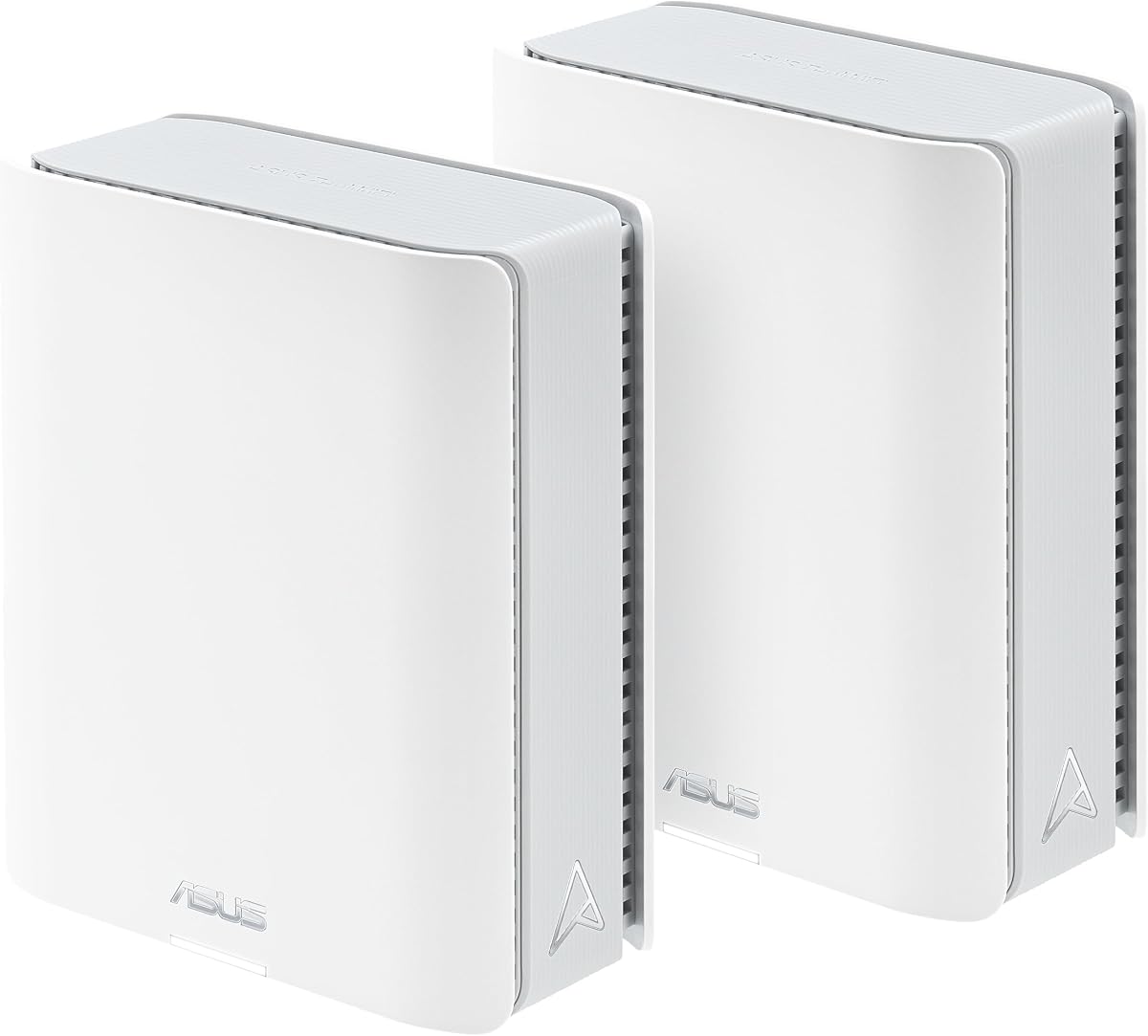
The ASUS ZenWiFi BT10 is a two-pack tri-band WiFi 7 mesh system for large homes where one centrally placed router may not provide satisfactory coverage. It advertises speeds up to 18 Gbps, coverage of up to 6,000 square feet for the two-pack, and dual 10G ports. Its 3.4 rating is the lowest in the list, so potential buyers should consider both its ambitious specifications and the mixed customer feedback.
We may earn a commission when you buy through this link, at no additional cost to you.
The package is designed to create a whole-home network with AI-powered AiMesh backhaul. Its goal is to provide robust connections between nodes and maintain a seamless experience as devices move between rooms. Eight internal antennas and ten high-power front-end modules are included to distribute signal in multiple directions, while heat dissipation is intended to support reliable operation.
Smart Home Master allows up to three SSIDs, making it easier to isolate IoT devices, apply parental controls, and configure instant VPN connections. For wired networks, dual 10G WAN and LAN ports and Multi-WAN support provide serious capacity. USB connectivity also permits 4G LTE and 5G mobile tethering, which can be helpful for backup service.
The BT10 is best suited to large, multi-floor properties or homes with thick walls and several difficult coverage areas. Placement remains essential, since a mesh system cannot fully overcome poor node placement or an unnecessarily large gap between access points. Its lower rating also warrants checking recent customer feedback and the current return terms. Even so, the two-node format, 6 GHz support, 10G ports, and scalable AiMesh design make it one of the most capable whole-home options.
AI-powered AiMesh is designed to maintain robust backhaul connections between the two nodes. The system can also scale with compatible ASUS extendable routers, allowing buyers to add capacity where their floor plan requires it.
Dual 10G ports on each unit allow compatible wired devices to benefit from very fast local connections. This is useful for network storage, high-end workstations, and homes beginning a deliberate multi-gigabit upgrade.
We may earn a commission when you buy through this link, at no additional cost to you.
The ASUS RT-AX82U is a high-speed dual-band WiFi 6 gaming router that remains compelling for gamers who do not need WiFi 7. Its 4.4 rating is among the strongest in this guide, and the renewed listing may appeal to buyers seeking established ASUS gaming features at a more restrained cost.
We may earn a commission when you buy through this link, at no additional cost to you.
The router supports WiFi 6 with 160 MHz channels and advertised combined speeds of up to 5,400 Mbps. Its dedicated gaming Ethernet port and Mobile Game Mode are designed to reduce lag and latency for compatible gaming setups, while MU-MIMO helps the network handle multiple clients more efficiently. These are meaningful advantages for a home where gaming traffic is more important than newer wireless generation alone.
Aura RGB lighting effects add visual customization, allowing the router to fit a particular gaming setup or match other lighting modes. The RT-AX82U also supports AiMesh, giving owners a path toward whole-home coverage without giving up the central gaming router. Lifetime-free AiProtection Pro, WPA3, and advanced parental controls provide a strong security and family-management foundation.
The renewed condition is the primary consideration. Buyers should review the seller's condition description, return policy, and warranty information carefully. Performance-wise, this is an excellent fit for a gaming household with WiFi 6 devices, a fast connection, and a desire for a dedicated wired gaming route. It is less suitable for buyers seeking a new-condition WiFi 7 system or extensive 2.5G and 10G ports.
The dedicated gaming port and Mobile Game Mode focus ASUS's networking features on latency-sensitive play. Wired gamers can use the special port directly, while compatible mobile games can benefit from the simplified optimization option.
Aura RGB makes the router visually distinct in an entertainment setup, and AiMesh compatibility preserves a route to expanded coverage. Users can therefore begin with one capable router and add compatible units if their home needs them.
We may earn a commission when you buy through this link, at no additional cost to you.
The ASUS ZenWiFi BT8 is a one-pack WiFi 7 mesh router designed to provide a modern starting point for a medium-sized home. It supports tri-band operation with 6 GHz WiFi, Multi-link Operation, 4K-QAM, and advertised speeds up to 14 Gbps. The supplied 4.0 rating positions it as a capable option, particularly for buyers interested in mesh flexibility without immediately choosing a multi-node package.
We may earn a commission when you buy through this link, at no additional cost to you.
AI-powered Smart AiMesh is designed to boost coverage up to 3,000 square feet for the one-pack configuration. Seven internal antennas and eight high-power front-end modules help direct coverage in multiple directions. The system is extendible with compatible ASUS routers, making it possible to begin with one unit and add nodes as connected spaces or larger floor plans demand broader coverage.
The management features cover both security and device organization. AiProtection Pro provides commercial-grade network protection, while advanced VPN support is included. Smart Home Master simplifies IoT networking, parental controls, and VPN setup for multiple devices by allowing multiple SSIDs. Together, these tools are useful in homes where consoles, televisions, phones, work devices, and smart appliances all need dependable service.
This is a sensible choice for a medium home, apartment, or first phase of a mesh deployment. A single unit may be sufficient for many layouts, but larger homes may need additional nodes for upstairs, basement, or far-corner coverage. Older clients will still connect, although they cannot exploit all WiFi 7 benefits. For a buyer seeking a flexible, secure tri-band mesh foundation, the BT8 offers a balanced feature set.
The single-node format offers a straightforward way to begin using WiFi 7 and Smart AiMesh. Compatible ASUS routers can be added later, reducing the need to predict the exact number of nodes a future floor plan will require.
Smart Home Master allows different device groups to use separate SSIDs. That separation can simplify parental controls, VPN access, and IoT setup without requiring every device to share one network name.
We may earn a commission when you buy through this link, at no additional cost to you.
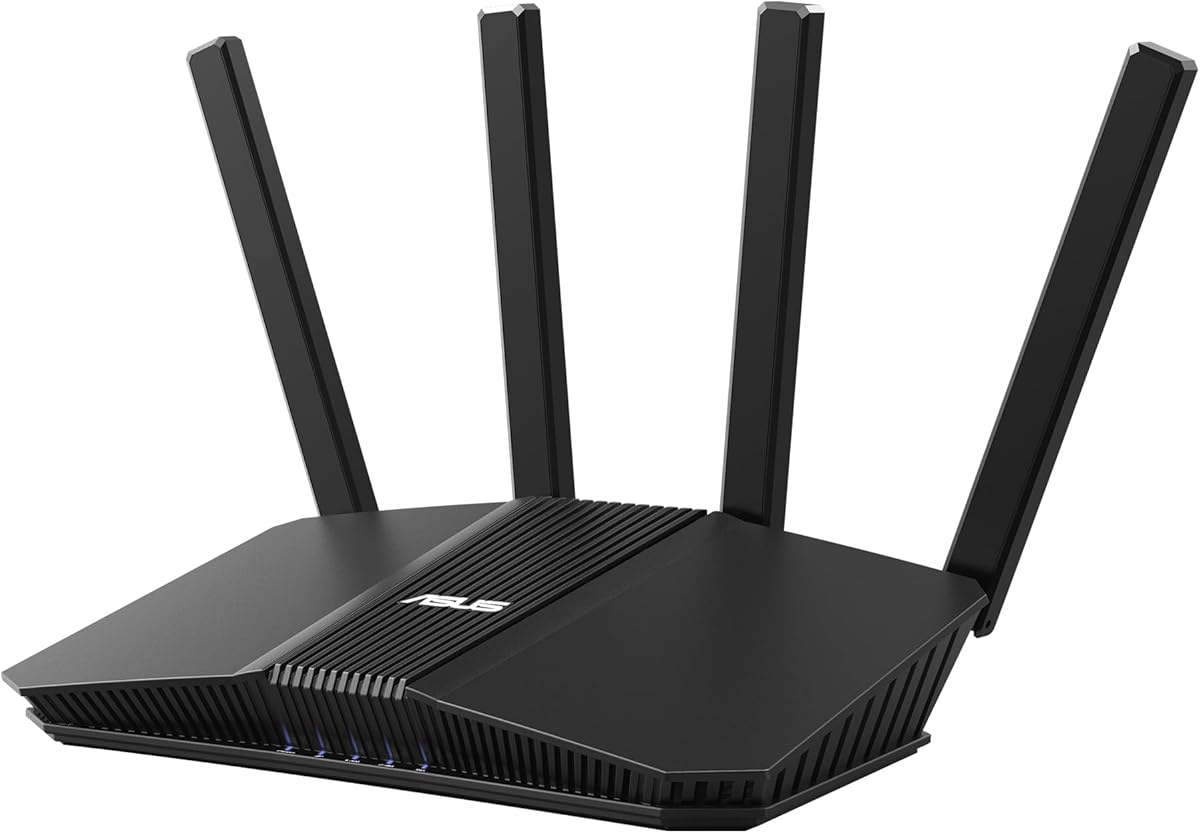
The ASUS RT-AX3000 is a well-balanced WiFi 6 router that deserves consideration by almost any household seeking an affordable ASUS upgrade. It has a 4.5 rating, combines dual-band wireless performance with useful management tools, and includes one WAN plus four Gigabit LAN ports. It is less futuristic than the WiFi 7 choices, but its core feature set is highly practical.
We may earn a commission when you buy through this link, at no additional cost to you.
The router supports 160 MHz bandwidth and 1024-QAM, with a total advertised network speed of 3,000 Mbps. That capacity is split between the 2.4 GHz and 5 GHz bands, allowing compatible devices to use the less congested band when appropriate. Adaptive QoS helps prioritize network tasks, while OFDMA and MU-MIMO improve efficiency in busy, multi-device environments.
AiMesh compatibility is a major long-term advantage. Owners can add compatible ASUS routers later to build a more even whole-home network, making the RT-AX3000 a practical starting point rather than a disposable standalone device. AiProtection Pro and advanced parental controls provide security and family controls, while a USB 3.0 port adds another avenue for compatible network storage or accessories.
The RT-AX3000 is ideal for apartments, small homes, offices, and users who want dependable WiFi 6 without paying for a high-end gaming or multi-gigabit platform. Its four Gigabit LAN ports provide enough wired connectivity for a desktop, television, game console, and other network devices. It is the strongest general-purpose value choice here, provided buyers do not need 6 GHz, WiFi 7, or ports faster than Gigabit Ethernet.
Dual-band operation provides compatibility for a wide range of clients, while 1024-QAM and 160 MHz bandwidth allow newer devices to achieve better throughput. OFDMA and MU-MIMO help the network remain efficient when many devices are active.
AiMesh support allows the RT-AX3000 to work with compatible ASUS extendable routers. This makes it a sensible core unit for a staged deployment, especially when a second floor or distant room later needs additional coverage.
We may earn a commission when you buy through this link, at no additional cost to you.
The ASUS RT-AC68U is a proven dual-band 802.11ac router that remains relevant for users who need established ASUS features, multiple Gigabit LAN connections, and broad configuration support. Its 4.5 rating is one of the strongest customer ratings in the guide, although it operates on the older WiFi 5 standard rather than WiFi 6 or WiFi 7.
We may earn a commission when you buy through this link, at no additional cost to you.
Combined advertised speeds reach 1,900 Mbps using 3 by 3 802.11ac technology. A 1 GHz dual-core processor separates WiFi and USB traffic into different lanes, helping the router manage multitasking. Five Gigabit LAN ports are useful for computers, televisions, consoles, and other wired devices, while USB functionality expands the options for storage and peripherals.
Its configuration depth is notable. The supplied specifications list PPPoE, PPTP, L2TP, automatic IP, and static IP connection types, along with Dual WAN, 3G and 4G LTE dongle support, Android tethering, port forwarding, port triggering, DMZ, DDNS, and NAT passthrough for several protocols. Guest networks are provided for both bands, and ASUSWRT offers browser-based control alongside the ASUS router app.
Trend Micro-powered protection adds vulnerability detection and sensitive-data safeguards, with features such as malicious-site blocking, two-way IPS, and infected-device prevention. The RT-AC68U is a sensible choice for a modest home, secondary router, or legacy-device setup, and its high rating may give buyers confidence. However, a newer WiFi 6 model offers a more future-oriented platform and better performance for current clients, so this recommendation mainly rewards buyers who value the RT-AC68U's established platform and extensive port options.
The 802.11ac standard is supported by a large installed base of phones, laptops, televisions, and other devices. Its mature feature set makes the router a practical option where compatibility matters more than access to the newest wireless standard.
Five Gigabit LAN ports exceed the connection count of many current budget routers. Dual WAN, mobile dongles, tethering, port controls, and multiple guest networks provide additional options for technically inclined administrators.
We may earn a commission when you buy through this link, at no additional cost to you.
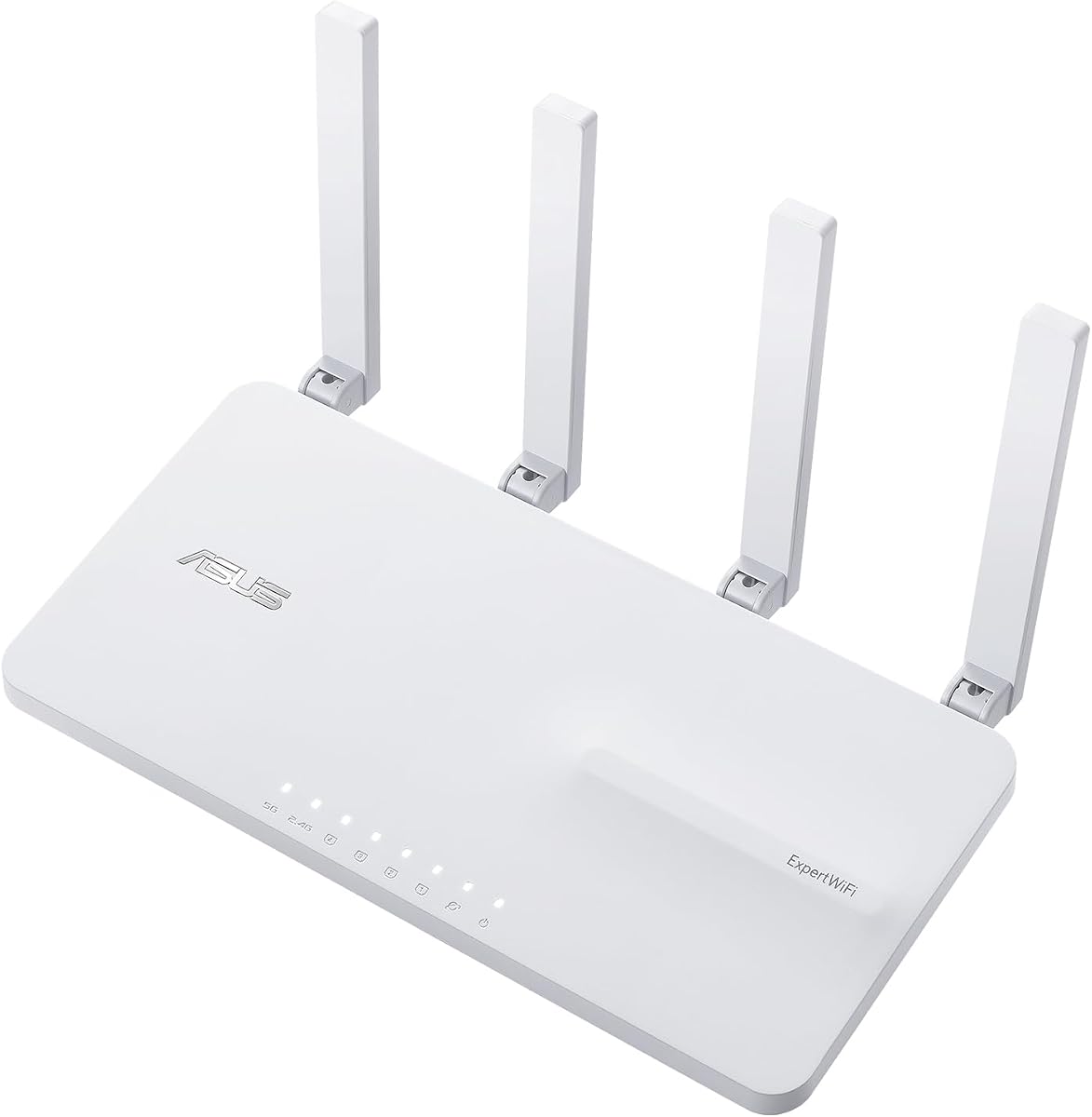
The ASUS ExpertWiFi EBR63 is the most business-oriented router in this guide. It combines AX3000 dual-band WiFi 6 with ExpertWiFi software, remote management, network segmentation, a customizable guest portal, and scalability through ExpertWiFi AiMesh. Its 4.2 rating indicates a generally positive reception, particularly among users who need more structured network administration than a typical home router provides.
We may earn a commission when you buy through this link, at no additional cost to you.
One of its defining capabilities is support for up to five SSIDs, allowing devices to be separated and prioritized for different business scenarios. The guest portal can be customized with an SSID, portal type, brand name, and templates, making it possible to present a more consistent identity to visitors. VLAN support and advanced VPN functions add further tools for organizing traffic and protecting access.
Remote management through the all-in-one ASUS ExpertWiFi app helps administrators maintain the network without needing to be physically present. A USB port can serve as a backup WAN when connected to a phone hotspot, offering a practical continuity option for a small office or business. The router also includes a free subscription to AiProtection Pro and safe browsing features.
This model is best suited to small offices, guest accommodations, clinics, shops, and advanced home networks that need multiple isolated networks. It offers less obvious value in a simple household with one broadband service and a few personal devices. For the environments it targets, however, the EBR63's guest portal, VLAN support, remote management, and fallback connectivity make it a distinctly capable business choice.
The customizable guest portal allows businesses to present their own branding and choose the appropriate portal type. Separate SSIDs and prioritization rules also make it easier to divide customer traffic from operational devices.
ExpertWiFi centralizes setup and management for administrators who may not always be on site. USB hotspot backup provides an additional way to maintain connectivity if the primary WAN service is interrupted.
We may earn a commission when you buy through this link, at no additional cost to you.
The most suitable ASUS router depends on your wireless clients, home layout, internet speed, wired devices, security requirements, and tolerance for setup complexity. Use the following factors to narrow the field before choosing between a budget WiFi 6 model, a capable WiFi 7 router, a mesh system, or a specialized business platform.
In short, buy for the clients you own now and expect to own next, not for a theoretical peak.
In short, match wired ports to your fastest service and only invest in extreme wireless capacity when compatible devices can use it.
In short, use a mesh system when dead zones are structural, and optimize node placement before adding more hardware.
In short, ensure the router has enough ports of the right speed and leave room for future devices.
In short, select advanced management tools when separate device roles matter more than raw wireless speed.
In short, buy a gaming router for prioritization and specialized features, not as a guarantee of lower latency.
In short, prefer a mesh-ready model when future expansion is likely and confirm compatibility before purchasing additional units.
In short, verify condition, warranty, accessories, and return terms before treating renewed equipment as equivalent to new.
Start by placing the router in an open, central location away from enclosed cabinets, dense electronics, and large obstructions. For a mesh system, position nodes so there is a strong connection between them while avoiding placements that force wireless signals through excessive walls. Before configuring advanced features, connect the main router to the modem or optical network terminal, power it on, and use the ASUS router app or the appropriate ExpertWiFi interface for setup.
Update the router's firmware, change the administrator credentials, and create a strong wireless password as soon as the network is available. Then configure the appropriate SSIDs, parental controls, guest access, VPN options, and security tools. If using Smart Home Master, assign compatible IoT devices to their dedicated network. Users with a mesh system should check backhaul quality and compare coverage in every room rather than relying only on the phone used during setup.
For long-term care, keep the router in a ventilated location, periodically check for firmware updates, and review connected devices and security logs. Reboot when performance becomes inconsistent, but avoid frequent unnecessary power cycling. If coverage problems develop, first test placement, nearby interference, and the number of active clients. Upgrade to a mesh node or faster Ethernet only after confirming that hardware limitations, rather than configuration or placement, are causing the issue.
A WiFi 7 router is most worthwhile when several main devices support WiFi 7 and your home has a fast internet connection. It can offer more capacity, wider 6 GHz channels, higher-order modulation, and Multi-link Operation on compatible clients. Older WiFi 5 or WiFi 6 devices will connect normally, but they will not gain every benefit.
Not always. A capable standalone ASUS router can cover many apartments and moderate homes, particularly when placed centrally. AiMesh becomes more valuable when the property has multiple floors, thick walls, long corridors, or consistent dead zones. It is also useful for buyers who want to add coverage gradually rather than replace the main router immediately.
The 2.4 GHz band provides long reach but is more prone to interference and lower throughput. The 5 GHz band offers a stronger balance of range and speed for many devices. The 6 GHz band appears on newer WiFi 7 systems and provides wide channels and high capacity, though compatible clients and a clear path are important. A tri-band router can combine these bands more effectively for mixed devices.
Many of the listed models include AiProtection or AiProtection Pro features powered by Trend Micro, along with parental controls and VPN-related tools. The exact feature set varies by model, and the ExpertWiFi EBR63 includes a free subscription to AiProtection Pro. Review the current product listing and ASUS interface to confirm the features available for the specific router.
Choose 2.5G or 10G ports when you have a multi-gigabit internet service, fast network storage, a modern workstation, or other equipment that benefits from higher local throughput. Gigabit ports are sufficient for typical broadband plans and standard devices. Faster ports alone will not improve every wireless client, so the rest of your network and attached hardware must also support the higher speed.
Several listed routers support ASUS mesh technologies, but compatibility should be confirmed for the exact models involved. AiMesh-compatible models are designed to work with compatible ASUS extendable routers, while ExpertWiFi systems use the ExpertWiFi platform. Matching standards and checking current ASUS compatibility guidance helps avoid management or feature limitations.
A dedicated gaming port can provide a convenient wired path and may assist with traffic prioritization, but it does not guarantee low latency by itself. Game-server distance, internet service quality, WiFi conditions, and device performance also matter. The RT-AX82U offers gaming-focused features at a more modest level, while the ROG Rapture GT-BE98 Pro is aimed at enthusiasts who want both specialized gaming tools and extensive multi-gigabit connectivity.
Check the seller's description of cosmetic and functional condition, included accessories, warranty coverage, and return period. Confirm that every port, radio, and mesh feature works as expected, and ask whether the unit has been factory reset. A renewed router can be a good option, but it should be evaluated on its own terms rather than treated as identical to a new unit.
The ASUS RT-AX3000 is the most balanced value pick for many homes, combining a strong supplied rating, WiFi 6 performance, multiple Gigabit ports, AiProtection Pro, and AiMesh expansion. The RT-BE58U is the most versatile WiFi 7 recommendation for compatible modern devices, while the ROG Rapture GT-BE98 Pro stands apart as the premium choice for gamers and enthusiasts who can use quad-band WiFi 7 and extensive high-speed Ethernet.
Before purchasing, prioritize your real requirements rather than the largest headline speed. Match the wireless generation to your client devices, choose a mesh system only when the floor plan requires it, and make sure the Ethernet ports match your internet plan and local hardware. Business users should also consider VLAN support, multiple SSIDs, guest portals, and remote management, while gamers should evaluate dedicated prioritization alongside overall network capacity.
Ratings and product details provide a useful starting point, but prices, availability, seller conditions, and firmware features can change. Confirm the current listing, warranty, included components, and return terms before buying. With those checks in place, the right ASUS WiFi router can provide a secure, flexible, and dependable network for years of connected use.