
Zoom H1 XLR 2-Channel Recorder
4.5Editor score
Two XLR/TRS combo inputs
32-bit float at 96kHz
OLED waveform monitoring
SDXC storage up to 1TB
Our expert guide compares the best audio field recorders for film, examining inputs, float recording, timecode, portability, monitoring, and synchronization
Audio field recorders for film help filmmakers capture dialogue, sound effects, ambience, and location audio with more control than a camera or phone microphone. A strong field recorder should protect quiet sounds from sudden noise, provide reliable inputs, and make it easy to monitor and organize a take.
The recorders in this guide range from compact lav systems to professional multi-input units built for demanding productions. We compared them using the supplied specifications, focusing on recording formats, microphone connectivity, timecode, storage, monitoring, power options, and suitability for different film workflows.
Each pick highlights a particular way to approach location sound, from a straightforward two-channel setup to a multi-track production recorder. Ratings and specifications reflect the supplied product information, while prices and availability can change, so compare current listing details before making a final decision.
4.5Editor score

4.7Editor score
4.6Editor score
This side-by-side comparison covers the key differences among all ten recorders, including channel count, input flexibility, timecode support, recording formats, storage, and portability.



The Zoom F3 is a professional field recorder built around two locking XLR inputs and 32-bit float recording. Its supplied rating is 4.6, and its strongest attraction is dependable capture across a wide range of levels, from restrained dialogue to sudden environmental peaks. It is particularly well suited to filmmakers who need a compact, reliable two-channel recorder rather than a large multi-input console.
We may earn a commission when you buy through this link, at no additional cost to you.
The recorder's ultra-low-noise preamps help preserve quiet details, while 32-bit float recording reduces the risk of a clipped take. Locking XLR connections are valuable on location because they remain secure when the recorder is mounted away from the operator or connected to a larger rig. Flexible power options also support both standalone recording and connected production workflows.
The main limitation is scale. With only two XLR inputs, the F3 cannot capture a large ensemble of microphones at once, and its lack of built-in microphones makes it less convenient for a spontaneous ambience or reference recording. These are meaningful trade-offs for documentary crews, but they are easy to accept when sound quality, portability, and dependable operation are the priorities.
The F3 is a strong recommendation for a run-and-gun filmmaker, small documentary unit, or sound recordist who wants a compact professional tool. It suits crews comfortable connecting their own microphones and comfortable accepting a focused two-input workflow in exchange for clean capture and secure connections.
The combination of 32-bit float recording and ultra-low-noise preamps gives the F3 useful headroom for difficult location conditions. It allows the operator to record changing sources without repeatedly stopping to manage levels.
Dual locking XLR inputs are especially useful when the recorder is mounted on a stand, belt, or larger field setup. The recorder can therefore remain separate from the microphone operator while keeping critical connections secure.
We may earn a commission when you buy through this link, at no additional cost to you.
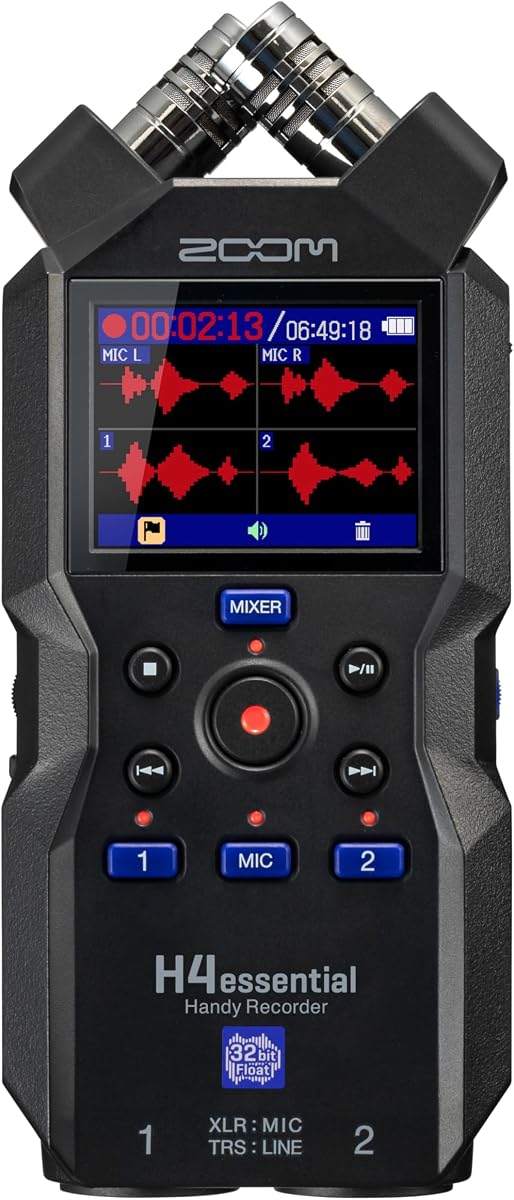
The Zoom H4 Essential is a versatile four-track recorder with a supplied rating of 4.4. It combines built-in stereo microphones with two XLR/TRS inputs, giving filmmakers several ways to capture a scene. You can record room ambience with the internal pair, attach a dedicated microphone to a subject, or use multiple external sources when the production calls for them.
We may earn a commission when you buy through this link, at no additional cost to you.
Its four-track capability makes it useful for projects that need more than a single stereo file. The H4 Essential is also designed for a variety of creators, including filmmakers, podcasters, and musicians. USB-C connectivity allows it to record or stream to a phone, tablet, or computer while also saving a backup to an SD card, which is helpful for a more redundant production process.
Its controls may feel more involved than those of a basic compact recorder, and the supplied information does not detail the precise handling of all four-track modes. Spoken menu guidance is a meaningful accessibility benefit, although experienced operators may still prefer a more specialized interface for complex multi-microphone work.
For budget-conscious filmmakers who want flexibility without committing to a large production recorder, the H4 Essential is a compelling choice. It works well for interviews, short documentaries, behind-the-scenes material, and controlled location sessions where four-track flexibility is useful but six or eight simultaneous inputs are unnecessary.
Built-in stereo microphones make the H4 Essential useful without any external microphone setup. The XLR/TRS inputs then let a filmmaker add lavs, shotguns, instruments, or line sources for a more deliberate recording session.
Spoken menu guidance makes the interface more approachable, particularly for visually impaired users. It can also reduce setup friction when a recordist is working quickly or operating the recorder in a less-than-ideal location.
We may earn a commission when you buy through this link, at no additional cost to you.
The Zoom F6 is the most highly rated recorder in this group, with a supplied rating of 4.7. It is built for filmmakers and recordists who need more than two channels without moving to an eight-input production system. Six XLR inputs and the ability to record up to 14 tracks make it a strong middle ground for documentary, narrative, and location crews.
We may earn a commission when you buy through this link, at no additional cost to you.
Its 32-bit float recording and dual AD converters cover a broad dynamic range, from quiet dialogue to explosive location sound. Timecode input and output are especially important for film workflows because they help align separately recorded audio with picture. Headphone monitoring and line input add useful control, while the option to work as a standalone recorder or USB audio interface broadens its role in a production.
The F6 requires more deliberate setup than a compact stereo recorder. A crew using timecode must coordinate clocking across devices, and the greater channel count can create a more complicated signal path. These are acceptable demands for a professional tool whose purpose is to give the recordist more control, not to eliminate every setup step.
For a small professional crew that wants six inputs, dependable float recording, and timecode without stepping up to a larger eight-channel body, the F6 is an excellent recommendation. It offers the strongest balance of portability, capability, and professional workflow features in this guide.
Six XLR inputs allow a sound recordist to capture several isolated sources at once, including lavs, a boom, and room microphones. The option to record up to 14 tracks provides room for flexible production arrangements.
Timecode input and output allow the F6 to join a broader recording setup that needs precise alignment with camera or other production audio. It is a meaningful feature for editors working with multiple synchronized sources.
We may earn a commission when you buy through this link, at no additional cost to you.
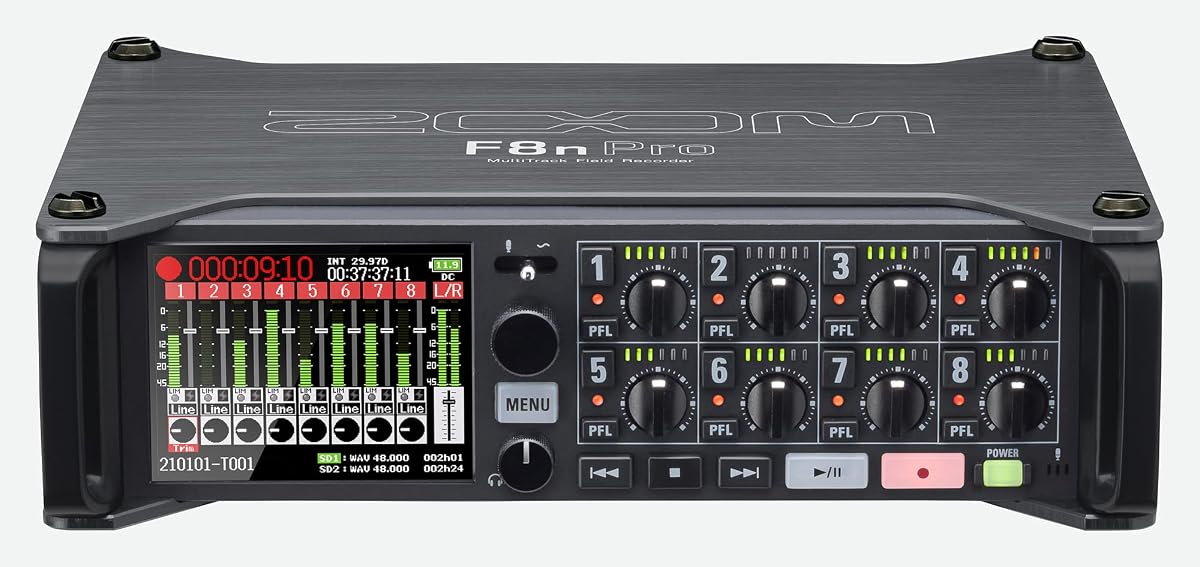
The Zoom F8n Pro is an eight-input, ten-track recorder designed for professional film and field audio. Its supplied rating is 4.6, and the high input count gives it a clear purpose: capturing a larger number of isolated sources without adding another external device. It is a natural fit for documentary teams, larger narrative units, and productions that need dedicated tracks for several microphones.
We may earn a commission when you buy through this link, at no additional cost to you.
The recorder combines 32-bit float recording with dual AD converters and high-quality preamps offering up to 75dB of gain. Timecode accuracy down to 0.2ppm supports precise synchronization, while dual SD slots allow redundant recording to separate cards. Three outputs provide flexibility for camera feeds, headphones, and external devices.
Its capabilities also increase the importance of preparation. Eight inputs can be more than a small crew needs, and the recordist must still plan microphone placement, gain staging, timecode, and file management. The F8n Pro is therefore better suited to an experienced recordist than to someone looking for a recorder that can be taken out and used immediately.
For productions that value redundancy, precision, and maximum input flexibility, the F8n Pro is a top-tier choice. It also functions as an 8-in/4-out USB audio interface while recording to card, which helps it bridge a location capture session and a computer-based workflow.
Dual SD card slots permit redundant recording, providing an additional layer of protection for important takes. The feature is valuable on long shoots where replacing or recovering a card would be inconvenient.
The 0.2ppm timecode specification and flexible outputs make the recorder appropriate for crews synchronizing several devices. It is designed to fit a professional production chain rather than a simple standalone session.
We may earn a commission when you buy through this link, at no additional cost to you.
The Zoom H1 XLR is a compact two-channel recorder with a supplied rating of 4.5. Its two XLR/TRS combo inputs and support for 32-bit float recording at 96kHz bring useful production features to a relatively simple format. It suits filmmakers who need clean dialogue or a compact recorder for a two-microphone setup.
We may earn a commission when you buy through this link, at no additional cost to you.
The OLED waveform display is a practical feature for a field recorder because it allows the operator to see levels at a glance. The additional 3.5mm stereo input and headphone output provide flexibility for monitoring and external connections. SDXC support up to 1TB gives the recorder ample room for extended sessions and high-quality files.
The tradeoff is that it is not a multi-channel production machine. Two inputs may not be enough for a crew recording several subjects, a boom, and separate ambience tracks at the same time. There is also no built-in microphone mentioned in the supplied specifications, so it is less convenient for spontaneous stereo capture without additional equipment.
The H1 XLR is an excellent fit for small crews, interviews, and compact documentary work where two clean channels are the priority. It is also a practical choice for anyone who values straightforward level monitoring and high-resolution float recording without the complexity of a larger field mixer.
The OLED waveform display gives the operator a visual indication of signal activity. It helps reduce the need to watch separate meters and makes level management more direct on location.
Two XLR/TRS combo inputs support microphones and other line-level sources without adding a full-size field recorder. The recorder is well suited to productions that only need one or two carefully chosen channels.
We may earn a commission when you buy through this link, at no additional cost to you.
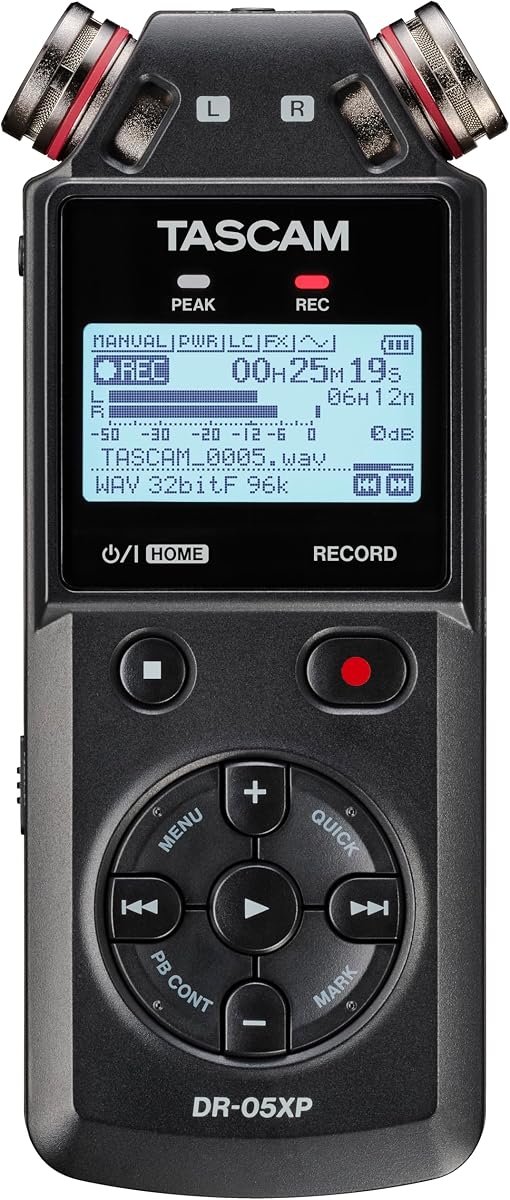
The TASCAM DR-05XP is a portable handheld recorder whose supplied rating is 4.2. It is designed to be especially easy to use for music, audio-for-video, meetings, dictation, and general stereo recording. Its built-in omnidirectional condenser microphones make it a practical option for filmmakers who want ambience, reference audio, or room sound without carrying separate microphones.
We may earn a commission when you buy through this link, at no additional cost to you.
Recording modes include 32-bit float, 24-bit, and 16-bit, with sample-rate options of 96kHz, 48kHz, and 44.1kHz, as well as MP3. The built-in microphones handle loud environments and sources up to 125dB SPL, while the 2-in/2-out USB-C interface allows direct computer recording. Battery life of up to 17.5 hours with two AA alkaline batteries supports extended sessions.
The supplied information does not list dedicated timecode, and its two-input USB interface is not a substitute for a dedicated multi-track production recorder. The 4.2 rating is also lower than the ratings of the other products in the guide, so buyers should weigh its convenience against the more specialized feature sets elsewhere.
The DR-05XP is best for quick stereo capture, backup ambience, scratch audio, and straightforward production work. It is particularly attractive to a filmmaker who values a self-contained handheld unit, broad recording choices, and a long operating duration over complex synchronization features.
The built-in omnidirectional condenser microphones make the DR-05XP ready to record immediately. This is useful for ambience, room tone, location references, and scratch tracks where speed matters.
Choices across float, fixed-bit, and MP3 recording modes let the operator match the file to the task. The range supports everything from a detailed production recording to a smaller working file.
We may earn a commission when you buy through this link, at no additional cost to you.
The Zoom H5 earns a supplied rating of 4.7 and stands out for its interchangeable input capsule system. It includes a detachable X/Y capsule with shock-mounted microphones and extended signal capacity, allowing filmmakers to change the recording configuration in much the same way a photographer changes lenses.
We may earn a commission when you buy through this link, at no additional cost to you.
Four-track simultaneous recording and two mic/line inputs with XLR/TRS combo connectors give the H5 substantial flexibility for small productions. Each input offers selectable phantom power and a -20dB pad, while the included X/Y capsule supports stereo recording without external microphones. The audio safety net also provides an added layer of protection.
The main limitation is its older storage specification of up to 32GB, which is modest compared with the newer recorders listed here. Its USB interface is also designed as a multichannel and stereo option for PC, Mac, and iPad, with a loopback function, rather than a modern high-resolution computer interface with extensive channel counts.
The H5 remains a versatile choice for filmmakers who value the capsule system, four-track flexibility, and a high supplied rating. It works well for interviews, small crews, and flexible location sessions, particularly when a production may benefit from switching between stereo and external microphone configurations.
Interchangeable capsules let the operator choose a different microphone arrangement as a production changes. The included detachable X/Y capsule offers a convenient starting point for stereo and reference recording.
Four-track simultaneous recording adds useful flexibility for small film crews. Two XLR/TRS inputs, phantom power, and a pad make it easier to accommodate a varied collection of sources.
We may earn a commission when you buy through this link, at no additional cost to you.
The TASCAM DR-10L Pro is a compact wearable recorder designed to capture personal audio close to the subject. Its supplied rating is 4.4, and it includes a matched TM-10L clip-on lavalier microphone. This makes it a direct, practical choice for documentary, wedding, interview, and behind-the-scenes recordings where a visible recorder would be distracting.
We may earn a commission when you buy through this link, at no additional cost to you.
Its 32-bit float recording captures a wide range of levels, while firmware version 2.0 adds LTC Jam Sync for timecode synchronization. The recorder supports high-capacity microSDXC media, and the included lav is designed for clear personal capture in busy environments such as receptions. Compatibility with the AK-BT1 Bluetooth adapter also opens the door to Atomos Wireless Timecode workflows.
The wireless timecode feature is limited to the AK-BT1, and the supplied information explicitly states that the AK-BT2 is not compatible. A buyer who already owns the newer adapter should choose another solution or verify compatibility before purchasing. The device is also specialized around a lav-microphone workflow rather than general-purpose multi-input mixing.
The DR-10L Pro is a strong recommendation for a filmmaker who wants a discreet audio solution with minimal setup. It is especially useful when recording several people independently, provided the crew is willing to manage compatible synchronization hardware and understand the recorder's wireless accessory requirements.
The included TM-10L lavalier and wearable format place the microphone close to the speaker. That proximity can improve the directness of dialogue while keeping the recorder out of the camera's main view.
LTC Jam Sync and Atomos Wireless Timecode support through the AK-BT1 expand the recorder's role in multi-device productions. The compatibility limitation is important, so the required adapter should be confirmed before the shoot.
We may earn a commission when you buy through this link, at no additional cost to you.
The Zoom H1 Essential is a simple stereo recorder with a supplied rating of 4.0. It is built for musicians, podcasters, and content creators who need better sound than a phone or camera microphone without a complicated production signal chain. For film, it is most useful for ambience, room tone, sound effects, rehearsals, and general reference recording.
We may earn a commission when you buy through this link, at no additional cost to you.
Its built-in microphones are positioned for convenient stereo capture, and the supplied information highlights video, reels, tutorials, voiceovers, interviews, and behind-the-scenes content as suitable applications. USB-C connectivity allows the recorder to serve as a microphone for livestreams, remote meetings, calls, podcasts, and desktop or mobile recording, making it useful before and after a shoot.
Its limitations are channel count and specialization. There is no indication of XLR or timecode support in the supplied specifications, so it should not be treated as a dedicated production recorder for a multi-microphone crew. The 4.0 rating is also the lowest or joint-lowest in this group, which buyers should consider alongside the simple design.
The H1 Essential is a good choice for a filmmaker who needs a compact backup recorder or a quick way to capture atmosphere and reference audio. It is less appropriate when the production requires isolated dialogue channels, professional timecode, or a direct upgrade to camera audio.
The built-in stereo microphones make the H1 Essential useful for ambience, nature, room tone, and sound effects. A filmmaker can capture a clean reference quickly without assembling a microphone cable.
USB-C expands the recorder beyond standalone capture into streaming, meetings, calls, and computer recording. It is a useful shared tool for a filmmaker working across interviews, tutorials, and short-form content.
We may earn a commission when you buy through this link, at no additional cost to you.
The Zoom F2 is the smallest 32-bit float recorder in this guide and is built around discreet personal audio capture. It has a supplied rating of 4.0 and includes the LMF-2 omnidirectional lavalier microphone, a windscreen, and a lapel clip. That combination makes it straightforward to place and use on interviews, vlogs, weddings, and on-camera recordings.
We may earn a commission when you buy through this link, at no additional cost to you.
The recorder captures at 44.1kHz or 48kHz without requiring gain adjustments, while the internal +/-0.5ppm clock supports audio and video synchronization. The REC Hold switch helps prevent accidental stops during important recordings. It can run for up to 15 hours on two AAA batteries and supports microSD, microSDHC, and microSDXC cards up to 512GB.
The F2 is intentionally specialized. It does not offer the multi-input flexibility, dedicated multi-channel timecode workflow, or multiple isolated tracks available from larger recorders in the guide. Its value comes from portability, ease of placement, and dependable float capture rather than broad input flexibility.
For a filmmaker recording a single presenter or participant, the F2 can be an excellent discreet solution. It is best suited to solo creators, documentary interviews, wedding coverage, and backup audio duties where wearing a compact recorder is more practical than operating a larger field mixer.
The included LMF-2 microphone, screw-lock connector, windscreen, and lapel clip create a ready-to-use personal recording setup. The small footprint also makes the recorder less noticeable on camera.
A REC Hold switch protects against accidental stops, while the long stated battery duration supports full-day interviews and events. The precision internal clock adds useful timing accuracy for later synchronization.
We may earn a commission when you buy through this link, at no additional cost to you.
The right audio field recorder for film depends on the size of your crew, the number of isolated sounds you need, how recordings will be synchronized, and how portable the setup must be.
Begin by counting the independent microphone positions your production actually needs. A two-channel model may be sufficient for a presenter and a backup, while a small documentary crew may need room for a boom, several wireless lavalier transmitters, and a separate ambience channel. Six-input and eight-input recorders provide more room for isolation, but every added channel also increases gain management, labeling, and post-production complexity.
Choose the smallest recorder that comfortably covers your planned source count. More inputs are not automatically better if the extra channels will remain unused.
Thirty-two-bit float recording can preserve a wider range of levels and reduce the consequences of an unexpected peak. It is particularly useful in uncontrolled locations where the operator cannot continuously watch levels or where a subject may move from a whisper to a shout. Fixed-bit recording can still produce excellent results with careful gain control, so float is best understood as added protection rather than a substitute for good technique.
Prioritize float when surprises are common or the microphone is difficult to monitor. For controlled studio-style narration, accurate gain management remains important with either format.
Timecode features become essential when the recorder must align with a camera, another recorder, a wireless system, or multiple personal recorders. Built-in timecode input and output provide more direct control, while jam-sync workflows can coordinate devices that exchange clock information. A basic precision clock may be sufficient for a single-camera workflow with a common start point, but it does not replace full timecode coordination across a multi-device rig.
Confirm the exact synchronization method before buying, especially if the production already uses a particular timecode standard or wireless adapter.
A recorder that performs well in a controlled space can still become a liability on a location shoot. Consider size, weight, mounting options, battery life, power flexibility, and whether the controls remain readable in bright sunlight or harsh weather. Compact wearable recorders are excellent for single-subject capture, while larger multi-input units are more practical when a sound mixer needs to operate a central signal path.
Match the recorder to the physical role it will play. A device that must be worn should prioritize discreet size, while a bag-mounted mixer benefits from accessible inputs and outputs.
Reliable headphone monitoring helps a recordist identify noise, handling movement, clipping risk, and microphone placement problems before the take is lost. Waveform displays, meters, and clear headphone outputs improve this feedback, while a physical recording hold can help prevent accidental stops. A monitor that is inconvenient to use may provide little practical benefit during a fast take.
Look for clear level information and dependable headphone output. Test the included monitoring behavior with the microphones and production workflow you expect to use.
Card capacity determines how long a production can record before files must be transferred or swapped. It also affects how many channels and high-resolution formats can be used in the field. Dual-card redundancy is valuable for irreplaceable material because it can protect against a card failure, while large single-card support offers a simpler operating model. Confirm the supported media type, maximum capacity, and required file format before the shoot.
Bring enough cards for the planned session and maintain a disciplined backup routine. Redundancy is helpful, but it does not replace regular file transfer and verification.
Battery life, removable batteries, USB power, and standalone versus computer-connected operation can determine whether a recorder suits a long production day. USB audio interface support can be valuable when the filmmaker wants to record directly into a computer, but a standalone field workflow remains important for locations without reliable power or connectivity. Consider which power methods fit the crew's habits and whether the recorder will operate as a central audio device or a personal wearable.
Choose a power strategy that supports the longest realistic shooting day. A long stated runtime is valuable only when the required batteries and charging equipment are available.
Before recording, format a compatible memory card, confirm the date and time settings, choose the required file format and sample rate, and perform a short level check with the actual microphones and cables. Set gain conservatively, listen through headphones, and record several seconds of room tone. This preparation helps reveal rumble, electrical noise, handling movement, and signal problems before the production begins.
During a take, keep the recorder and microphone positions consistent, label channels and files clearly, and note the timecode or recording start. Monitor through headphones without making noise that could enter the microphones. After each important take, confirm that the file is present and playable, copy it to a separate drive, and avoid formatting the card until the files have been verified.
For care, keep the recorder away from moisture, excessive heat, dust, and impact. Use a protective case for transport, strain-relief cables where appropriate, and replace batteries according to the manufacturer's guidance. Clean the microphone windscreen and connector surfaces gently, and periodically test the recorder with a short recording rather than waiting until the next critical shoot to discover a storage, battery, or connection problem.
For a two-person interview, a two-channel recorder with reliable XLR or XLR/TRS inputs is usually the most practical choice. The Zoom H1 XLR offers two combo inputs, float recording, and a visible waveform display, while the Zoom F3 provides locking XLR connections and ultra-low-noise preamps. Choose according to how compact and simple the setup needs to be.
Float recording is especially useful on location because levels can change unexpectedly and the operator may not be able to watch the recorder continuously. It can reduce the risk of losing a take to clipping. It does not eliminate the need for sensible gain staging, good microphone placement, or careful monitoring.
It depends on the workflow. A single camera and one separately recorded audio track may be aligned manually from a clear sync point, while timecode becomes more valuable with multiple cameras, recorders, or wireless units. A recorder with timecode input and output provides a more structured and repeatable synchronization process.
A built-in microphone is useful for ambience, room tone, reference tracks, sound effects, and backup recordings. Production dialogue generally benefits from a dedicated microphone placed close to the subject. Recorders such as the TASCAM DR-05XP and Zoom H1 Essential are therefore strongest as supplementary tools when a filmmaker does not need isolated microphone channels.
The Zoom F2 and TASCAM DR-10L Pro are designed for discreet personal recording and are easy to wear or carry. The Zoom H1 Essential is also compact and self-contained. For a central multi-microphone setup, the Zoom F3 is more appropriate because it has locking XLR inputs while remaining relatively portable.
The correct number depends on how many sources must be isolated, not simply how many microphones you own. Two channels may suit a small interview, while a boom, several wireless lavs, ambience, and camera-feed monitoring can require more. Use the smallest recorder that provides clean separation without making the setup unnecessarily difficult to operate.
Several models support USB audio interface operation, including the Zoom F3, Zoom F6, Zoom F8n Pro, TASCAM DR-05XP, Zoom H5, and Zoom H1 Essential. Compatibility requirements and supported channel configurations differ, so confirm the intended computer workflow before the shoot rather than assuming every USB mode behaves identically.
For critical material, redundancy can be valuable. The Zoom F8n Pro includes dual SD card slots for redundant recording, while other models rely primarily on card capacity and a disciplined backup routine. Whichever recorder you choose, transfer files promptly and verify them before reusing or formatting the card.
The Zoom F3 is the strongest all-around recommendation for a filmmaker who wants two dependable professional inputs in a compact body. The Zoom F6 is the better choice when six channels and timecode are needed, while the Zoom F8n Pro stands apart for eight inputs, redundant card recording, and advanced synchronization features.
For a smaller production, prioritize only the capabilities the crew will use: two clean channels for a simple interview, built-in microphones and long battery life for ambience and backup audio, or a wearable recorder for discreet personal capture. Good microphone placement, disciplined gain control, and reliable file management remain at least as important as the feature list.
Finally, check current prices, availability, card compatibility, accessories, and synchronization requirements before purchasing. The supplied ratings provide a useful starting point, but the best audio field recorder for film is ultimately the one that matches your recording topology, physical workflow, and post-production synchronization plan.