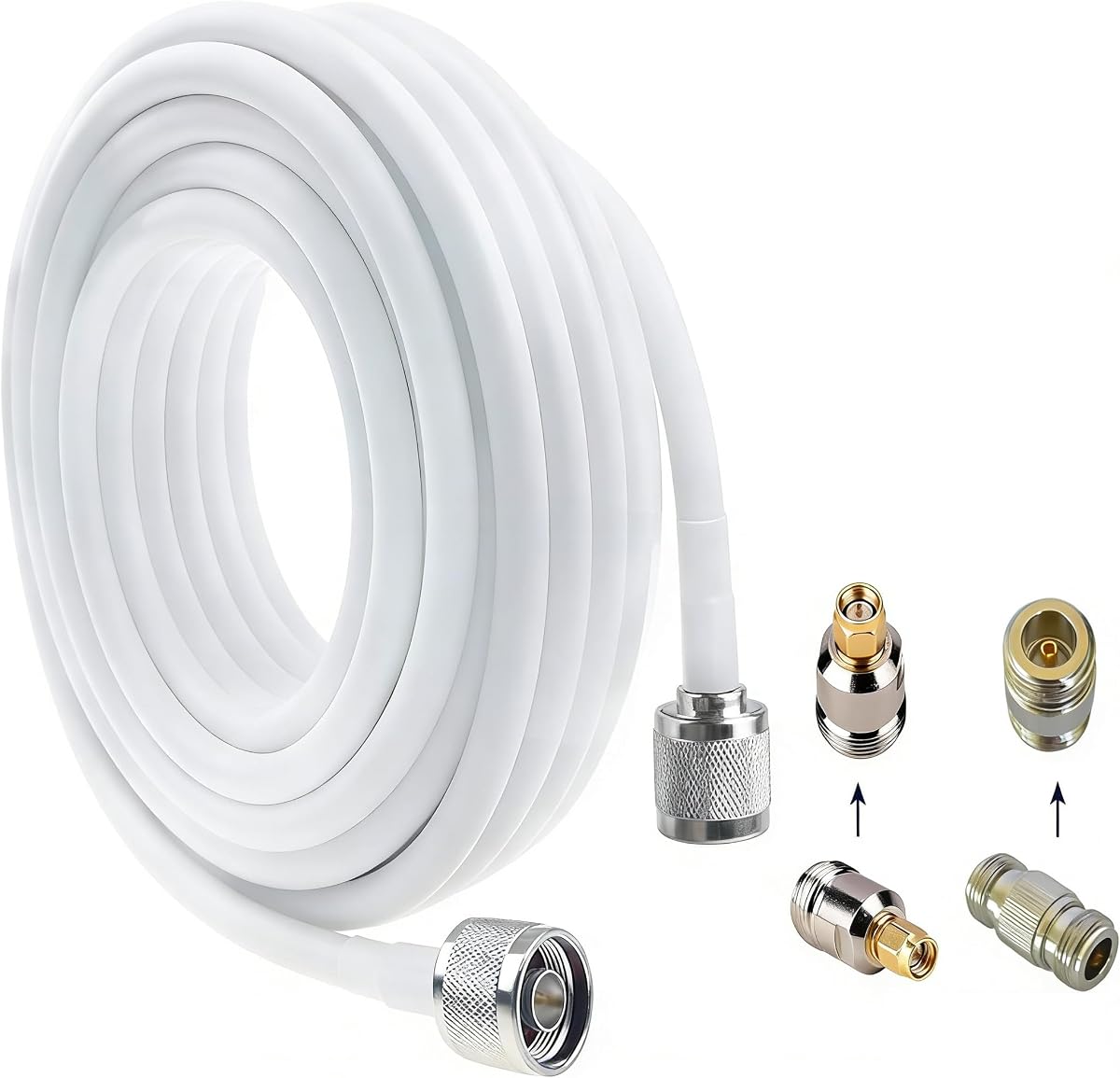
N Male to N Male Coaxial Cable 50ft
4.3Editor score
50-foot 3D-FB run
N male to N male
Includes coupling adapters
Our guide compares the 10 best coaxial cables for cell phone boosters, covering loss, impedance, length, connectors, weather resistance, and installation fit.
Coaxial cables for cell phone boosters connect outdoor antennas, indoor antennas, splitters, and amplifiers, so the right cable can materially affect signal transfer and installation flexibility. A useful cable balances low attenuation, correct 50-ohm impedance, dependable connectors, suitable length, and the durability required by its route.
We compared all 10 products by examining their stated cable type, impedance, length, connector configuration, shielding, environmental features, and intended booster applications. The list includes 3D-FB and 5D-FB runs, RG8X options, N-to-N and N-to-SMA configurations, a dual-cable kit, and a short RG58 jumper.
Each review explains where that cable stands out, what compromises buyers should consider, and which installation it suits best. The recommendations reflect the supplied product information rather than hands-on testing, and product listings, connector availability, and installation conditions can change as well.
4.3Editor score

5.0Editor score
4.6Editor score
The table below compares all 10 cables by construction, run length, connector arrangement, and booster-related use, making it easier to identify the option that matches a particular antenna system and installation route.



This 50-foot 3D-FB cable is designed as a practical extension between compatible cellular booster components, and its 4.3 rating reflects a generally positive reception. The most notable feature is the included adapter set: a female-to-female N coupler and an N-female-to-SMA-male adapter give installers extra options when the antenna, booster, or existing cable does not present matching N-male ports.
We may earn a commission when you buy through this link, at no additional cost to you.
The cable uses 50-ohm impedance, a high-quality CCA conductor, and shielded construction intended to preserve cellular signal transfer over a moderate run. At 50 feet, it offers enough distance to move an outdoor antenna away from a wall, route a connection through an attic, or reach between a garage and the main building without committing to a 100-foot installation. The white jacket may also blend more readily with some exterior and interior finishes than a conventional black cable.
Its weather-resistant insulation is an important strength for outdoor antenna or rooftop runs, where the cable may encounter moisture, sunlight, and changing temperatures. The shielding is also intended to resist interference, while the supplied adapters make it easier to adapt an existing installation. The tradeoff is that N-to-N ends do not directly fit SMA equipment without one of the included adapters, and CCA is not the same construction as solid copper.
This is a strong choice for buyers who want a moderately sized booster cable without moving to the longest available run. It is especially useful when an outdoor antenna needs a little more distance from the building or when an installer wants adapter flexibility. Verify every connector before ordering, plan the route to minimize sharp bends, and use compatible weatherproof connections for exposed installations. For many straightforward residential and small-office booster systems, it offers the most versatile balance in this list.
The included adapters make this cable more practical than a basic fixed-connector run. Instead of replacing every incompatible component, a user may be able to build or extend the system using the supplied coupler and SMA adapter. That convenience, combined with a manageable 50-foot length and 3D-FB construction, explains why it works well as a value-oriented selection for common cell phone booster setups.
The N female-to-female coupler and N-female-to-SMA-male adapter provide useful connection options for mixed equipment. They can extend a run, join compatible sections, or bridge an N-equipped booster component to an SMA connection without requiring a completely new cable.
Fifty feet is long enough to improve antenna placement around many buildings while remaining easier to route than a 100-foot cable. It works particularly well for moderate outdoor-to-indoor booster runs, attic routes, and garage installations.
We may earn a commission when you buy through this link, at no additional cost to you.
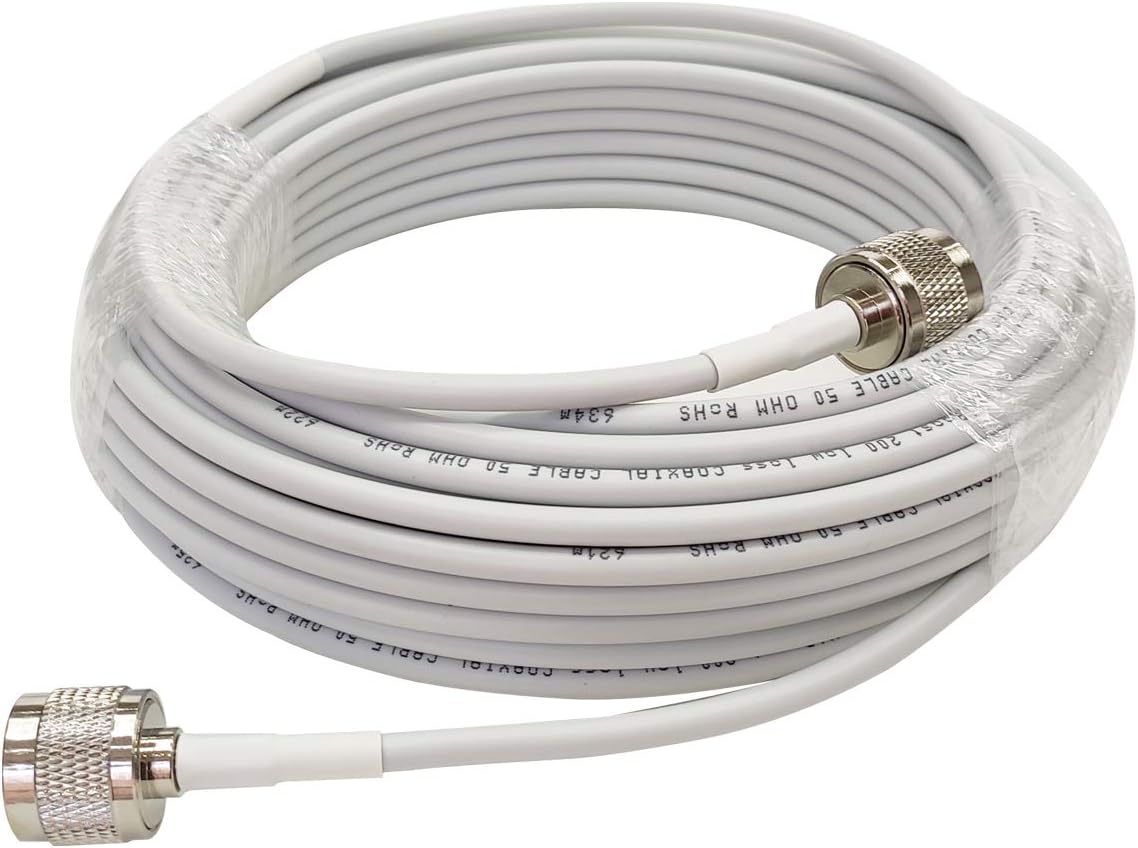
The HiBoost 50ft Ultra Low Loss Coaxial Cable is a straightforward 3D-FB run for cell phone signal boosters, splitters, and indoor or outdoor antennas. It carries a 4.3 rating and is built around a 50-ohm characteristic impedance. Its clearest appeal is the combination of a useful moderate length, low-loss designation, and a jacket explicitly described as both waterproof and UV resistant.
We may earn a commission when you buy through this link, at no additional cost to you.
The N-male-to-N-male configuration fits many conventional booster components without adapters. Because the listed applications include splitters, taps, outdoor antennas, and indoor antennas, it is a versatile link for installers building a complete signal-distribution setup. The outer PVC jacket is described as durable and suitable for indoor or outdoor use, allowing the same cable to handle a protected interior route or an exposed exterior section.
The principal limitation is that 50 feet may not be sufficient when an outdoor antenna is far from the building or needs to be mounted at a substantial elevation. A longer cable can provide more placement flexibility, but the 50-foot option is easier to manage, conceal, and route through finished spaces. Buyers also need to confirm that both attached devices have female N ports because the cable itself has male connectors at both ends.
This cable is a good fit for a standard N-connector booster system that needs a durable link of moderate length. It is particularly attractive for outdoor antenna runs, rooftop placements, indoor antenna connections, and installations that pass through both interior and exterior environments. For users who prioritize a concise 50-foot run and rugged jacket characteristics over maximum distance, it deserves consideration.
What distinguishes it from the first option is its more focused positioning around a straightforward N-to-N booster connection. It does not include the extra adapter set offered elsewhere, but its stated waterproof and UV-resistant construction makes it a clean choice for compatible systems that need a dependable cable without extra connection hardware.
The waterproof and UV-resistant PVC jacket is designed for outdoor antenna and rooftop use while remaining suitable indoors. This makes the cable a practical choice when a run crosses an exterior wall, attic, garage, or other mixed environment.
Both ends use N-male connectors, allowing one cable to serve outdoor antennas, indoor antennas, splitters, and compatible booster hardware. Buyers should confirm that the connected equipment has female N ports.
We may earn a commission when you buy through this link, at no additional cost to you.
This 100-foot 5D-FB cable combines a long installation run with direct N-male and SMA-male ends, making it an especially practical option for mixed cellular booster systems. Its 5.0 rating is the highest listed among these products. The stated use of a larger center conductor is intended to reduce attenuation over the 30-meter run while preserving stable cellular transfer.
We may earn a commission when you buy through this link, at no additional cost to you.
The nickel-plated connectors offer a secure, corrosion-resistant connection, and the different connector types increase routing flexibility when an outdoor antenna uses one interface and the amplifier or booster uses another. The cable is also listed for Wi-Fi extenders, CB radios, and ham radios, although its 100-foot length and low-loss 5D-FB construction are particularly relevant to cellular antenna placement.
A flexible, heat-resistant, waterproof PVC jacket is designed to tolerate rain, snow, UV exposure, and temperature changes while remaining bendable enough for attic or interior routing. That combination is useful for a long exterior run that may need to curve around building features. The tradeoff is that longer cables must be installed carefully, and the N-to-SMA configuration will not connect directly to two female N ports or two female SMA ports without an appropriate arrangement.
This is the most versatile long-run choice for a compatible booster setup, especially when antenna and amplifier connectors differ. It is well suited to an outdoor Yagi or panel antenna feeding an indoor amplifier, repeater, tap, or splitter. Measure the complete route, minimize excess slack, and verify both connector genders before installation. For buyers who want substantial length and a ready-to-use mixed-connector configuration, it is the strongest all-around recommendation in this guide.
The product's 5.0 rating should not be treated as a guarantee of performance in every environment, but it does indicate especially strong customer reception among the listings reviewed. The 100-foot length gives users room to improve antenna placement, while 5D-FB construction, 50-ohm impedance, and a weather-resistant jacket address the core requirements of a dependable booster run.
A 100-foot cable provides meaningful freedom to position an outdoor antenna farther from obstructions, a building edge, or internal booster equipment. That extra distance can make it easier to find a clearer location for the antenna before routing the cable indoors.
The N-male and SMA-male ends suit many common outdoor-antenna and amplifier combinations. The mixed arrangement can be more convenient than carrying an extra adapter, although the connected ports still need to match the cable ends.
We may earn a commission when you buy through this link, at no additional cost to you.
This SMA cable kit pairs a 20-foot 3D-FB extension with a 20-inch jumper, giving installers two useful lengths in one package. Its 5.0 rating reflects strong customer reception, while the dual format distinguishes it from conventional single-run cables. It is intended for cellular systems that need short-to-medium extensions, equipment relocation, and flexible routing around finished walls.
We may earn a commission when you buy through this link, at no additional cost to you.
The longer cable is a low-loss extension for an outdoor antenna, indoor booster, garage, RV, or office. The short jumper is designed to pass through a tight window gap or a small wall penetration, including installations where drilling would be undesirable. Together, they create a practical system for placing a short distance from a wall or window rather than committing to a long cable that must be concealed.
Standard SMA male-to-female connectors provide broad compatibility with many signal booster systems, although users still need to check the gender and type of every port. The 3D-FB construction is intended to limit attenuation over the 20-foot extension, while the flexible jumper makes a tidy connection where equipment sits close to an opening. The main limitation is reach: neither included cable can replace a 50- or 100-foot run for a distant outdoor antenna.
This kit is an excellent choice for renters, finished homes, RV installations, and compact offices where neat routing matters. It is also useful for replacing short booster leads or creating a staged extension that can be repositioned. It is less appropriate when the antenna must sit far from the building or high on a distant pole. For those situations, a longer 5D-FB or RG8X cable would be a better match.
Rather than competing as the longest or most powerful cable, it succeeds through flexibility of installation. The two-piece format solves several common routing problems at once, and the 5.0 rating indicates a favorable response among buyers seeking a straightforward SMA-based extension solution.
The 20-foot section covers a moderate extension, while the 20-inch jumper handles a final short connection near a wall, window, or device. Including both reduces the need to select and route a separate short lead.
The short jumper can pass through a narrow window gap or a small wall hole without the disruption associated with drilling. This makes the kit useful in homes, offices, and RVs where appearance and minimal construction work matter.
We may earn a commission when you buy through this link, at no additional cost to you.
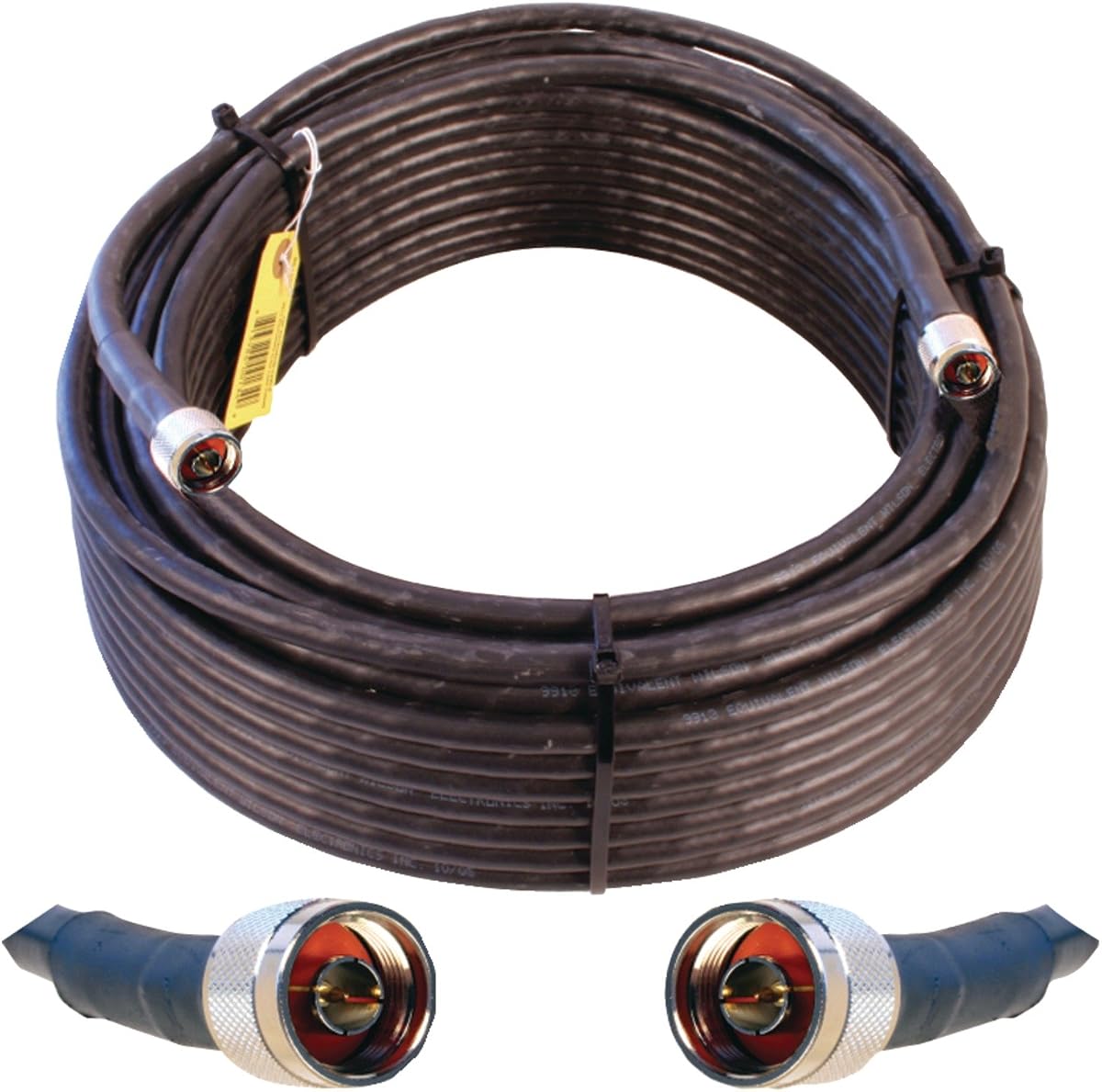
The Wilson Electronics WILSON-400 is a 100-foot ultra low-loss N-male-to-N-male cable built for demanding 50-ohm booster installations. It carries a 4.6 rating and stands apart through its premium construction, broad stated frequency support, weatherproof threaded connectors, two-year manufacturer warranty, and US-based customer support.
We may earn a commission when you buy through this link, at no additional cost to you.
The cable is manufactured and assembled in the USA and is described as CL3 rated, with a stated capacity of up to 300 volts. Its construction uses premium double-shielded twisted pairs and triple-shielded coaxial cable, while the threaded N connector is designed to preserve a secure, weather-resistant connection. The listed frequency range is 30 to 5800 MHz, which covers a wide range of cellular and other RF applications.
The 100-foot length gives an outdoor antenna or indoor antenna considerable placement freedom, including routes between floors, from an attic to a lower level, or around a larger building. The trade-off is the same one associated with any long premium cable: it is more cumbersome to route than a 20- or 50-foot lead, and both connected devices must have female N ports. Its heavier premium construction may also feel less flexible than lighter economy cables.
This is a strong recommendation for a permanent, professionally planned installation where signal continuity, connector security, and manufacturer support matter. It works with 50-ohm antennas and amplifiers, including compatible weBoost in-building amplifier systems equipped with N connectors. Buyers seeking the highest-grade long-run option in this roundup will find a well-specified cable with a reassuring warranty, while standard DIY users may find a shorter cable easier to manage.
Its strongest differentiator is the combination of long reach and premium shielding. The stated construction is intended to minimize signal loss and maintain uninterrupted transfer over distance, and the weatherproof connector supports dependable outdoor use. That makes the WILSON-400 especially appropriate for users who would rather install one robust cable than repeatedly add adapters or extension sections.
Double-shielded twisted-pair and triple-shielded coaxial construction are intended to reduce signal loss and protect the connection from interference. This is valuable in permanent installations that run near other wiring or through demanding building environments.
A two-year manufacturer warranty and US-based customer support make this a more reassuring premium choice. The stated compatibility with 50-ohm antennas, amplifiers, and weBoost systems fitted with N connectors also helps simplify system planning.
We may earn a commission when you buy through this link, at no additional cost to you.
This 100-foot 5D-FB cable delivers a long run with N-male and SMA-male connectors, and its 4.9 rating makes it one of the strongest customer-rated products in the group. It is explicitly intended for cell signal boosters, outdoor and indoor antennas, taps, and splitters, giving it broad relevance for complete residential or commercial RF systems.
We may earn a commission when you buy through this link, at no additional cost to you.
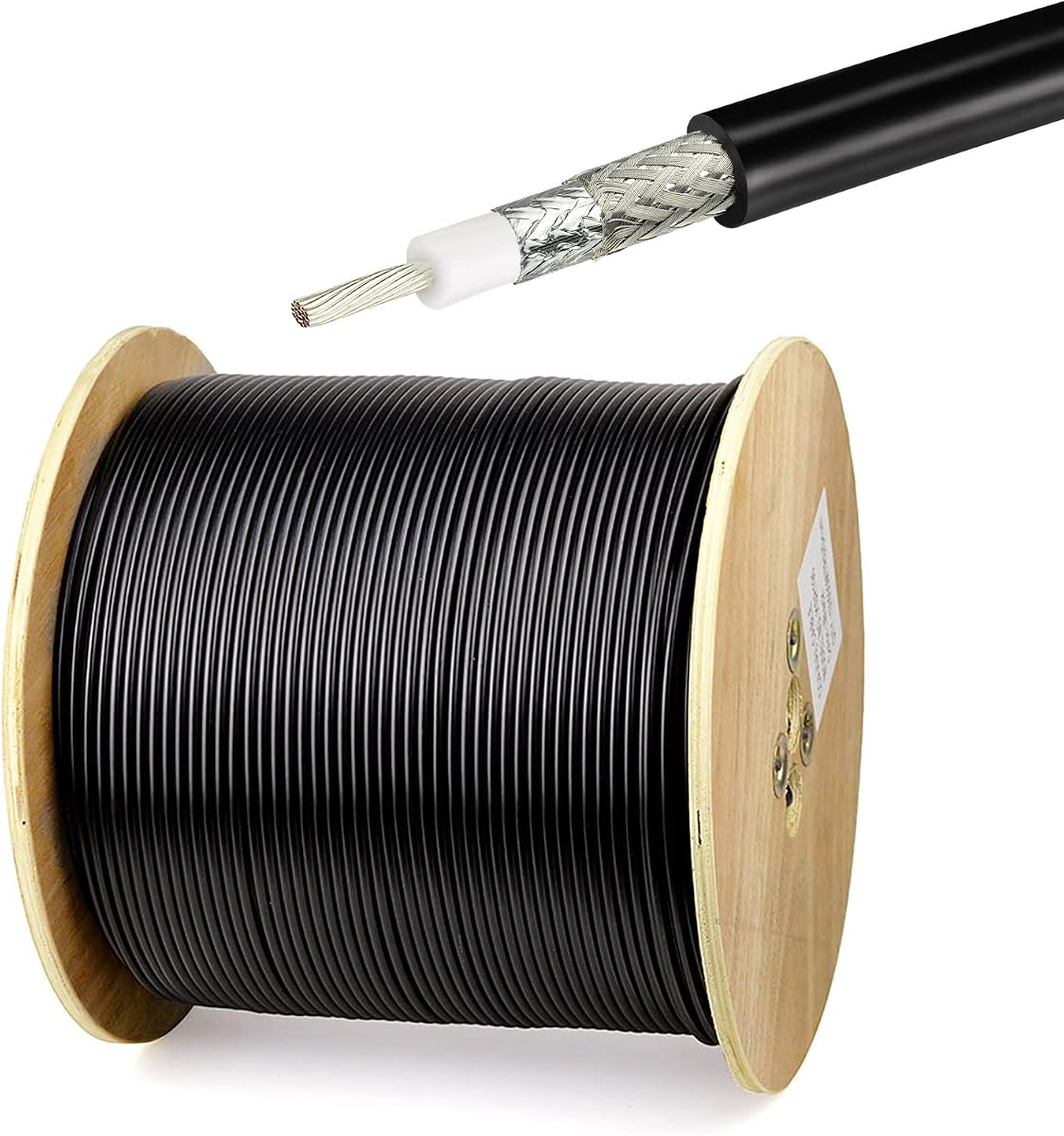
The cable uses copper-clad aluminum and double-layer aluminum foil shielding to support signal integrity while limiting external electromagnetic and radio-frequency interference. Its 50-ohm impedance is designed to reduce reflection and maximize power transfer across standard RF equipment. A tough but flexible PVC jacket provides moisture and UV resistance while allowing routing through attics, walls, and other confined spaces.
Precision-machined N-male and SMA-male connectors use threaded coupling for secure attachment to compatible antennas, amplifiers, and boosters. The necessary trade-off is connector gender: the product note specifically advises checking for an N-female device connection and an SMA-female device connection. Like other 100-foot runs, it also needs careful handling during installation to avoid unnecessary kinks or stress at the terminations.
This option is well suited to installers who want a long cable with a mixed-connector interface and flexible routing characteristics. It can connect a 100-foot separation between an outdoor panel or Yagi antenna and an indoor amplifier, repeater, tap, or splitter. Choose it when the equipment naturally uses one N port and one SMA port, and avoid forcing incompatible interfaces or unnecessary adapters into the installation.
The 4.9 rating and detailed shielding specification make this a compelling alternative to the other 100-foot 5D-FB option with the same connector arrangement. Its double-layer foil shield and flexible weather-resistant jacket are especially attractive for runs that transition from an exterior antenna into an attic, wall cavity, or equipment room.
Double-layer aluminum foil shielding is intended to reduce incoming electromagnetic interference and outgoing signal leakage. That is useful when the cable runs near electrical equipment or passes through areas with multiple wired systems.
The PVC jacket is described as tough and flexible, allowing a 100-foot cable to follow confined paths in attics or walls. Its moisture- and UV-resistant characteristics also suit outdoor and indoor antenna runs.
We may earn a commission when you buy through this link, at no additional cost to you.
The 100-foot 5D-FB N-male-to-N-male cable is designed for long booster runs involving antennas, taps, splitters, and other compatible RF equipment. Its 4.7 rating indicates strong customer satisfaction, and the N-to-N configuration makes it a clean option for systems whose devices already use female N connectors.
We may earn a commission when you buy through this link, at no additional cost to you.
The copper-clad aluminum conductor and double-layer aluminum foil shielding are intended to maintain signal integrity and reduce external interference. A 50-ohm impedance match helps limit signal reflection and maximize power transfer with standard booster, splitter, and antenna equipment. The cable also benefits from a tough, flexible PVC jacket that is described as moisture- and UV-resistant for both indoor and outdoor routing.
At 100 feet, the principal benefit is freedom in antenna placement. The cable can span larger buildings, connect an elevated outdoor antenna to an indoor system, or reach between separate floors and rooms without requiring several extension pieces. Its limitation is that it cannot connect directly to SMA ports, and both connected devices must accept female N connectors. Long runs also demand deliberate routing to prevent strain or sharp bends.
This is a good selection for a standard N-connector cellular booster installation that needs more distance than a 50-foot cable provides. It suits users who value a simple, direct cable configuration and a long run supported by low-loss 5D-FB construction. It is less versatile than the mixed N-to-SMA version, but that focused design can make installation easier when connector types are already standardized.
Its close 4.7 rating and focus on 50-ohm RF distribution make it a versatile long-run selection. The same cable can link compatible outdoor and indoor antennas, taps, and splitters, provided those components use female N ports and operate within compatible electrical specifications.
N-male connectors on both ends create a direct link between compatible female N ports. This is particularly useful when the outdoor antenna, amplifier, tap, and splitter all use a consistent connector standard.
The 100-foot run allows substantial separation between components, while the flexible PVC jacket can follow attic, wall, floor, and outdoor paths. Moisture and UV resistance make it suitable for mixed indoor-outdoor installations.
We may earn a commission when you buy through this link, at no additional cost to you.
This 10-foot RG58 cable is the shortest run in the guide and is positioned for extending an amplifier or connecting a small vehicle antenna to a wireless amplifier. Its 4.6 rating is strong, while the stated attenuation of less than 2 dB makes it a sensible choice where a short, clean connection is all that is needed.
We may earn a commission when you buy through this link, at no additional cost to you.
The SMA male-to-SMA female configuration allows the cable to connect between compatible devices with opposite connector genders. Its low-loss RG58 construction is suitable for the compact applications identified by the manufacturer, including vehicle wireless amplifier setups. A ten-foot lead is also easy to position near a desktop booster, indoor antenna, or piece of cellular equipment without creating excess slack.
This cable is not intended to replace a 50- or 100-foot run between an outdoor antenna and a remote indoor amplifier. RG58 is also a lighter-duty cable type than the RG8X and higher-performance 5D-FB options reviewed here, leaving less capacity for demanding high-power or extended installations. The one obvious advantage of its short length is that signal loss and cable management remain simple.
The best buyer is someone with a specific short-range or vehicle-related need and matching SMA ports. It is also useful as a temporary extension, equipment repositioning lead, or low-loss jumper within a larger system. For a home booster with a distant outdoor antenna, choose a longer cable; for a small vehicle antenna or a nearby indoor component, this compact lead can be exactly the right tool.
A short cable is not automatically a compromise when the route is short. By keeping the run under ten feet, the product maintains a practical loss profile and avoids the routing complexity of a much longer installation. Its focused use case makes it a useful specialized option rather than a general-purpose booster cable.
Ten feet is enough to reposition an indoor antenna, booster module, or vehicle component while keeping the installation tidy. It is particularly useful where the equipment sits close to the relevant antenna or access point.
The stated attenuation of less than 2 dB is appropriate for a short extension or vehicle amplifier connection. It helps avoid adding unnecessary loss where a long cable would be impractical.
We may earn a commission when you buy through this link, at no additional cost to you.
The Superbat RG8X cable is a 50-foot, 50-ohm low-loss option intended to be a step up from standard RG58. Its 4.7 rating indicates strong customer reception, and the stated SWR below 1.15 supports its positioning for high-powered applications and users seeking dependable performance over moderate cable runs.
We may earn a commission when you buy through this link, at no additional cost to you.
The waterproof PVC jacket is designed for harsh outdoor environments. The cable can be bent and strapped without inducing signal interference, according to the supplied product information, which makes it easier to install around buildings, antennas, and other fixed equipment. Its stated compatibility with cell boosters, Wi-Fi repeaters, CB and ham radios, antenna analyzers, and SWR meters gives it broad RF utility.
The product listing mentions compatibility with PL259, SMA, BNC, TNC, UHF, and N connectors, but the specific connector fitted to the included 50-foot cable is not specified in the supplied data. That distinction matters because a coax cable's body and its installed terminations are separate decisions. Buyers must confirm the actual connector combination before purchase, rather than assuming that every listed connector is included.
This cable is a good option for a 50-foot booster run where a robust general-purpose RF cable is desired. It can be used with compatible cell booster systems, and its low-loss RG8X construction offers more headroom than RG58. It is less suitable when the antenna needs a 100-foot run or when a specific 3D-FB or 5D-FB cable is specifically required.
The Superbat stands out for flexibility across several RF applications and a construction that is expressly intended to remain stable when bent and strapped. It is a compelling choice for users who want one cable type for multiple radio-related tasks, provided the installed connectors match the equipment.
RG8X is positioned as an upgrade over RG58 for higher-power systems and longer runs. Its low-loss construction and stated SWR below 1.15 make it suitable for a range of booster and radio applications.
The waterproof PVC jacket is intended for harsh outdoor environments. Its bendable construction can be strapped along a building or support structure without the interference concerns associated with poorly managed coax.
We may earn a commission when you buy through this link, at no additional cost to you.
The MOOKEERF RG8X provides a 100-foot, 50-ohm low-loss run for cellular boosters, Wi-Fi repeaters, ham radio, and other RF systems. Its 4.4 rating reflects generally positive customer reception. The cable is positioned as an upgrade over RG58, with lower loss, an SWR stated below 1.15, and support for longer distances and higher-frequency use.
We may earn a commission when you buy through this link, at no additional cost to you.
The waterproof PVC outer jacket is designed for harsh outdoor conditions. According to the supplied information, the cable can be bent and strapped without inducing signal interference, allowing it to follow a building exterior, roofline, antenna support, or other extended route. Its length provides meaningful freedom in outdoor antenna placement while its broad 50-ohm compatibility makes it applicable to multiple types of RF equipment.
Connector selection is the main point requiring attention. The listing states compatibility with TS9, SMA, BNC, TNC, UHF, and N connectors, but it does not identify which connector is actually installed on this cable. The package includes one 100-foot RG8X cable, and the supplied product information also notes that the received cable does not come with the wooden spool shown in the image.
This cable suits buyers who want a long, rugged, general-purpose RF run and do not specifically need 3D-FB or 5D-FB construction. It may be useful in a 50-ohm booster system that already uses RG8X terminations, as well as in radio and antenna-analysis setups. Before ordering, verify the physical connector type, its gender, and whether the devices require an adapter.
The MOOKEERF's principal advantage is the combination of long reach, low-loss RG8X construction, and an outdoor-oriented jacket. The omitted spool and unspecified installed connector are modest inconveniences rather than functional flaws, but they justify careful attention to the listing details before purchase.
A 100-foot RG8X run allows an outdoor antenna to sit farther from the connected equipment and the structure. It is useful for larger booster layouts, elevated antennas, and installations spread across multiple floors or buildings.
The stated SWR below 1.15 indicates an effort to provide a stable 50-ohm connection with minimal reflection. That makes the cable suitable for boosters, repeaters, radio equipment, and antenna-analysis applications when the correct termination is selected.
We may earn a commission when you buy through this link, at no additional cost to you.
The most suitable booster cable depends on signal loss, system impedance, connector matching, required distance, routing conditions, and the type of equipment being connected. These factors matter more than cable appearance or generic speed claims because even a well-made cable cannot perform ideally when connectors, length, or installation methods are mismatched.
A cellular booster installation should use 50-ohm cable and compatible 50-ohm antennas, amplifiers, splitters, and taps. A mismatch in impedance can contribute to reflections, inefficient power transfer, and unstable performance. Every option in this guide is described as 50 ohm or as a low-loss 50-ohm RF cable, so the more important next step is confirming that the rest of the system uses the same standard.
Choose a cable whose stated impedance matches every connected component, and avoid introducing unnecessary adapters. Consistent 50-ohm equipment creates the most straightforward installation path.
The difference between RG58, RG8X, 3D-FB, and 5D-FB becomes more important as cable length increases and the installation becomes more demanding. RG58 works well for short runs, while RG8X, 3D-FB, and 5D-FB are generally more appropriate when attenuation matters over longer distances or in higher-power RF systems. Within the 3D-FB and 5D-FB groups, 5D-FB is positioned as the more performance-oriented construction.
Prioritize low-loss construction for outdoor antenna runs and use RG58 only when a short connection genuinely meets the installation need. For longer routes, select the higher-performance option that matches your system.
The connector printed on a cable's title must match the port on the device at both ends, including gender. N-male-to-N-male cables require female N ports, while an N-male-to-SMA-male cable requires one female N port and one female SMA port. An SMA male-to-female cable similarly needs a female SMA connection on the male end and a male SMA connection on the female end.
Inspect both devices before ordering, write down the port types, and purchase any necessary coupler or adapter at the same time. Never force a mismatched connector or assume that a listed compatible connector is included.
A longer cable offers more freedom in placing an outdoor antenna away from obstructions, but it also introduces greater attenuation and becomes more difficult to route. A 100-foot cable can be worthwhile when the antenna needs elevation or distance from the building. A 50-foot cable may be sufficient for a moderate exterior route, while a 10-foot lead is better suited to a nearby component or vehicle antenna.
Measure the complete planned path, including vertical drops, turns, service loops, and entry points. Buy enough length to avoid tight bends and unnecessary strain, but avoid leaving large amounts of unmanaged cable where it can create installation problems.
Shielding helps prevent external electromagnetic and radio-frequency interference from degrading the signal and can reduce unwanted signal leakage. The 5D-FB products in this guide use double-layer foil shielding, while the Wilson WILSON-400 has premium double-shielded and triple-shielded construction. These attributes are particularly helpful where the cable runs near electrical equipment, other communications wiring, or shared building infrastructure.
Look for a shielded cable with a 50-ohm design when the route passes through electrically busy areas. Proper grounding and compatible surge protection remain separate installation considerations, but a well-shielded cable provides a stronger foundation for the system.
An outdoor antenna cable needs a jacket that can withstand moisture, sunlight, and changing temperatures. Products described as weatherproof, waterproof, heat-resistant, or UV-resistant are better suited to rooftop, exterior wall, and pole-mounted routes. Indoor and outdoor ratings also help when a single run passes from an exterior antenna into an attic, garage, basement, or finished wall.
Match the jacket to the exposure, protect connector interfaces from moisture, and secure the cable without crushing it. A durable jacket does not excuse poor sealing at the termination, where water and corrosion can cause serious problems.
Flexible cables are easier to move through attics, wall cavities, window gaps, and around curved surfaces. The 20-inch jumper in the dual-cable kit is especially useful for a small wall penetration or a no-drilling installation. Longer 100-foot cables need enough flexibility to avoid sharp bends and stress at the connectors.
Choose a compact jumper for tight access and a flexible long-run cable for broader antenna placement. Follow the manufacturer's routing guidance and avoid forcing the cable into a bend much tighter than its construction allows.
Included couplers and adapters can save time and reduce compatibility risk, while manufacturer warranties and customer support can add confidence for a permanent installation. The WILSON-400 includes a two-year manufacturer warranty and US-based support, whereas the 50-foot N-to-N cable includes a coupler and an N-to-SMA adapter. Neither advantage is decisive if the connector configuration does not match the system.
Check the full package contents before purchase and compare those contents with the ports on your equipment. Warranty support is useful, but correct connector and impedance matching should remain the first priorities.
Begin by identifying the connector and port type at both ends of the system. Confirm that the cable's length can reach the intended antenna and amplifier positions while leaving enough slack for service loops and stress relief. Arrange the route before connecting equipment, keeping the cable away from sharp metal edges, moving parts, excessive heat, and sources of electrical interference.
Connect the cable to compatible ports without twisting or forcing the locking interface. Outdoor terminations should be sealed against moisture, and exposed cable should be secured at intervals with supports that do not deform the jacket. Use gentle bends, avoid tightly coiling a long run, and keep excess cable in a controlled loop rather than leaving it stretched or hanging.
For maintenance, inspect outdoor sections for damaged insulation, corrosion, loose connectors, and water intrusion. Do not sharply bend a cable to make it fit a narrow opening, because the center conductor and shielding can be stressed. If a booster system becomes unstable after adding or replacing a cable, check connector compatibility, the 50-ohm system match, the installation route, and the integrity of every termination before changing other components.
A low-loss 50-ohm cable is generally the most suitable foundation for a cellular booster installation. RG8X, 3D-FB, and 5D-FB options are more appropriate than lightweight RG58 for long or demanding runs, although RG58 can work well for short connections. The exact choice should also match the connector types, amplifier, antennas, and routing conditions.
5D-FB is generally the more performance-oriented cable construction, especially over longer distances or in higher-demand RF installations. The difference may not be dramatic in a short, clean run, but 5D-FB can be a better choice when attenuation and shielding are priorities. Connector compatibility, correct installation, and antenna placement still have a major effect on the completed system.
Choose a length that allows the outdoor antenna to reach a clear location without unnecessary slack, sharp bends, or strain. A 50-foot run suits many moderate installations, while 100 feet can provide useful elevation or distance for larger properties. Short ten-foot cables are primarily for nearby equipment and vehicle amplifier applications, not distant outdoor antennas.
Yes, provided the booster, antennas, splitters, taps, and other components are also designed for a 50-ohm system. A matching cable cannot correct an impedance mismatch elsewhere in the installation. Confirm the specifications of the complete system and ensure that all adapters and terminations preserve the intended connection.
It means that both cable ends have male N-type connectors. To connect directly, the corresponding ports on the antenna, amplifier, booster, or splitter must be female N. If one device has an SMA port, a suitable N-to-SMA adapter or a cable with mixed connectors will be needed.
Yes, when the specific RG8X cable has a weather-resistant jacket and properly sealed terminations. Both 50-foot and 100-foot RG8X options in this guide are described with waterproof PVC jackets and are intended for outdoor RF uses. Weatherproof connectors and careful strain relief remain necessary even when the cable itself is weather resistant.
No. Length only helps when it allows the antenna to move to a better location, such as higher up or farther from obstructions. An unnecessarily long run can add attenuation and make routing more difficult. The best length is the shortest practical run that provides the antenna placement the system needs.
They need adapters only when the cable connectors do not directly match the equipment ports. Some products include an N female-to-female coupler and an N-female-to-SMA-male adapter, while mixed-connector cables can eliminate the need for a separate adapter. Always compare the cable ends with every device before ordering.
The strongest overall recommendation is the 100-foot 5D-FB N-male-to-SMA-male cable because it combines a long run, mixed connector compatibility, 50-ohm impedance, a 5.0 rating, and a heavy-duty weather-resistant jacket. The 50-foot N-to-N cable with included adapters stands out as a versatile value pick, while the Wilson WILSON-400 is the premium option for buyers who prioritize shielding, long reach, warranty support, and established brand support.
Prioritize correct connector gender, a consistent 50-ohm system, and the amount of attenuation appropriate to the route. Choose a shorter cable for nearby equipment, a 50-foot option for moderate placement needs, and a long 5D-FB or RG8X run when the antenna must be placed farther away. Also account for shielding, weather exposure, routing flexibility, and whether the installation needs adapters or a short penetration jumper.
Before making a final selection, recheck the current product listing, included accessories, connector configuration, and compatibility notes. Product details and installation requirements can change, and the most reliable purchase is the cable whose construction, length, and terminations fit the complete booster system rather than simply offering the longest run.