
DJI Osmo Pocket 3
4.5Editor score
Three-axis mechanical stabilization
One-inch CMOS sensor
4K at 120fps
Our guide compares the best gimbal for filming on kayaks and boats, evaluating stabilization, tracking, weather resistance, battery life, and portability.
Filming from a kayak or boat exposes every camera movement to wind, swells, paddle strokes, and engine vibration. A suitable gimbal should compensate for those forces while remaining portable, controllable, and dependable in damp outdoor environments.
We compared all ten available options across stabilization systems, subject tracking, battery life, mounting flexibility, weather resistance, charging features, and practical travel design. The list includes phone stabilizers, action-camera gimbals, a dedicated vlogging camera, and a multi-device model.
Each review identifies the strongest reason to consider that model, along with meaningful limitations. The selections emphasize real-world suitability for paddling, fishing, cruising, and boating; prices and availability change, so confirm current listings before purchasing.
4.5Editor score

4.4Editor score
4.2Editor score
This side-by-side comparison covers every model in the guide, highlighting the device each gimbal supports, its stabilization approach, outdoor-oriented features, and the most useful distinctions for filming on the water.


The DJI Osmo Mobile 8 combines three-axis stabilization with native tracking, integrated audio reception, and lighting in a phone gimbal designed for movement. Its 4.4 rating reflects a well-rounded feature set, while the direct phone connection and foldable construction make it especially practical for travelers who want to begin filming without assembling a large camera rig.
We may earn a commission when you buy through this link, at no additional cost to you.
Its strongest boating advantage is the combination of native tracking and 360-degree horizontal rotation. A kayaker can position a subject, establish a locked frame, and let the gimbal follow movement without requiring continuous manual correction. Integrated lighting is also useful on an overcast morning or near a shaded shoreline, while the Multifunctional Module adds audio reception in a more compact arrangement than a collection of separate accessories.
The built-in extension rod and tripod allow the device to sit independently for wide boat scenes, group selfies, and stationary observations. Its maximum operating time is listed at ten hours, and it can charge a phone while filming, reducing the risk of a depleted phone during a long outing. The comfortable grip may also be preferable to holding a bare phone throughout an extended paddle or cruise.
This is not a waterproof device, so it still needs protection from splashes and spray. The product information also notes that DJI Mimo has been removed from Google Play because of platform compatibility issues and advises downloading the latest app from DJI's official website. Subjective tracking and app-based features can vary by phone. Even with those considerations, the Osmo Mobile 8 is the strongest all-around recommendation for creators filming from a moving boat because it balances stabilization, tracking, lighting, power management, and flexible mounting in one phone-based system.
Native tracking lets the gimbal follow a person without relying on a separate accessory, while the 360-degree horizontal pan gives paddlers and anglers room to compose moving scenes. This combination is especially useful when the subject cannot hold position or remain directly in front of the operator.
A ten-hour operating limit supports long boating sessions, and phone charging while filming helps manage the demands of continuous capture. The integrated tripod also makes it possible to record unattended scenic footage without occupying both of the operator's hands.
We may earn a commission when you buy through this link, at no additional cost to you.
The DJI Osmo Pocket 3 is the premium choice in this roundup because it combines a dedicated one-inch CMOS camera with built-in three-axis mechanical stabilization. Rather than relying on a smartphone, it offers a 4.5-rated, compact camera system with 4K recording up to 120fps, a rotating two-inch touchscreen, and ActiveTrack 6.0 for keeping a subject centered.
We may earn a commission when you buy through this link, at no additional cost to you.
Mechanical stabilization is especially compelling for filming from a kayak, where slow hull movement, paddle motion, and uneven water can challenge a handheld camera. The compact body is easier to keep stable than a larger phone-and-clamp arrangement, while the rotating display helps frame landscape, vertical, and low-angle compositions. ActiveTrack 6.0 is useful when setting the camera on the included tripod and allowing the subject to move.
The Pocket 3 also provides capabilities that phone gimbals cannot match internally. Its 1-inch sensor supports 4K at 120fps, D-Log M and 10-bit color provide substantial post-production latitude, and stereo recording improves the starting point for vlogs or interviews. It connects directly to two DJI Mic 2 or DJI Mic Mini transmitters for expanded audio workflows. The package includes a protective cover, wrist strap, and a handle with a 1/4-inch thread.
The trade-off is that it is a more substantial purchase than a basic phone stabilizer, and it cannot use the owner's existing phone as the camera. It also does not carry a stated waterproof rating, so rain, spray, and submersion still require caution. For creators who value image quality, audio, compact mechanical stabilization, and integrated tracking, though, it is the most capable premium option for a carefully protected boating setup.
A one-inch CMOS sensor gives the Pocket 3 a clear imaging advantage over typical phone cameras. 4K at 120fps also provides a strong option for slow-motion paddling, fishing, wakes, and other fast outdoor moments where detail and motion cadence matter.
ActiveTrack 6.0 can keep a moving person in frame, allowing the camera to rest on its tripod. This creates a useful unattended filming option when the subject is moving around the boat and the operator needs both hands for paddling, steering, or handling equipment.
We may earn a commission when you buy through this link, at no additional cost to you.
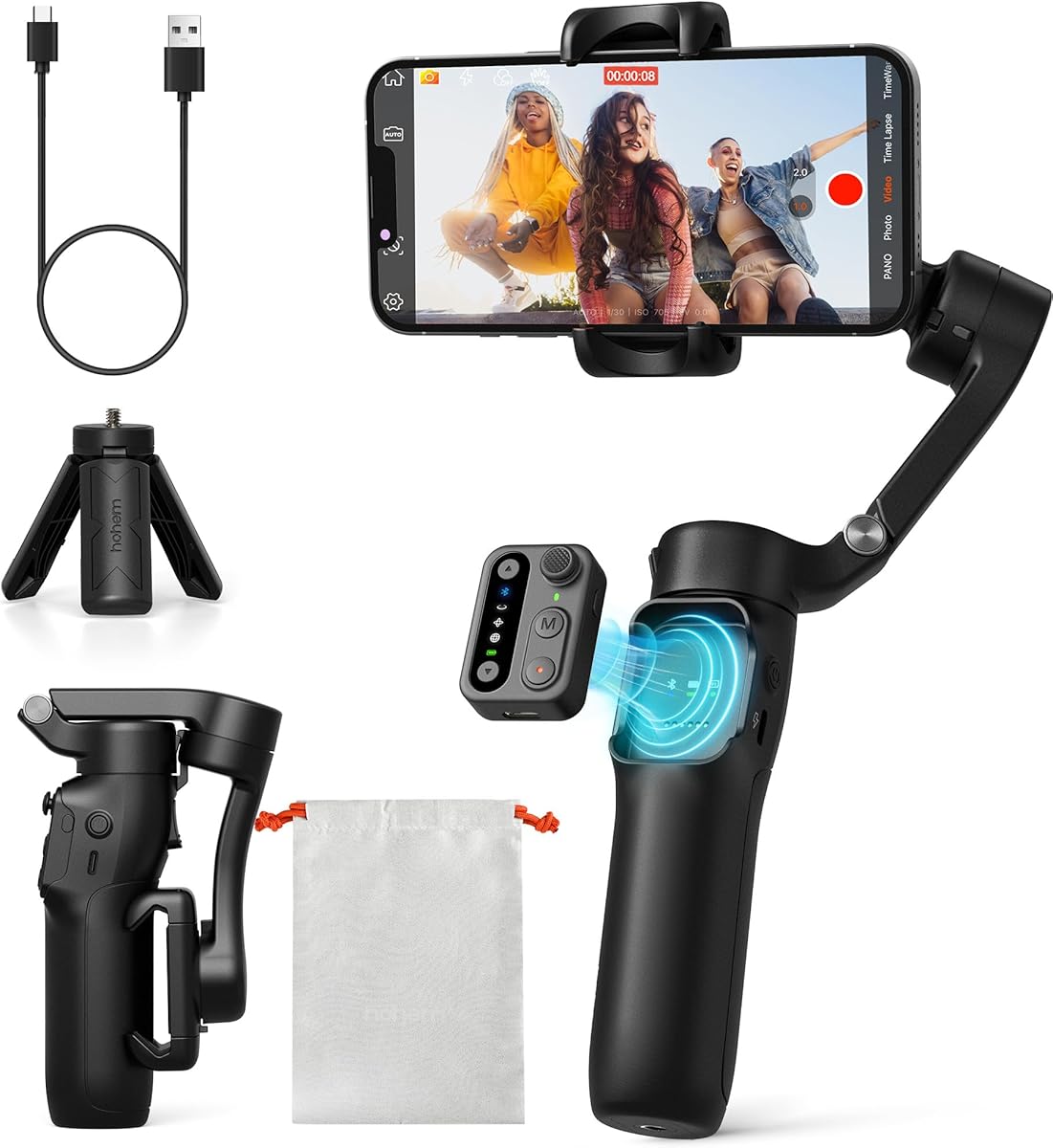
The hohem iSteady X3 SE is a value-focused phone gimbal with upgraded three-axis stabilization, a detachable remote, and a claimed maximum operating time of 11 hours. Its 4.2 rating reflects a capable feature set, and the folding design, quick horizontal-to-vertical switching, and remote control make it easy to adapt to different boating compositions.
We may earn a commission when you buy through this link, at no additional cost to you.
The remote is especially useful in a kayak. Instead of reaching toward the phone and risking a destabilized movement, the operator can start recording, take a selfie, or manage capture from up to 32.81 feet away. Hohem Joy features include AI tracking, gesture control, and creative templates, giving the gimbal more flexibility than a basic stabilization-only stabilizer. Its iSteady 8.0 system is designed to smooth movement during jogging, jumping, and other active situations.
Portability is another major strength. The unit weighs 0.79 pounds and folds to a pocket-sized form, making it easier to carry than a full camera rig. It can also charge in two hours, while the 11-hour operating time covers long fishing sessions, scenic paddles, or full-day events. The 0.66-pound payload supports a range of smartphones, including many larger-screen models.
Its main limitation is the lack of a stated water-resistance rating, which matters around open water. The modest payload also means owners should confirm their phone and any case fit within the stated limit. It lacks the integrated fill light of some competitors, but the combination of wireless remote, long runtime, tracking, and folding portability makes the X3 SE a compelling budget choice for boaters who already own a capable phone.
The detachable magnetic remote gives paddlers and anglers a way to operate the camera without touching the mounted phone. That reduces accidental bumps and permits wider, more deliberate compositions when nobody else is available to hold or retrieve the device.
An 11-hour maximum operating time and two-hour charging period make the X3 SE suitable for extended outings. Its low weight and pocket-sized folding shape also make it easier to protect in a dry bag whenever conditions turn wet.
We may earn a commission when you buy through this link, at no additional cost to you.
The GoPro Fluid Pro AI is the most flexible gimbal in the guide because it works with mobile phones, GoPro cameras, and select compact point-and-shoot cameras. Its interchangeable mounting system, three-axis motors, AI tracking module, integrated fill light, 360-degree rotation, and device-charging support give it a broader role than a standard smartphone stabilizer.
We may earn a commission when you buy through this link, at no additional cost to you.
The removable tracking module can lock onto a person's face or body, which is useful for filming a person fishing, paddling, or moving around a small boat. The integrated fill light can balance darker or strongly backlit scenes, while wireless camera control provides a more direct way to operate supported devices. The supplied package includes mounting brackets for phones and GoPro cameras, a finger adapter, thumb screw, tripod base, two USB-C cables, and a zippered case.
This flexibility also allows the operator to choose a small action camera for boating instead of a larger phone. A GoPro can be useful in a protective housing, and the gimbal's charging capability can extend a filming session. Its AI tracking module is particularly relevant when a person is moving and the boat itself is also swaying, since it reduces the need to make constant framing corrections.
Compatibility requires care. Bluetooth functionality is stated only for GoPro HERO9 Black, HERO10 Black, HERO11 Black, HERO12 Black, and HERO13 Black. The gimbal itself has no stated waterproof rating, so a protective dry bag remains important near waves. Even so, the ability to alternate between action cameras, phones, and selected compact cameras makes the Fluid Pro AI a distinctive choice for creators who want one stabilization platform for several shooting situations.
Interchangeable phone and GoPro mounts make this system more adaptable than conventional phone gimbals. Creators can choose an action camera for compact boating setups or use a phone for the familiarity and flexibility of their normal applications.
The forward- or rear-facing AI module can identify a face or body and maintain it in frame. On a boat, that automation helps preserve composition while the operator concentrates on steering, paddling, or managing the subject.
We may earn a commission when you buy through this link, at no additional cost to you.
The DJI Osmo Mobile 7 remains a strong lightweight choice for filming from a kayak. It has a 4.4 rating, three-axis stabilization, a 300-gram weight, an anti-slip grip, and a 10-hour maximum operating time. Those characteristics make it comfortable for long handheld sessions without the bulk associated with a dedicated camera system.
We may earn a commission when you buy through this link, at no additional cost to you.
ActiveTrack 7.0 can follow subjects in varied situations, while dual-lens enhanced tracking uses the phone's two cameras to support steadier subject framing and fast close-up action. The foldable design includes a built-in tripod, so the same unit can shift from handheld operation to a stationary position without requiring a separate support. DJI Mimo also provides ShotGuides and One-Tap Edit features for creators who want guided framing and faster post-production.
A further convenience is the ability to charge a phone through the gimbal's USB-C connection while filming. That helps preserve shooting time on long outings, although users should still consider their phone's weather protection and battery requirements. The supplied magnetic phone clamp and lightweight body make the Mobile 7 a natural fit for a compact day bag or dry bag.
The optional tracking module is not included, which means buyers wanting the full modular setup may need another accessory. As with the other DJI models in this guide, the Mimo app is no longer available through Google Play due to platform compatibility concerns, and the official DJI site is the stated download source. The Mobile 7 is best for paddlers who prioritize low weight, long battery life, and dependable basic stabilization over the newest integrated tracking features.
At 300 grams, the Mobile 7 minimizes fatigue during repeated paddling strokes and long scenic recordings. The ergonomic anti-slip handle also provides a more secure grip than a phone held directly in wet or moving conditions.
ShotGuides and One-Tap Edit reduce the learning curve for new gimbal users. The built-in tripod adds a stable alternative when an angler wants to frame a shoreline, another paddler, or a self-facing scene without holding the device.
We may earn a commission when you buy through this link, at no additional cost to you.
The DJI Osmo Mobile 7P has the highest rating among the phone stabilizers listed, at 4.5, and is built around three-axis stabilization and a Multifunctional Module. It combines intelligent tracking, compatibility with DJI Mic 2 and DJI Mic Mini reception, and lighting in a compact module, giving boaters a well-rounded mobile production setup.
We may earn a commission when you buy through this link, at no additional cost to you.
The extension rod and built-in tripod are particularly useful for varied compositions. A kayaker can place the phone farther away for a wide river scene, use it as a stable platform for a subject moving nearby, or switch to vertical framing for social media. The magnetic phone clamp and automatic app launch reduce setup time, while dual-lens enhanced tracking helps keep a subject framed during more demanding movement.
The stated maximum operating time is 10 hours. When the Multifunctional Module is functioning as a microphone receiver, the gimbal can also deliver additional power to the phone. That makes the 7P attractive for creators who want stabilized video, wireless audio reception, and fill lighting from a single platform rather than several disconnected accessories.
The module-based approach requires more deliberate setup than a basic phone stabilizer, and the device is not listed as waterproof. The DJI Mimo app must also be obtained from DJI's official website rather than Google Play. Those are meaningful considerations for wet outdoor use. Even so, the 7P's 4.5 rating, native module features, and long runtime place it near the top for mobile creators who want a capable, expandable setup.
The Multifunctional Module is the defining feature of the 7P. It centralizes intelligent tracking, lighting, and wireless microphone reception, allowing creators to adapt the same rig for silent B-roll or narrated boat footage.
A built-in extension rod and tripod eliminate the need for separate accessories for common selfie and stationary shots. This versatility is useful for scenic records, group boating moments, and low-angle perspectives near the water.
We may earn a commission when you buy through this link, at no additional cost to you.
The Hohem iSteady Pro 4 is built for action cameras and rated at 4.1, with a three-axis brushless-motor system, iSteady 5.0 anti-shake processing, and a maximum operating time of 14 hours. That runtime makes it a compelling choice for long fishing days, multi-hour paddles, and boating trips where changing batteries would be inconvenient.
We may earn a commission when you buy through this link, at no additional cost to you.
Its IPX4 rating means it resists water splashes from any direction. That makes it more appropriate for exposed outdoor conditions than an unprotected phone gimbal, although splash resistance should not be confused with full waterproofing or permission for submersion. The gimbal can also act as a power bank, charging the action camera while filming, which adds another layer of endurance for long outings.
Compatibility covers GoPro HERO13 through HERO3 cameras, DJI OSMO Action, Insta360 ONE R in 4K and 1-Inch versions, and similar-sized action cameras. The low-energy Bluetooth connection can control the shutter on listed GoPro models. There are important exceptions: GoPro HERO7 White and Silver models are not supported, and the DJI OSMO Action and Insta360 ONE R can be stabilized but cannot be controlled for photo or recording functions.
The device is a specialist choice because the camera itself is not included and action-camera users may already own a housing for rough conditions. Its 4.1 rating is slightly lower than several alternatives, but the exceptional runtime, splash resistance, and power-bank function make the Pro 4 a strong pick for extended action-camera outings around the water.
The long stated runtime is the standout advantage for full-day boating. Powering the camera while filming adds further flexibility, reducing the need to return to shore when the camera's internal battery would otherwise limit recording.
IPX4 resistance suits spray, light rain, and splashes from multiple directions. It still requires sensible care: the gimbal should be dry before storage, and it should not be treated as a fully waterproof unit.
We may earn a commission when you buy through this link, at no additional cost to you.
This version of the Hohem iSteady Pro 4 emphasizes rapid camera changes with a spring-loaded quick-release clip that reportedly takes three seconds to mount or detach. It offers three-axis stabilization, iSteady 5.0 anti-shaking, 600-degree rotational Inception mode, a 14-hour maximum runtime, and IPX4 splash resistance, earning a 4.2 rating.
We may earn a commission when you buy through this link, at no additional cost to you.
The fast mounting system is useful when a creator moves between action-camera framings while on a boat. A 600-degree rotation can create spinning transitions, while the three-axis system is intended to smooth running and other dynamic movement. Bluetooth shutter control works with GoPro HERO13 through HERO3 models, and cable control expands compatibility with other supported cameras.
As with the broader Pro 4 platform, the gimbal can charge the attached action camera while shooting. That makes it valuable on long outings where access to power is limited. Its splash resistance provides more confidence around spray and light rain than an ordinary electronic stabilizer, provided the unit is allowed to dry before being packed away.
The listing does not mention AI subject tracking, so this is more of a stabilization and creative-movement tool than an automated tracking solution. Control features also depend on the camera model. It is best recommended for action-camera users who value quick mounting, long runtime, power-bank capability, and weather tolerance over automatic subject recognition.
The spring-loaded quick release makes it easier to change cameras or reposition the action camera without fumbling with a conventional clamp. That convenience is valuable when a paddler wants to move quickly between different viewpoints.
The 600-degree Inception mode adds a dedicated transition tool for energetic edits. Bluetooth and cable control provide flexible operation across supported cameras, although buyers should verify their exact model's compatibility.
We may earn a commission when you buy through this link, at no additional cost to you.
The Hohem iSteady M6 is the most feature-dense phone gimbal in the guide, with a 4.3 rating, three-axis stabilization, an OLED status display, AI tracking, a magnetic fill light, and a multi-function control wheel. It supports up to a 400-gram payload, accommodating most smartphones, and is designed for creators who want direct access to operating information.
We may earn a commission when you buy through this link, at no additional cost to you.
The OLED display shows battery level, Bluetooth status, gimbal mode, and other parameters without opening an app. That makes it particularly useful in bright outdoor locations where changing menus or checking a phone can be inconvenient. The control wheel supports roll-axis rotation, focus control, and adjustments to cold, warm, or RGB lighting.
The magnetic fill light offers a color temperature range of 2700K to 6500K, allowing the operator to match early-morning, overcast, or evening conditions. Its AI tracking is described as working in mobile apps, which is valuable for recording a person in a boat while the framing follows automatically. The gimbal can also operate with the phone in front of or behind the roll motor, helping avoid an obstructed view in certain orientations.
The iSteady 7.0 algorithm smooths movement while walking or running, and the 400-gram capacity is more generous than that of several compact competitors. Against that, the M6 lacks a stated splash-resistance rating, which is a meaningful omission for a device intended to be used around open water. Its numerous controls also create a steeper learning curve. It is a compelling choice for a phone-based creator who values tracking, lighting, and a clear display, provided the gimbal is protected from spray.
The OLED display gives immediate access to the information that matters during a shoot. Boaters can check battery and connection status without stopping to open menus, which is particularly helpful on a wet, bright, or unstable deck.
Adjustable CCT and RGB fill lighting can improve subjects that would otherwise be shadowed or strongly backlit. AI tracking across mobile apps then allows the framing to follow a person while keeping attention on the action.
We may earn a commission when you buy through this link, at no additional cost to you.
The Insta360 Flow is built for creators who want to deploy a phone gimbal quickly and keep shooting for a long day. It has a 4.3 rating, three-axis stabilization, Deep Track 3.0, a one-step rapid-deploy design, and a stated battery life of 12 hours. Its folding construction makes it straightforward to carry in a boat bag.
We may earn a commission when you buy through this link, at no additional cost to you.
Deep Track 3.0 supports person re-identification, zoom tracking, slow-motion tracking, and other automated framing functions. Those tools can keep an angler, paddling companion, or nearby wildlife in frame while the operator concentrates on the boat. The AI-powered Shot Genie feature offers scenario-specific filming tips and advice, which lowers the barrier for users unfamiliar with cinematic framing.
The Flow combines several functions in one body: a selfie stick, tripod, and power bank. One-step deployment means the device can be unfolded without twisting a separate extension or pressing a power button, allowing a creator to respond quickly to a passing bird, a shoreline view, or an unexpected moment. Its 2900mAh battery supports the stated 12-hour performance figure.
Compatibility deserves attention. It works with both Android and iOS phones, but some features are unavailable on certain Android models because brand-specific interface protocols differ; the product listing advises checking the compatibility list. The gimbal is also not stated as splash resistant. Subject to those limitations, the Flow is a convenient, portable choice for mobile creators who prioritize fast deployment, long runtime, and sophisticated tracking.
The one-step deployment mechanism removes several common setup steps. That is useful on a moving boat when a wildlife encounter, wave, or scenic passage happens before the operator is ready with conventional phone equipment.
Deep Track 3.0 adds person re-identification, zoom tracking, and slow-motion tracking. These features give creators a way to frame a moving subject while their attention remains on paddling, fishing, or operating the boat.
We may earn a commission when you buy through this link, at no additional cost to you.
The best gimbal for a boat is not simply the one with the longest feature list. Balance stabilization, device compatibility, water exposure, battery life, tracking, mounting options, and the amount of gear the operator can safely handle while the boat is moving.
A kayak introduces constant, irregular movement from hull rocking, current, paddle strokes, and the operator's shifting balance. A three-axis gimbal uses separate movement controls to compensate for pitch, roll, and yaw, producing a more level image than a simple handheld stabilizer. This matters most when filming scenery, wildlife, or another person rather than intentionally preserving raw movement.
Phone gimbals offer flexibility because most travelers already carry a phone, but they must support the phone's size, weight, operating system, and app environment. Action-camera gimbals serve a different audience and should be matched by camera model, while the GoPro Fluid Pro AI supports several device categories. The DJI Osmo Pocket 3 is a complete camera system rather than a mount for an existing phone.
Open water creates a constant risk of spray, drizzle, and accidental splashes. The Hohem iSteady Pro 4 models have an IPX4 splash-resistance rating, giving them a documented advantage in exposed conditions. Other gimbals are not stated as waterproof or splash resistant, so a dry bag, rain cover, or sealed storage pouch is essential. Even a splash-resistant model should be dried before storage, and neither rating nor housing should be treated as permission for submersion.
A long boating session can last far longer than a casual hike. Runtime figures range from 10 hours on several DJI models to 12 hours for the Insta360 Flow and 14 hours for the Hohem iSteady Pro 4. Several devices can also charge an attached phone or camera while filming, which is especially helpful for all-day outings. Actual run time varies with movement, tracking, lighting, and connected accessories, so a spare battery can still be useful for extended trips.
Automated tracking is valuable when another person is moving around the boat or when the operator must keep both hands on a paddle. ActiveTrack 7.0, native tracking, Deep Track 3.0, and AI face-and-body tracking all serve this purpose. Tracking quality can depend on the phone, app, lighting, and subject movement, so it should be treated as a compositional aid rather than a guarantee of perfect framing.
Built-in tripods, extension rods, and selfie sticks can turn a handheld stabilizer into a stationary camera. This expands filming options without requiring another accessory, particularly for scenic records, group shots, and time-lapse-style compositions. A quick-release mechanism also helps when switching cameras or repositioning an action camera. The right choice depends on whether the operator needs continuous handheld support, unattended framing, or rapid angle changes.
A gimbal carried in a kayak must be easy to hold for long periods without causing wrist fatigue. The DJI Osmo Mobile 7 weighs 300 grams, while the hohem iSteady X3 SE weighs 0.79 pounds and folds into a pocket-sized form. The Insta360 Flow similarly emphasizes a foldable, rapid-deploy design. Compactness matters even when the device is powerful because every unnecessary gram becomes more noticeable during repetitive paddling.
Smooth video is less useful when dialogue is noisy or the subject is poorly lit. The DJI Osmo Mobile 8 and 7P integrate lighting and compatible microphone reception features, while the M6 provides adjustable CCT and RGB fill light. The GoPro Fluid Pro AI also includes an integrated fill light. The DJI Osmo Pocket 3 adds stereo recording and direct connection to two DJI Mic 2 or DJI Mic Mini transmitters for creators prioritizing audio.
Begin on land with a fully charged gimbal and compatible camera. Update the required app from its official source, complete the pairing process, balance the device on every axis, and confirm that recording and remote-control commands work. On the water, test the operator's balance and movement before launching, especially when a tripod, extension rod, or large phone changes the center of gravity.
Mount the gimbal securely and keep the phone or camera clamp tight, but avoid overtightening it. Use a wrist strap and retain the camera even if the vessel tips. Keep the lens area clear of moisture and debris, use a protective case or dry bag when spray is likely, and position the device so waves cannot flood an open port. Never submerge a model unless its documentation explicitly permits it.
After the outing, power down the gimbal, disconnect the phone or camera, wipe salt and water from every surface, and let the unit dry fully before storage. Avoid leaving it in direct heat inside a closed vehicle. Periodically inspect the clamp, tripod threads, buttons, charging cables, and motor housings, and update the app or firmware as directed by the manufacturer.
None of the listed products is described as fully waterproof. The Hohem iSteady Pro 4 models have an IPX4 splash-resistance rating, while the other options have no stated water-resistance rating in the supplied information. Use a protective housing or dry bag when appropriate, and do not interpret splash resistance as permission for submersion.
The hohem iSteady X3 SE is a strong answer because its detachable remote allows the operator to control recording without touching the mounted phone. The Insta360 Flow also stands out for one-step rapid deployment, while the DJI Osmo Mobile 8 adds a comfortable grip, integrated tripod, and native tracking. The best choice depends on whether remote operation, speed, or automation matters most.
A phone gimbal is convenient if your phone provides the image quality and app support you need. An action-camera gimbal is better suited to small, protective cameras and models such as the Hohem iSteady Pro 4 that support GoPro cameras. The GoPro Fluid Pro AI bridges both categories, while the DJI Osmo Pocket 3 operates as a standalone dedicated camera.
A full-day trip benefits from the 12-hour Insta360 Flow or 14-hour Hohem iSteady Pro 4, especially if the latter can also charge its action camera. DJI models list 10-hour maximum operating times, and the X3 SE lists 11 hours. Actual performance depends on active stabilization, tracking, lighting, and connected devices.
Yes, because tracking can maintain a subject's position while the operator concentrates on paddling, steering, or handling gear. Native tracking, ActiveTrack 7.0, Deep Track 3.0, and AI face-and-body tracking can all reduce manual corrections. Lighting, subject movement, phone compatibility, and app limitations can affect tracking performance.
Only when the boat is sufficiently stable or the gimbal is secured appropriately. A built-in tripod is useful for scenic filming, group shots, and unattended recording, but it should not be placed where it could tip, fall overboard, or obstruct navigation. Secure the device and maintain awareness of balance and movement.
Choose a gimbal with phone-charging support, such as the DJI Osmo Mobile 7, 7P, 8, GoPro Fluid Pro AI, or Insta360 Flow. Start with both devices fully charged, reduce screen brightness, close unnecessary background applications, and carry a protected power bank for outings that extend beyond the stated runtime.
All ten can stabilize movement, but their different strengths shape the best use. The Osmo Mobile 8 and Flow suit tracked human subjects, the Hohem Pro 4 models suit action cameras and long outings, and the M6 adds adjustable fill light. Stabilization cannot replace proper exposure, audio capture, weather protection, or patience when wildlife remains distant.
The DJI Osmo Mobile 8 is the most balanced overall recommendation because it combines three-axis stabilization, native tracking, integrated lighting and audio reception, a long runtime, and flexible tripod mounting. The DJI Osmo Pocket 3 is the premium alternative for creators who want a dedicated camera, while the hohem iSteady X3 SE delivers the strongest budget-focused package for phone users.
For action-camera users, the Hohem iSteady Pro 4 stands out with 14-hour runtime, IPX4 splash resistance, and camera-charging support. The Insta360 Flow favors spontaneous outings with rapid deployment and advanced tracking, while the M6 offers an unusually informative OLED display and adjustable fill light. Prioritize weather protection, device compatibility, secure handling, and battery needs before optional tracking features.
Prices, availability, accessory bundles, and app compatibility can change, so review the current listing and official compatibility information before purchasing. Keep the selected gimbal protected from immersion, dry it after wet use, and test the complete setup on land before taking it onto the water.