
BZGNSS BZ-251 Dual Protocol
5.0Editor score
NMEA and UBX protocols
Rescue and failsafe support
Oil-sprayed ceramic antenna
Explore the best GPS modules for drones, comparing satellite support, compass accuracy, update rates, protocol compatibility, installation, and portability for
GPS modules for drones add satellite navigation, position feedback, rescue support, and directional awareness to aircraft that may otherwise fly without reliable location data. A worthwhile module must suit the airframe, flight controller, antenna arrangement, and flight style rather than simply offer the longest feature list.
The modules in this guide were compared using their stated chipsets, supported constellations, compass hardware, refresh rates, protocols, dimensions, mounting options, and flight-controller compatibility. The list covers compact racing modules, fixed-wing navigation units, and external-compass designs for Pixhawk and other autonomous platforms.
Each review explains the module's strongest use case, practical advantages, and trade-offs while preserving the distinction between manufacturer claims and independently verifiable information. Rankings reflect the complete supplied feature sets, and product availability, firmware details, and seller information can change over time.
5.0Editor score
4.8Editor score

4.6Editor score
The comparison below places the ten modules side by side, emphasizing chipset generation, GNSS support, compass integration, refresh rate, physical size, mounting arrangement, and the flight platforms each unit is designed to serve.

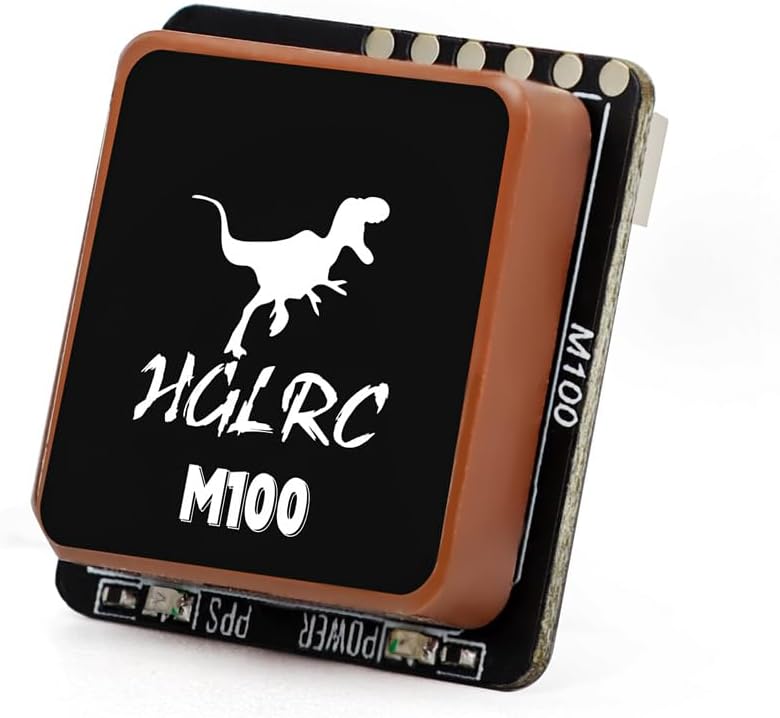




The HGLRC M100 Pro combines a 10th-generation positioning chip, an expanded 120-channel receiver, and a QMC5883L compass in a package explicitly aimed at FPV fixed-wing UAVs. Its 4.6 rating reflects a favorable balance of features, and the integrated heading sensor is especially relevant to aircraft that need more than a basic position fix.
We may earn a commission when you buy through this link, at no additional cost to you.
The expanded receiving channel is one of the module's most interesting features because it suggests broader satellite-tracking capability than older compact systems. A ceramic antenna and separate compass integration can give the fixed-wing builder both spatial position and directional reference, while the external expansion PCB described by the manufacturer is intended to support stable signal reception.
The trade-offs are chiefly the absence of detailed protocol, voltage, dimension, and flight-controller information in the supplied listing. That makes it harder to verify installation fit before purchase, particularly for pilots who need precise integration with a particular controller. The M100 Pro is still appealing when a fixed-wing build needs a modern receiver and compass together without a large external navigation package.
This is the strongest general recommendation for a compact FPV fixed-wing project because it combines a current-generation chipset, wide channel reception, and a digital compass. Buyers should confirm board dimensions, wiring, baud rate, and supported protocols with the seller before committing, and they should place the compass away from motors, ESCs, and high-current wiring.
Combining the receiver and QMC5883L compass reduces the number of separate navigation components that must be coordinated. It also gives fixed-wing pilots useful heading information for orientation-dependent navigation and return-to-home logic.
A 120-channel receiver can draw from a broader pool of visible satellites than a limited-channel design. That can be useful near the edge of a flight area, under partial obstruction, or in locations where the sky view is not ideal.
We may earn a commission when you buy through this link, at no additional cost to you.
The HGLRC M100-5883 is a 21mm-square GPS and compass module built around an upgraded 10th-generation chip. It carries a 4.5 rating and weighs only 7.73g, making it particularly attractive for small FPV fixed-wing aircraft where every gram and millimeter affects the airframe layout.
We may earn a commission when you buy through this link, at no additional cost to you.
Its stated positioning modes cover GPS, Galileo, and BDS, giving the receiver access to three major satellite systems. The manufacturer also highlights fast satellite acquisition, a ceramic antenna, an external expansion PCB, and a QMC5883 compass for identifying direction. Together, these features cover the basic requirements of a compact fixed-wing navigation package.
Compared with modules supporting five or six constellations, this design offers a narrower satellite roster. The supplied information also does not identify exact voltage, connector type, update rate, or supported flight-controller protocols. Those details should be verified before installation, particularly if the builder expects high-rate navigation or a particular wiring standard.
The M100-5883 is best for a lightweight fixed-wing build that needs position and heading in a very small footprint. It offers a clear advantage over a receiver-only GPS when directional awareness matters, but pilots who need broader constellation support or a higher refresh rate should examine the more feature-dense alternatives in this guide.
At 21mm square and 7.73g, the module leaves room for navigation without consuming the center of a small airframe. The reduction in mass also makes it easier to keep the aircraft within its intended performance envelope.
GPS, Galileo, and BDS support can improve the number of satellites available in many environments. The practical benefit depends on signal visibility, and the aircraft should not be flown solely on the assumption of an immediate lock.
We may earn a commission when you buy through this link, at no additional cost to you.
The HGLRC Mini M100 is designed for 2-7 inch FPV racing drones, giving it one of the broadest explicitly stated airframe ranges in the group. Its 4.6 rating, 3.3-5V input range, and visible POWER and PPS indicators make it a straightforward option for builders who value broad fit and simple status checks.
We may earn a commission when you buy through this link, at no additional cost to you.
The ceramic antenna and externally expanded PCB are intended to support reliable satellite reception, while the voltage tolerance makes integration less dependent on a single exact supply level. Status lights are especially useful during bench setup because they provide immediate visual clues about whether the module is receiving power and producing pulse-per-second output.
The principal limitation is that the supplied feature list does not mention an integrated compass. A racing drone that relies on GPS for rescue, position display, or home direction may need to account for that absence. Exact dimensions, connector type, protocol support, and update rate are also unspecified in the available information.
This module is well suited to a compact racing build that needs a position source and works with UBLOX-compatible hardware. It may be the most accessible choice for a pilot moving between small freestyle aircraft and larger FPV models, provided the flight controller can use the module's output and the builder verifies the wiring details.
Compatibility with 2-7 inch drones makes the Mini M100 useful for builders who own more than one FPV platform. Actual fit still depends on available mounting space, cable routing, and the controller's connector and protocol requirements.
Separate POWER and PPS indicators help distinguish basic electrical operation from timing-signal availability. They are particularly helpful before a full flight test, when tracing connections in a crowded electronics layout.
We may earn a commission when you buy through this link, at no additional cost to you.
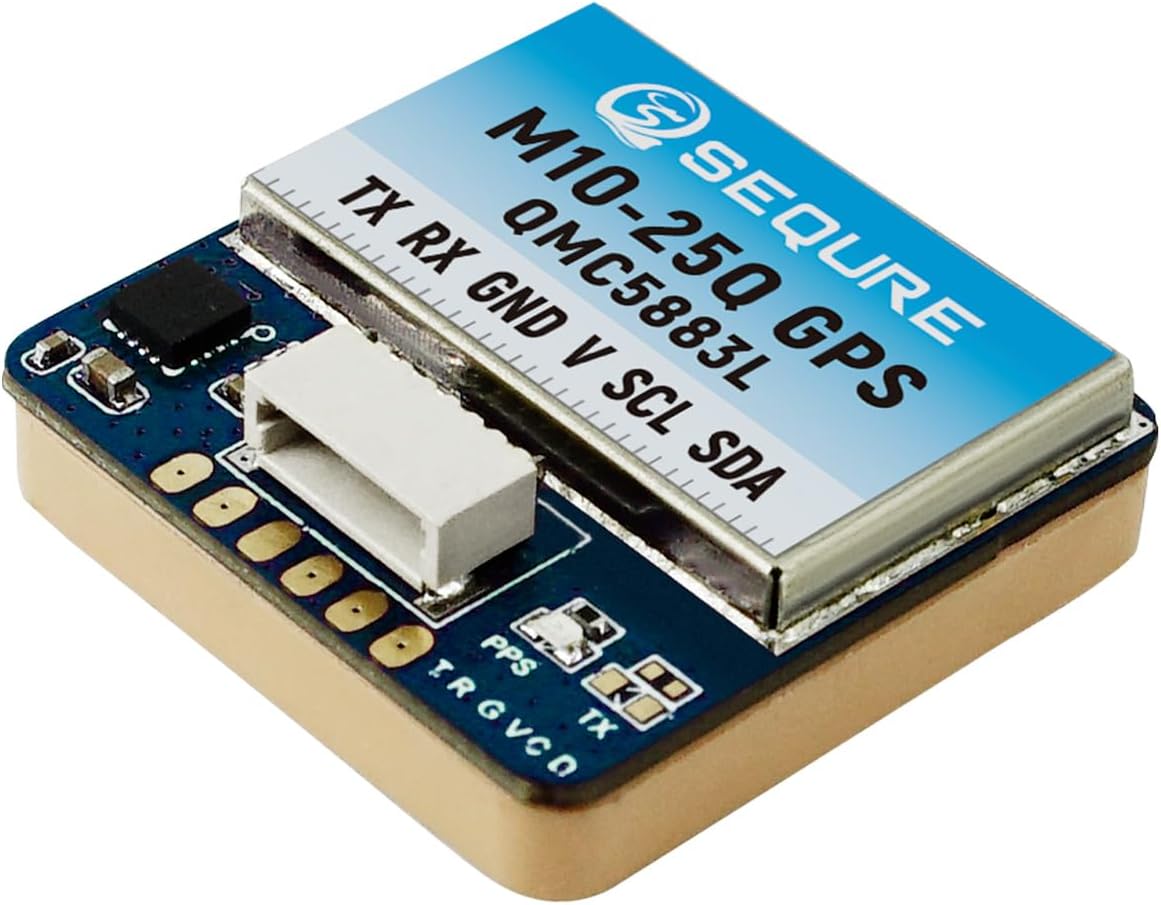
The SEQURE M10-25Q is one of the most complete compact modules in the guide, combining a 10th-generation chip, 10Hz output, a QMC5883L compass, and six supported constellations. Its 4.8 rating is among the strongest among the rated products, and the stated ability to use GPS, GLONASS, BDS, GALILEO, SBAS, and QZSS offers considerable flexibility.
We may earn a commission when you buy through this link, at no additional cost to you.
The module is designed for 5-inch-and-larger UAVs, with a ceramic antenna and external PCB intended to improve signal acquisition. Two connection methods—plug-and-play and soldering—give builders flexibility depending on the flight controller's available connector and the need for a permanent installation.
Its lower power consumption is favorable for battery-powered aircraft, although the exact current draw is not listed. The 5-inch-and-larger target also makes it less suitable for the smallest sub-250g racers, while the precise connector and default baud configuration should be confirmed before assembly.
The M10-25Q is an excellent all-around choice for FPV pilots who want broad satellite support, frequent position updates, and an integrated compass. It stands out for a 10Hz output in a compact package and is especially compelling for fixed-wing, cinematic, and freestyle builds that can accommodate its size.
Supporting six satellite systems gives the module a wider selection of signals than simpler three-mode designs. The additional constellations can be valuable around buildings, wooded areas, and other locations where the visible satellite mix changes.
A 10Hz stream refreshes position data ten times per second, which can benefit navigation and rescue functions that rely on timely updates. The flight controller must be configured to accept the module's baud rate and refresh capability.
We may earn a commission when you buy through this link, at no additional cost to you.
The JeeFly M8N is aimed at autonomous and semi-autonomous aircraft, with compatibility for Pixhawk, PX4, and F4/F7 flight controllers. It combines a 72-channel Ublox M8N receiver, an integrated compass, a 10Hz update rate, and simultaneous support for GPS, GLONASS, BeiDou, and QZSS.
We may earn a commission when you buy through this link, at no additional cost to you.
The included 270mm cable, mounting base, and separate GPS antenna mount give the builder more installation flexibility than an all-in-one board with a fixed patch antenna. LED feedback communicates lock status, with a flashing blue light indicating a lock, a solid blue light indicating a search, and a red power indicator.
The stated ideal accuracy is 0.5m, improving to 30cm under ideal conditions, while the operating range extends from -40°C to 85°C. Compatibility is broad, but the manufacturer explicitly excludes APM and notes that some Pixhawk models may require firmware updates.
The M8N is a strong recommendation for a Pixhawk or PX4 aircraft that needs a mounted external antenna, conventional cable routing, and autonomous-flight features. Pilots should verify connector pinouts, controller settings, and firmware support before installation, particularly when integrating the unit into an existing airframe with limited internal space.
A separate mounting system lets the GPS antenna sit away from electronics that may interfere with satellite reception or magnetic sensing. The included 270mm cable provides enough routing distance for many frame layouts, though the builder should confirm its connector orientation.
The 10Hz update rate, multi-GNSS reception, and Pixhawk or PX4 support align well with missions, waypoint navigation, and return-to-home behavior. Configuration should still include a proper compass calibration and an outdoor satellite lock test before relying on autonomous features.
We may earn a commission when you buy through this link, at no additional cost to you.
The Readytosky M10 is specialized for the Pixhawk 2.4.8 flight controller, using an external-compass and holder arrangement rather than a universal compact module. Its stated ideal positioning accuracy is 1.5m CEP, and onboard flash preserves configuration changes after the system is powered down.
We may earn a commission when you buy through this link, at no additional cost to you.
The external compass is valuable in larger autonomous aircraft because it can be positioned away from the flight controller, motors, and power distribution equipment. The M10 generation is also described as low-power and precise, while the included holder supports a more deliberate installation than an adhesive-mounted patch antenna.
Its biggest limitation is compatibility: the supplied information states that the GPS works only with the specified Pixhawk flight controller and cannot operate with other controllers. That narrow requirement may be appropriate for an established platform, but it excludes many modern F4 and F7 builds and reduces its usefulness as a general purchase.
For a Pixhawk 2.4.8 builder who values configuration persistence and a dedicated external compass, this remains a focused solution. The lower 4.2 rating and restricted platform support should be weighed against broader alternatives, and the exact connector and wiring requirements must be confirmed before installation.
Onboard flash retains modified settings after power is removed. This is convenient for autonomous platforms where repeated manual configuration would add setup time or create avoidable field errors.
The module is designed around a specific Pixhawk platform, reducing ambiguity about intended use. It is not a general-purpose upgrade for ArduPilot, PX4, INAV, or Betaflight installations.
We may earn a commission when you buy through this link, at no additional cost to you.
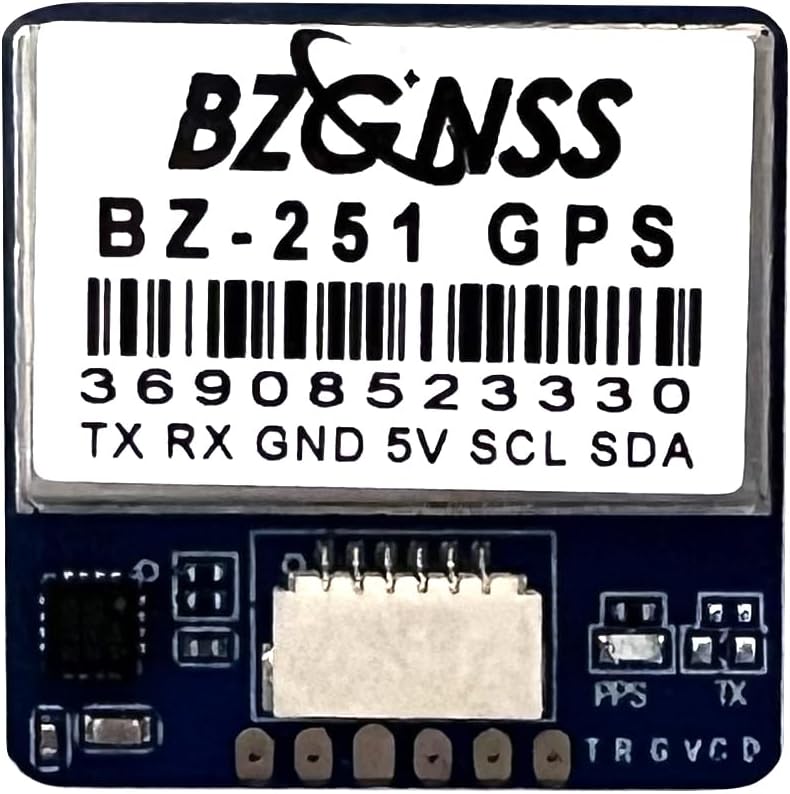
The BZGNSS Dual Protocol BZ-251 is presented as a navigation and rescue module for FPV fixed-wing and RC aircraft. It pairs a 10th-generation Ublox M10 chipset with NMEA and UBX protocol support, a 10Hz maximum refresh rate, and a stated 1.5m 2D positioning accuracy. Its 5.0 supplied rating makes it the highest-rated option in the group.
We may earn a commission when you buy through this link, at no additional cost to you.
Multi-GNSS operation defaults to GPS, GLONASS, and BDS, allowing the receiver to search for more satellites than a single-constellation module. Dual protocol compatibility also gives flight-controller configurations more options, while F4 and F7 support places the product squarely in modern hobby and FPV installations.
The oil-sprayed ceramic antenna is intended to resist scratching and oxidation, addressing a practical concern for modules exposed to repeated handling. The 10Hz rate is a maximum capability rather than a guarantee, and pilots must configure the flight controller and module accordingly. Detailed dimensions and exact connector information are not included in the supplied description.
For pilots who value failsafe return-to-home and rescue behavior, this is the leading specialized recommendation. It combines a current receiver, broad satellite support, and protocol flexibility in a durable package. Confirm that the controller supports the selected protocol and that the aircraft can be configured to use the module for the intended rescue workflow.
The module is explicitly positioned around failsafe and return-to-home use, which matters most when an aircraft can travel beyond visual line of sight. Position data is valuable only when the flight controller is configured to interpret it correctly.
Supporting NMEA and UBX gives installers more than one way to connect the receiver to a flight stack. This can simplify adaptation to an existing controller configuration, though the correct baud rate and protocol must still be selected.
We may earn a commission when you buy through this link, at no additional cost to you.
The BZGNSS BZ-251 is a compact M10 GPS module designed for FPV racing, fixed-wing, and long-range aircraft. It supports NMEA and UBX protocols, is listed as compatible with F405 and F722 flight controllers, and includes a built-in battery intended to prevent position loss from poor battery connections.
We may earn a commission when you buy through this link, at no additional cost to you.
Its dual-protocol capability offers flexibility when matching the receiver to an FPV controller. The module also supports BeiDou satellites, and its engineered quick-lock behavior is intended to reduce the wait before a first position fix. Compact construction and low weight suit aircraft where electronics space is limited.
The integrated battery is a double-edged feature. It may protect the module from an interrupted power lead, but it introduces another component that may eventually need replacement and does not eliminate the need for sound wiring and power distribution. The supplied information also does not state an update rate or exact dimensions.
The BZ-251 is a practical choice for F405- and F722-based FPV builds that need both position and an integrated battery-backed connection. It is especially relevant to long-range or fixed-wing pilots who need rescue data, provided the flight controller is configured for the correct protocol and the module is tested outdoors before relying on it.
Long-range and fixed-wing aircraft can move far enough that a live position reference becomes important for navigation and recovery. This module gives those projects a compact option, although adequate sky visibility remains essential.
The onboard battery is intended to keep the receiver operating if its main power connection becomes unstable. It does not replace proper soldering, connector security, or a full preflight electrical check.
We may earn a commission when you buy through this link, at no additional cost to you.
The AERO SELFIE FK-C1 is a compact M9-based module for FPV and other drones, measuring 20mm square, 8mm thick, and weighing 7g. It supports GPS, GLONASS, Galileo, and BeiDou, can track up to 32 satellites, and includes an IST8310 magnetic compass for heading information.
We may earn a commission when you buy through this link, at no additional cost to you.
Its stated current consumption of 80mA is one of the more useful figures in the guide because power availability is often limited in small aircraft. A blue LED flashes at 1Hz after a three-dimensional GNSS fix, offering a clear indication that the receiver has progressed beyond basic power-up.
The operating range of -20°C to 80°C supports use across varied weather conditions. On the other hand, the supplied data does not identify supported protocols, update rate, connector type, or exact flight-controller compatibility. Those are essential details to establish before considering the module for a specific build.
The FK-C1 is well suited to weight-conscious FPV pilots seeking more than a receiver-only GPS. Its four-constellation support, integrated compass, and clear fix indicator make it a balanced navigation component. Confirm electrical and protocol requirements with the manufacturer or seller before installation.
The module weighs 7g and draws a stated 80mA, making it comparatively restrained in both mass and electrical demand. A lighter electronics load can help preserve flight time on small battery-powered aircraft.
The IST8310 sensor adds directional information to the positioning solution. Magnetic calibration is still essential, and the compass should be mounted away from current-carrying wires and ferromagnetic fasteners that could distort its readings.
We may earn a commission when you buy through this link, at no additional cost to you.
The FK-D1 is a versatile GNSS module for drones and robotics, built around a 10th-generation chip with a 10Hz update rate and support for up to 32 satellites. It supports GPS, GLONASS, BeiDou, and Galileo while including a QMC5883L magnetic compass and a 25 by 25 by 4mm high-gain antenna.
We may earn a commission when you buy through this link, at no additional cost to you.
Its compatibility with INAV, Betaflight, ArduPilot, and PX4 makes it one of the broadest platform matches in the guide. A UART interface and built-in flash for saving user settings also support practical integration across different flight stacks, reducing the need for repeated configuration after power cycles.
The 12g weight is modest for autonomous aircraft but should still be considered on small racing platforms. The claimed 25mm antenna is larger than some ultra-compact patch antennas, which may require a top-mounted position. Exact board dimensions, cable details, and current draw are not supplied.
The FK-D1 is a strong choice for a builder who wants one module to work across several popular flight ecosystems. Its 10Hz updates, persistent configuration, compass, and four-constellation support make it especially useful for robotics and larger FPV aircraft. Verify the UART wiring and supported baud rate before connecting it to a flight controller.
Compatibility with INAV, Betaflight, ArduPilot, and PX4 offers useful flexibility for builders who maintain different aircraft. The flight software, receiver mode, baud rate, and wiring still need to be configured for each installation.
The 25mm patch antenna is designed to improve reception in urban settings and beneath partial natural cover. Keeping the antenna unobstructed and mounted with a clear view of the sky remains more important than the chipset label alone.
We may earn a commission when you buy through this link, at no additional cost to you.
The right GPS module depends on aircraft size, flight-controller platform, navigation requirements, antenna placement, and the level of autonomous behavior expected. Use the specifications as a compatibility checklist rather than relying on chipset generation alone.
Start with the flight controller and its supported receiver modes. Some modules are designed for a specific Pixhawk generation, while others support common F4 and F7 boards, INAV, Betaflight, ArduPilot, or PX4. Confirm the physical connector, UART assignment, baud rate, protocol, and any required firmware version before ordering. A module that physically fits but outputs a protocol the controller does not understand will not provide a position fix.
Multi-constellation support can improve acquisition speed and signal availability by allowing the receiver to use satellites from several systems. The choices range from three systems to six, including GPS, GLONASS, Galileo, BeiDou, SBAS, and QZSS. More constellations are not automatically better in every environment, but they increase the pool of usable signals around buildings or under partial obstruction. Adequate sky visibility remains essential regardless of the supported systems.
An integrated compass provides heading information for return-to-home, navigation, and orientation-dependent features, but it can be disturbed by motors, ESCs, high-current wiring, speakers, and magnetic fasteners. An external compass offers better placement options on larger aircraft. Regardless of design, perform compass calibration in the completed airframe and recheck it if the electronics layout changes.
A 10Hz position stream refreshes navigation data ten times per second and can suit fast-moving aircraft and responsive rescue logic. Other modules omit a stated rate, so they may be better suited to fixed-wing or conventional autonomous flight. The refresh capability matters only when the flight controller is configured to accept and use it. Rescue features also require correct failsafe settings, home-point capture, and a validated satellite lock.
A ceramic patch antenna keeps the package compact, while a larger antenna or externally mounted GPS assembly may improve placement flexibility. The antenna should have the clearest possible view of the sky and should not sit under a carbon-fiber plate, battery, or electronic speed controller. Check whether the antenna is fixed or can be mounted on a separate holder, especially on autonomous aircraft with crowded interiors.
Compact modules around 20 to 21mm square and approximately 7g fit the smallest FPV builds, while larger antenna assemblies may be better for autonomous platforms. A stated 80mA draw is useful for power planning, but many competing modules do not disclose consumption. Calculate the module's draw together with the flight controller, telemetry radio, video system, and other electronics, and confirm the available voltage and connector arrangement.
NMEA and UBX are common protocol options, and dual-protocol support can make integration easier. The module should also offer a way to persist settings when the aircraft is powered down. Onboard flash is particularly useful for autonomous platforms because it prevents a powered flight controller from losing a carefully configured receiver setup. Default baud rates, output messages, and update rates must still be checked against the flight software.
A racing drone prioritizes low mass, rapid satellite acquisition, and perhaps failsafe rescue, while a fixed-wing aircraft may value endurance and reliable position reporting. Autonomous platforms benefit most from persistent configuration, external antenna placement, and broad controller support. Robotics projects may also value the documented UART interface and multi-GNSS reception. Choose the module that directly supports the aircraft's mission rather than selecting on chipset generation alone.
Begin with the flight controller manual, the GPS module documentation, and the airframe's wiring diagram. Confirm the receiver protocol, assigned UART, baud rate, and power requirements before connecting anything. With the aircraft disassembled, inspect the module's connector and solder joints, then secure the cable so it cannot pull against the board or move near the propeller arc.
Mount the GPS antenna where it has an unobstructed view of the sky, and keep it away from carbon fiber, batteries, transmitters, and large metal components. If the compass is integrated, position the whole board away from motors, ESCs, and high-current leads when possible. Complete the flight controller's compass and accelerometer calibration with the aircraft in its final configuration, then save the settings and verify that they persist after a power cycle.
Perform the first satellite test outdoors with the propeller removed whenever possible, confirming a stable three-dimensional fix and the expected indicator behavior. On the bench, inspect power consumption, connector temperature, and serial data flow. Before flight, test rescue logic without risking an expensive aircraft, and treat a GPS fix as an aid to navigation rather than a guarantee. Protect the antenna from impact, moisture, abrasion, and excessive heat, and replace damaged connectors or cables before they cause intermittent failures.
No. A micro FPV drone flown indoors or in a light, short-range environment may operate without GPS, while long-range, autonomous, fixed-wing, and mapping aircraft often benefit greatly from position data. GPS becomes especially useful for return-to-home, rescue logic, waypoint navigation, and post-flight location information. The module still requires a clear view of the sky and proper flight-controller configuration.
GPS is one satellite navigation system, while multi-GNSS combines systems such as GLONASS, Galileo, BeiDou, QZSS, or SBAS. A multi-GNSS receiver can use signals from more satellites, which may improve acquisition and continuity around buildings or partial obstructions. It does not guarantee a position in every environment, and antenna placement remains critical.
A 10Hz module refreshes position data ten times per second, which can benefit fast aircraft, responsive navigation, and rescue behavior. For slower fixed-wing craft, a lower update rate may be sufficient, provided the flight controller supports it. The module's maximum rate must be configured correctly and should be verified in the flight software.
A GNSS receiver determines geographic position, but a magnetic compass supplies heading information. That heading helps the flight controller interpret direction, maintain stable orientation, and execute functions such as return-to-home or waypoint navigation. Integrated compasses must be calibrated away from interference, while external compasses allow more careful placement.
No. The receiver's protocol, connector, baud rate, and supported flight-controller hardware must all match. Some modules are specific to a Pixhawk model, while others support F4, F7, INAV, Betaflight, ArduPilot, or PX4. Always consult the controller documentation and the module wiring instructions before installation.
Mount the antenna with the clearest available view of the sky, preferably on top of the aircraft and away from carbon-fiber plates, batteries, and electronics. Use a stable holder and prevent the cable from moving or pulling on the connector. If the module includes a compass, keep the complete board away from motors, ESCs, and high-current wiring.
A powered module does not necessarily have a valid satellite fix, and an incorrectly configured receiver may not reach the flight controller at all. Test outdoors, confirm the fix indicator, inspect serial data, calibrate the compass, and verify the home point before enabling autonomous behavior. Rescue functions should also be tested progressively before relying on them.
No. A modern chipset can improve acquisition speed, but satellite visibility, interference, antenna orientation, and settings still affect the result. Give the receiver time to acquire satellites before departure, and avoid launching beside buildings, cliffs, or dense trees if a reliable fix is essential.
The HGLRC M100 Pro stands out for fixed-wing builders seeking a 10th-generation receiver, expanded 120-channel reception, and a QMC5883L compass. The SEQURE M10-25Q offers the broadest compact feature set, with six constellations, 10Hz output, and a QMC5883L compass, while the HGLRC Mini M100 provides a versatile option for 2-7 inch FPV drones with broad voltage input and clear operating indicators.
For autonomous aircraft, the JeeFly M8N, Readytosky M10, and FK-D1 may prove more appropriate because they emphasize controller compatibility, external antenna options, persistent configuration, or conventional UART integration. The BZGNSS choices serve pilots who want dual protocols and rescue-oriented navigation, while the AERO SELFIE FK-C1 stands out for a compact footprint, low stated power draw, and integrated IST8310 compass.
Before ordering, verify the exact flight-controller model, connector, protocol, baud rate, dimensions, and mounting space. Check current product listings and seller documentation for updated compatibility or firmware details, then complete an outdoor fix test and calibration before trusting position or rescue functions in flight.


