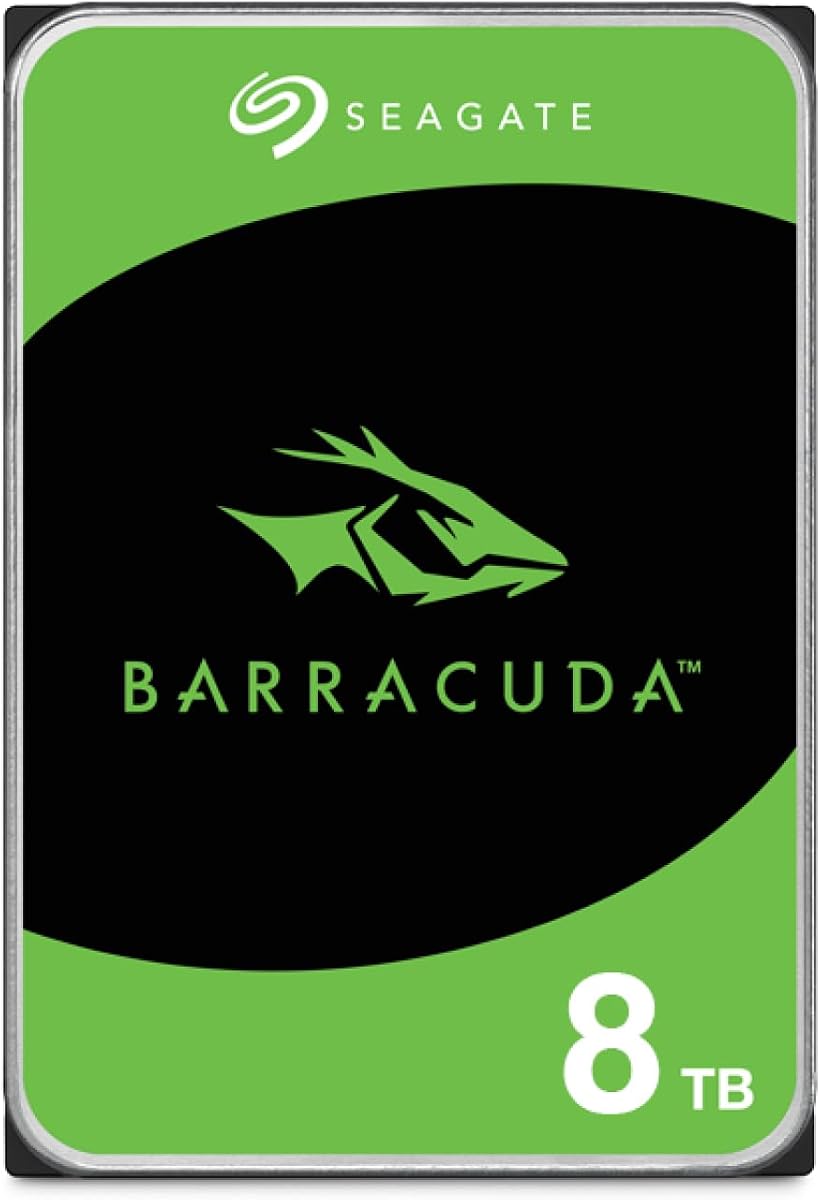
Seagate BarraCuda 8TB
4.7Editor score
190 MB/s sustained transfer
8TB desktop storage capacity
SATA 6 Gb/s interface
Building a RAID 0 array rewards drives that deliver consistent throughput, dependable mechanics, and enough capacity for large working sets. However, striping also concentrates risk because one failed disk can make the entire array inaccessible. The best hard drive for RAID 0 therefore balances speed, CMR support, reliability features, and compatibility rather than considering raw capacity alone.
This guide compares ten SATA hard drives using their supplied specifications, including recording technology, rotational speed, cache, sustained transfer rate, workload rating, NAS optimization, and intended operating environment. The list includes a desktop-oriented option, several NAS-focused models, and a renewed enterprise drive, allowing buyers to compare practical designs for workstations, network storage, and always-on arrays.
Each review explains the strongest reasons to choose a drive, along with important limitations that should be considered before deployment. The top picks highlight a value-focused desktop drive, a well-balanced NAS drive, and a high-capacity enterprise model. Product availability and market conditions change, so readers should confirm current specifications and compatibility with their exact RAID controller before purchasing.
4.7Editor score

4.7Editor score

4.6Editor score
As an Amazon Associate we earn from qualifying purchases.
The comparison below highlights the major differences among these ten SATA hard drives, including capacity, recording method, rotational speed, cache size, workload expectations, and the environments for which each model was designed.




The Seagate BarraCuda 8TB is a straightforward desktop hard drive that offers a useful combination of capacity, a listed 190 MB/s sustained transfer rate, and a 4.7 buyer rating. It is not designed specifically for NAS or RAID systems, yet its large capacity and conventional SATA interface make it a potentially economical choice for a noncritical striped storage array.
We may earn a commission when you buy through this link, at no additional cost to you.
The main appeal is the amount of usable raw capacity without moving to a higher-tier enterprise family. A SATA 6 Gb/s interface provides ample bandwidth for typical file-transfer tasks, while the 190 MB/s sustained rate is sufficient for sequential media, backups, and large project files. The stated support for music, video, photo editing, and gaming broadens its usefulness beyond a simple file repository.
The important limitation is the drive's desktop orientation. Its supplied information does not mention a NAS workload rating, RAID-specific firmware, rotational vibration sensors, or a formal NAS compatibility program. RAID 0 also eliminates redundancy, so using a non-RAID-oriented model in a critical array deserves careful thought. Data should be backed up independently, and the controller should support the exact model.
This is a sensible choice for builders assembling a large, secondary RAID 0 volume where cost matters more than continuous multiuser NAS service. It may suit a home media workspace or scratch storage pool that can be recreated. For an always-on business array or irreplaceable data, a NAS-optimized CMR model is the safer choice despite the BarraCuda's capacity and strong rating.
An 8TB drive gives RAID 0 builders room for large media libraries, project archives, and game installations. In a two-drive stripe, its raw capacity can be pooled into one larger volume, although the usable total will be below the simple sum because of filesystem and formatting overhead.
The BarraCuda makes more sense when the array is a performance workspace or secondary store than when it is the sole home for critical records. A separate backup strategy is essential because striping provides speed, not protection against drive failure.
We may earn a commission when you buy through this link, at no additional cost to you.
The Seagate IronWolf Pro 4TB combines a 4.5 rating with explicit NAS and RAID positioning. Its listed maximum sustained transfer speed of 214 MB/s is the highest figure supplied for a conventional 3.5-inch model in this comparison, making it appealing for compact NAS builds, creative workstations, and striped arrays that need quick sequential transfers.
We may earn a commission when you buy through this link, at no additional cost to you.
This drive is explicitly designed for multi-user NAS server environments and is described as suitable for systems with up to 24 bays. Its AgileArray-style NAS positioning, 7200 RPM spindle, and 128MB cache support the demands of a busy array. Integrated IronWolf Health Management also gives administrators a way to monitor drive condition rather than waiting for a complete failure.
The trade-off is capacity. Four terabytes is more modest than the 10TB, 12TB, 14TB, 16TB, and 24TB alternatives, so users should think carefully about how quickly a small RAID 0 volume will fill. Its 128MB cache is also smaller than the 256MB or 512MB configurations offered by several larger drives. These are meaningful distinctions, although cache capacity alone does not determine real-world array throughput.
The IronWolf Pro 4TB is a strong recommendation for compact professional NAS arrays, smaller multi-bay systems, and buyers who want a short, well-defined set of NAS features. The included three-year Rescue Data Recovery Services and five-year limited warranty add reassurance, but the four-year Rescue period referenced in the supplied data should be checked for the exact package and region of purchase.
IronWolf Health Management and a NAS-oriented design make this model more appropriate for a managed enclosure than a conventional desktop drive. Those tools can help operators identify developing problems and maintain consistent array behavior.
The supplied 214 MB/s maximum rate is notable for a 4TB model. It can be a good fit for compact RAID 0 systems where fast sequential I/O matters more than having an extremely large pool of raw capacity.
We may earn a commission when you buy through this link, at no additional cost to you.
The Seagate IronWolf Pro 16TB is an enterprise-oriented NAS model built around 16TB of capacity, all-CMR recording, a 7200 RPM spindle, and 256MB of cache. Its 4.0 rating is lower than those of several other products here, but the supplied technical specifications position it as a strong option for high-intensity, multi-drive storage environments.
We may earn a commission when you buy through this link, at no additional cost to you.
Its workload rating of up to 550TB per year is a major differentiator. The drive also uses AgileArray features such as dual-plane balancing, time-limited error recovery, and rotational vibration sensors. Those characteristics are especially relevant in a multi-bay RAID 0 array, where several spinning disks can influence one another mechanically and where consistent sustained performance is more important than short desktop benchmarks.
The caution is that enterprise NAS hardware is designed for demanding service rather than casual storage. The product information specifically notes that it may require particular setup and compatible hardware and should be tested in a compatible NAS or RAID environment. Its 4.0 rating may also reflect a comparatively mixed customer experience, although the listing does not provide enough information to determine why individual ratings differ.
This model is most appropriate for organizations that need a high-capacity striped pool, sustained multiuser access, and a clearly enterprise-rated workload class. It is a better fit for an enterprise NAS or carefully selected RAID workstation than for a basic home computer. Buyers should validate controller support, cooling, backplane requirements, and array-building procedures before committing.
A 550TB-per-year workload rating supports use in active business storage rather than occasional archival storage. The rating describes an annualized usage profile, so it should match the intensity of the planned array.
All-CMR recording avoids the write-penalty characteristics associated with SMR drives. That consistency is particularly useful when rebuilds, sustained writes, and multi-drive operations place heavy demands on the array.
We may earn a commission when you buy through this link, at no additional cost to you.
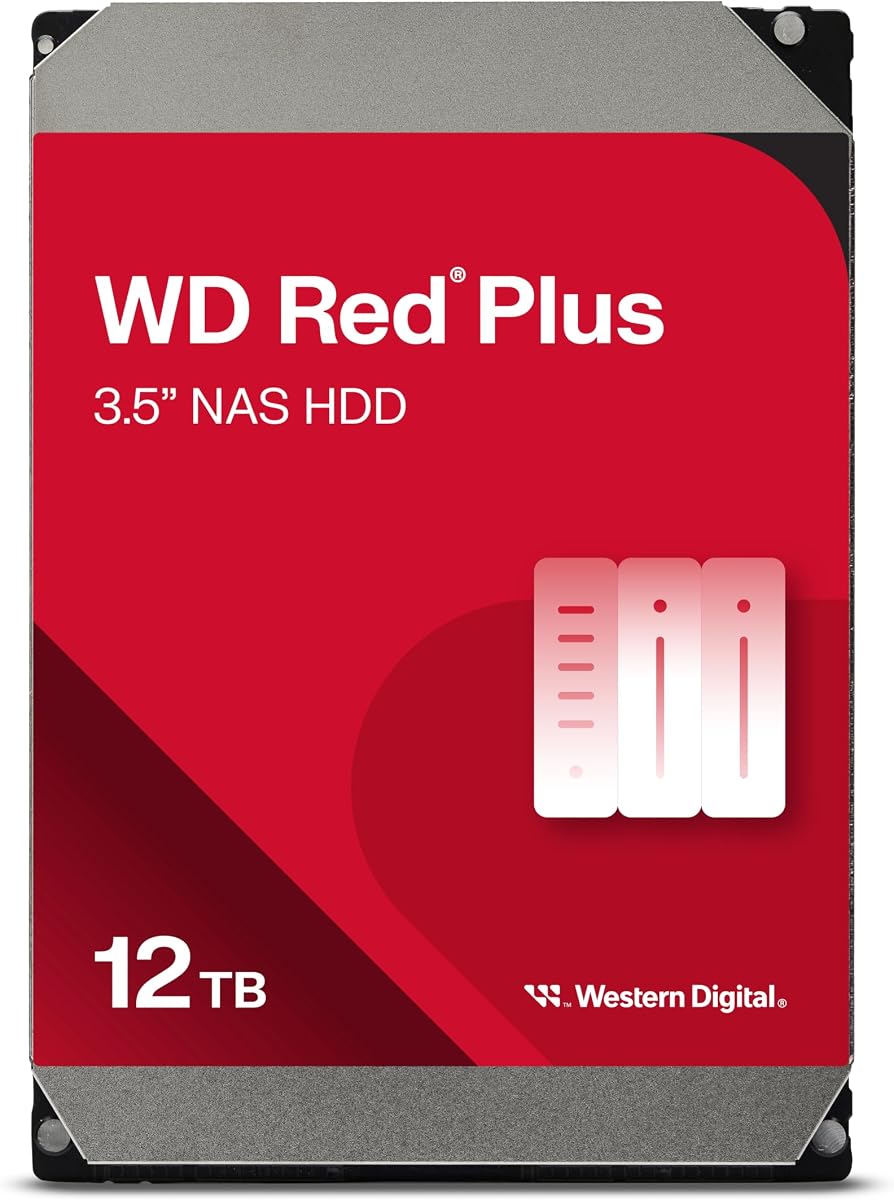
The WD Red Plus 12TB combines a 12TB capacity point with 7200 RPM performance, 512MB of cache, and CMR recording. Its 3.9 rating places it near the lower end of this list, but the product's stated NAS compatibility, NASware firmware, and 24×7 operating focus make it a credible option for a medium-sized striped array.
We may earn a commission when you buy through this link, at no additional cost to you.
The generous cache and conventional magnetic recording provide a solid foundation for RAID workloads. WD states that the drive supports up to 180TB per year and is intended for small or medium business NAS systems running around the clock. The 6 Gbps data transfer rate applies to the SATA interface rather than guaranteed disk throughput, so buyers should not interpret it as a sustained file-transfer result.
Its capacity is less than the 14TB, 16TB, and 24TB models in the guide, while the 512MB cache exceeds every other option. Whether that cache advantage translates into noticeable benefit depends on the workload and controller, but it can help smooth bursts and rapid sequential operations. The product information notes support for up to eight bays, which may limit deployment in unusually large enclosures.
This drive is well suited to a business NAS or power workstation that needs CMR consistency without moving into the Pro or enterprise class. Its lower buyer rating warrants attention, but the supplied data does not justify claiming a specific technical fault. Confirm enclosure support, noise expectations, and current warranty terms before using it as the foundation of an important array.
CMR is a valuable feature in a striped array because it avoids the sustained-write limitations that can affect SMR drives. It helps keep behavior more consistent when the system handles large files or rebuild activity.
The 512MB cache is the largest in the group and may assist short bursts of reads and writes. It cannot replace sufficient memory, a capable controller, or a properly engineered backplane.
We may earn a commission when you buy through this link, at no additional cost to you.
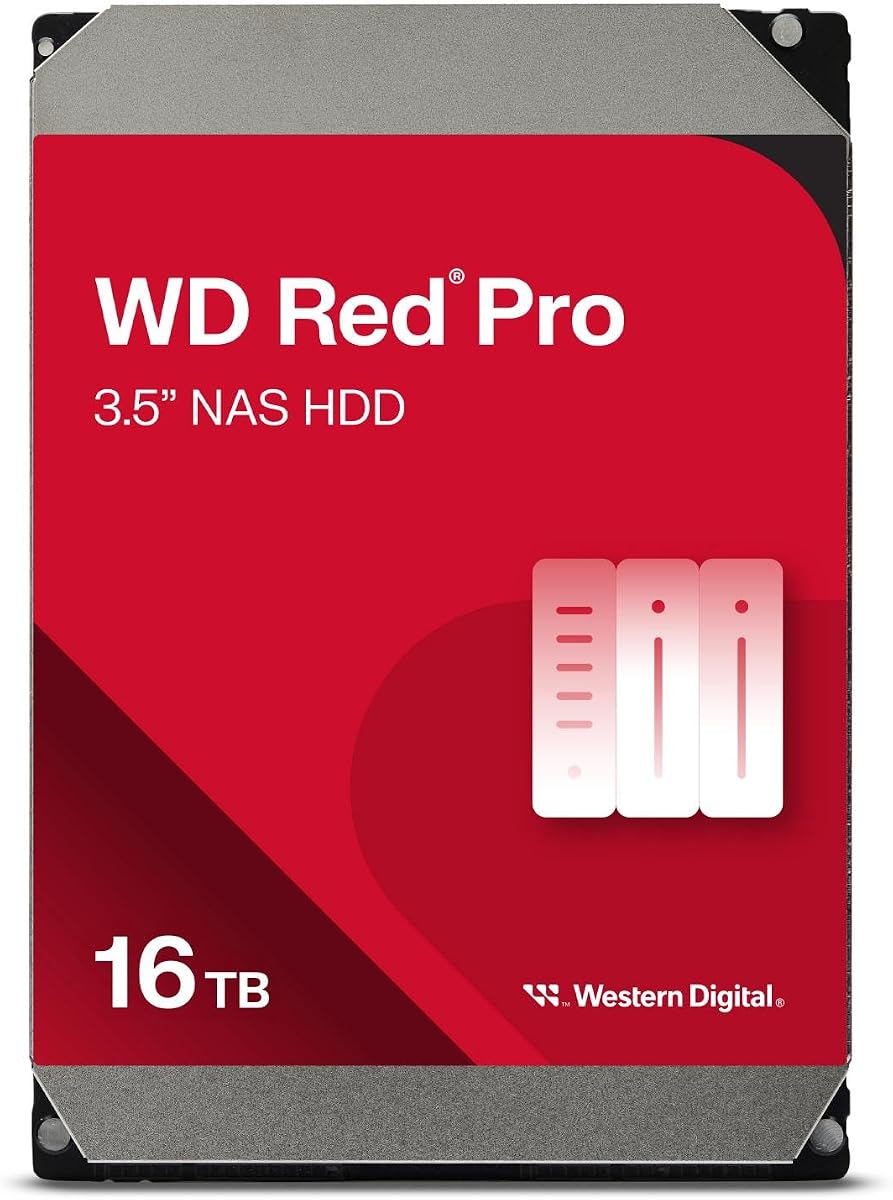
The WD Red Pro 16TB is designed for RAID-optimized NAS systems and high-intensity, 24×7, multiuser environments. Its listed 16TB capacity, 550TB-per-year workload rating, 7200 RPM speed, and 512MB cache place it firmly in the professional storage category, although its 3.9 rating does not lead the field.
We may earn a commission when you buy through this link, at no additional cost to you.
CMR recording is a particularly important strength for this use case. Professional arrays can experience extensive sequential writes during backups, file synchronization, media processing, and recovery operations. A conventional recording method helps maintain consistent performance under those conditions. The 512MB cache and 7200 RPM mechanism also support systems that need more than basic desktop responsiveness.
Western Digital states that it partners with a wide range of NAS vendors to test compatibility, which is helpful when selecting a drive for a multi-bay enclosure. Buyers still need to check the specific controller or NAS because partnership does not guarantee support for every model in every configuration. The listed capacity range extends from 2TB to 22TB across the Red Pro family, indicating a broad professional product line.
This is an excellent candidate for a large RAID 0 workspace when its capacity and workload rating match the intended use. It may be excessive for a small home project, but for a high-traffic business NAS it offers a strong balance of density and endurance. The final decision should include enclosure validation, cooling, noise placement, and independent backup planning.
The 550TB-per-year rating suits a storage system that moves substantial data every day. It is more meaningful for a working NAS than for an archive that is connected only occasionally.
The combination of 16TB capacity and CMR recording is valuable for users who want a large striped pool but do not want SMR behavior. The result is better suited to sustained array activity.
We may earn a commission when you buy through this link, at no additional cost to you.
The WD Ultrastar DC HC580 24TB is the highest-capacity drive in the comparison and combines that density with enterprise features. Its 4.6 rating supports the shortlist, while the supplied specifications describe a 7200 RPM SATA hard drive with 512MB cache, 512e formatting, CMR recording, and a 2.5 million-hour MTBF rating.
We may earn a commission when you buy through this link, at no additional cost to you.
This model targets hyperscale environments, data centers, cloud storage, and other demanding server workloads. CMR is valuable because it supports more consistent behavior across sustained writes, and the high MTBF figure points toward a durability-oriented enterprise design. The 24TB capacity can reduce the number of disks required to create a large RAID 0 pool, potentially simplifying cabling, heat management, and enclosure space.
The word Renewed is important and should not be overlooked. It means the unit is sold in a renewed condition, so buyers should check the seller's condition standards, return policy, warranty coverage, and any evidence of use. The listing also describes massive scale-out and data-center applications, which may place its dimensions, power, acoustics, and operating requirements beyond a typical desktop setup.
This is the premium selection for a technically capable buyer who prioritizes density and enterprise endurance over simplicity. It can be compelling in a carefully engineered storage server, but it is not automatically the safest choice for a novice RAID 0 project. Confirm 512e support, controller compatibility, airflow, and renewed-unit protections before purchasing.
A 24TB drive can reduce the number of physical disks needed for a large array. Fewer drives may simplify expansion, but every enclosure still needs adequate cooling and reliable power delivery.
A renewed enterprise drive can offer unusual capacity, but condition, warranty, and return terms vary. Treat the listing details as a starting point and verify the seller's standards before placing irreplaceable data on the drive.
We may earn a commission when you buy through this link, at no additional cost to you.
The Seagate IronWolf 10TB stands out as the most balanced option in the guide. It combines a 4.7 rating with 10TB of CMR capacity, 7200 RPM speed, 256MB cache, and a listed sustained transfer rate of up to 210 MB/s. More importantly, it is explicitly optimized for RAID and built for continuous NAS use.
We may earn a commission when you buy through this link, at no additional cost to you.
AgileArray firmware is a central feature, supported by dual-plane balancing, error recovery controls, and rotational vibration sensors. Those features are particularly relevant when multiple 3.5-inch drives spin together in a RAID 0 array. A workload rating of up to 180TB per year, one million hours MTBF, and 600,000 load/unload cycles make this a credible drive for regular multiuser storage service.
The model is not flawless for every application. A 10TB capacity may be modest for a rapidly expanding archive, and its 256MB cache is smaller than those in the WD Red and Ultrastar selections. The listed workload rating also sits below the 550TB-per-year class offered by Pro and enterprise drives. Buyers with continuous heavy write loads should consider those higher-end options instead.
Despite those limits, this IronWolf offers the clearest package for the main audience: strong sequential performance, CMR consistency, explicit RAID optimization, health management, and a highly regarded rating. It is the editor's choice for a home-lab, creative, or small-business RAID 0 array. Verify controller support and back up all data because RAID 0 itself offers no recovery protection.
AgileArray, rotational vibration sensors, and balanced dual-plane operation address practical multi-bay concerns. These features can help maintain consistent behavior in a densely populated array.
IronWolf Health Management gives NAS users a way to review drive health and receive recommendations. In a striped array, early visibility is valuable because a single drive issue can affect access to the whole volume.
We may earn a commission when you buy through this link, at no additional cost to you.
The Seagate IronWolf 10TB with model ST10000VN0004 is a long-established NAS design aimed at multiuser environments with as many as eight bays. It combines 10TB capacity, 7200 RPM speed, 256MB cache, SATA 6GB/s, and a 4.0 rating, making it a familiar choice for builders who prefer an established IronWolf configuration.
We may earn a commission when you buy through this link, at no additional cost to you.
Its stated strengths include reduced wear and tear, low noise and vibration, improved file-sharing performance, and integrated IronWolf Health Management. The one-million-hour MTBF figure adds an enterprise-oriented reliability context, while the three-year limited warranty provides a defined support period. These features make the drive more appropriate for sustained NAS use than a conventional desktop model.
The main concern in this comparison is the absence of explicit CMR language in the supplied description. CMR is strongly preferable for predictable RAID behavior, especially during sustained writes. Buyers should verify the exact model identifier with the manufacturer or seller and ensure that the installed array remains compatible with the controller. They should also review the 4.0 rating for any recurring patterns in buyer feedback.
This model is a reasonable choice for an eight-bay or smaller NAS that values an established IronWolf drive and 10TB of capacity. It is particularly useful when compatibility with a known IronWolf environment is important. For the most predictable modern RAID setup, the newer ST10000VNZ00, explicitly identified as CMR, is the more straightforward recommendation.
The drive's explicit support for multiuser NAS environments makes it a closer match to RAID storage than a desktop drive. Its health-management integration is useful for routine administration.
Because the supplied listing does not state CMR or SMR, exact model verification matters. A confirmed CMR configuration is generally preferable for demanding striped workloads and array rebuilds.
We may earn a commission when you buy through this link, at no additional cost to you.
The Seagate IronWolf CMR 10TB is a more clearly specified alternative to the older ST10000VN0004. It explicitly uses CMR, runs at 7200 RPM, includes 256MB of cache, and carries a 4.6 rating. These details make it one of the most compelling mid-capacity drives for a striped NAS or RAID-oriented desktop.
We may earn a commission when you buy through this link, at no additional cost to you.
The combination of CMR and a conventional 7200 RPM spindle is especially attractive for RAID 0. CMR supports predictable write behavior, while the rotational speed benefits sustained workloads. The drive is described for up to eight-bay multiuser NAS environments, offering enough scale for many small-business and prosumer systems without moving into a high-end enterprise enclosure.
The product information also highlights reduced wear, lower vibration, increased file-sharing performance, and IronWolf Health Management. The one-million-hour MTBF figure supports the drive's positioning for continuous operation. The trade-off is that its three-year limited protection plan is shorter than the five-year terms attached to the IronWolf Pro and WD Red Pro families, which may matter for a business refresh cycle.
This model is a good middle ground for a 10TB-per-drive RAID 0 array. It has the explicit CMR confirmation and strong rating that the older IronWolf listing lacks, while remaining easier to deploy than the renewed 24TB enterprise drive. It is especially well matched to a small business, studio, or advanced home NAS that values clarity and proven NAS positioning.
Explicit CMR support makes this a safer technical match for RAID 0 than an unconfirmed model. It offers consistent behavior during sustained writes and storage maintenance.
A 4.6 rating places this drive near the top of the comparison. Health monitoring and NAS-oriented operation further distinguish it from a basic desktop hard drive.
We may earn a commission when you buy through this link, at no additional cost to you.
The WD Red Plus 14TB offers an unusual combination of 14TB capacity, CMR recording, 512MB cache, and a 5400 RPM spindle. Its 4.5 rating is solid, and the drive is clearly aimed at small and medium business NAS systems that operate around the clock. The lower rotational speed differentiates it from the many 7200 RPM models in this guide.
We may earn a commission when you buy through this link, at no additional cost to you.
A 5400 RPM mechanism can contribute to lower noise and power use than a 7200 RPM drive, although the listing does not provide a direct noise measurement. The large 512MB cache may help with bursts, while CMR and NASware firmware make the drive suitable for storage workloads that demand predictable writes. The stated workload rating is up to 180TB per year.
The main limitation is that the 5400 RPM class may not deliver the same sustained transfer performance as the faster options. RAID 0 can combine multiple drives to improve throughput, but it does not guarantee that a slower individual disk will match a 7200 RPM model. Buyers who prioritize rapid sequential transfers should examine the available performance figures more closely.
This drive is a compelling choice when capacity, CMR behavior, and an established NAS orientation matter more than maximum spindle speed. It can suit an eight-bay or smaller system operating continuously, especially when lower acoustic output is desirable. As with every RAID 0 build, an independent backup remains necessary because the array offers no fault tolerance.
The 14TB capacity gives RAID 0 builders a large raw pool while remaining smaller than the 16TB and 24TB alternatives. It is a practical middle ground for storage-conscious NAS configurations.
The 5400 RPM spindle prioritizes a different balance from high-speed models. It may be appropriate for quiet or power-conscious deployments, but sequential throughput expectations should remain realistic.
We may earn a commission when you buy through this link, at no additional cost to you.
The right drive for a striped array depends on controller support, recording technology, sustained performance, intended workload, enclosure design, and the consequences of failure. Capacity should be considered alongside these factors rather than in isolation.
The summary is simple: verify exact model compatibility before buying, and do not assume that every 3.5-inch SATA disk will work correctly in a particular enclosure.
The summary is to choose CMR whenever the listing and controller documentation confirm support, especially for business or continuously used arrays.
The summary is to buy enough per-drive capacity to delay unavoidable expansion, without paying for storage that will remain idle for years.
The summary is to compare sustained figures rather than interface speed, and to account for whether your workload is dominated by large files or many smaller operations.
The summary is to compare annual workload expectations with actual usage and favor a NAS or enterprise model for an always-on server.
The summary is to treat monitoring and array-aware firmware as important operational features, not just optional extras.
The summary is to ensure the enclosure can cool and support every selected drive, and to use vibration-aware placement for dense multi-bay arrays.
The summary is to treat RAID 0 as a performance tool rather than a backup solution, and maintain at least one verified copy of every important file.
Begin by confirming that the RAID controller or NAS supports the exact drive models and capacities. Install all members in an enclosure that provides stable SATA data connections, adequate power, and consistent airflow. Record each serial number and the array configuration before initializing the drives so that a future rebuild or replacement uses compatible hardware.
Create the RAID 0 volume through the controller's management interface rather than using operating-system disk tools independently on each member. The controller must treat the selected drives as one striped array, and the user should allow the initialization process to finish without interruption. After creation, verify the expected logical capacity, confirm that the array appears healthy, and run a read/write test using a tool appropriate for the controller.
Keep the array powered on when possible, maintain a cool and ventilated environment, and review the controller's health warnings regularly. Leave enough free capacity for normal operations and be cautious with sustained workloads that exceed a drive's stated workload class. If a member fails, avoid repeated reset attempts or modifications. Protect independent backups, obtain a compatible replacement, and follow the controller's documented recovery procedure before attempting to restore the array.
RAID 0 is an array configuration, not a separate type of physical drive. The members can be ordinary SATA hard drives or purpose-built NAS and enterprise models. NAS and enterprise drives are often preferable because they include workload ratings, RAID-aware firmware, health monitoring, and vibration-management features.
CMR is generally the better match for demanding RAID 0 use because it avoids the sustained-write constraints commonly associated with SMR. This can matter during large file transfers, backups, and rebuilds. Any drive's recording method should also be confirmed in its official model documentation and in the controller's compatibility list.
Using identical model and capacity drives simplifies performance prediction, rebuild planning, and replacement. Some controllers permit mixed capacities, but a striped array still has one logical capacity, and uneven performance can create a bottleneck. Follow the controller manufacturer's guidance rather than assuming mismatched members will behave identically.
No. RAID 0 does not provide redundancy, so the loss of one member can make the entire volume inaccessible. Critical data needs a separate verified backup. RAID 0 is most appropriate for fast scratch space, media working files, or other data that can be restored from another copy.
Often, yes, provided the desktop controller supports the exact model and the operating system recognizes the RAID functionality. A NAS drive may have different acoustic, power, and vibration characteristics from a desktop disk, so enclosure fit and cooling should also be checked. Conversely, a desktop drive may lack the endurance and monitoring features expected in a continuously operating NAS.
A larger cache can help with certain burst workloads, but sustained RAID 0 performance is shaped by many factors. These include the member drives, recording method, controller, cache policy, workload, and transfer size. The listed cache sizes therefore help identify the hardware, but they should not be treated as a standalone performance score.
It can be, but the renewed condition requires extra scrutiny. Review the seller's testing standards, return policy, warranty, and description of wear before buying. A high-capacity renewed enterprise drive may suit an experienced builder, but a new NAS-focused model can be a more straightforward choice for a primary or business-critical array.
Confirm the reported logical capacity, review the controller's member-drive health, and test both reading and writing across the full volume. Ensure the operating system sees the intended filesystem and that backups run independently. A short stress test can reveal cabling, thermal, or controller problems before the array receives important files.
The Seagate IronWolf 10TB is the strongest all-around choice because it combines CMR recording, RAID-oriented firmware, health monitoring, a 210 MB/s listed sustained rate, and a 4.7 rating. The BarraCuda 8TB is the budget-oriented alternative for secondary striped storage, while the renewed WD Ultrastar 24TB is the premium selection for buyers who need maximum capacity and enterprise endurance.
Prioritize exact controller compatibility, confirmed CMR technology, adequate cooling, and a workload rating that matches the array's role. NAS-oriented drives are generally more appropriate for continuous multiuser service, while a desktop model can work for recreatable scratch space or media. No drive removes the central limitation of RAID 0: one failed member can affect the entire volume.
Finally, check current product listings, condition details, warranty coverage, and seller terms before ordering, especially for renewed or specialized enterprise drives. Availability can change, and compatibility should be verified against the exact hardware rather than inferred from the product family. A separate and tested backup remains the most important part of any RAID 0 deployment.