
FreedConn TCOM VB
4.7Editor score
Two-person real-time intercom
800-meter maximum range
Bluetooth 5.0 connectivity
Audio multitasking support
Compare the best Helmet Walkie Talkie Intercom Systems for Riders in 2026, including range, group capacity, audio, controls, waterproofing, and battery life.
Helmet walkie talkie intercom systems let riders communicate without reaching for a phone, which is especially useful during group rides, navigation, and roadside stops. A useful system balances connection reliability, sound clarity, controls, battery endurance, helmet compatibility, and resistance to rain, dust, and wind.
The systems in this guide were compared using their published specifications and stated features, with particular attention to rider capacity, maximum range, microphone technology, audio functions, waterproofing, battery life, mounting options, and interoperability. The list includes compact two-person designs and advanced systems intended for larger touring groups.
Each review explains the most important strengths, limitations, and ideal rider profile, while the comparison table provides a quicker way to narrow the field. Product details and availability can change, so readers should verify current specifications, compatibility, and pricing before purchasing.
4.7Editor score

4.8Editor score

4.6Editor score
This side-by-side comparison highlights the practical differences in group size, connection range, audio, durability, and control options, making it easier to identify the right system for solo riders, couples, and larger motorcycle groups.




The Fodsports FX-S is a two-pack helmet intercom built around Bluetooth 5.4, two-way rider communication, and a stated range of up to 1000 meters. It receives a 4.3 rating, and its strongest appeal comes from combining modern wireless processing, IP67 protection, dual microphone options, and phone connectivity in a lightweight package.
We may earn a commission when you buy through this link, at no additional cost to you.
Its most notable technical features include CVC and DSP noise cancellation, 40 by 9 millimeter speakers, support for two connected phones, one-touch voice-assistant activation, and controls designed for use with gloves. Type-C charging and the ability to operate the headset while charging add practical value for riders who want to extend their active listening time.
The main limitation is its focus on two-person communication. It is not intended to coordinate a large group through an eight- or fifteen-rider mesh. Its stated 1000-meter range should also be understood as a maximum under favorable conditions rather than a guarantee across hills, dense traffic, buildings, or heavily wooded routes.
This is a strong choice for couples, a rider and passenger, or two friends who want music sharing, navigation prompts, phone calls, and straightforward voice communication without managing a complicated group network. For those needs, the FX-S offers useful features at a manageable level of complexity.
The 40mm speakers and CVC and DSP processing focus on improving vocal clarity and reducing the effect of engine and wind noise. This makes the headset especially useful for short navigation exchanges or coordinating stops with one other rider.
A button microphone suits full-face helmets, while the boom microphone is intended for open-face designs. Type-C fast charging, use while charging, and a weight of 0.08 pounds make the system convenient for regular touring use.
We may earn a commission when you buy through this link, at no additional cost to you.
The Fodsports M1-S Air is a dual-pack intercom designed for as many as four riders, with quick pairing and a stated maximum range of 1000 meters. Its 4.3 rating reflects a practical balance of group communication, music sharing, noise reduction, FM radio functionality, and a substantial 900mAh rechargeable battery.
We may earn a commission when you buy through this link, at no additional cost to you.
Quick pairing is particularly useful for groups that do not want to repeat complicated setup procedures every time they meet. Once connected, riders can share music from a phone or MP3 player, communicate with the group, listen to FM stations, and use hands-free features while traveling. Advanced noise reduction and dedicated microphones and speakers are designed to keep audio intelligible at speed.
The four-rider limit is the clearest trade-off. Riders who routinely travel with larger clubs may need a system with a larger mesh capacity, and the M1-S Air does not advertise that advanced capability. Its 1000-meter range is also most realistic on open routes with few obstructions, rather than in cities or mountainous terrain.
The M1-S Air is best suited to small groups of three or four riders who value quick setup and a generous battery. It gives those users more networking flexibility than a basic two-person headset while remaining simpler than the advanced touring systems designed for very large groups.
One-click pairing reduces setup friction when a group is assembling. Up to four motorcyclists can be connected, making the system a practical middle ground between a two-rider intercom and a larger mesh network.
Music sharing allows a connected phone or MP3 player to become a group soundtrack source. A built-in FM radio adds another audio option, while noise-reduction technology supports clearer communication through wind and engine noise.
We may earn a commission when you buy through this link, at no additional cost to you.
The Cardo Spirit is a dual-pack Bluetooth helmet communication system with a 4.5 rating. Its defining feature is universal connectivity: it can connect with Bluetooth headsets from other brands, reducing the risk that riders will be unable to communicate because their equipment came from different manufacturers.
We may earn a commission when you buy through this link, at no additional cost to you.
The system is also described as waterproof and intended to withstand rain, shine, mud, dust, and snow. Firmware can be updated over the air through the Cardo Connect App, helping owners keep the hardware current without relying solely on a wired connection or computer-based update process.
Compared with the group-focused models in this guide, the Spirit's published feature list is concise. It does not advertise a large rider capacity, an extended maximum range, or a long list of entertainment functions. Those omissions may be positive for users seeking a straightforward intercom, but they limit its appeal as a central communications hub for large tours.
The Spirit is most appropriate for riders who use different Bluetooth headset brands or want a simple, durable unit that can receive software improvements. Its cross-brand compatibility makes it a versatile companion for mixed-brand groups, although riders should confirm the desired calling and intercom functions with their other equipment before buying.
Universal Bluetooth connectivity can be more valuable than adding many proprietary features. Riders can pair with compatible headsets from other manufacturers, making the Spirit useful in groups where everyone does not own the same equipment.
Waterproof construction suits variable riding conditions, while over-the-air updates allow the system to receive new software through Cardo Connect. These features support long-term ownership without requiring constant physical access.
We may earn a commission when you buy through this link, at no additional cost to you.
The ZOVTIX X8 Intercom has a 4.8 rating, the highest in this guide, and is the most feature-dense value-oriented system on the list. It supports communication for up to eight riders, uses wireless 5.1, includes 40mm speakers, music sharing, three EQ modes, FM radio, noise reduction, voice control, and IP67 protection.
We may earn a commission when you buy through this link, at no additional cost to you.
Group pairing is designed to take approximately 10 seconds, which is a major convenience for clubs and tour groups. A 1000mAh battery is claimed to provide up to 16 hours of continuous operation after about 2.5 hours of charging. Large glove-friendly controls, a knob, hard and soft microphones, and a slim 51-gram profile improve everyday usability.
Its range is listed at approximately 500 meters in an unobstructed straight line, and the product notes that a unit leaving that area will disconnect. When connected to another brand, only two-way intercom is supported rather than the full eight-person group function. Those constraints make it less suitable for long-distance mesh touring than premium alternatives.
The X8 is an excellent choice for clubs that want one headset to support as many as eight riders, multiple audio modes, fast pairing, and dependable weather resistance. Riders seeking a premium mesh network with a larger stated range should look further up the list, but this model offers an unusually rich feature set for its category.
Putting multiple devices into pairing mode and selecting one power button completes the stated group setup in about 10 seconds. That convenience is valuable for ride gatherings where riders should be connected and moving without a prolonged configuration process.
The X8 offers Pure Vocals, DJ Music, and Pop Music EQ profiles alongside music sharing in two-way intercom mode. Windproof microphones, DSP, and CVC processing support clearer communication when wind and engine noise are present.
The lightweight housing, included hard and soft microphones, and glove-friendly knob and buttons support different helmet styles. Natural Voice Operation can also be activated for hands-free management of calls, music, and navigation.
We may earn a commission when you buy through this link, at no additional cost to you.
The FreedConn TCOM VB is a two-pack, two-way helmet intercom with a 4.7 rating. It supports real-time conversation between two people, can pair with up to three units, reaches a stated maximum distance of 800 meters, and works with Bluetooth 5.0.
We may earn a commission when you buy through this link, at no additional cost to you.
Audio multitasking allows riders to switch among phone calls, intercom communication, music, and FM radio without ending every function. The system also supports GPS prompts, voice dialing, hands-free operation, automatic call answering that can be disabled, and music sharing with a passenger. A replaceable hard or soft microphone makes it adaptable to full-face, three-quarter, half, and open-face helmets.
Its group capabilities are intentionally limited. Although as many as three units can be paired, only two people participate in a live two-way intercom at once, and there is no larger mesh network. The stated 800-meter range and maximum speed of 120 km/h should also be treated as maximum operating figures rather than guaranteed results in every environment.
The TCOM VB is a compelling pick for couples, solo riders sharing with a passenger, or two friends who want an established Bluetooth 5.0 intercom with a long standby time. Its one-button operation and interchangeable microphone make it approachable, while the feature set covers the essentials riders use most often.
Audio multitasking lets communication and entertainment sources coexist with convenient switching. GPS prompts, FM radio, music, and phone calls remain useful without requiring a separate device for every function.
The replaceable two-in-one hard and soft microphone lets owners match the hardware to their helmet type. This flexibility is especially useful for riders who switch between full-face and open-face helmets.
The stated endurance includes up to 10 hours of phone talk time, seven hours of intercom time, and 300 hours of standby. These figures make the system practical for multi-day trips where charging opportunities may be limited.
We may earn a commission when you buy through this link, at no additional cost to you.
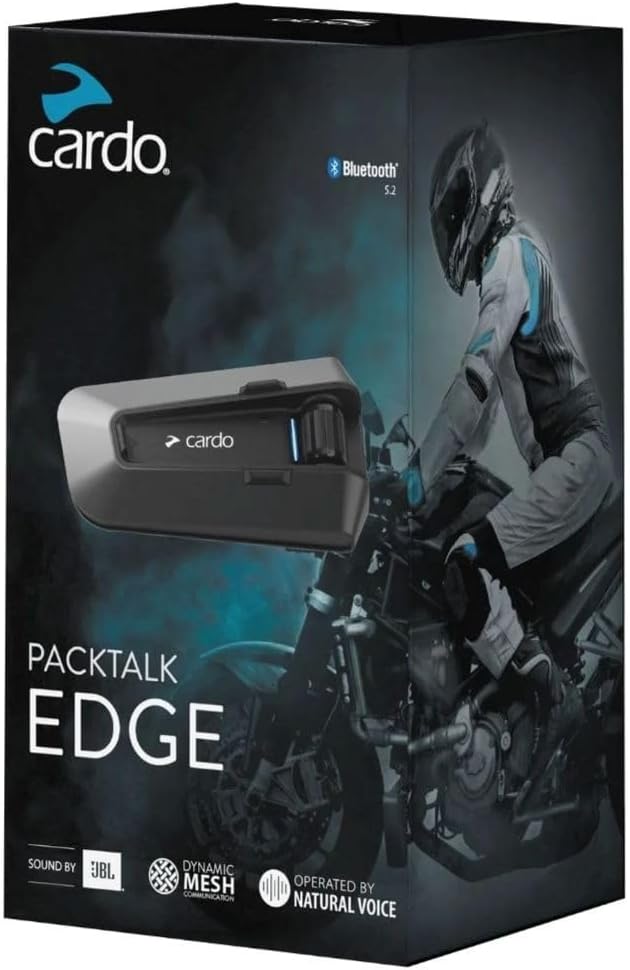
The Cardo Packtalk Edge is a premium dual-pack motorcycle communication system with a 4.5 rating. Its primary attraction is Natural Voice Operation, which lets a rider say hey Cardo and request functions without navigating physical buttons while keeping attention on the road.
We may earn a commission when you buy through this link, at no additional cost to you.
The system's waterproof construction is designed for rain, mud, dust, snow, and general outdoor exposure. Its focus is on uncomplicated, hands-free communication during travel, making it attractive to riders who value voice control more than a large collection of media settings.
The supplied product information is limited compared with several other entries in the guide. It does not state a maximum rider count, detailed range, battery endurance, speaker dimensions, or interoperability profile. Buyers who need those figures should confirm them with the manufacturer or current listing before making a final decision.
Packtalk Edge is best suited to premium touring riders who want straightforward, natural voice interaction and a durable unit. It is a sensible choice for riders who consider hands-free operation the most important feature and do not need a large mesh network specified in the product summary.
Natural Voice Operation allows core requests to be made by voice. That reduces the need to locate and press controls while riding, particularly helpful during busy traffic or route changes.
Waterproof construction supports use in rain, shine, mud, dust, and snow. The system is therefore positioned for touring and commuting rather than fair-weather recreational riding alone.
We may earn a commission when you buy through this link, at no additional cost to you.
The Cardo Packtalk Neo is a premium dual-pack intercom built around Dynamic Mesh Communication Generation 2. It can connect as many as 15 riders over a stated range of 1.6 kilometers, making it one of the strongest choices in this guide for clubs, guided tours, and long groups that need a resilient communication backbone.
We may earn a commission when you buy through this link, at no additional cost to you.
Its 40mm high-definition speakers were engineered with JBL and are supported by an improved music processor and three redesigned audio profiles. Natural Voice Operation lets riders activate functions with hey Cardo, and Easy Grouping is designed to make network formation fast and uncomplicated.
The important trade-off is the premium nature of the system. Riders who only need a two-person connection will find its mesh capabilities unnecessary. As with all radio links, real-world reach can be reduced by terrain, traffic, structures, and the arrangement of the group, so the stated 1.6-kilometer figure should not be interpreted as guaranteed performance in every setting.
Packtalk Neo is the recommendation for riders who regularly travel with many people, value refined audio, and want a feature-rich mesh network with hands-free operation. It combines generous capacity, premium speakers, weather resistance, and convenient grouping in a system aimed at serious touring and organized riding.
Dynamic Mesh Communication Generation 2 supports as many as 15 riders and a stated range of 1.6 kilometers. This capacity makes the Packtalk Neo especially relevant to clubs, event groups, and tours where a four-person intercom would be too restrictive.
JBL-engineered 40mm drivers, an improved processor, and three audio profiles provide a more refined listening experience. The larger drivers and dedicated sound processing are intended to serve both communication and entertainment.
Easy Grouping is designed to form mesh connections quickly, while Natural Voice Operation reduces physical control use. Together, these features help a large group get organized without extensive button handling.
We may earn a commission when you buy through this link, at no additional cost to you.
The Cardo FreeCom 4X is a waterproof, four-way helmet communication system with a 4.3 rating. It combines 40mm speakers, universal Bluetooth connectivity, wireless operation, and over-the-air software updates, offering a well-rounded format for small groups that want clear audio and flexible pairing.
We may earn a commission when you buy through this link, at no additional cost to you.
Four-way communication gives it a useful position between a basic two-person headset and larger touring mesh systems. Universal Bluetooth connectivity also allows it to connect with compatible equipment from other brands, which can be helpful in groups that do not standardize on one manufacturer.
The supplied information does not state a maximum communication distance, detailed battery endurance, or a large rider capacity. Consequently, riders who expect many participants or need a specific long-range guarantee should not rely on unstated figures. The absence of a stated mesh capacity may also be significant for large tours.
FreeCom 4X is a good fit for couples, small riding groups, and commuters who want four-way talk capability, larger speakers, and cross-brand flexibility. It is especially appealing to buyers who value Cardo's update platform and durable construction without needing the largest possible network.
Four-way connectivity covers the needs of a couple, a bike with a passenger, or a compact group of riders. It delivers more conversational capacity than a two-person unit while remaining less complex to manage than a large mesh network.
The 40mm speakers are designed to provide more body and clarity than smaller helmet drivers. Universal Bluetooth connectivity expands pairing options across compatible headset brands.
Over-the-air updates through Cardo Connect allow the system to receive new software without a conventional wired update process. This supports continued use and adds convenience for owners who ride regularly.
We may earn a commission when you buy through this link, at no additional cost to you.
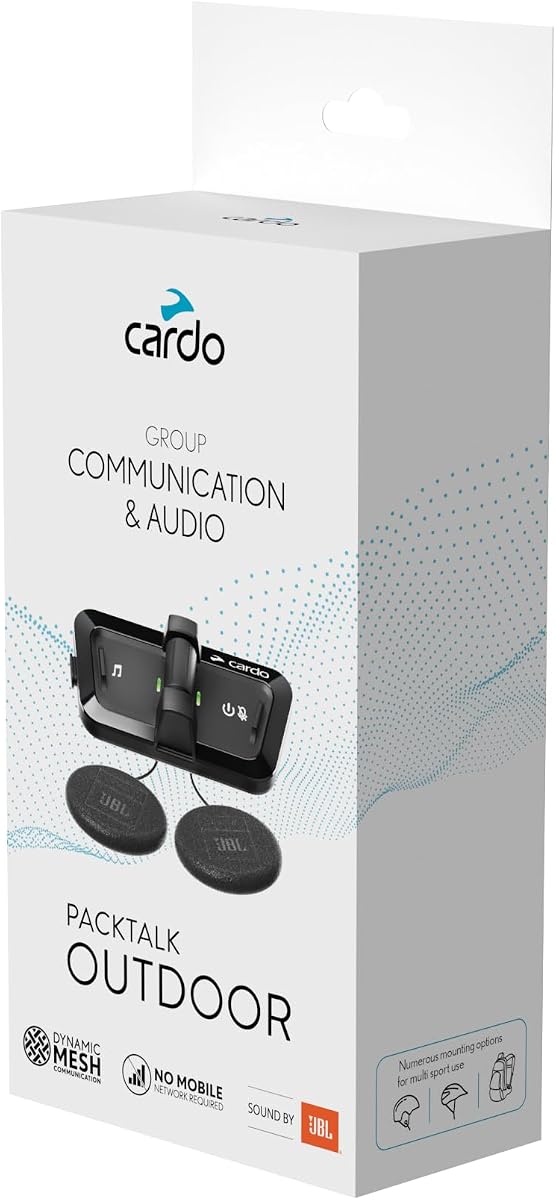
The Cardo Packtalk Outdoor is a single-pack communication system designed for skiing, snowboarding, cycling, and helmet-based activities in addition to motorcycle use. It has a 4.6 rating, supports as many as 15 users over a stated 1 kilometer range, and includes IP67 waterproof protection.
We may earn a commission when you buy through this link, at no additional cost to you.
Its mounting options broaden its appeal. A glue plate and V-strap clip support winter and full-face helmet installation, while a 3.5 millimeter to USB-C adapter allows connection to wired headphones for use without a helmet. It can also pair with Apple AirPods over Bluetooth.
Because this is a single-pack product, riders need to purchase enough units for everyone who wants direct participation. It is also a general-purpose outdoor system rather than a motorcycle-exclusive design. Some motorcyclists may prefer a dedicated helmet unit with an integrated boom microphone and a package containing multiple devices.
Packtalk Outdoor is best for riders with an active winter or cycling lifestyle, or for people who want one intercom platform across several sports. The 15-user capacity, durable construction, flexible mounting, and natural voice operation make it a compelling multi-purpose option.
The system is explicitly designed for skiing, snowboarding, and cycling, in addition to motorcycle riding. This makes it useful for buyers who want one communication platform for helmets used across seasons and activities.
A glue plate, V-strap clip, and wired-headphone adapter cover several installation needs. Bluetooth pairing with Apple AirPods adds another option for users who prefer an alternative to the integrated helmet hardware.
Support for up to 15 users and a stated one-kilometer range suits organized outings. IP67 waterproofing provides protection against rain, sun, mud, dust, and snow encountered in outdoor environments.
We may earn a commission when you buy through this link, at no additional cost to you.
The Sena 60S is a dual-pack helmet communication system with a 4.4 rating. It combines Mesh 3.0, Wave intercom, smartphone connectivity, IPX7 waterproofing, up to 24 hours of talk time, and second-generation Harman Kardon audio, giving it one of the strongest specifications for long-distance and large-group riding.
We may earn a commission when you buy through this link, at no additional cost to you.
Its stated two-user range is 2 kilometers, extending to 8 kilometers when six or more users are connected. That unusual high-capacity figure makes the system relevant to tour leaders and groups that spread out along a route. Bluetooth connectivity also supports calls, GPS navigation, and music.
The range figures remain dependent on terrain, interference, group structure, and other wireless conditions. IPX7 is a water-resistance rating rather than the IP67 water-and-dust rating offered by some competitors, so buyers should understand the distinction and check the installation guidance.
Sena 60S is best for riders who want more range than a compact group intercom, long battery life, and premium branded sound. It is especially attractive to touring riders and groups prepared to maintain separation while remaining connected.
The stated 2-kilometer range applies to two users, while networks of six or more may reach 8 kilometers. This makes the 60S compelling for dispersed groups and routes with longer stretches between riders.
Up to 24 hours of talk time reduces charging interruptions during long trips. Fast recharging between rides adds further convenience for riders who use the system across multiple outings.
Second-generation Harman Kardon audio is used for communication and entertainment, while Bluetooth smartphone pairing supports calls, navigation prompts, and music. Over-the-air updates help keep the firmware current.
We may earn a commission when you buy through this link, at no additional cost to you.
The right helmet intercom depends on group size, riding environment, control preferences, audio expectations, and interoperability. Comparing these factors before buying is more useful than focusing on a single headline range or rider-capacity number.
A two-person setup is sufficient for a couple, a rider with a passenger, or two friends traveling together. Four-way systems suit slightly larger groups, while mesh systems built for eight or fifteen riders are better for clubs, tours, and events. The relevant question is not merely the maximum number of people a product supports, but whether every unit can maintain live communication simultaneously within the same network.
Choose a two-person model for simplicity, a small-group unit for quick coordination, and a mesh platform for flexible group formation. Riders should also check whether a device can connect to other brands and whether cross-brand operation supports the full group or only a private two-person link.
Published range figures generally represent favorable conditions. Obstacles, hills, dense trees, buildings, vehicle traffic, and radio interference can all reduce actual reach. Two-user maximums may also differ from the range available to larger groups, so buyers should look for the number of riders associated with each range claim rather than treating every distance as interchangeable.
For city riding and tightly grouped tours, a shorter range may be perfectly adequate. Rural highways, open scenic routes, and widely spread groups benefit from a system with a stronger stated long-range profile. Always treat the maximum as a laboratory-style upper limit rather than an unconditional guarantee.
A helmet intercom is only as useful as its ability to cut through wind, engine noise, and helmet padding. Look for CVC, DSP, echo cancellation, windproof microphones, and speakers sized around 40 millimeters for a more full-range presentation. The included microphone type also matters because boom microphones suit open-face helmets, while button or soft microphones often fit full-face configurations more neatly.
Noise reduction cannot create a perfectly quiet environment, but a properly positioned microphone and well-matched speaker can greatly improve intelligibility. Riders who emphasize clear navigation prompts and spoken directions should prioritize microphone quality over extra entertainment modes.
Motorcycle intercoms are regularly exposed to rain, dust, mud, snow, vibration, and changing temperatures. An IP67 rating indicates protection against dust and temporary water immersion, while IPX7 emphasizes water immersion resistance without the same dust designation. Either can be useful, but the mounting position and exposed ports should also be considered.
Choose a weather-resistant system with a compact control housing and secure helmet attachment. A product that combines water resistance with replaceable microphones and modern charging is usually better suited to year-round riding than a basic unit with an exposed proprietary connector.
Battery claims should distinguish talk time, intercom time, music time, and standby time. A long standby figure is useful between rides, but active-use endurance matters more for long-distance touring. Riders should compare realistic operating durations with the length of their typical day and whether they can recharge between outings.
Type-C charging, fast charging, and use while charging add flexibility. The best system is not necessarily the one with the largest battery, since larger housings can affect weight and helmet comfort. Balance endurance, unit size, and the amount of power needed for your group.
Large buttons and a dedicated knob are easier to identify through gloves than small touch controls. Voice operation can further reduce distraction by allowing a rider to manage calls, music, and navigation without taking a hand off the controls. However, voice recognition may perform differently with wind, road noise, helmets, and different speaking accents, so physical controls remain a valuable backup.
Look for a balanced control layout that supports common actions without navigating complicated menus. Audio multitasking is another useful feature when a rider wants to hear GPS prompts or music while remaining available for intercom calls.
Beyond intercom calls, many systems support music, FM radio, stereo playback, phone calls, voice assistant access, and navigation prompts. Music sharing lets one phone or player provide a soundtrack to connected riders, which can add a communal element to group trips. Equalizer profiles can tailor the output for speech, pop, or more bass-heavy music.
Extra audio features are not automatically better. Riders who want the clearest possible communication may prefer a simple system with strong microphones and noise cancellation. Those who regularly share playlists or listen to FM radio will receive more value from a model designed around entertainment.
A lightweight profile reduces pressure and helmet interference, but the included mounting hardware, speaker positioning, and microphone choice are equally important. Full-face, modular, three-quarter, half, and open-face helmets may all work, though the supplied components determine how neatly the unit can be installed. Quick-release or adhesive mounting options may matter for people who change helmets.
Check whether the system works with other brands before purchasing for a mixed group. Also confirm compatibility with the phone, music source, and preferred voice assistant. A dual pack is convenient for couples, while larger groups should count the number of units required.
Begin with the helmet stopped and the unit fully charged. Install the speakers where they sit close to the ears without pressing painfully against the cheek pads, then choose the supplied microphone that best matches the helmet. Position a boom microphone near the mouth or secure a button microphone inside the chin area, keeping the cable clear of the strap and shell. Tighten every fastener and confirm that the headset does not shift when the helmet is moved.
Pair the intercom according to the manual, often by charging both units and holding the designated control until the pairing light changes. Set one device as needed and pair additional riders one at a time when configuring a group. Connect the phone afterward, download any required app, and test calls, music, navigation prompts, and intercom functions while stationary. Learn the voice commands and locate the main controls before entering traffic.
For care, remove the unit before washing the helmet liner and keep the speaker openings clear of dirt, sunscreen, and earbud residue. Check the microphone and charging port after wet rides, and do not charge a unit that is visibly wet. Clean the attachment points periodically, inspect the cable for damage, and update the firmware when instructed. Keeping the system maintained helps preserve sound quality, reliable controls, and dependable connectivity.
It depends on the model and connection mode. Some products support private two-person conversations, while others provide four-way, eight-rider, or fifteen-user mesh communication. Verify whether the stated capacity refers to pairing, active connections, or simultaneous group conversations before purchasing.
Many modern systems use universal Bluetooth connectivity, but the available features can still differ. A rider may be able to connect two devices from different brands while retaining only two-way intercom rather than full multi-person mesh functionality. Check compatibility carefully for mixed-brand groups.
IP67 indicates protection against dust ingress and temporary water immersion, while IPX7 indicates water-immersion protection without the same stated dust protection. These ratings support use in wet conditions, but they do not make every exposed connector immune to damage. Proper mounting and care remain important.
Most systems are designed for several helmet styles, but the included microphone and mounting hardware determine the cleanest installation. Full-face helmets often work well with soft or button microphones, while open-face helmets benefit from a boom microphone. Check the product contents and compatibility notes before installation.
Several models support music sharing, usually allowing a phone or media player connected to one rider to send audio to other intercom users. Shared playback generally operates within the active intercom group, so riders should agree on volume and content while stopped before using the function on the road.
Range matters most for rural routes, large tours, and groups that spread out. Terrain, buildings, traffic, and radio interference can reduce actual reach considerably. Riders staying close together can prioritize a compact system, while touring groups may benefit from a model with stronger long-range and mesh specifications.
Physical buttons remain important for reliable access to core functions, especially with gloves on or in noisy conditions. Voice control adds convenience and can reduce distraction, but performance varies with wind, accents, and background noise. A good compromise is a headset with large glove-friendly controls plus hands-free voice activation.
Charge every unit, install and position the microphones and speakers carefully, and complete all pairing while parked. Then test the group connection, phone calls, music sharing, navigation prompts, and voice commands before leaving. Familiarity with the controls helps riders focus on the road rather than the setup process.
The ZOVTIX X8 stands out as the feature-rich editor's choice for groups of up to eight riders, while the FreedConn TCOM VB delivers a focused and economical two-person experience. For riders who want premium mesh capacity, refined speakers, and natural voice operation, the Cardo Packtalk Neo is the most compelling high-end option.
Prioritize the features that match your actual riding pattern. Couples and solo riders may need nothing more than clear two-way audio, compact controls, and dependable weather protection. Small groups should consider four-way communication, while clubs and tour organizers should examine mesh capacity, range under real conditions, battery life, and mixed-brand compatibility.
Before purchasing, verify the current specifications, included accessories, mounting requirements, and pricing for every unit required. Inventory, firmware, and availability can change, and checking the latest product information ensures that the chosen helmet walkie talkie intercom system remains suitable for your helmet, riding group, and typical routes.
