
IPX8 Metal Water Flow Meter
4.4Editor score
IPX8 sealed metal housing
Plus-or-minus one-percent accuracy
Adjustable 360-degree display
Our Hose Flow Meter guide compares ten top models for accuracy, displays, durability, hose compatibility, measurement modes, and reliable outdoor use decisions.
A hose flow meter turns an ordinary garden hose into a practical water-management tool. The best models reveal real-time flow, track individual or cumulative usage, and help gardeners, RV owners, and homeowners control irrigation without estimating water consumption by guesswork.
We compared the supplied options by considering measurement accuracy, display readability, hose compatibility, water-resistance ratings, brass or metal construction, operating modes, and suitability for outdoor environments. The list covers conventional garden-hose meters, RV filling devices, sprinkler monitors, and premium metal-bodied models.
Each review identifies the strongest feature and any practical limitation of the product, helping you match a meter to your hose, watering routine, and display preferences. Ratings and specifications reflect the available product information, while current prices and availability can change at any time.
4.4Editor score

4.7Editor score

4.6Editor score
This side-by-side comparison covers ten hose flow meters across the features that matter most: measurement capability, display orientation, connector construction, outdoor protection, and ease of use.


The RESTMO Water Flow Meter is a general-purpose garden-hose monitor with a 4.5 rating and a feature set aimed at everyday irrigation. It displays real-time flow, the previous session's consumption, a daily average across a week, and cumulative usage. That combination gives it more flexibility than a basic single-reading flow gauge.
We may earn a commission when you buy through this link, at no additional cost to you.
Its brass inlet and metal thread are designed to withstand repeated installation and removal, while the ABS body is rated IPX6 for resistance to rain, splashing, and ultraviolet exposure. A hall-type sensor and chipset support measurements within a stated tolerance of less than five percent. A long press in flow mode changes between gallons and liters, and the screen sleeps after a minute of inactivity.
The main compromise is its fixed screen orientation. That may be inconvenient when the meter sits beneath a raised hose connection or beside a wall. The product information also describes the meter in general terms without a stated minimum flow, so it is less predictable for very slow trickles than models that publish explicit minimum and maximum rates.
This is a strong choice for a gardener who wants current flow, recent consumption, weekly averages, and a running total without navigating a complicated interface. It is particularly useful for checking whether a sprinkler or hose nozzle is delivering the expected amount of water. For buyers who do not need a reversible display, it provides a balanced feature set and dependable outdoor-oriented construction.
The meter separates real-time flow from the last session, a seven-day daily average, and cumulative use. This makes it possible to compare a quick watering cycle with a broader watering habit without repeatedly restarting the device.
A brass inlet and metal thread are especially useful for people who move their meter between a faucet, sprinkler, and nozzle. The weather-resistant body and IPX6 rating also suit routine outdoor exposure, although the battery compartment should always be closed correctly.
We may earn a commission when you buy through this link, at no additional cost to you.
The RAINPOINT Water Flow Meter with Brass Inlet combines a 4.7 rating with an unusually flexible installation and display design. It is built for garden hoses, RV tanks, sprinklers, and nozzle sprayers, and it can display a reading up to 9999.9 gallons or liters. The 180-degree screen flip is a practical improvement when the meter cannot be mounted upright.
We may earn a commission when you buy through this link, at no additional cost to you.
Its four modes cover real-time flow, the last usage session, and two separately stored totals. Those totals can organize different time periods, such as a current period and a previous period, without erasing one another. Bidirectional installation broadens placement options, and the brass inlet is designed for regular outdoor use. Rubber sealing rings around the display and battery cover add leak resistance.
The learning curve is slightly greater than that of a simple one-button meter. The two total modes must be selected deliberately, and although flow can enter from either side, the configured direction still needs to align with actual movement for dependable readings. The screen also sleeps after one minute without operation or flow.
This is the most versatile option for users who move a meter around or install it in awkward positions. The reversible screen, two totals, and broad application range make it particularly effective for RV filling and mixed outdoor watering tasks. It is our top general-purpose choice for combining readable data, flexible placement, and practical tracking features.
The one-touch 180-degree flip allows the numbers to remain readable when the meter is mounted sideways or upside down. That matters when the available faucet clearance is limited or when a garden hose naturally approaches the connection from the ground.
Keeping two total counters is more useful than repeatedly resetting a single accumulator. You can compare a short session against a longer period, maintain daily and monthly totals, or use one counter for RV filling and another for routine irrigation.
We may earn a commission when you buy through this link, at no additional cost to you.
The RESTMO Water Flow Meter with Brass Inlet Metal Thread stands out for publishing a clear measurable range of 0.3 to 12 GPM, equivalent to 1 to 45.5 LPM. Its 4.5 rating reflects a balanced design for garden watering, RV tank filling, lawn sprinklers, and hose nozzles. A hall sensor supports measurement within a stated tolerance of less than five percent.
We may earn a commission when you buy through this link, at no additional cost to you.
The four operating modes cover flow, last-session consumption, a daily average across seven days, and total usage. A one-touch button changes modes, while a long press in flow mode switches gallons to liters. Long presses in the other modes reset the corresponding data. The meter also switches off its LCD after a minute without operation.
Its flow range is useful for planning, but the 12 GPM ceiling means it may not cover unusually high-output irrigation arrangements. The product also recommends a moderate faucet setting rather than maximum flow for clearer readings. The screen cannot be flipped, so installation orientation deserves attention before purchasing.
This model is a good fit for users who value a clearly stated minimum and maximum flow range, particularly when estimating irrigation time or comparing nozzle output. It combines rugged brass and metal-thread components with simple controls and multiple tracking views. It is less suited to high-output systems or installations that require an adjustable display.
Knowing the meter works from 0.3 to 12 GPM lets you compare ordinary hose output with the device's capabilities. It also gives you a basis for testing whether a sprinkler, soaker, or nozzle is delivering a reasonable stream.
A single control button handles mode changes, unit conversion, and resets. The interaction is uncomplicated once the button-press pattern is learned, making the meter approachable for occasional users as well as those who check water usage every week.
We may earn a commission when you buy through this link, at no additional cost to you.
The RAINPOINT Water Flow Meter with Brass Inlet and Outlet has a 4.6 rating and emphasizes installation flexibility. Its compact body can be used in RVs, pools, patios, and garden-watering systems without requiring one fixed orientation. The metal-threaded brass inlet and outlet are designed for durability, while the display can be flipped 180 degrees.
We may earn a commission when you buy through this link, at no additional cost to you.
The interface provides flow rate, a last-use reading, and two total modes. Those total modes can track separate periods such as today and this month, or preserve usage from earlier sessions. Rubber rings around the display and battery cover provide double leak protection, while a flip action is intended to reduce the chance of water entering an exposed rotating joint.
There is an important operational note: the marked a-to-b flow direction must match the selected setting. Incorrect direction can interfere with accurate measurement. The supplied information also does not state a numerical accuracy tolerance, so buyers who need a documented accuracy specification should compare it carefully with models that provide one.
This is an appealing option for RV owners and gardeners who want a compact meter with brass fittings on both sides. The directional flexibility and reversible display improve usability in confined spaces. It is especially well suited to users who want two independent totals rather than only a current-session reading.
The body can accommodate flow in either direction, allowing it to fit hose layouts that would otherwise require awkward bends or adapters. Confirm the displayed a-to-b direction after installation so the meter interprets movement correctly.
The 180-degree screen flip preserves legibility when the meter is mounted below a faucet, against a wall, or in another awkward location. A single-button control keeps the adjustment straightforward.
We may earn a commission when you buy through this link, at no additional cost to you.
The RAINPOINT Green Water Flow Meter is designed with RV water-tank filling in mind, including overfill prevention and black-tank flushing. Its 4.5 rating is supported by a stated plus-or-minus five-percent accuracy, brass inlet and outlet fittings, four measurement modes, and a reversible 180-degree display.
We may earn a commission when you buy through this link, at no additional cost to you.
Garden use is another major strength. The meter can track water for newly planted trees, vegetable beds, lawn irrigation, pool refills, and well-water records. Dual total counters let users preserve separate usage figures, while bidirectional flow detection and the adjustable display reduce installation restrictions. Spare rubber washers are included, which is useful for routine maintenance.
Readings may become unstable under very low flow, so the meter is best suited to normal hose and sprinkler output rather than a barely perceptible trickle. The manufacturer also advises removing it from the faucet during freezing winter and avoiding all-day direct sun, which can cause screen fogging. A unit-level warranty of five years adds reassurance for long-term owners.
This is a particularly compelling choice for campers who want to meter RV tank filling or for gardeners who want one device across several outdoor tasks. The combination of brass construction, two totals, reversible viewing, and stated accuracy makes it a well-rounded option. Attention to low-flow conditions and seasonal care will help preserve reliable performance.
Real-time and cumulative readings let an RV owner stop filling at a defined point rather than relying on an uncertain estimate. The dual totals can also preserve a current fill separately from another usage category.
Removing the meter before freezing weather helps prevent damage to the body and electronics. Limiting prolonged direct sun can reduce display fogging and maintain visibility during warm-weather outdoor use.
We may earn a commission when you buy through this link, at no additional cost to you.
The RESTMO Dual-Zone Display Water Flow Meter is built around visibility. Its enlarged LCD uses separate areas for useful information, and it can show single-session volume, seven-day daily average, cumulative total, and real-time flow rate. The 4.5-rated model therefore reduces the need to switch through every mode just to check a second value.
We may earn a commission when you buy through this link, at no additional cost to you.
The product information states a plus-or-minus four-percent measurement tolerance under normal flow, supported by a hall-effect sensor and an upgraded chipset. It also includes a metal inlet filter intended to reduce clogging, brass connectors, a robust ABS body, and a stated working-pressure range from 0 to 116 PSI. A 3/4-inch NH metal inlet fits common garden hoses.
Its IPX5 rating is lower than the IPX6 or IPX8 alternatives, so it is best kept away from direct, heavy water exposure even though it is designed for outdoor scenarios. The separate set and clear buttons make controls explicit, but they also add a little more physical complexity than a one-button meter. Actual accuracy will still depend on steady flow and proper installation.
This is an excellent choice for users who want important readings visible at once rather than navigating a single-screen cycle. The clear display, tighter tolerance, anti-clog filter, and broad pressure specification make it particularly useful for garden irrigation, RV filling, and pool maintenance. It stands apart most clearly from simpler meters through its dual-zone layout.
The enlarged dual-zone screen keeps current usage information available without forcing repeated button presses. That convenience is valuable during a watering session, when checking flow and accumulated volume at the same time is useful.
The metal filter at the inlet is designed to help reduce debris-related obstruction. Combined with brass connectors and a stated operating range up to 116 PSI, it gives the meter a durable foundation for varied outdoor water systems.
We may earn a commission when you buy through this link, at no additional cost to you.
The IPX8 Metal Water Flow Meter is the premium choice for buyers who prioritize a documented tight accuracy tolerance and a highly protected body. It carries a 4.4 rating, uses an aluminum alloy housing for impact resistance, and specifies plus-or-minus one-percent accuracy. Its IPX8 rating makes it especially suitable for wet outdoor installations.
We may earn a commission when you buy through this link, at no additional cost to you.
The meter supports both hot and cold water across a working temperature range of 14 to 176 Fahrenheit, making it more versatile than meters intended only for outdoor cold-water applications. Its circular LCD can be rotated and fixed at any angle, while a low-battery warning and ten-minute auto-off function simplify maintenance and conserve standby power.
This premium construction comes with a higher cost than most plastic-bodied options. The ten-minute auto-off setting is longer than the one-minute sleep timing found on several competing meters, although the stated standby life extends beyond a year. Accuracy can also be affected by installation conditions, so the meter should be connected securely and used within its intended parameters.
Choose this model when precise tracking, impact-resistant construction, and stronger water protection justify a premium approach. It works well for garden hoses, RVs, sprinklers, spraying, and household applications that include hot water. The adjustable display and wide temperature compatibility make it especially versatile for installers working in different environments.
A plus-or-minus one-percent specification is the strongest stated tolerance in this group. That makes the meter appealing for users who need repeatable volume records, compare sprinkler zones, or document water use closely.
Aluminum alloy offers greater impact resistance than a typical plastic body, reducing concern about cracking during installation or transport. The IPX8 enclosure adds a high level of protection for rain, splashes, and wet outdoor conditions.
We may earn a commission when you buy through this link, at no additional cost to you.
The IP68 Metal Water Flow Meter is built for outdoor environments where splash resistance and physical durability are important. It has a 4.4 rating, an IP68 enclosure, an aluminum alloy housing, and an accuracy claim of up to plus-or-minus one percent. That protection is well suited to garden hoses, RVs, pools, and lawn sprinklers.
We may earn a commission when you buy through this link, at no additional cost to you.
Its principal attraction is the level of sealing. Unlike the lower-numbered IP ratings in this comparison, IP68 is designed to withstand demanding rain, splashes, and wet operating conditions. The rotatable LCD can be fixed at any angle, so the meter remains readable even when the hose connection limits the view. Battery replacement does not require removing the meter from the hose.
Compared with the IPX8 metal model, this product's supplied specifications do not include a working-temperature range for hot water. It is therefore more naturally aligned with outdoor cold-water applications. As with other premium metal options, the construction and sealing level come at a higher cost than basic ABS-and-brass meters.
This model is a strong option for buyers who want maximum listed weather protection in a rugged body. It is particularly suitable for frequently used outdoor hose connections, RV filling, and lawn irrigation where splash exposure is routine. Choose it over the hot-and-cold-compatible IPX8 model when full sealing and outdoor durability matter more than hot-water use.
The enclosure is designed to withstand heavy splashing and persistent wet conditions. That makes the meter a logical fit for outdoor faucet connections, sprinklers, pool work, and RV filling tasks.
The display can be turned and fixed at any angle, allowing the numbers to face the user regardless of the hose's position. This is especially valuable when a connection is mounted close to a wall or beneath a raised spigot.
We may earn a commission when you buy through this link, at no additional cost to you.
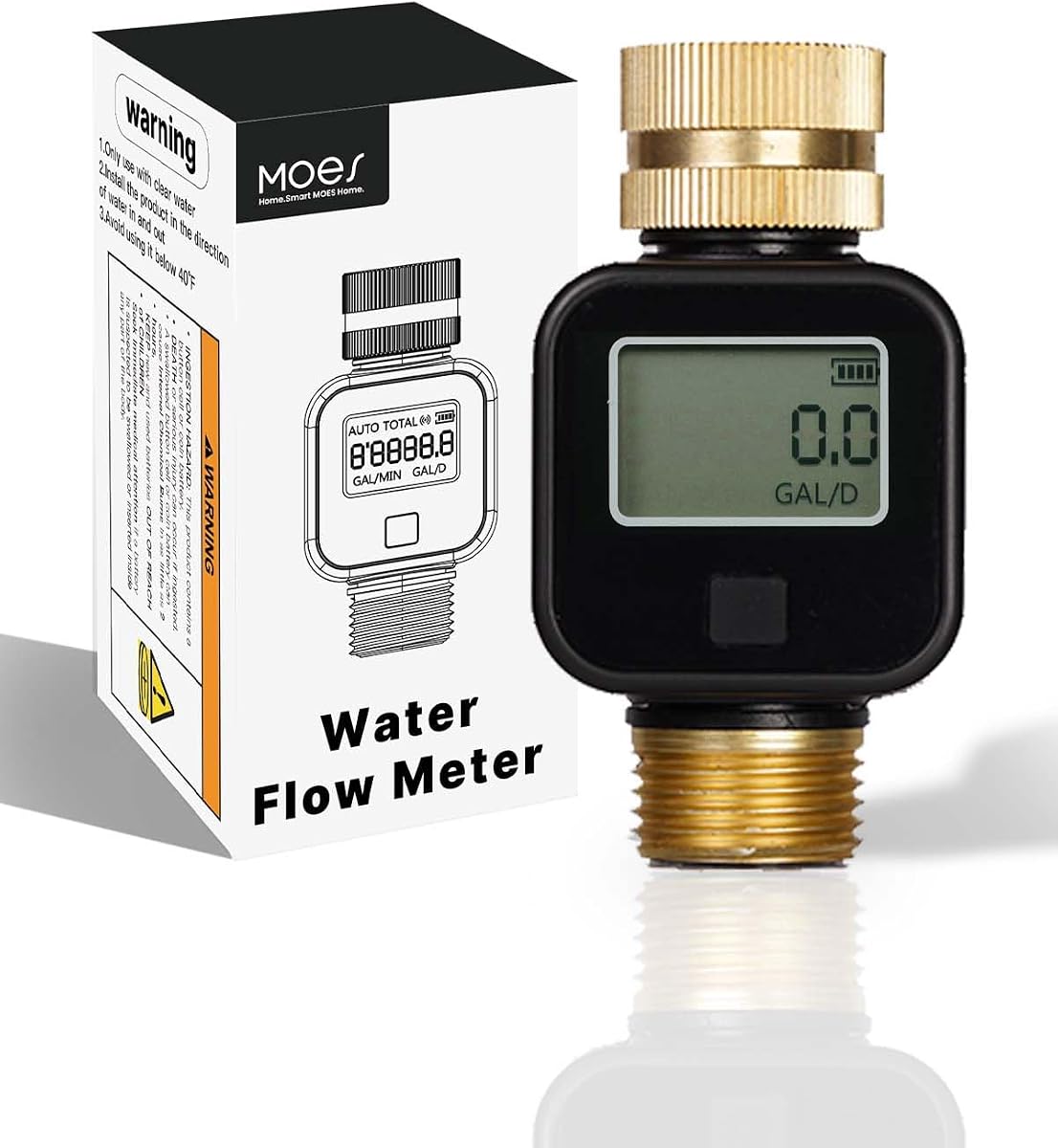
The MOES Water Flow Meter is a value-focused all-rounder with a 4.6 rating. It provides real-time flow, last-session usage, average daily use, and total consumption through a clear LCD and one-touch control. The brass inlet and metal thread are intended to handle repeated installation and removal without the fragility associated with lighter fittings.
We may earn a commission when you buy through this link, at no additional cost to you.
Its specifications are unusually complete for a budget-oriented model: flow from 1 to 45 liters per minute, a maximum of 12 gallons per minute, tolerance within plus-or-minus five percent, an IPX6 waterproof rating, and maximum consumption readings of 99999 gallons or liters. It is suitable for sprinklers and standard three-quarter-inch faucet hoses, with a working pressure range of 0.5 to 10 bar.
Its minimum flow of one liter per minute means the meter is less appropriate for a slow drip or exceptionally gentle trickle. The screen also has a fixed orientation, although it is deliberately readable upside down. A long press in auto mode reverses the values when a conventional upright reading is preferred.
This is a strong budget selection for everyday garden watering, hose nozzles, and sprinklers. It offers more modes and clearer specifications than many similarly positioned devices, while the 4.6 rating supports confidence in its overall appeal. Buyers with very low flow requirements should choose a model with a lower stated minimum.
The stated flow, pressure, temperature, tolerance, and maximum consumption limits make it easier to determine whether the meter fits a particular system. The one-to-45-liter-per-minute range covers common outdoor hose output.
Real-time flow helps evaluate a nozzle or sprinkler, last-session data records a recent watering event, and total and average modes reveal broader consumption patterns. Gallons and liters are both supported for households that use either unit.
We may earn a commission when you buy through this link, at no additional cost to you.
The MOES Water Flow Meter with Brass Inlet and Outlet combines a 4.7 rating with a high stated maximum flow and a straightforward four-mode interface. It is suitable for standard three-quarter-inch hoses, sprinklers, and other outdoor applications that operate from one to 45 liters per minute, with a maximum of 12 gallons per minute.
We may earn a commission when you buy through this link, at no additional cost to you.
A hall-type sensor and chipset support calculations within a plus-or-minus five-percent measurement tolerance. The meter can display real-time flow rate, last-session volume, average daily consumption, and cumulative use. Its large maximum consumption figure of 99999 gallons or liters is suitable for prolonged tracking, and the brass inlet and outlet are designed for repeated connection changes.
The minimum flow of one liter per minute is the main limitation for very slow drip systems. Its fixed screen is designed to be readable upside down, but it cannot be actively flipped. The operating temperature range is stated as 37.4 to 149 Fahrenheit, and the working pressure range extends from 0.5 to 10 bar.
This model is an appealing choice for users who want a high-capacity meter without moving to a premium metal body. It is particularly effective for ordinary sprinklers and hose-nozzle output, and its 4.7 rating makes it one of the strongest customer-rated options in this guide. Low-volume drip irrigation is the scenario it is least suited to.
A 45-liter-per-minute ceiling gives the meter room to handle common hose and sprinkler flow. It is more accommodating than units intended exclusively for modest drip output, provided your actual use remains within the published range.
Brass fittings at both ends provide a durable connection for users who move the meter among several outdoor outlets. The metal threads are better suited to repeated installation than lightweight plastic connectors.
We may earn a commission when you buy through this link, at no additional cost to you.
The right hose flow meter depends on the water you want to measure, where it will be installed, and how you plan to read and preserve the results. Accuracy, minimum flow, construction, sealing, and display design should be evaluated together rather than in isolation.
Accuracy is the core specification because the meter is useful only when its readings closely represent actual water movement. The stated tolerances in this group range from less than five percent on several hall-sensor models to plus-or-minus one percent on the premium metal-bodied options. A tighter tolerance is valuable when comparing sprinklers, filling an RV tank near capacity, or tracking water against a fixed schedule.
Accuracy claims should be considered alongside operating limits. A meter may perform well at normal hose pressure yet become less stable at very low flow. The RAINPOINT Green model specifically warns that readings may be unstable under very low flow, while the MOES meters publish a one-liter-per-minute minimum. Always choose a range that fits the intended application rather than selecting only on the headline accuracy number.
The flow range determines whether a meter can measure the full output of your hose, nozzle, or sprinkler. The RESTMO model labeled B0BL37TN96 lists a broad 0.3 to 12 GPM range, or 1 to 45.5 LPM, which includes lower flows than the MOES models' one-liter-per-minute minimum. The upper limit of 12 gallons per minute is common across several choices and generally suits ordinary garden watering.
For a normal hose, sprinkler, or spray nozzle, a meter that covers several liters or gallons per minute will usually be sufficient. Low-flow drip emitters require a model with a documented lower minimum, while unusually powerful irrigation equipment may exceed the maximum of several affordable meters. Match both ends of the range to your planned use.
A large, high-definition display makes a meter quicker to interpret during watering. Some models use a one-button interface that cycles through flow, last, average, and total readings. The RESTMO dual-zone model goes further by separating information into two screen areas, reducing the need to toggle between values. Its 4.5-rated design is particularly attractive when you want immediate access to more than one statistic.
The RAINPOINT options add a 180-degree screen flip, while the metal models use a panel that rotates a full 360 degrees. These adjustments are useful when the faucet sits below a counter, against a wall, or in a cramped RV connection. A fixed display may still work, but check the intended mounting position before buying.
Four modes are common across this group: real-time flow rate, last-session consumption, average daily use, and total consumption. Real-time flow is the most useful for comparing nozzle output, while last-session data records one watering event. Average and total modes reveal longer-term consumption and can help identify whether irrigation habits are changing.
Products with two total counters offer more flexibility than a single accumulator. You might use one total for a current day and another for a month, or keep RV tank filling separate from garden irrigation. Resetting behavior also differs, so check whether a long press clears a mode and whether accumulated values survive a session.
Brass inlets and metal threads are the most common durable features among the selected meters. They are well suited to repeated installation, removal, and exposure to outdoor moisture. Some models add a brass outlet, while the RESTMO dual-zone product uses a three-quarter-inch NH metal inlet and includes a metal filter at the entry point.
Confirm the hose size and connection type before purchasing. These meters are generally intended for standard garden hoses, sprinklers, RV filling arrangements, and common faucets. A filter can help prevent debris from reaching the sensor, while a broad pressure range can be useful if your household water pressure varies.
Outdoor use exposes a meter to rain, UV light, dirt, splashes, and changing temperatures. IPX6 models offer a practical level of protection for typical hose and sprinkler environments. The IP68 metal model goes further and is designed to withstand demanding rain, splashes, and wet conditions, while the IPX8 metal alternative provides high outdoor protection as well.
A water-resistance rating is not a substitute for sensible care. Keep battery covers sealed, avoid immersing a connector beyond its intended use, and remove the meter from outdoor plumbing during freezing weather. The RAINPOINT Green model also recommends avoiding all-day direct sun because prolonged heat can cause screen fogging.
Most models use an ABS body paired with brass fittings, while the premium options use aluminum alloy for greater impact resistance. Metal housings can be reassuring for frequently handled equipment, but they usually cost more. Power management also varies: several LCD screens sleep after one minute, whereas the metal models switch off after ten minutes and advertise standby life beyond a year.
Look for a low-battery warning and consider how batteries will be replaced in the installed position. The IPX8 and IP68 models allow battery changes without removing the meter from the hose, which is convenient. Spare washers can also be useful for maintaining a watertight hose connection over time.
Begin by confirming that the hose and faucet connection match the meter, then inspect the metal threads and sealing washers for debris, damage, or cross-threading. Install the meter with the direction of water flow aligned with the a-to-b marking or configured arrow. Tighten the connection by hand and the appropriate tool without applying excessive force, as overtightening can damage the thread or washer.
After installation, choose the display mode that matches your task. Use flow rate when comparing a faucet, sprinkler, or nozzle; use the last-session mode after one watering event; and use average or total modes for longer-term tracking. If the model supports two totals, assign one period or purpose to each counter. Learn the reset and unit-switch commands before beginning so an accidental press does not erase useful records.
Read the display while water is moving steadily, and allow a brief settling period when starting or changing the flow. Keep the battery tray dry, use the correct battery orientation, and close the compartment fully. After use, briefly run the hose to clear residual water, disconnect the meter without tugging on the connector, and store it dry. Remove it during freezing weather and inspect washers and seals periodically.
A hose flow meter measures the rate and total volume of water passing through a connected garden hose. It can show real-time output, record an individual watering session, calculate averages, and maintain cumulative totals. Gardeners use this information to compare sprinklers, estimate irrigation time, monitor RV tank filling, and identify excessive water use.
The unit setting should not inherently change the meter's measurement accuracy because it is a conversion of the detected flow. However, readings can be affected by low flow, unstable pressure, installation errors, or an incorrect flow direction. Keep the connection secure, align the direction marker, and compare the displayed rate with your hose or nozzle's expected output.
Yes, several models are specifically suited to RV tank filling, and the RAINPOINT Green model is designed with overfill prevention in mind. Real-time flow and total readings help you stop at a chosen volume. Ensure the hose, faucet, and connectors are compatible, and never leave a filling operation unattended.
The listed products range from tolerances of less than five percent to plus-or-minus one percent. Tighter specifications are helpful when comparing zones or filling a tank near capacity, but steady flow and correct installation remain important. Select a range and accuracy level that suit the task rather than assuming a single number applies under every condition.
Yes. Garden sprinklers, nozzle sprayers, lawn sprinklers, and standard three-quarter-inch faucet hoses are among the stated uses across the selected products. Check the meter's maximum flow so the sprinkler does not exceed its capacity, and keep a moderate or stable flow if readings appear inconsistent.
Some meters are designed so the LCD remains readable when the unit is installed upside down. The MOES models allow the orientation to be reversed in auto mode through a long button press, while RAINPOINT products use a 180-degree flip control. Follow the specific model's instructions to restore the preferred orientation.
Disconnect the meter from the faucet before freezing conditions and store it in a dry place. Freezing water within the body or connected lines can damage the unit. For year-round outdoor use, keep the battery compartment closed, inspect the seals, and limit prolonged direct sunlight when the manufacturer recommends it.
Flow rate tells you how quickly water is moving, while total consumption tells you how much water has passed through over time. A flow-rate reading is useful for comparing a faucet, sprinkler, or nozzle. Total consumption is better for budgeting a watering session, tracking a tank fill, or measuring repeated household and garden use.
The RAINPOINT Water Flow Meter with Brass Inlet is the strongest general-purpose choice because it combines bidirectional installation, a reversible screen, two total counters, and leak-resistant construction. The IPX8 Metal Water Flow Meter is the premium option for buyers who want a documented one-percent accuracy, a metal body, and high water protection, while the MOES Water Flow Meter offers a balanced budget package with four modes and detailed specifications.
Prioritize the operating range first, followed by the display style and tracking modes you will actually use. A hose that delivers less than the meter's minimum flow will not provide dependable readings, and a connector that does not match your setup can undermine the entire purchase. For outdoor durability, brass fittings and at least IPX6 protection offer a practical balance, while IP68 or IPX8 housings suit more demanding exposure.
Before buying, confirm the connector size, flow requirements, unit preference, and installation position with the product information. Ratings and specifications are useful points of comparison, but current prices, availability, and product details can change. Check the latest listing before making a final purchasing decision.