
Flow Hall Sensor with NPT Thread
4.7Editor score
1–30 liters per minute
Sealed magnetic hall-effect sensor
Arduino and Raspberry Pi compatible
Magnetic water flow meters use magnetic sensing, ultrasonic measurement, or related electronic flow-detection methods to track water moving through a pipe. The right model depends on pipe size, flow range, accuracy, output signals, environmental exposure, and whether you need continuous process control or basic consumption tracking.
This guide compares ten water flow meters suited to different needs, including industrial electromagnetic models, compact hall-effect sensors, clamp-on ultrasonic instruments, and connected garden or RV meters. We compared the stated specifications, measurement methods, installation requirements, display features, environmental ratings, and integration capabilities.
The selections show that magnetic water metering is not a one-size-fits-all category. Some products are true industrial electromagnetic meters, while others use hall-effect or ultrasonic technology and may be better for portable, residential, agricultural, or low-flow applications. Prices and availability can change.
4.7Editor score


3.7Editor score
As an Amazon Associate we earn from qualifying purchases.
This side-by-side comparison organizes the ten products by measurement method, flow range, pipe compatibility, power source, connectivity, and practical use. It includes true electromagnetic meters as well as closely related magnetic hall-effect and ultrasonic alternatives for household, agricultural, commercial, and industrial applications.



This DN25 electromagnetic flow meter is the most complete industrial choice in the group. It combines a 1-inch nominal size, a stated accuracy of 0.5%, and a flow range of 1–16 cubic meters per hour with both pulse and 4–20mA outputs. No customer rating is supplied, so its evaluation here rests on the published specifications rather than a quantified user-rating average.
We may earn a commission when you buy through this link, at no additional cost to you.
The wetted construction is especially relevant to wastewater and industrial liquids. A PTFE liner separates the conductive liquid from the sensing assembly, while SS316L electrodes resist corrosion and wear. The carbon-steel body, DIN flange connection, 24V power supply, and stated 4.0 MPa pressure capability make the unit more appropriate for fixed process installations than for a temporary hose connection.
Its dual-output design offers useful flexibility. The 4–20mA signal can support real-time flow-rate monitoring, while the pulse output can contribute to totalization or connected control equipment. The integrated IP65 housing also avoids the need to pair a separate sensor and transmitter when the installation is designed around that architecture.
This is the strongest recommendation for an operator who needs true electromagnetic sensing, pipe-mounted industrial measurement, and standard control-system signals. Installation requires matching DN25 flanges, confirming electrical requirements, and ensuring the flow direction and grounding arrangements are appropriate. It is less suitable for a homeowner who simply wants a garden-hose totalizer.
The PTFE liner and SS316L electrodes form the key material advantage in corrosive or abrasive conductive-liquid service. Their suitability still depends on the liquid chemistry, so compatibility should be confirmed before installation.
Providing both analog and pulse outputs lets the meter fit real-time monitoring and totalization roles. That flexibility is more valuable in an industrial control environment than in a simple household display.
We may earn a commission when you buy through this link, at no additional cost to you.
The DN100 model targets water measurement in substantially larger pipework than the first selection. Its four-inch nominal format and 4–20mA output make it a natural candidate for drainage or water-transfer systems where a larger signal and remote monitoring are priorities. The supplied information does not provide a numerical accuracy figure or customer rating.
We may earn a commission when you buy through this link, at no additional cost to you.
One of the main practical benefits of electromagnetic sensing is the unobstructed flow path. The product information specifically notes that there is no obstruction in the conduit, no pressure drop associated with an inserted obstruction, and only a relatively short straight-pipe requirement. Those properties can simplify comparison with mechanical or turbine meters in suitable installations.
The converter is designed for convenient operation in changing light conditions. Its LCD can be read in daylight or darkness, while infrared touch nubs allow parameters to be configured without opening the converter cover. The stated processing technology is also intended to provide strong immunity to negative pressure, which is useful where drainage conditions vary.
This meter is best considered for a fixed DN100 water or drainage line where 4–20mA integration and convenient local configuration are important. Buyers should request dimensional, pressure, liner, electrode, power, and flow-range details before ordering because those specifications are not included in the supplied listing. It is not a hose meter or a portable clamp-on instrument.
The absence of a protruding sensing element supports unobstructed flow and avoids the pressure loss associated with some insertable meters. Site planning should still account for the manufacturer's straight-pipe and installation requirements.
Infrared touch nubs simplify parameter changes while reducing the need to access the converter interior. This is convenient for routine setup and maintenance in fixed installations.
We may earn a commission when you buy through this link, at no additional cost to you.
This compact hall-effect flow sensor is the most approachable magnetic option for small water lines, appliances, filtration systems, and maker projects. It has a 4.7 customer rating, a 1–30 liter-per-minute range, and half-inch NPT threading. Unlike the larger industrial entries, it is designed around a simple electrical pulse that a microcontroller or compatible counter can interpret.
We may earn a commission when you buy through this link, at no additional cost to you.
The rotating component contains bearings, and an integrated magnetic hall-effect sensor produces an electrical pulse with each revolution. The sensor electronics are sealed from the water pipe, helping keep them dry while water passes through the fitting. Its light body and small outline are advantageous where space is limited or the meter must fit inside equipment such as a water heater or purifier.
The key trade-off is its restricted operating range. A maximum of 30 liters per minute is appropriate for residential water heaters, coffee machines, drinking fountains, beverage equipment, and reverse-osmosis filtration, but not for mainline or industrial flow. The installation must follow the indicated flow direction because the unit produces no signal when oriented incorrectly.
This is an excellent budget choice for a maker or technician who wants to add flow-rate or volume monitoring to a small system. It is especially attractive when pulse output and compatibility with Arduino or Raspberry Pi matter more than a finished digital display. A downstream controller, display, and appropriate electrical connection will generally be required.
Each rotor revolution produces an electrical pulse, allowing a controller to calculate flow and accumulated volume. This makes the meter adaptable to custom displays, alerts, and automated shutoff logic.
The sealed hall sensor helps protect electronics from moisture inside the pipe. Buyers must still respect the flow arrow because incorrect orientation prevents signal output.
We may earn a commission when you buy through this link, at no additional cost to you.
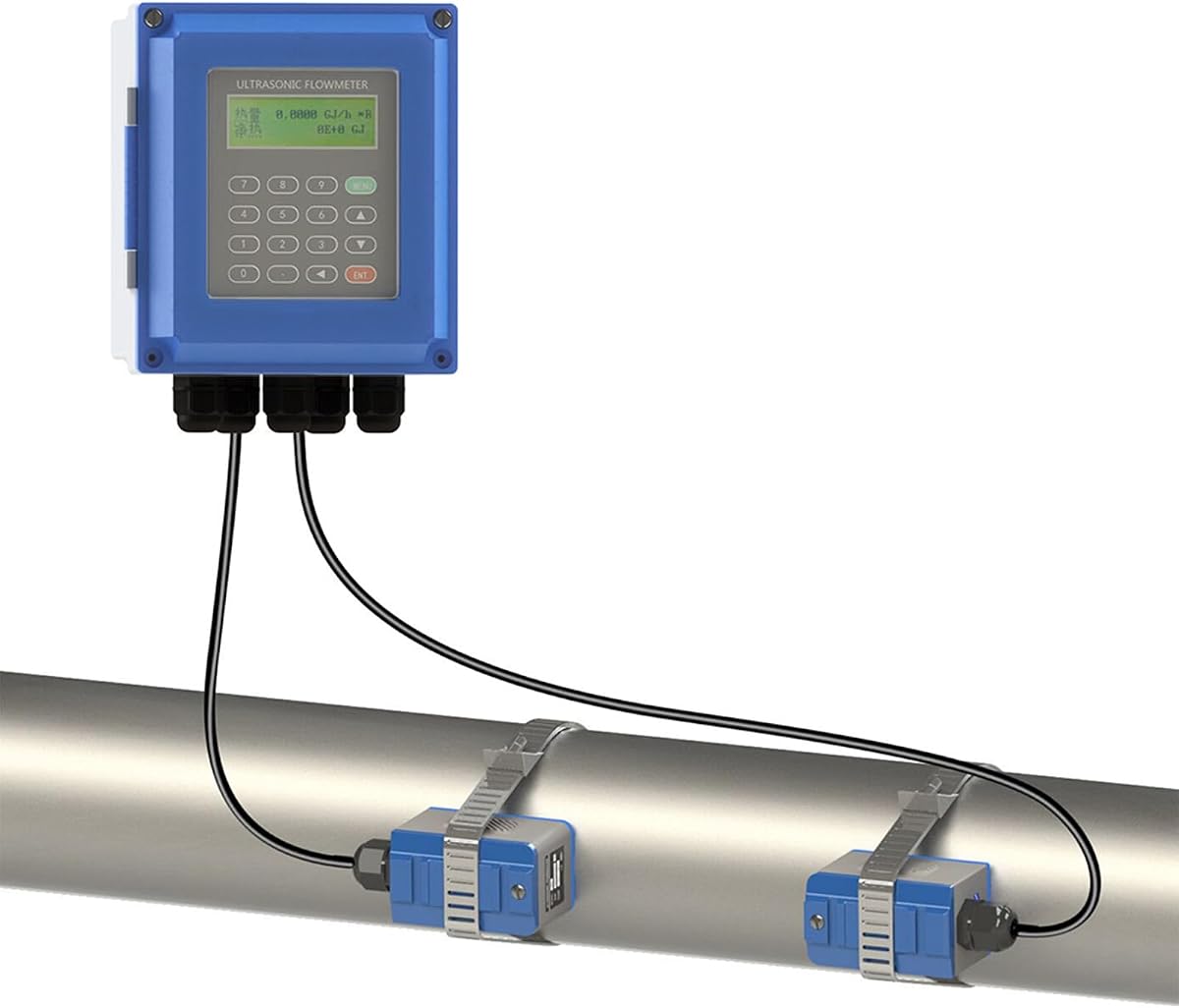
This digital ultrasonic flow meter is designed for fixed water-supply monitoring rather than a small inline fitting. It offers a stated accuracy of ±1%, uses durable ABS and steel components, and accepts a wide range of power inputs. No customer rating is provided, so the published accuracy, materials, and included equipment are the basis for this comparison.
We may earn a commission when you buy through this link, at no additional cost to you.
Its power flexibility is notable. The host can operate from 85–264V AC or 8–36V DC, allowing it to fit more electrical environments than a meter designed around a single supply. The complete kit includes the flow meter, TS-2 and TM-1 ultrasonic transducers, a signal cable, two steel belts, and silicone sealant, which helps cover the core installation components.
The stated applications extend to water supply, heating, water conservation, energy, and other industrial uses. It is suitable for copper and PVC pipes and liquids such as seawater, alcohol, and river water. Since ultrasonic meters depend on pipe and liquid conditions, installers should follow the transducer spacing, coupling, and pipe-material requirements supplied with the instrument.
This is a practical choice for a permanent pipe installation where ±1% accuracy, broad voltage support, and a complete mounting kit are desired. It is not the right pick for a portable survey because it is designed around installed transducers and signal cabling. Confirm the minimum and maximum detectable flow before purchasing, as those limits are not included in the supplied information.
Dual AC and DC input ranges simplify integration into different industrial and utility environments. The correct supply, grounding, and signal connections should still follow the product instructions.
The included transducers, cable, straps, and sealant provide the principal components needed to mount the system. Pipe diameter and spacing requirements should be confirmed before installation.
We may earn a commission when you buy through this link, at no additional cost to you.
The Bonvoisin handheld meter is the most mobile instrument in the group, combining a control unit with S1 and M2 clamp-on sensors. Its stated accuracy is ±1%, linearity is 0.50%, and repeatability is 0.20%. It supports pipe sizes from DN15 to 700mm, equivalent to roughly half an inch through 28 inches, and can be switched between liters and gallons.
We may earn a commission when you buy through this link, at no additional cost to you.
Because it clamps outside the pipe, it does not require cutting the pipeline or interrupting production. The sensors are intended for copper and PVC pipe, and the listed fluid applications include seawater, alcohol, river water, industrial sewage, lubricating oil, diesel, and fuel oil. The broad liquid range makes it useful for field audits across multiple service categories.
The internal logger can store up to 2,000 groups of measurement data. Real-time values appear on the unit, while historical data is accessed through software that the buyer must request. A built-in rechargeable battery supports up to 12 hours of continuous work, and the operating temperature range is 32–230°F.
This is the premium pick for technicians who need portable, non-invasive measurements and recorded results rather than a permanently installed meter. Its 3.7 rating is the lowest numerical customer score among the rated products, so potential buyers should consider both the strong feature set and the limited public feedback. Larger optional sensors may be needed for pipes outside the included range.
Clamp-on sensors measure from outside the pipe, avoiding permanent fittings and production downtime. Coupling quality and correct sensor placement remain important for dependable readings.
The internal logger preserves up to 2,000 groups of readings for later analysis. Access to the companion software requires contacting the seller, which is an important setup consideration.
We may earn a commission when you buy through this link, at no additional cost to you.
The RAINPOINT meter is designed for connected consumption tracking in gardens, RVs, sprinklers, and hose-nozzle applications. It has a 4.2 customer rating, a backlit LCD that flips 180 degrees, rotating brass inlet and outlet fittings, and an IPX5 water-resistance rating. Bluetooth connectivity works with the Smart Life app.
We may earn a commission when you buy through this link, at no additional cost to you.
The application supports real-time water-usage monitoring in gallons or liters and can store up to one year of historical data. This makes the meter more useful for reviewing repeated watering or filling sessions than a basic mechanical totalizer. Two separate total counters and five measurement modes support segmented statistics for monthly and yearly tracking.
A dual-counter design helps distinguish recurring usage categories, while the rotatable display and 360-degree brass fittings make the meter easier to operate in awkward hose positions. The anti-clog filter is intended to reduce interruptions from debris, and the stated maximum total usage of 26,416 gallons should be checked against expected seasonal consumption.
This meter is best for a user who wants app-based history without installing a full smart-home hub. Because it supports Bluetooth only, remote access depends on being within wireless range rather than relying on Wi-Fi. It is well suited to outdoor monitoring but is not an industrial electromagnetic flow meter and should not be selected for high-pressure process service.
Up to one year of stored data makes seasonal patterns easier to analyze than with a display-only meter. The app can help distinguish usage across recurring irrigation or filling schedules.
Rotating brass connections and a flip-backlit display make readings easier to access from different hose angles. The IPX5 rating adds outdoor resilience, though it does not imply full submersion protection.
We may earn a commission when you buy through this link, at no additional cost to you.
The YoLink FlowSmart Kit combines a 0.75-inch water meter, monitor, and hub, making it a more complete connected system than a standalone hose meter. It carries a 4.5 customer rating and supports real-time mobile notifications, consumption reports, leak detection modes, and smart-home integrations through the included hub.
We may earn a commission when you buy through this link, at no additional cost to you.
The app provides hourly, daily, weekly, and monthly usage information that can be saved or exported. Users can create as many as six time slots, add personalized leak parameters, and define maximum volumes for automated valve shutoff. Constant and conditional detection modes offer additional flexibility, while schedules can be bypassed when needed.
Battery life is stated at up to 10 years, and the display defaults to an off setting to reduce unnecessary activation. The included hub enables full functionality and supports Amazon Alexa and Google Assistant integration. That bundled connectivity is a major advantage for users who want the meter to participate in a broader smart-water system.
Installation conditions are important. The guidance says to avoid excessive moisture, flooding, standing water, condensation, extreme temperatures, and other harsh conditions unless specifically permitted, and to use suitable protection or enclosures when required. The kit is therefore best for a monitored whole-home or building water line where the meter can be installed within its environmental limits.
Custom time slots, maximum-volume thresholds, and conditional detection let users distinguish normal use from suspected leakage. These controls can trigger alerts and support automated shutoff behavior.
The included hub removes the need to source a separate central component and enables integration with Alexa, Google Assistant, and other supported devices. Installation must still provide a suitable and protected environment.
We may earn a commission when you buy through this link, at no additional cost to you.
The RESTMO meter offers a straightforward way to monitor outdoor hose consumption, with a 4.5 customer rating and a measurement tolerance of less than 5%. It uses brass metal-thread inlet and outlet connections, an LCD, and a one-touch control button. The design targets garden watering rather than industrial process measurement.
We may earn a commission when you buy through this link, at no additional cost to you.
Four display modes cover real-time flow, consumption during the most recent use, a daily average across a weekly counting cycle, and total usage. A long press changes between gallons and liters or resets data depending on the active mode. The screen automatically sleeps after one minute without operation or flow, helping preserve battery life.
Its built-in hall sensor and chipset support flow-rate and volume calculations, although the stated tolerance is less precise than the ±1% figures advertised by several ultrasonic products. The ABS body is described as heavy-duty, UV-resistant, and weatherproof, while the IPX6 rating improves confidence for outdoor use. Brass connections add durability where hoses are repeatedly connected and removed.
This is a good choice for a gardener or RV user who wants local readings without an app. The one-button interface keeps operation simple, and totalization can help reduce overwatering. It is less appropriate when a calibrated industrial reading or remote leak alert is required. Keep hands dry when opening the battery tray, observe battery polarity, and lock the compartment after installation.
Real-time, recent-use, average, and total views make the same meter useful for checking an active hose, comparing regular use, and tracking long-term consumption. One-button navigation keeps the interface approachable.
Metal-thread brass fittings are designed to withstand frequent hose connection and removal. The stated tolerance should be considered when deciding whether the meter is suitable for billing-like or precision applications.
We may earn a commission when you buy through this link, at no additional cost to you.
The TUF-2000B is a clamp-on digital flow meter with TS-2 and TM-1 transducers, aimed at permanent pipe monitoring and liquid testing. It has no supplied customer rating, but its published specifications include ±1.0% flow-meter accuracy, ±2.0% water-meter accuracy, bidirectional measurement, and a stated DN15–700mm pipe range.
We may earn a commission when you buy through this link, at no additional cost to you.
Bidirectional capability distinguishes it from many basic inline meters. The instrument can report forward flow, reverse flow, and net cumulative flow or heat, which is useful in systems where backflow is meaningful. The backlit LCD shows real-time flow rate, cumulative flow, and velocity for quick monitoring at the installation location.
Protection is split between two IP68 transducers and an IP65 host. The listing also highlights dust, waterproof, corrosion, and moisture resistance along with a fault self-diagnosis function. Compatible media include water, wastewater, seawater, and oils, while pipe materials include carbon steel, stainless steel, cast iron, cement, copper, PVC, and aluminum.
This model is a strong candidate for facilities that need reversible-flow awareness and broad pipe compatibility. The maximum stated flow speed is 64 meters per second with a resolution of 0.001 meters per second, and the supported fluid temperature spans 32–320°F. Installation quality is critical, so transducer spacing, pipe condition, and fluid characteristics should be verified before relying on the readings.
Bidirectional measurement reveals movement in either direction and can calculate a net total. This is valuable in systems where recirculation, drainage, or temporary reversal has practical meaning.
IP68 transducers and an IP65 host provide strong environmental protection, while fault self-diagnosis can help identify operating problems. The host and sensor still need to be mounted according to their specified limits.
We may earn a commission when you buy through this link, at no additional cost to you.
This metal garden water meter is a rugged, display-based option for garden hoses, RVs, pools, and lawn sprinklers. It carries a 4.4 customer rating and states up to ±1% accuracy for batch volume, total usage, and real-time flow rate. Its aluminum alloy housing offers greater impact resistance than a plastic body.
We may earn a commission when you buy through this link, at no additional cost to you.
The IP68 sealing is the defining feature for outdoor use. It is designed to withstand rain, splashes, and wet conditions, making it more appropriate for exposed hose connections than a basic indoor fitting. A 360-degree rotatable LCD allows the display to be fixed at a convenient angle regardless of how the hose is positioned.
An automatic LCD shutoff after ten minutes is said to extend standby to more than one year. A low-battery alert and tool-free battery replacement reduce maintenance inconvenience. The meter remains focused on local readings, however, and does not offer the app history, cloud notifications, or smart-home controls seen in the RAINPOINT and YoLink products.
This is a compelling option for a homeowner who values rugged construction, clear readings, and accurate outdoor batch tracking without managing a hub or app. It is best matched to garden, RV, pool, and sprinkler flows rather than a large industrial main. Confirm hose thread size, maximum pressure, minimum flow, and operating temperature before purchase because these figures are not supplied.
The aluminum alloy body is less prone to cracking than plastic during installation or accidental knocks. That durability is especially useful around active gardens, RV connections, and yard equipment.
Automatic display shutdown, a low-battery alert, and straightforward battery replacement simplify long-term outdoor use. A rotatable screen makes the meter readable from multiple installation angles.
We may earn a commission when you buy through this link, at no additional cost to you.
A useful flow meter must match the fluid, pipe, expected flow, installation environment, and output requirements. The terminology can be confusing because some products marketed within this category are true electromagnetic meters, while others use magnetic hall-effect sensing or ultrasonic transit-time measurement. Start by identifying the technology and the job the meter must perform.
Electromagnetic meters are designed for conductive liquids and use the voltage induced as conductive fluid moves through a magnetic field. Hall-effect flow meters instead use a rotating impeller or turbine to create pulses, while ultrasonic meters measure the time difference of ultrasonic signals traveling with and against the flow. These are fundamentally different measurement principles with different installation demands, so the technology should be selected before comparing accuracy figures.
Choose an electromagnetic meter for fixed industrial water or wastewater measurement, a hall sensor for a compact low-flow appliance or maker project, and an ultrasonic meter when non-invasive installation or broad pipe compatibility is important.
A meter can be accurate in theory yet useless if normal operating flow is below its detection limit or above its stated maximum. Compact hall sensors may be ideal around 1–30 liters per minute, while industrial electromagnetic and clamp-on models cover substantially larger systems. Compare both instantaneous flow range and total-volume expectations, and consider occasional peak demand rather than only the average.
Verify that typical and peak flow both fall comfortably inside the manufacturer's supported range. If those figures are absent from the listing, request them before installation.
Accuracy describes how closely the meter approaches the reference flow, while repeatability indicates how consistently it produces the same result under similar conditions. A ±1% specification is useful for process monitoring and water-management decisions, but it does not guarantee the same performance in every pipe installation. Non-ionic liquids, entrained air, poor pipe condition, incorrect sensor placement, and flow turbulence can affect real-world performance.
Treat accuracy as one part of the decision and also review resolution, linearity, repeatability, and installation guidance. A simple consumption meter with a stated 5% tolerance may be sufficient for watering, but not for critical process control.
Inline meters need the correct connection type, including NPT threads, flange dimensions, or the manufacturer's stated pipe range. Clamp-on ultrasonic meters avoid opening the pipe but still need compatible pipe material, sufficient straight runs, and proper transducer spacing. Large-bore systems also require confirmation of pressure, bore, and transducer coverage. RV and garden meters need the correct hose-thread size and enough flow for the connected appliance.
Measure the pipe before ordering and compare diameter, thread, flange standard, and material with the listing. A broad stated diameter range does not guarantee that every pipe within it will produce reliable readings.
A local LCD is convenient for occasional readings, while pulse output can feed a controller, totalizer, or custom automation. A 4–20mA signal is common in industrial control systems because it can communicate a measurement over distance. Bluetooth and hub-based products are better for phone notifications, historical reports, leak detection, and smart-home integration. The right output depends on who will read the data and what action should follow.
Choose a local display for simple manual tracking, pulse output for embedded electronics, 4–20mA for process control, and a connected platform when remote alerts and long-term usage reports are the priority.
Fixed industrial meters commonly use 24V DC, while the digital ultrasonic model supports both a broad AC range and DC input. Garden and RV meters are usually battery powered, making replacement and standby behavior important. A long stated battery life is helpful, but actual runtime depends on display activity, flow, temperature, and radio use. Low-battery alerts and easy replacement can be more valuable than a headline estimate.
Confirm the available power source and connector requirements before purchasing a fixed meter. For portable or hose-mounted products, consider how often the battery compartment will be opened and whether the meter will remain exposed to moisture.
IP ratings describe degrees of protection against solids and water, but they are not interchangeable. IP65 is associated with protection from dust and water jets, IPX5 with water jets, IPX6 with powerful water jets, and IP68 with continuous immersion under the conditions defined by the manufacturer. Material resistance also matters: brass, stainless steel, PTFE, ABS, and aluminum respond differently to ultraviolet exposure, chemicals, abrasion, and temperature.
Match the enclosure rating and materials to the actual exposure. A meter under a roof, inside a cabinet, or on an irrigation line does not need the same protection as one mounted outdoors in rain.
Inline electromagnetic meters normally need compatible flanges, adequate straight pipe, electrical power, grounding where applicable, and attention to the indicated flow direction. Hall sensors also depend on correct rotor orientation, while ultrasonic meters depend on sensor alignment, coupling, pipe diameter entry, and clean contact points. Smart meters add app pairing, hub placement, and leak-detection configuration. Review these requirements before purchasing, not after the pipe is dismantled.
Choose the meter whose installation method fits the available space and maintenance access. Confirm whether additional fittings, transducers, sealant, signal cables, controllers, or hubs are included.
Before installation, identify the flow direction, pipe dimensions, fluid characteristics, expected operating range, and required output. Flush the pipe to remove debris, verify that the meter supports the liquid and pressure, and position it where it will remain accessible. Inline units need compatible fittings and the specified straight-pipe allowance, while clamp-on units need properly spaced transducers with clean, even pipe contact.
For an inline meter, shut down or depressurize the line as appropriate, install the unit in the indicated direction, and complete all electrical connections. Hall sensors need correct orientation to produce pulses. For ultrasonic devices, center each transducer on the pipe, use the supplied cable and coupling material, and enter the exact pipe material and internal diameter. Configure analog limits, pulse scaling, units, alarms, and app schedules before relying on the readings.
After installation, compare the display or controller reading with an independent reference where practical, then observe several normal operating cycles. Check for leaks, abnormal noise, unstable readings, signal loss, and low-battery warnings. Clean or replace filters and strainers as needed, keep electronic compartments dry, and follow the specified battery polarity. Recalibrate or verify the meter after a major change in pipe condition, fluid, sensor placement, or operating range.
An electromagnetic meter measures the voltage created as conductive liquid moves through a magnetic field, so it requires a conductive fluid such as water. A magnetic hall-effect meter uses a rotating impeller or turbine to generate electrical pulses and can measure a wider variety of liquids, although it usually includes a wetted rotor. Choose based on fluid compatibility, pipe size, and whether pulse-based electronics suit the installation.
Accuracy depends on the selected model and installation. The RAINPOINT, RESTMO, and garden-focused products are more practical for hose and sprinkler monitoring, while high-end clamp-on or electromagnetic models may offer tighter stated performance. Confirm the supported flow range, pipe size, and accuracy under the actual installation conditions before using readings to calculate watering schedules.
Some can, but fluid compatibility matters. The DN25 industrial model has a PTFE liner, SS316L electrodes, and a carbon-steel body, making it designed for conductive wastewater applications within its stated limits. Hall-effect impellers can clog in dirty water, while ultrasonic meters may be affected by entrained air or suspended solids. Cleaning, filtration, and the manufacturer's medium limitations should be considered.
No. The YoLink FlowSmart Kit includes a hub, while the RAINPOINT meter connects directly through Bluetooth to the Smart Life app and does not support Wi-Fi. A hub can provide longer-range connectivity, voice-assistant integration, and broader smart-home support, but it also adds a device that must be installed and powered.
Usually not. Clamp-on ultrasonic models mount transducers on the outside of an existing pipe, which makes them useful for measuring operating systems without interrupting flow. They still require correct sensor spacing, compatible pipe material, good acoustic coupling, and suitable straight-pipe conditions, so installation quality can affect accuracy.
Choose a meter that matches the actual pipe and expected flow rather than selecting by nominal size alone. The YoLink kit uses a 0.75-inch meter, while the compact hall sensor uses NPT threading and a 1–30 liter-per-minute range. Confirm connection dimensions, maximum pressure, minimum flow, and whether the product measures total use, instantaneous flow, or both.
Connected products are better suited to leak detection than basic display meters. YoLink supports alerts, time schedules, maximum-volume thresholds, conditional modes, and automated shutoff functions, while RAINPOINT focuses on usage history and segmented totals. A non-connected meter can still help identify abnormal consumption manually, but it will not provide automatic warnings.
Common causes include incorrect flow direction, a partially closed valve, air in the line, an incorrect pipe diameter setting, poor ultrasonic sensor placement, or flow outside the meter's supported range. Inline meters may also require adequate straight pipe and proper electrical grounding. Verify installation instructions, remove trapped air, and confirm the configured dimensions and flow units before treating the reading as a product defect.
The top selection for true industrial measurement is the DN25 digital electromagnetic flow meter, with a 0.5% stated accuracy, PTFE lining, SS316L electrodes, and both pulse and 4–20mA outputs. The DN100 model is the alternative for larger drainage lines, while the half-inch hall sensor serves small-flow DIY and appliance projects at a modest cost.
Prioritize the measurement principle that fits the application, then verify flow range, pipe compatibility, and installation conditions. Portable ultrasonic models excel when non-invasive field measurements and data logging are needed. Connected meters suit household leak control and irrigation tracking, and rugged brass or metal display meters are best for garden, RV, and outdoor hose use.
Before buying, review the current listing for the exact dimensions, pressure limits, included accessories, electrical requirements, and current product availability. Prices, ratings, software access, and seller details can change over time, so the final purchase should reflect the latest specifications and installation conditions.
