
Magnasonic All-in-One 24MP Film Scanner
4.3Editor score
Up to 24MP JPEG output
Five-inch viewing display
Standalone SD card workflow
Medium format film scanner systems can preserve 120, 35mm, 110, 126, Super 8, mounted slides, and other photographic material that may be difficult to view or share safely. A capable scanner should deliver accurate color, manageable software or controls, dependable file output, and a workflow that makes handling irreplaceable originals feel reassuring rather than intimidating.
We compared all ten products by supported film formats, scanning resolution, display size, editing controls, storage method, connectivity, and physical scanning design. The list also includes several flatbed and mobile solutions because they can be useful for 120 film, negatives, slides, or larger images when their holders and optical path suit the collection.
Each review explains who the scanner is best for, where it stands out, and where its workflow is less convenient. Ratings reflect the supplied customer feedback, while feature assessments are based on the documented specifications. Product availability, bundles, and configurations can change, so confirm the current listing before purchasing.
4.3Editor score

4.2Editor score

4.4Editor score
As an Amazon Associate we earn from qualifying purchases.
This side-by-side comparison highlights supported formats, resolution, display size, and workflow type, helping readers distinguish dedicated film machines from flatbed, large-format, and smartphone-based solutions.


The JJC Mobile Film Scanner is a purpose-built solution for 35mm and 120 negatives, earning a 4.2 rating for its flexibility and accessible design. Unlike conventional scanners that photograph a small fixed sensor, this unit aligns a phone camera over an illuminated film holder and captures each frame through the smartphone.
We may earn a commission when you buy through this link, at no additional cost to you.
Its defining strength is the included holder system. The 120 and 35mm holders keep negatives flat, while the magnetic light panel supplies even illumination and offers ten brightness steps beyond the lowest setting. The rail and movable clamp let you align a phone precisely over each frame, and the included wireless remote reduces the chance of moving the setup when pressing the shutter.
There are important trade-offs. Image quality depends on the phone's camera, its macro focusing ability, and the user's alignment, while color and exposure may require editing in a suitable mobile application. The listing specifically notes that no scanning software is included and suggests a free app such as Snapspeed for conversion. This is a photography-based workflow rather than a fixed-sensor scanner with predictable native output.
The JJC is best for people with a modest collection of 120 negatives who want a compact, affordable digitization setup and already own a capable smartphone. The included 120 holder makes it more directly relevant to the medium-format focus than most entry-level slide scanners. For users who value a simpler, more uniform digital workflow, a dedicated standalone model may be easier, but for portable 120 scanning this is the most focused option in the list.
The supplied holders are designed to support 35mm and 120 negatives flat, reducing the risk of bends and keeping frames aligned. They can also be used with a flatbed scanner and a separate backlight, which adds flexibility when moving to a computer-based setup.
The adjustable clamp, sliding rail, magnetic light panel, and remote shutter work together to make phone positioning more repeatable. Eleven brightness levels allow you to tune the illumination for the density and format of the negative being photographed.
We may earn a commission when you buy through this link, at no additional cost to you.
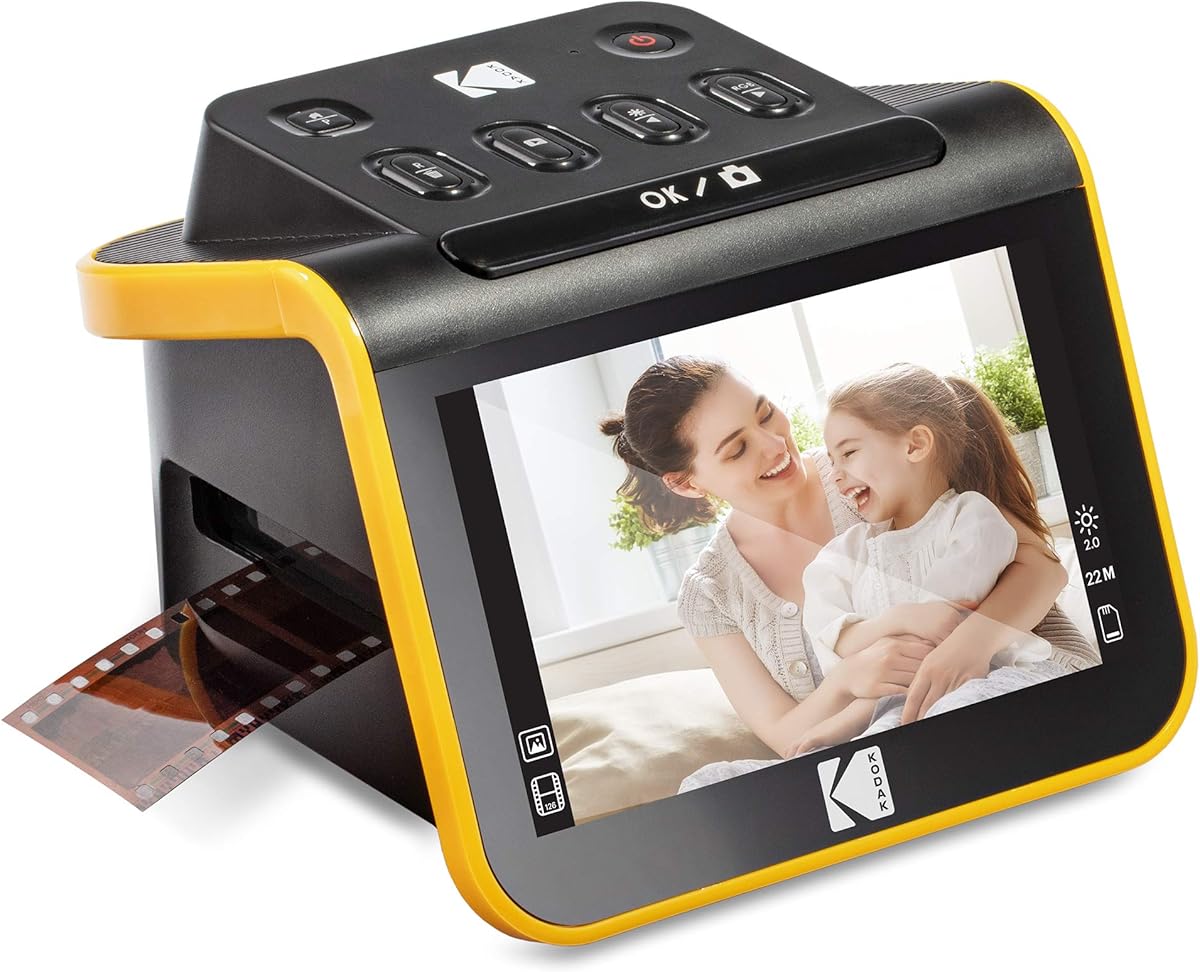
The Magnasonic FS71 provides a dedicated, computer-free route to digitizing several common film and slide formats. Its 4.3 rating reflects a generally favorable reception, and the specification combines 24MP JPEG output with a five-inch display, fast-loading trays, and broad support for 35mm, 126, 110, and Super 8 material.
We may earn a commission when you buy through this link, at no additional cost to you.
Standalone operation is the model’s main appeal. You can preview images, adjust brightness, apply RGB color correction, and flip or mirror them directly on the scanner. Files can be saved to an SD card supporting up to 128GB, while the HDMI connection can present images on a television or monitor. This reduces the learning curve for anyone who does not want to install drivers or operate complex editing software.
The primary limitation is format coverage. The documented supported sizes do not include 120 medium-format film, so this is more relevant to mixed 35mm, 110, 126, Super 8, and slide collections. The ability to scan in under five seconds per image and the included fast-loading trays help offset the lower resolution, but the device is not a specialized large-format solution.
Choose the FS71 if you want an approachable all-in-one scanner for smaller negatives and slides without tying every session to a computer. It is a strong budget pick for family archives and casual users. Medium-format photographers with 120 negatives should choose the JJC or another scanner explicitly designed to hold and illuminate larger film.
The FS71 can scan, review, correct, and save without photo-editing software or driver installation. Its display and direct controls make the process approachable for families, older archivists, and anyone comfortable using familiar appliance-style buttons.
Fast-loading trays support common 35mm, 126, and 110 negatives as well as slides and Super 8. The scanner fills a useful niche for collections built around these formats, although 120 film requires a different approach.
We may earn a commission when you buy through this link, at no additional cost to you.
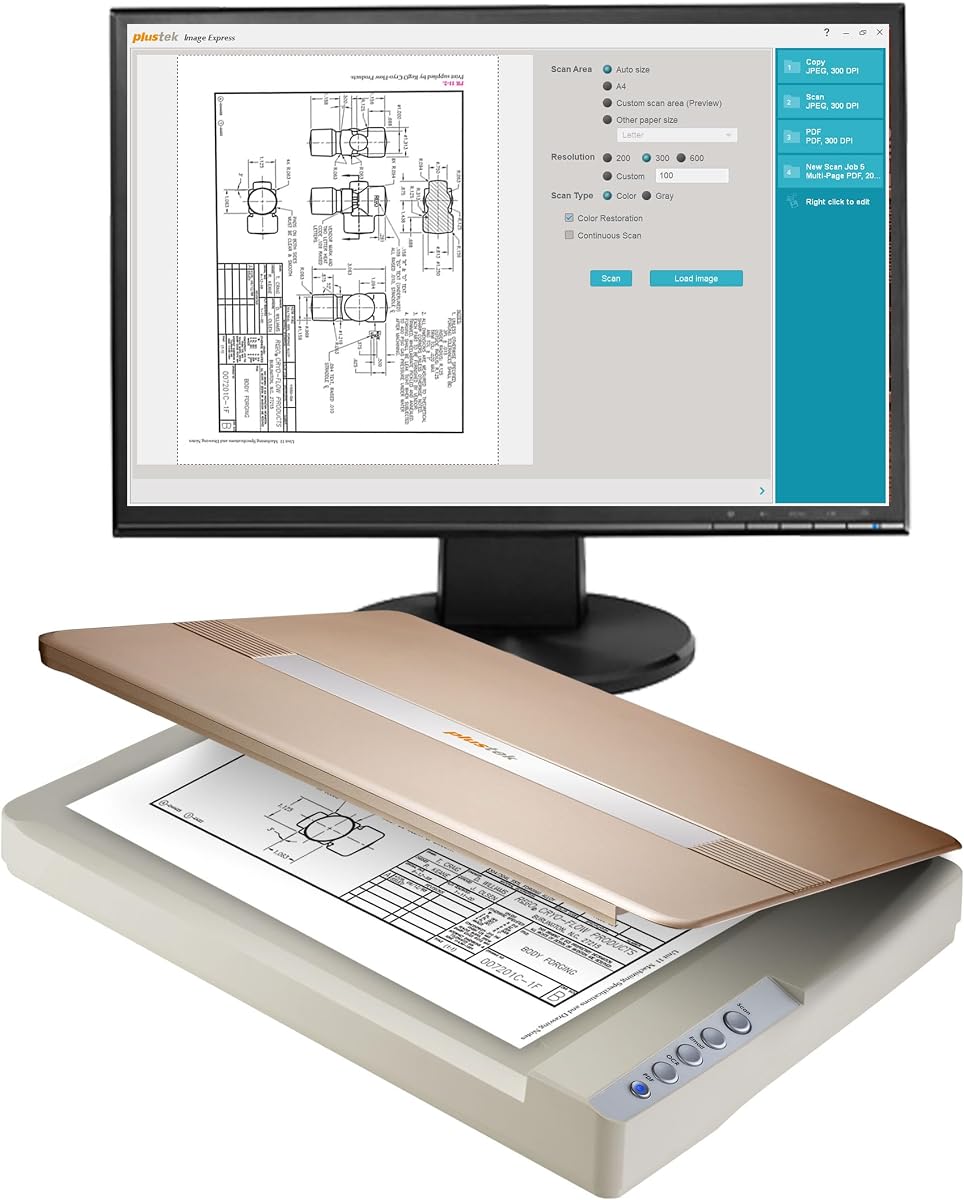
The Plustek OpticSlim 1680 is fundamentally a large-format flatbed scanner rather than a dedicated film machine, but its 11.7-by-17-inch platen makes it relevant to photographers with oversized negatives, contact prints, and photographic documents. It carries a 3.8 rating, the lowest among the ten products, so buyers should evaluate its exact role carefully.
We may earn a commission when you buy through this link, at no additional cost to you.
Its main advantages are speed and a broad working area. A tabloid-size document can be scanned in approximately three seconds in 300dpi grayscale or five seconds in color. Four configurable buttons can store destinations, file formats, file names, and related settings, reducing repetitive choices. The dual-view interface also helps users check adjustment effects before committing a scan.
Compatibility is strong for a flatbed. TWAIN support covers Windows, while ICA support is listed for Mac OS X. The system works with thousands of compatible software applications, giving it flexibility for users who already have an established digital workflow. However, 300dpi color is modest compared with the dedicated slide and film models in this guide, and 120 negatives still require a proper holder and suitable illumination.
The OpticSlim 1680 makes the most sense for mixed-format scanning, archival prints, large documents, or photographers who already use TWAIN-compatible software. It is not the first choice for producing highly detailed files from 120 film. Its spacious bed, quick operation, and configurable presets are valuable, but a dedicated film scanner will usually provide a more appropriate optical path for individual transparencies.
The wide 11.7-by-17-inch glass area is the feature that separates this model from ordinary desktop flatbeds. It can accommodate larger prints, strips, and documents that would need to be repositioned on a smaller platen.
Four one-key buttons consolidate frequently used destination, format, and naming choices. For people scanning large quantities of records, this can reduce repetitive menu navigation and make batch processing more consistent.
We may earn a commission when you buy through this link, at no additional cost to you.
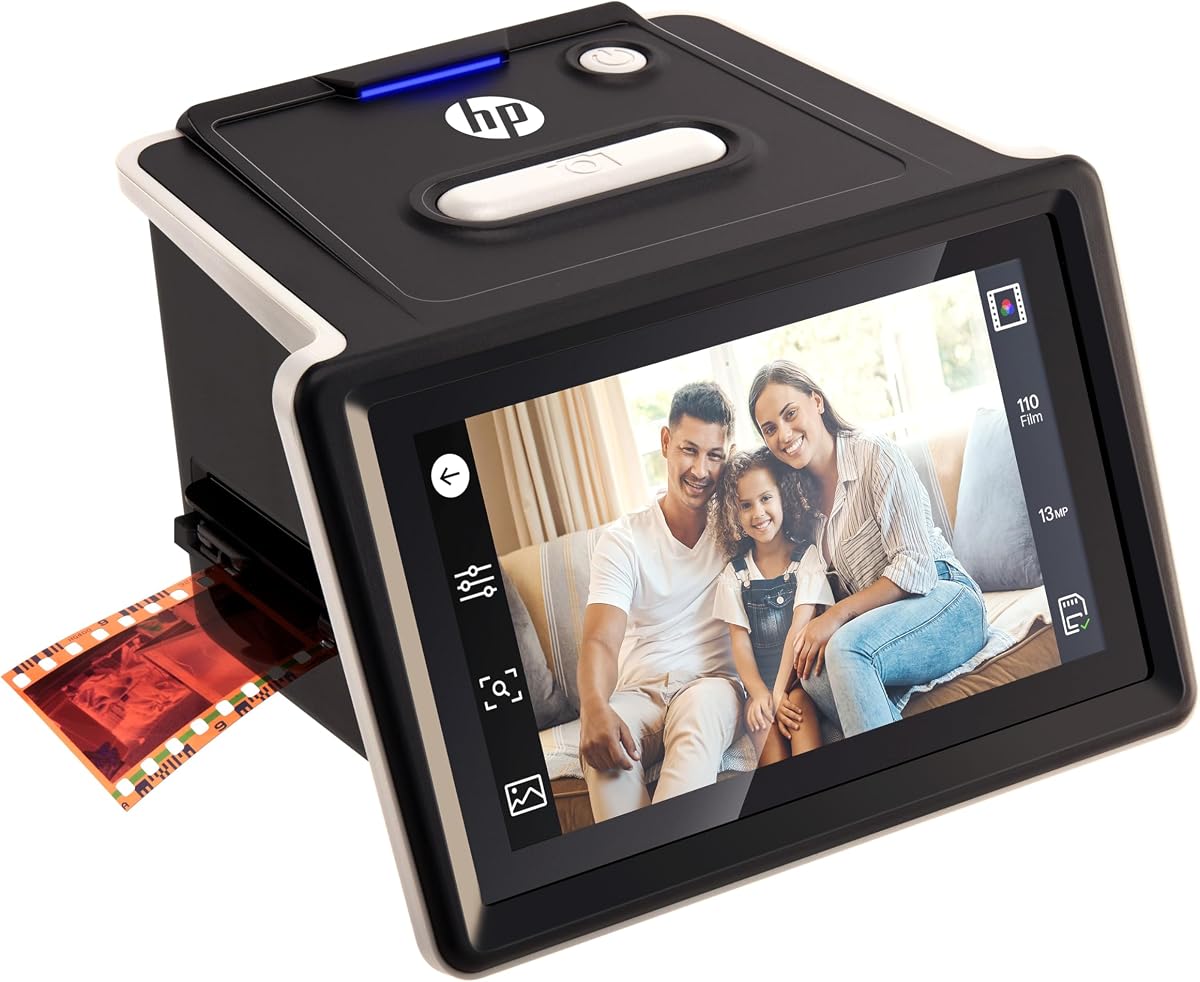
The HP FilmScan HPFS500 is a standalone film and slide scanner with a 4.3 rating, a five-inch all-angle touchscreen, and a 13MP CMOS sensor offering 22MP interpolation. It is designed for people who want to digitize mixed archives without having to route every frame through a computer.
We may earn a commission when you buy through this link, at no additional cost to you.
The touchscreen is central to the experience. Users can preview and edit images directly on the scanner, making the device feel more like a modern photo appliance than a traditional flatbed. The quick-load tray is particularly useful for collections because it streamlines transitions between frames, while supported 135, 126, and 110 negatives and positive slides cover several widely encountered formats.
As with the Magnasonic FS71, the documented format list does not include 120 film. The HPFS500 is therefore not a direct solution for photographers whose primary archive consists of medium-format negatives. It also depends on the available memory and computer connection for some workflows, so users should verify exactly how they intend to transfer and store their scans.
This model is best for families or archivists who value a large-enough touchscreen, on-device editing, and batch handling over specialist medium-format support. Its 22MP interpolated output and approachable interface are useful strengths. For true 120 film work, look instead to the JJC mobile system or a flatbed with dedicated medium-format film holders.
The all-angle LCD lets users review and adjust images on the scanner itself. This can make repeated sessions more direct, particularly when the goal is to create a small digital archive rather than a professional production workflow.
A quick-load tray reduces the interruptions associated with feeding individual frames. Mixed support for common negative sizes and positive slides makes the scanner practical for household collections with more than one film type.
We may earn a commission when you buy through this link, at no additional cost to you.
The Epson Perfection V850 Pro is the premium professional flatbed in this group, combining 6400 dpi resolution, a dual-lens system, and a maximum density rating of 4.0 Dmax. Its 4.4 customer rating is the highest listed, making it a credible choice for photographers who prioritize fine detail and tonal quality.
We may earn a commission when you buy through this link, at no additional cost to you.
The dual-lens design selects between two optical configurations to optimize results. That distinction matters when scanning different transparency types, prints, and documents, since a single lens cannot always serve every subject equally. The 4.0 Dmax specification indicates a particularly strong ability to render subtle shadow gradations, which is valuable when working with dense negatives and high-quality photographic originals.
The trade-off is a more involved, computer-based workflow. This is a flatbed and transparency scanner rather than a compact standalone appliance, so it is better suited to photographers who already organize files and adjust images on a computer. The operating systems listed in the supplied information are dated, which means compatibility with current systems should be confirmed before purchase.
The V850 Pro is the premium recommendation for users who want professional scanning specifications and broad control over the final image. It can handle prints and film, making it useful for mixed archives. Dedicated film scanners are simpler for 135 and slides, while the Epson's optical quality and density range make it especially compelling for detailed work and larger photographic originals.
The exclusive dual-lens system allows the scanner to choose an optical configuration suited to the source. This is valuable for a photographer who alternates between mounted slides, negatives, prints, and documents instead of digitizing only one narrow format.
A 4.0 Dmax rating represents a strong tonal range for recovering fine shadow detail and smooth gradations. Combined with 6400 dpi resolution, it gives the scanner a clear advantage for users who examine scans at substantial magnification.
We may earn a commission when you buy through this link, at no additional cost to you.
The JJC Mobile Film Scanner stands out as the only product in the list explicitly presented as a 120-format negative digitizer that uses a smartphone camera. Its 4.2 rating reflects a practical system with several thoughtful stabilization and alignment features, although results are closely connected to the quality of the paired phone.
We may earn a commission when you buy through this link, at no additional cost to you.
The supplied film holders provide transparent masks and magnetic closures that keep negatives flat. Silicone pads reduce slipping and protect the scanning surface, while the heavy-duty metal base and anti-slip feet provide stability. The phone clamp accommodates devices from 2.2 to 3.5 inches, and its vertical adjustment helps position the lens at a suitable macro distance.
Unlike a fixed-sensor scanner, this product does not create a file through dedicated hardware alone. You photograph the illuminated negative, then use a suitable app to convert the image, and no software is supplied with the unit. Phone lens variation, alignment, reflections, and editing choices can all affect the final result, so consistency requires practice and a capable device.
For a photographer with a limited number of 120 negatives, this is an appealing, compact approach. It avoids the space and complexity of a large flatbed and can be moved between locations. It is less suitable for large batches or users who need guaranteed native outputs from every phone. Still, as a dedicated 120 solution, it is more relevant than most slide scanners in the list.
The compact base, phone clamp, holders, and detachable remote create a self-contained imaging station without a desktop scanner. It is well suited to digitizing selected negatives rather than processing a continuously growing professional archive.
Flat holders, transparent masks, magnetic closures, and silicone pads all help protect film from bending, slipping, and scratches. These details are important when handling old negatives that may be brittle or already worn.
We may earn a commission when you buy through this link, at no additional cost to you.
The HP FilmScan 7-Inch is built around a large seven-inch color touchscreen that handles preview, editing, and display. Its 4.0 rating places it in the middle of the group, and its 13MP CMOS sensor makes it most relevant to 135, 126, 110, and 50mm slide collections rather than medium-format negatives.
We may earn a commission when you buy through this link, at no additional cost to you.
A large display makes frame selection and on-device corrections easier. The device can crop and adjust scans directly, while a gallery mode can present completed images on the screen. USB provides a route to a computer, and HDMI allows slideshows on a television. The quick-feed tray and 50mm adapter help speed up repetitive scanning without changing the underlying output quality.
The resolution is solid for family archiving and screen-based sharing, though it does not match the 24MP or interpolated output offered by some dedicated models. The lack of documented 120-film support is more consequential for readers focused specifically on medium format. Buyers should also confirm which storage and transfer workflow best matches their computer setup.
The HP FilmScan 7-Inch is best for people who want a large, easy-to-use screen and prefer not to install editing software for basic corrections. It makes previewing and sharing especially pleasant. If your collection includes 120 negatives, however, this is not the most relevant selection; choose a system explicitly designed for that frame size.
The seven-inch screen provides more room to inspect framing, dust, contrast, and sharpness than a compact display. That visibility is particularly helpful for older slides whose condition may vary from frame to frame.
Built-in crop and adjustment tools reduce the need for separate software during basic archiving. Gallery mode and HDMI connectivity make it easy to turn the scanner into a digital display after the scanning session.
We may earn a commission when you buy through this link, at no additional cost to you.
The KODAK Slide N Scan Max pairs a quick-feeding tray with a seven-inch tiltable LCD, and its 4.1 rating reflects a generally practical design for home archives. It supports 135mm, 110mm, and 126mm formats, along with slides, but its documented capabilities do not extend to 120 negatives.
We may earn a commission when you buy through this link, at no additional cost to you.
The tiltable display is a meaningful convenience because it can be positioned at a comfortable viewing angle rather than remaining fixed. The quick-feed tray supports continuous scanning without repositioning every frame, which improves efficiency when working through family slide collections. After capture, one-touch editing options handle resizing, conversion, and adjustments without a complicated menu system.
Files can be saved directly to SD or SDHC cards up to 32GB. This keeps the scanner independent of a computer during the initial capture process, although storage capacity is more limited than the 128GB support listed for the Magnasonic FS71. The screen can also function as a digital picture frame, providing a simple way to revisit completed conversions.
Choose this Kodak for households with 135, 110, 126, and slide collections who want fast feeding and a comfortable, larger display. It is less appropriate for 120 film, and buyers with a large archive should consider the storage implications before committing to this format. As a straightforward home scanner, however, it covers common needs neatly.
A tilting seven-inch LCD can be angled toward the user, making preview and editing more comfortable in different positions. It also provides a clear view of image framing before each capture.
The continuous tray removes the need to reposition individual frames for every scan. Combined with one-touch editing, it creates an efficient workflow for slides and common negative formats.
We may earn a commission when you buy through this link, at no additional cost to you.
The Epson Perfection V600 is one of the most directly relevant flatbed choices for medium-format work because its built-in transparency unit supports medium-format film up to 6 by 22 centimeters. It handles 35mm mounted slides, 12 negatives, prints, and documents, while the included 6-by-22-centimeter film holders make 120 use explicit.
We may earn a commission when you buy through this link, at no additional cost to you.
Its maximum resolution of 6400 by 9600 dpi supports detailed files and enlargements up to 17 by 22 inches. The supplied software adds useful restoration tools: DIGITAL ICE addresses dust and scratches, ArcSoft PhotoStudio supports image enhancement, and Easy Photo Fix can address fading. Four customizable buttons streamline common tasks such as scanning, copying, email attachments, and PDF creation.
The trade-offs are the size of a flatbed workflow and the need for a computer. ReadyScan LED technology removes the warm-up delay, and Hi-Speed USB 2.0 provides a straightforward wired connection, but this is not the convenience of an all-in-one standalone scanner. Buyers should also verify current driver and operating-system support before installation.
The V600 is a strong recommendation for photographers who want one flatbed to handle 120 film, 35mm transparencies, and prints. It is especially useful for mixed collections where a single machine can cover several media types. Dedicated slide scanners are more convenient for nontechnical users, while the Epson rewards users who want software control and high-resolution results.
The transparency unit and dedicated 6-by-22-centimeter holders provide a clear route for 120 film. This makes the scanner more broadly useful than models limited to 135mm, 110mm, and 126mm formats.
DIGITAL ICE, PhotoStudio, and Easy Photo Fix target common archive problems such as dust, scratches, and fading. These tools can save significant manual work when scanning imperfect family material.
We may earn a commission when you buy through this link, at no additional cost to you.
The BEONEGLOBAL ClearScan P7 combines a seven-inch display, 24MP output, and an included SD card in a standalone package. Its 4.1 rating suggests a balanced feature set, and the included storage makes it especially convenient for users who want to begin scanning without sourcing a separate card.
We may earn a commission when you buy through this link, at no additional cost to you.
The scanner supports 35mm, 135, 126, 110, Super 8, and 8mm material along with slides. A one-touch control scheme handles scanning, editing, and color enhancement without a complicated setup. The 1/2.3-inch CMOS sensor is dedicated to film imaging, and the bright seven-inch screen provides enough space to review and adjust images before saving them.
Its limitation is the absence of documented 120 film support, which matters for readers seeking a direct medium-format solution. A 24MP figure can also reflect interpolated rather than native capture in some scanner designs, so detailed buyers may want additional close-up specifications from the manufacturer. The product is also newer than several established models in this list, making independent user feedback especially valuable when evaluating long-term reliability.
The P7 is best for a ready-made home scanning package covering common negatives, slides, and motion-picture film formats. Its included SD card, large display, and standalone operation reduce setup barriers. If the collection is specifically 120 film, however, select the JJC Mobile Film Scanner or Epson Perfection V600 instead.
The included SD card removes one common obstacle for standalone scanners. Users can save digital files directly during the first session instead of first searching for compatible storage media.
A dedicated 1/2.3-inch CMOS sensor is intended to capture film rather than general documents. Combined with a large display and one-touch color enhancement, it creates a straightforward workflow for mixed home archives.
We may earn a commission when you buy through this link, at no additional cost to you.
The right scanner depends on your actual film formats, collection size, image-quality expectations, and tolerance for computer-based editing. The most important decision is whether the device and its holders can physically accommodate the negatives you intend to preserve.
In short, require documented 120 support rather than assuming a 35mm scanner will handle it.
Choose a dedicated unit for repeatability, a flatbed for mixed media, and a mobile system for portability.
Compare native sensor detail and output resolution separately, then match the result to realistic enlargement needs.
Prioritize tonal range, correct film-type selection, and dependable illumination over headline resolution alone.
Choose standalone operation for simplicity, or a computer workflow when file organization and advanced editing matter most.
A larger display improves inspection, while simple controls should complement—not replace—your preferred editing workflow.
Confirm card limits, included storage, transfer method, and backup expectations before setting up a long archive session.
Match throughput and file handling to the archive size, then build a backup routine before scanning irreplaceable material.
Begin by identifying the film type, checking that the appropriate holder or tray fits, and cleaning the scanner's glass or imaging surface. Work in a dim, dust-controlled area and handle negatives by their edges. Before beginning the main archive, scan several representative frames and inspect focus, color, exposure, cropping, and file organization.
Load one frame at a time when precision matters, and make sure the film sits flat against the illuminated surface. For smartphone-based capture, align the phone carefully, use the remote to avoid touching the setup, and keep the lighting panel level. On flatbeds, select the correct transparency and film settings, preview at full magnification, and use the included holders rather than improvising a loose placement.
Save an initial test batch to the computer or card, back it up in a separate location, and confirm that the files open correctly before processing the entire collection. Clean the glass with an appropriate lint-free method, keep the scanner covered when it is not in use, and store archived film in a cool, dry environment. Periodically check the digital backup as well as the original negatives, because a scan is valuable only when it remains accessible.
A medium format film scanner digitizes negatives or slides produced on larger film formats, including 120 film. The term can also describe multipurpose scanners with medium-format holders, such as the Epson Perfection V600. The important distinction is whether the product documentation specifically supports the physical dimensions of the negatives you own.
Usually not. Many entry-level slide scanners support 35mm, 110, 126, Super 8, and mounted slides but lack a holder or optical path for 120 film. Look for explicit 120 or 6-by-22-centimeter support, as offered by the JJC Mobile Film Scanner and Epson Perfection V600.
A flatbed can be suitable when it includes a transparency unit, appropriate film holders, and a clean, evenly illuminated transparency path. The Epson V600 meets these needs with its built-in unit and medium-format holders. A normal document flatbed without transparency support is unsuitable because opaque film cannot be scanned as a reflective print.
They can produce good results with a capable phone, careful alignment, suitable software, and even illumination, but they offer less consistency than a dedicated fixed-sensor model. The JJC system improves repeatability with its clamp, rail, holders, remote, and adjustable backlight. Phone camera differences and manual positioning remain important factors.
No. Standalone models such as the HP FilmScan, KODAK Slide N Scan, Magnasonic FS71, and ClearScan P7 can preview, edit, and save files to removable storage without a computer. Flatbed scanners and the JJC mobile workflow generally involve a computer or phone for capture, conversion, editing, and final file management.
The best target depends on the negative type and how you plan to use the file. A 13MP sensor can be sufficient for ordinary screen viewing, while 22MP or 24MP output offers more room for cropping and moderate enlargement. Flatbeds advertising 6400 dpi may provide excellent detail, but native resolution, film-holder quality, optics, and software also influence the finished scan.
Keep original negatives in archival sleeves or inert containers and store them in a cool, dry, dark environment away from excessive heat, humidity, and direct light. Digitization reduces everyday handling risks, but it does not replace proper physical storage. Maintain at least one verified backup of the digital files in a separate location.
Software and on-device controls can improve color balance, brightness, contrast, dust, and scratches, but they cannot restore information that was never captured. The Epson V600 includes dedicated restoration tools, while several film scanners offer automatic color and brightness adjustments. Severe fading, tears, mold, or abrasion may be best handled by a professional archive service.
The strongest overall choice for direct medium-format use is the JJC Mobile Film Scanner because it explicitly supports 35mm and 120 negatives in a portable phone-based system. The Magnasonic FS71 is the best budget option for smaller formats, while the Epson Perfection V850 Pro stands apart as the premium professional flatbed with 6400 dpi resolution, dual lenses, and a 4.0 Dmax rating.
Prioritize physical format compatibility before every other feature. If you own 120 negatives, choose a product with explicit 120 or 6-by-22-centimeter support; if your collection consists of 35mm, 126, 110, slides, or Super 8, a dedicated standalone scanner may be simpler. Next, decide whether portability, batch convenience, software flexibility, or maximum detail matters most, and then check storage and backup requirements.
Before purchasing, verify the current listing, package contents, format support, computer compatibility, and included accessories. Product configurations can change, and customer feedback evolves as more owners use the equipment. Choose the workflow that matches both your archive and your level of technical comfort, then preserve the digital results with regular backups.
