
Akai Professional MPK Mini IV
4.6Editor score
Dedicated chord and scale modes
Velocity-sensitive keys and pads
Extensive included instrument suite
Explore the best MIDI Chord Packs for inspiration, with 10 products compared for musical features, compatibility, format, and creative value.
MIDI chord packs can accelerate songwriting by providing playable chord progressions, melodies, and production-ready patterns that respond to your DAW. A useful pack should be musically coherent, clearly labeled, easy to import, and flexible enough to suit different genres, tempos, and workflows.
This guide compares ten supplied MIDI products, including downloadable chord and melody libraries, compact MIDI controllers, and essential connection cables. We considered musical utility, file organization, hardware compatibility, signal features, portability, and the value each product adds to a chord-based production setup.
Each pick reveals what it contributes to composing, performing, and arranging MIDI music, from instantly usable trance progressions to hands-on chord triggering. Product details and availability can change, so confirm specifications, software requirements, and current pricing before purchasing.
4.6Editor score

4.8Editor score

4.7Editor score
The comparison covers downloadable MIDI assets, performance controllers, and connection options that support chord writing and playback across studios, stages, and home setups.


This 2 Pack 6.56ft/78in MIDI Cable carries a 4.4 rating and stands out for its generous reach, dependable five-pin construction, and practical spare included in the set. It is not a downloadable chord library, but it provides the physical link needed to move MIDI data between a controller, interface, synthesizer, or other compatible device.
We may earn a commission when you buy through this link, at no additional cost to you.
Full five-pin wiring and shielding support bidirectional MIDI communication, while the listed construction is designed to reduce electromagnetic interference and maintain low-latency transmission. The 78-inch length is especially useful when equipment sits across a large stage, studio floor, classroom, or home production area.
The trade-off is that long leads demand thoughtful cable management to avoid creating trip hazards or accidental unplugging. Straight male DIN connectors also occupy more space than low-profile angled alternatives. Even so, the inclusion of two identical cables makes this a sensible option for users who want reach plus a replacement or backup connection.
Choose this cable when your MIDI chord workflow involves several pieces of hardware spread across a room, or when you want a spare for live performance. It is best suited to musicians who already know their devices use standard five-pin MIDI ports and need dependable wiring rather than another chord preset library.
At 78 inches per cable, the set offers enough distance to avoid crowding and makes long-distance stage or studio wiring more manageable. A second lead can be reserved for a separate signal path or kept as a backup.
The five-pin male-to-male format works with common MIDI keyboards, controllers, samplers, drum machines, synthesizers, and external sound cards without requiring special drivers.
We may earn a commission when you buy through this link, at no additional cost to you.
The Akai Professional MPK Mini IV in black holds a 4.6 rating and is the strongest all-around controller in this guide for musicians who want to create and perform chords rather than merely import prewritten MIDI. Its dedicated chord and scale modes are directly relevant to faster songwriting, experimentation, and live improvisation.
We may earn a commission when you buy through this link, at no additional cost to you.
Twenty-five velocity-sensitive mini keys provide expressive input, while eight assignable knobs, a full-color display, a push-and-turn encoder, and eight RGB-feedback MPC-style pads expand the performance workflow. The included virtual instrument suite contains more than 1,000 sounds from AIR, Akai Professional, and Moog, giving users playable material without starting from a blank project.
Its compact size and USB-C connection make it convenient for mobile sessions, streaming, and travel, although musicians accustomed to full-size keys may find the mini layout less ideal for extended piano playing. The software also has trial or time-limited components, so users should review those details if they intend to rely on them beyond the included access periods.
This is an excellent choice for a beginner building a first home studio, a producer seeking instant musical ideas, and a performer who wants hands-on chord triggering. It combines hardware control, software instruments, and song-focused tools in one package, making it more versatile than a cable or a genre-specific MIDI file collection.
Chord and scale modes help performers explore harmonically related notes without manually auditioning every option. The arpeggiator, Pattern, Freeze, and Mutate functions add further ways to turn a simple chord into a moving sequence.
The included drums, keys, synths, bass, and effects, combined with pre-mapped controls for Ableton Live Lite 12, Logic Pro, and FL Studio, reduce the setup required for a first production session.
We may earn a commission when you buy through this link, at no additional cost to you.
The Elecan 5 Pin DIN MIDI Cable earns the highest listed rating in this roundup at 4.8. Although it is a connection accessory rather than a chord pack, it supports the reliable transfer of notes, controller changes, and system messages needed to play chord progressions and control hardware instruments.
We may earn a commission when you buy through this link, at no additional cost to you.
Its five-core conductors use strands of 0.12mm oxygen-free copper with individual PE insulation. Full aluminum foil coverage and a grounding drain wire are intended to suppress radio-frequency and electromagnetic interference, while the gold-plated connectors and molded black PVC tail support dependable connections and repeated handling.
The product is not universal in the broadest sense because it specifically uses a straight 180-degree five-pin DIN interface rather than USB or quarter-inch connectors. It also includes a two-year warranty, adding reassurance for regular studio use, although careful routing remains important in crowded setups.
Pick this cable for a serious home studio, recording room, or stage where dependable shielding and conductor construction are priorities. It is particularly appropriate for linking MIDI keyboards, digital pianos, synthesizers, samplers, electronic drums, and external sound cards through standard five-pin ports.
The combination of five individually insulated oxygen-free copper cores, foil shielding, and grounding reduces potential interference. That makes it a sensible connection for setups containing computers, audio interfaces, lighting, and other electronic equipment near the MIDI path.
A flexible, moisture-resistant PVC jacket and a molded strain-relief tail help protect the connector area. The listed 10,000-plus bend testing supports regular studio and stage use, while five hook-and-loop ties help keep longer runs organized.
We may earn a commission when you buy through this link, at no additional cost to you.
Dj Sample Pack provides a downloadable collection of MIDI melodies and chords designed around 20 trance songs, along with 135 24-bit WAV samples. No published rating is supplied, so its appeal is best evaluated from the stated library size, genre focus, and file organization.
We may earn a commission when you buy through this link, at no additional cost to you.
The collection includes 53 trance MIDI samples with major and minor scale melodies, and defined keys are listed in the filenames. That metadata makes it easier to find compatible material when building a progression, while the accompanying WAV library provides a related audio-production layer.
The principal limitation is genre specificity. A producer working in trance, melodic electronica, or related styles may find substantial immediate value, but those in jazz, hip-hop, pop, or acoustic music may need to transform the material considerably. The box is only for illustration, and delivery is through an instant digital download.
Choose this pack if you need a focused source of trance chord and melody ideas and prefer a library that can be auditioned quickly. It is particularly useful for beatmakers who want to start with a recognizable harmonic direction and then edit it to fit their own arrangement.
The 53 MIDI files provide playable melodic and harmonic ideas that can be opened, transposed, shortened, or expanded. Defined keys in the filenames help users match material to an existing project without searching blindly.
Alongside the MIDI content, the pack includes 135 24-bit WAV samples. This dual-format approach supports producers who want to both rebuild MIDI passages and draw on ready-made audio textures.
We may earn a commission when you buy through this link, at no additional cost to you.
The EMK 5-Pin DIN MIDI Cable has a 4.6 rating and offers a short, direct solution for linking nearby MIDI devices. Its most notable use in a chord-focused setup is moving performance data between a controller and a sound module, interface, sequencer, or effects unit.
We may earn a commission when you buy through this link, at no additional cost to you.
A nylon jacket, strain-relief construction, nickel-plated contacts, oxygen-free copper wiring, and double shielding form the core design. The listed bend lifespan of more than 10,000 cycles supports regular connection changes, while the 180-degree male DIN configuration matches the common port orientation on many instruments.
At 3.3 feet, it is best for a keyboard perched above a stand, a controller positioned close to an interface, or a pedalboard arrangement where excess cable would be inconvenient. The limitation is reach: a single short lead cannot serve widely separated devices without an extension or different cable arrangement.
This cable is best for compact home studios, rehearsal rooms, and desktop production rigs. Choose it when a tidy, short connection matters more than long-distance routing or having several backup cables available immediately.
The one-meter length helps prevent loops around a desk, keyboard stand, or pedalboard. It is particularly useful when a controller and instrument are positioned within easy reach of one another.
A standard MIDI link can carry data for up to 16 channels, allowing the cable to serve compatible multi-device configurations. Double shielding and oxygen-free copper are intended to maintain clean, stable communication.
We may earn a commission when you buy through this link, at no additional cost to you.
Bass Sample Pack is a digital collection of 212 MIDI samples organized as tech-trance construction kits for music production. No published rating is supplied, but the stated file count and focused format make it a relevant option for producers seeking a substantial library of editable MIDI foundations.
We may earn a commission when you buy through this link, at no additional cost to you.
Every item is delivered in MIDI format, allowing compatible software to interpret notes, timing, and controller data in ways that can differ from fixed audio loops. That flexibility is valuable when building bass patterns, harmonic movement, or broader trance arrangements that must fit an existing tempo and structure.
The collection is deliberately narrow. It is not a general-purpose chord library for every style, and the absence of WAV audio means producers who want rendered sounds should already have suitable virtual instruments. Digital-only delivery also means there is no physical media to inspect before obtaining the files.
Choose this pack for trance and related electronic production when editable patterns are more useful than finished audio. It is a practical starting point for home-studio producers who want many ideas to audition, edit, and combine into complete arrangements.
MIDI files allow notes to be transposed, resequenced, or recolored inside compatible production software. That makes the collection more adaptable than a one-size-fits-all audio recording.
With 212 samples, the library offers enough variety to explore multiple phrases and patterns. Producers can combine compatible elements, then edit them into a track with their own structure, sound design, and automation.
We may earn a commission when you buy through this link, at no additional cost to you.
The CME MIDI Cable 4-Pack has a 4.7 rating and is built for compact setups where connector size and cable direction matter. Its four 3-foot, five-pin DIN cables use mirrored 45-degree plugs to fit more easily beside MIDI interfaces, keyboards, controllers, and guitar pedals.
We may earn a commission when you buy through this link, at no additional cost to you.
Ultra-thin nickel-plated connectors and an oxygen-free copper core are combined with integrated shielding for MIDI message transfer. The angled geometry can preserve access to adjacent sockets that might otherwise be blocked by a straight plug, making it especially useful on densely populated pedalboards.
The four-lead bundle offers more flexibility than a single cable, but the three-foot length still limits placement distance. The set is designed specifically around five-pin DIN connections, so it will not solve a setup whose devices require TRS Type A or USB MIDI.
Choose this pack for compact studio desks, pedalboard builders, and musicians who want a spare for every essential device. It is especially useful for controlling chord-capable synths, controllers, and effects while keeping a crowded setup easy to navigate.
The mirrored angle directs each cable away from neighboring controls and sockets. This can make it easier to operate a pedalboard or connect a keyboard without a straight connector blocking nearby hardware.
Four matching leads let a user connect several devices without sourcing separate cables one at a time. Additional lengths remain available for transport or backup use.
We may earn a commission when you buy through this link, at no additional cost to you.
The white Akai Professional MPK Mini IV shares the 4.6 rating and core features of the black edition while offering a different visible finish for desk and stage aesthetics. It is a compelling portable controller for artists who want to explore chords, scales, melodies, and beat patterns away from a permanent studio.
We may earn a commission when you buy through this link, at no additional cost to you.
Twenty-five velocity-sensitive mini keys, eight pressure- and velocity-sensitive pads, eight assignable knobs, and a full-color screen provide a broad control surface in a lightweight design. Chord and scale modes, an arpeggiator, Pattern, Freeze, and Mutate functions support quick harmonic and rhythmic experimentation.
As with the black model, the mini keys may not suit every pianist, and the included learning, loop, and sound-library access includes trial or time-limited components. USB-C connectivity supports modern computers and mobile configurations, while full-size MIDI Out provides an additional hardware connection path.
Choose this edition when portability, chord performance, and a polished visual appearance are priorities. It is well suited to travelers, livestream creators, students, and producers who want enough bundled software and hardware control to begin creating quickly.
Velocity-sensitive keys and pads make it possible to add dynamics and variation while triggering chord-based parts. The compact layout supports a more portable workflow than a full keyboard.
The included VST, AU, and standalone suite contains more than 1,000 professional sounds, while pre-mapped DAW controls help users move from opening a project to performing without navigating a large list of assignments.
We may earn a commission when you buy through this link, at no additional cost to you.
The CME TRS MIDI Cable 4-Pack has a 4.7 rating and provides four two-foot cables with TRS Type A connectors on one end and five-pin DIN connectors on the other. This mixed format is useful when connecting compact synths or controllers that use 3.5mm MIDI to equipment with conventional DIN ports.
We may earn a commission when you buy through this link, at no additional cost to you.
The low-profile right-angle plugs are designed to fit into tight spaces, which helps in pedalboard and desktop arrangements. Nickel-plated contacts, an oxygen-free copper core, and integrated shielding support dependable communication across the cable set.
Compatibility requires attention because TRS MIDI wiring is not standardized in exactly the same way across every device. A Type A cable is intended for ports that follow the corresponding MIDI TRS convention, so users should confirm the socket labeling and manufacturer instructions before connecting. The two-foot length also limits larger installations.
Choose this bundle for a compact setup that includes compatible 3.5mm TRS MIDI devices and traditional five-pin hardware. It is especially helpful for synth and pedalboard builders who want multiple low-profile leads without occupying neighboring ports.
The TRS Type A to five-pin DIN combination bridges two common connection styles. This can simplify a signal chain that includes a compact controller, synthesizer, or pedal with a full-size MIDI port.
The thin right-angle housing makes connections more convenient where clearance is limited. Four short cables keep a pedalboard visually clean and allow users to organize a small multi-device system.
We may earn a commission when you buy through this link, at no additional cost to you.
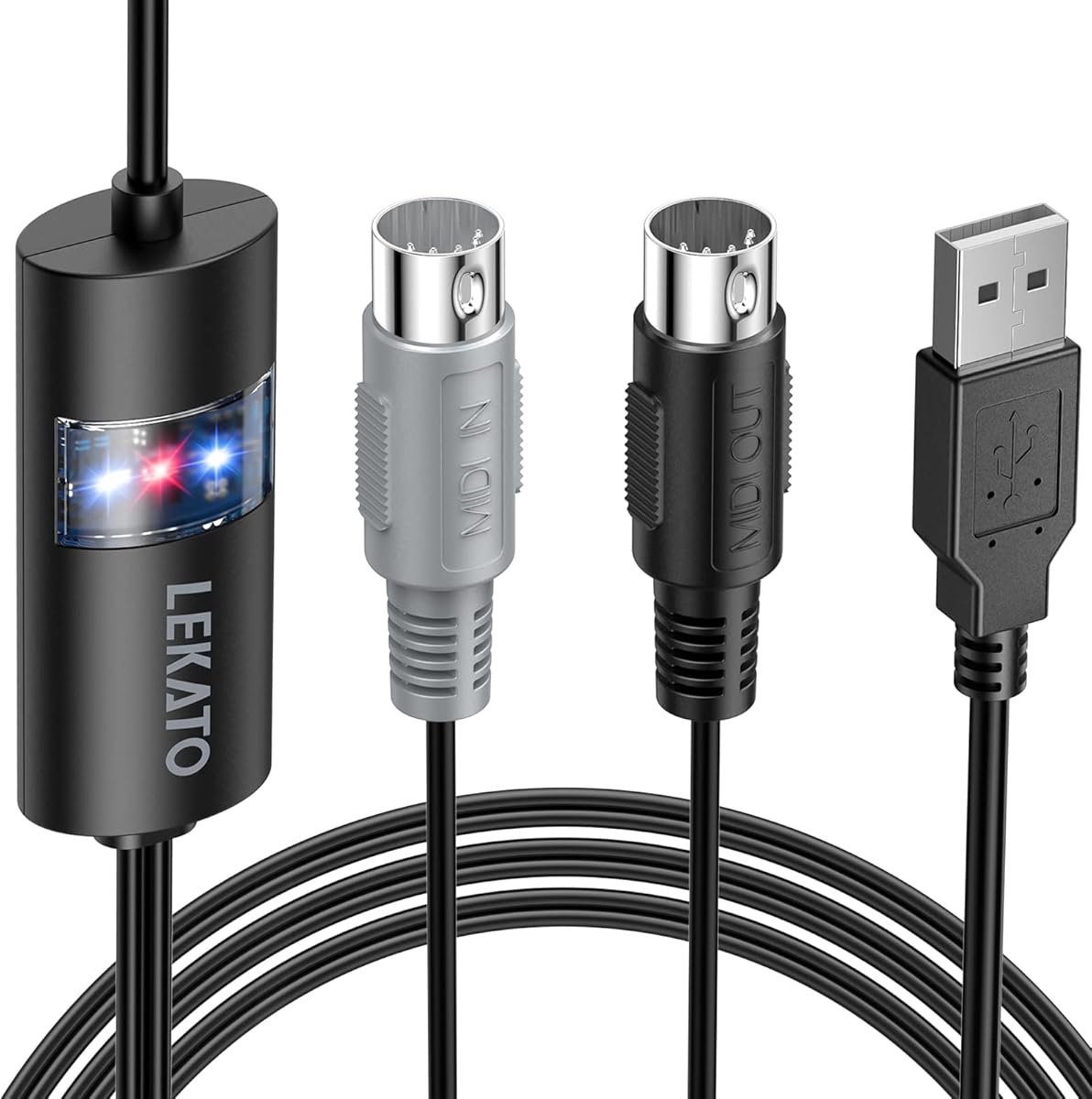
The LEKATO USB MIDI Cable has a 4.5 rating and serves as a direct bridge between MIDI instruments and a computer. With one input and one output, it supports recording, editing, and playback workflows where chord performances are captured into a DAW or software instrument.
We may earn a commission when you buy through this link, at no additional cost to you.
The built-in driver supports plug-and-play operation on listed Windows versions and Mac OS, avoiding a separate driver installation for compatible systems. Blue and red indicators show power and signal activity, making it easier to diagnose whether a connection is active without opening software menus.
Unlike a standard five-pin MIDI cable, this adapter does not provide a conventional MIDI output for a hardware synthesizer. It also lists compatibility extending back to older Windows releases, so current operating-system support should be confirmed before relying on a specific legacy setup.
Choose this cable for a home studio where a keyboard or synthesizer needs to send chord performances to a computer and receive accompaniment back. Its combination of input, output, status lights, and a built-in driver makes it a practical bridge for recording and arrangement.
The one-input, one-output arrangement supports both recording a performance from an instrument and sending sequenced data from the computer. This is useful for recording chord ideas directly into a DAW and auditioning edits afterward.
A blue power light and red signal-transfer light provide a quick indication of cable activity. These indicators make troubleshooting easier when a software-based workflow appears not to be receiving or sending data.
We may earn a commission when you buy through this link, at no additional cost to you.
The most useful MIDI chord solution depends on whether you want editable musical material, a controller for performing chords, or reliable hardware connections that move MIDI data between devices.
Choose editable MIDI when you want control over notes, timing, transposition, and arrangement. MIDI construction kits can be edited, combined with other parts, and rendered through the virtual instruments of your choice, making them more flexible than a finished audio loop. Check whether the product is explicitly identified as MIDI and whether the described files include the chord or melodic material you need.
A trance-focused library can be excellent for trance, melodic electronica, and related styles but poorly matched to jazz, folk, classical, or mainstream pop production. Read the stated genre, included scale information, and library description before buying. A controller is more genre-neutral and may suit a composer who wants to generate chords rather than browse a predetermined collection.
If your goal is to explore harmony interactively, look for dedicated chord and scale modes. These features can constrain notes to relevant intervals or suggest compatible voicings, helping beginners build musically coherent progressions while still allowing more freedom than a fixed preset library.
Clear metadata saves considerable time when auditioning a large collection. Defined keys in filenames help users match material to an existing project, while MIDI files remain easier to transpose than audio. For a pack without visible organizational details, expect more effort to identify compatible phrases and edit them to fit a composition.
For hands-on chord playing, velocity sensitivity, stable key action, and dedicated controls matter more than the number of preset sounds. The Akai MPK Mini IV options use 25 mini velocity-sensitive keys, which are compact and portable. Players accustomed to full-size piano keys may prefer a larger instrument and should consider key feel before choosing.
Verify the exact connector on every device before choosing a cable. Standard MIDI equipment commonly uses five-pin DIN, while some compact devices use 3.5mm TRS Type A, and computers require a USB MIDI interface. Cable direction, DIN pin standard, TRS wiring, and device input or output roles all affect whether a connection will work as expected.
For a studio or stage, look for oxygen-free copper, shielding, reinforced strain relief, and a stated bend lifespan. Longer cables offer routing freedom but need more organization, while short angled cables can prevent clutter in compact installations. Match the length to the actual distance between equipment rather than choosing based on cable flexibility alone.
A controller package may include virtual instruments, DAW support, lessons, loops, and control presets. These can make a new setup easier to launch, but trial periods, activation requirements, and operating-system compatibility should be reviewed carefully. For downloadable libraries, check the delivery method, file format, required software, and any restrictions on distribution.
Begin by importing one small group of MIDI files rather than opening the entire collection. Listen for the chord progression, key, tempo, and phrase length, then duplicate the pattern in your DAW before editing. If you are using a controller, enable its chord or scale mode, select the appropriate root or progression, and keep the feature active only while needed so it does not restrict sections requiring chromatic notes.
For cable-based setups, power off devices where appropriate, compare the cable connector and port markings, and route the lead without creating tight bends or strain at the plug. Keep five-pin and TRS connections separate, observe the stated input and output direction, and test the route with a simple MIDI message before building a larger chain.
Store downloaded chord content in a clearly named folder and keep a separate backup. Use temporary copies when experimenting so an accidental edit does not alter the original phrase. For hardware, unplug connectors by their housings rather than pulling the cable, coil leads without sharp folds, and keep the controller away from moisture, excessive heat, and crowded surfaces that could press its keys or pads.
A MIDI chord pack is primarily a collection of editable musical files, such as chord progressions, melodies, or construction-kit phrases. A MIDI controller is a hardware instrument that sends notes, controllers, and other performance data to a computer or sound module. One provides material to arrange, while the other gives the musician a way to play and control chords in real time.
Yes, compatible DAWs can transpose MIDI notes and preserve the relationships within a progression. The exact workflow depends on the software, but scale, octave, and chord-root options are generally available in the piano roll or MIDI editor. It is wise to duplicate the phrase before making major changes so the original file remains available.
They can be adapted for many genres because MIDI files are editable, but their original phrasing and musical character are designed for trance. Pop, house, cinematic, and electronic producers may find them useful after changing notes, rhythm, and instrumentation. Acoustic, jazz, or classical users may need more substantial melodic editing.
A five-pin DIN cable uses the traditional round MIDI connector found on many keyboards, synthesizers, and interfaces. A TRS Type A cable uses a 3.5mm connector at one end and a five-pin DIN connector at the other. TRS wiring conventions can differ between devices, so confirm that the compact device explicitly supports TRS Type A before connecting.
Many modern computers recognize a class-compliant USB MIDI controller without a separate audio interface, and the Akai MPK Mini IV is described as plug-and-play across Mac, PC, and mobile setups. Traditional five-pin DIN controllers usually require a MIDI interface with DIN input and output ports or an appropriate USB MIDI adapter. Check the computer, controller, and interface before assembling the system.
Chord modes can trigger a selected harmony with one press, while scale modes limit available notes to a chosen tonal framework. These features speed up sketching and reduce unsuitable notes during experimentation. They also encourage deliberate changes in inversion, voicing, rhythm, and root movement instead of playing every note manually.
Organize files by musical key, scale, chord quality, tempo, and progression type, then include a text note describing compatible sounds or instrumentation. Keep the source library read-only and use working copies for edits. Periodic backup also protects against accidental changes, storage failures, and file confusion during a busy production session.
One cable can carry data for multiple MIDI channels, but it normally connects one output to one input. Additional devices are usually added through a MIDI interface, hub, or a device with MIDI Thru. Thru passes incoming data onward, while a powered hub can make branching easier and may preserve the ability to connect several devices.
For editable musical ideas, Dj Sample Pack offers trance MIDI melodies and chords alongside a substantial WAV collection, while Bass Sample Pack provides 212 focused MIDI samples for trance construction. For hands-on creativity, either Akai MPK Mini IV edition supplies velocity-sensitive playing, chord and scale modes, pads, knobs, and a broad included software suite.
The cable and interface options complete the hardware side of a dependable chord workflow. The Elecan cable leads the list for its detailed shielding and conductor construction, the CME four-packs suit space-conscious pedalboards, and the LEKATO adapter provides a direct computer bridge. Prioritize correct connector compatibility first, then select the musical format or performance features that match your production style.
Finally, verify current product specifications, software access, operating-system support, and current pricing before purchasing. Inventory and product details can change, and the most suitable MIDI chord solution ultimately depends on your DAW, hardware ports, preferred genre, and the amount of hands-on control you want.