
Fosi Audio TP-02
4.4Editor score
Compact mono amplifier design
Adjustable low-frequency control
Built-in speaker protection
This expert guide compares 10 plate amplifier for subwoofer options, evaluating power, connectivity, bass controls, protection, installation flexibility, and
A plate amplifier for subwoofer can turn a passive driver or cabinet into a dedicated low-frequency system while keeping power electronics compact, accessible, and close to the speaker. A strong choice should deliver adequate clean power, provide useful crossover and phase controls, accept the signals from your source, and operate safely under sustained low-frequency load.
This guide compares ten plate amplifiers across power class, amplifier topology, input and output options, low-pass filtering, bass shaping, protection circuitry, ventilation, and intended installation environment. The list covers home-theater, hi-fi, PA, DJ, automotive, and DIY projects, with particular attention to the practical differences between finished amplifiers, exposed boards, and professional rack-oriented designs.
Each review highlights the product's strongest feature, useful compromises, and most appropriate application. The overall selection favors the WAudio SUA-350 for balanced home and pro functionality, the Fosi Audio TP-02 for compact DIY use, and the Sound Town STPA11-G900 for feature-rich professional control. Product availability and configurations can change, so verify the current listing and specifications before purchase.
4.4Editor score

4.3Editor score

5.0Editor score
The comparison below highlights the main distinctions among all ten amplifiers, including their intended applications, output ratings, control features, connection options, and practical trade-offs.



The WAudio SUA-350 is a 350W RMS Class-D plate amplifier designed for powered subwoofer projects and replacement plate-amp upgrades. Its 4.3 rating reflects a broadly capable design that combines useful room-matching controls, several input options, flexible power behavior, and protection circuitry in one enclosure.
We may earn a commission when you buy through this link, at no additional cost to you.
Its standout strength is control. The crossover adjusts from 50 to 180 Hz, phase covers 0 to 180 degrees, and EQ and gain modes help blend subwoofer output with main speakers. Balanced inputs and outputs support compatible systems and longer signal runs, while stereo RCA inputs provide a familiar connection method. A three-way switch offers always-on, automatic signal-sensing, and off positions.
The amplifier also includes a 45 Hz bass boost with up to 6 dB of additional low-frequency emphasis, along with short-circuit, over-temperature, and overload protection. These features make it adaptable, although the boost should be adjusted carefully because extra low-frequency energy can make a cabinet boom or reveal enclosure noise. The rear voltage selector must also match the installation location.
This is a strong choice for a home theater, living-room subwoofer, or custom passive cabinet where you want room integration and flexible source routing. It may be more powerful than necessary for a small driver, but its connectivity and tuning options justify the additional capability for a carefully chosen system.
The crossover, phase, gain, and EQ settings make the SUA-350 particularly useful when the subwoofer shares low-frequency duties with main speakers. Those controls let the installer refine the transition instead of relying entirely on source settings.
RCA and balanced connections accommodate consumer and professional sources, while automatic, always-on, and off modes simplify operation. The front status LED and low-power standby behavior add convenience without complicating the signal path.
We may earn a commission when you buy through this link, at no additional cost to you.
The Dayton Audio SPA100-D delivers 100W RMS into a 4-ohm load through an efficient Class-D design. It is a more purpose-built choice than many general-purpose mini amplifiers, with a dedicated 30 Hz bass boost and the controls commonly needed to integrate a passive subwoofer with the rest of a home system.
We may earn a commission when you buy through this link, at no additional cost to you.
Its crossover and phase adjustments help with room placement, while gain provides basic output matching. The 6 dB boost at 30 Hz adds impact for compatible speakers, although it should be used conservatively in small rooms. Manual and automatic on/off modes give the installer a choice between predictable operation and signal-triggered standby.
The main limitation is its 100W RMS rating. It is best matched to a subwoofer designed for modest power, not a large driver that needs hundreds of watts to reach useful low-frequency output. Buyers should also check that their speaker wiring, cabinet, and enclosure support the intended amplifier-to-driver relationship.
Despite that limitation, the SPA100-D is a logical choice for a small home-theater subwoofer, a secondary low-frequency speaker, or a modest DIY project. It offers the essential tuning and operating functions without the complexity of a larger professional plate amplifier.
The 100W RMS output is most appropriate for a driver or passive subwoofer specified for moderate amplification. Pairing the amplifier within the speaker manufacturer's limits reduces the likelihood of distortion and excessive excursion.
Crossover, phase, and gain controls cover the main adjustments needed for basic placement compensation. The result is a practical design for listeners who want tuning without a complicated DSP interface.
We may earn a commission when you buy through this link, at no additional cost to you.
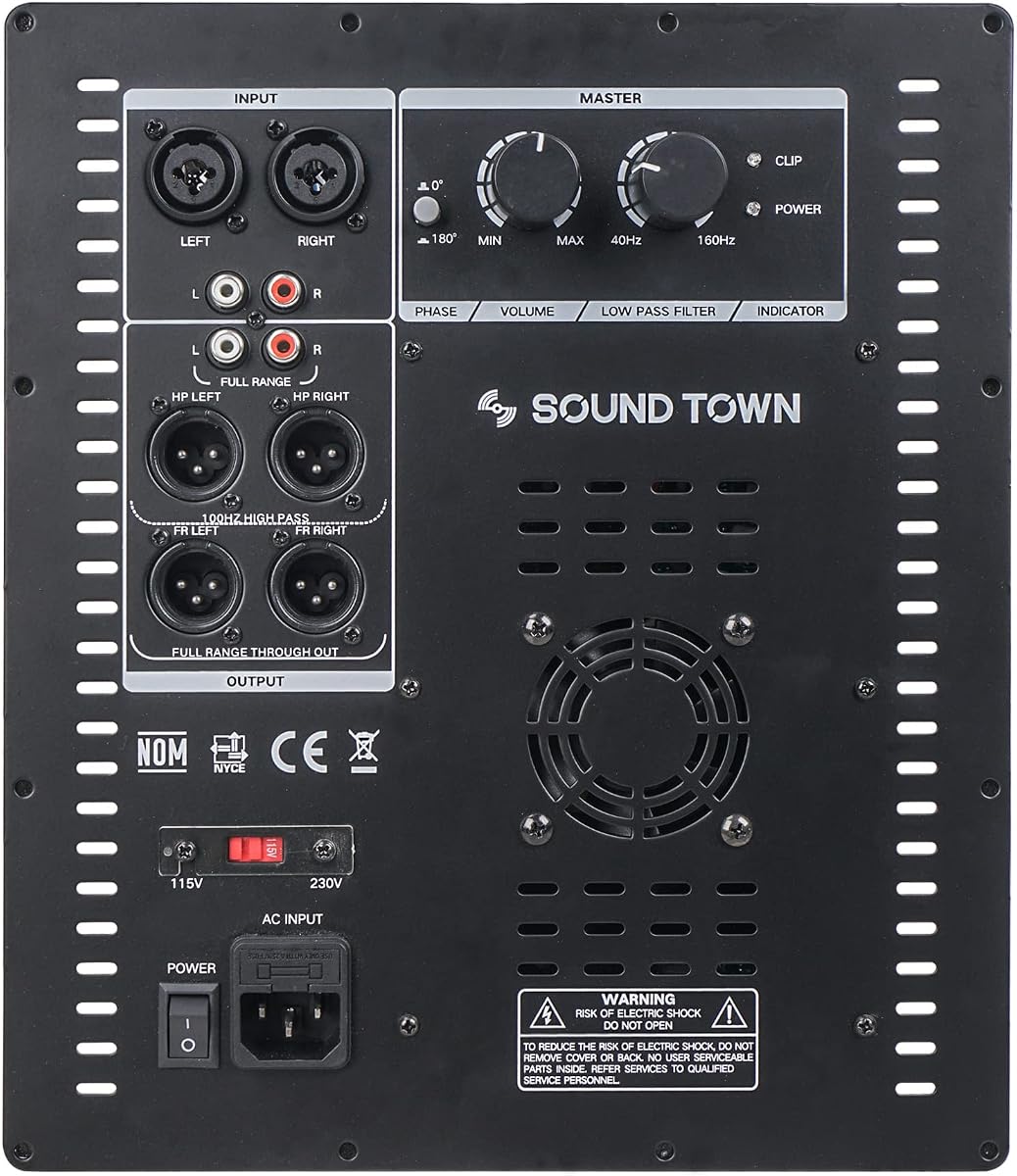
The Sound Town STPAS-G800 is a 700W RMS Class-D plate amplifier aimed at PA and DJ subwoofer cabinets. Its 4.1 rating reflects a substantial professional design with several signal-routing options, bass processing, low-pass filtering, and integrated thermal management.
We may earn a commission when you buy through this link, at no additional cost to you.
Two XLR-1/4-inch combo inputs and two RCA inputs make it adaptable to different source equipment. Outputs include two XLR positions and RCA connections, with one of the XLR outputs associated with a 100 Hz high-pass function. Dynamic bass enhancement, an RMS dynamic processor, and a second-order IIR low-pass filter provide more control than a basic subwoofer plate.
The amplifier's high output means proper speaker matching, ventilation, and wiring are essential. Its pro-oriented controls may be unnecessary for a simple home installation, and users who are unfamiliar with high-pass output routing should follow the manual carefully. Protection against overcurrent and short circuits adds valuable safeguards, but it does not excuse an incorrect load or inadequate cooling.
This model is best suited to mobile PA work, DJ systems, stage applications, or a serious dedicated subwoofer installation. It earns its place through power and professional connectivity rather than compactness or decorative simplicity.
The combination of combo XLR, RCA, filtered XLR, and RCA outputs supports several source and system arrangements. That flexibility makes the STPAS-G800 useful when linking a subwoofer with other PA equipment.
Dynamic bass enhancement, dynamic processing, and an IIR low-pass filter provide more ways to shape large-cabinet output. These tools should be set conservatively and checked with different source material.
We may earn a commission when you buy through this link, at no additional cost to you.
The Sound Town STPAS-600D is a 350W RMS Class-D plate amplifier designed for PA and DJ subwoofer cabinets. Its 3.9 rating places it among the more modest selections, but the core combination of power, professional connections, and low-pass filtering remains relevant for straightforward installations.
We may earn a commission when you buy through this link, at no additional cost to you.
Two XLR-1/4-inch combo inputs and two RCA inputs provide flexible source options. The two XLR outputs are described as through outputs, supporting pass-through signal routing. A low-pass filter helps separate the subwoofer's frequency range, while overcurrent and short-circuit protection provide safeguards for normal professional use.
Compared with the STPAS-G800, this model has a simpler feature set and no stated dynamic bass processing. Its 350W RMS output still demands a properly rated cabinet and driver. Because the specifications are less extensive, buyers should pay particular attention to the manual, terminal layout, ventilation requirements, and input sensitivity before integrating it into a permanent system.
The STPAS-600D is a practical option for a DJ subwoofer, small PA cabinet, or dedicated installation where reliable power and standard pro connections matter more than Bluetooth or digital signal processing.
Combo XLR inputs and through-style XLR outputs support familiar balanced signal paths. RCA inputs add convenience when connecting consumer or semi-professional equipment.
The built-in low-pass filter is the central sound-shaping feature. It keeps the amplifier focused on the role expected in a dedicated subwoofer cabinet without requiring extra external processors.
We may earn a commission when you buy through this link, at no additional cost to you.
The Fosi Audio TP-02 is a compact mono subwoofer amplifier with a 4.4 rating and a maximum output specification of 220W. It is aimed at home audio, powered passive subwoofers, bass shakers, and DIY systems where useful bass control matters more than professional input flexibility.
We may earn a commission when you buy through this link, at no additional cost to you.
Its low-pass filter removes high-frequency content from the signal, with frequency adjustment covering 30 to 260 Hz. Volume control provides basic output management, and the specified 20 Hz to 250 kHz frequency response, THD of 0.04% or less, and signal-to-noise ratio of 98 dB or more present a technically ambitious performance profile.
The Texas Instruments TDA7498E chip and NE5532 op-amp form the core of the design. A built-in speaker protection circuit adds useful safeguarding, while the supplied 24V adapter simplifies setup. The trade-offs are enclosure simplicity and the lack of balanced professional connections, which makes this less suitable as a drop-in unit for a complex PA network.
For a bedroom system, compact home theater, passive subwoofer project, or desktop bass setup, the TP-02 offers an appealing combination of size, control, and output capability. It is also the most accessible option for a builder creating a simple custom enclosure.
The broad frequency-control range makes it possible to match the amplifier's low-pass behavior to different subwoofer sizes and room positions. It provides a practical tuning tool without the complexity of a digital interface.
The small mono format fits readily inside a custom subwoofer cabinet. A 24V power adapter, speaker protection, and straightforward controls reduce the number of separate components a DIY builder needs.
We may earn a commission when you buy through this link, at no additional cost to you.
The Dayton Audio SPA1000 is a high-output subwoofer plate amplifier distinguished by its Class-AB output stage and 1000W designation. Its 4.0 rating reflects a design aimed at serious high-power applications rather than small desktop or apartment subwoofers.
We may earn a commission when you buy through this link, at no additional cost to you.
A patented tracking downconverter power supply and toroidal transformer form the power-supply foundation. Low-frequency parametric EQ allows an installer to boost or cut selected low-frequency regions, offering more precise cabinet correction than a simple bass control. Advanced soft-clip circuitry is intended to improve headroom and protect connected woofers when the amplifier approaches its limits.
The main consideration is electrical and physical demand. A Class-AB amplifier at this power class typically requires a robust supply, adequate enclosure space, and careful heat management. The 1000W figure also needs to be interpreted according to the manufacturer's detailed test conditions and speaker-load requirements rather than treated as a guarantee for every driver.
This amplifier makes sense for experienced builders with a high-power subwoofer, a robust enclosure, and the electrical capacity to operate it safely. For most consumers, the smaller Class-D alternatives are easier to install and use less space.
Parametric EQ is valuable when a particular cabinet resonance or room mode needs correction. The ability to boost or cut selected frequencies is more surgical than relying only on a broad bass adjustment.
The tracking downconverter supply and toroidal transformer distinguish this model from compact Class-D units. These features support its high-output orientation, although they also increase the need for careful installation planning.
We may earn a commission when you buy through this link, at no additional cost to you.
The Hosyond ZK-6001 is an exposed mono amplifier board intended for builders comfortable with high-current DC systems. It carries a 4.1 rating and combines a TPA3255-based design with frequency and volume adjustment for home, car, professional, and DIY audio projects.
We may earn a commission when you buy through this link, at no additional cost to you.
Its stated output is 300W rated at 4 ohms and up to 600W peak at 2 ohms when supplied with 48V DC. The board accepts an 18–50V DC range, with 36–48V recommended and a current requirement of at least 10A. That flexibility can suit builders with different power-supply arrangements, but the system must be correctly sized and protected.
Heat dissipation, stable operation, and comprehensive protection are major strengths. The design includes undervoltage, overtemperature, overcurrent, and short-circuit safeguards. However, it has no input reverse-connection protection, so polarity must be checked carefully before powering it. The included XH2.54-3P shielded cable and stereo input simplify source connection, although solder-level integration is still required.
This board is best for an experienced DIY installer who needs flexible supply voltage and bare-board integration. It is not the easiest option for a first-time builder because the power supply, wiring, grounding, and enclosure all need careful attention.
The broad 18–50V input range allows the board to fit different supply arrangements. Achieving its stated output requires careful attention to the recommended 36–48V range and substantial current capability.
Overheat, overcurrent, short-circuit, and undervoltage protection reduce some installation risks. Reverse input protection is absent, however, so correct polarity and thorough pre-power checks remain essential.
We may earn a commission when you buy through this link, at no additional cost to you.
The 300W 12V Car Amplifier Board is an exposed dual-channel board intended for automotive subwoofer and car-audio installations. Its 4.2 rating indicates reasonable customer reception, while its slim format and prominent aluminum cooling panel distinguish it from bulkier enclosed amplifiers.
We may earn a commission when you buy through this link, at no additional cost to you.
The thickened exposed aluminum panel provides a large surface for heat dissipation, which is valuable when an amplifier board is mounted inside a vehicle where airflow can be limited. The dual-channel design offers some flexibility, and the stated 300W power figure is aimed at driving vehicle subwoofers from a 12V system.
Published product details are limited compared with the finished amplifiers in this guide. Buyers should verify channel power ratings, impedance requirements, input type, terminal arrangement, signal requirements, and protection features before relying on it in a completed installation. Automotive electrical systems also require a correctly fused connection and sound grounding practices.
This board is most attractive to a vehicle builder who values a thin, exposed design and already understands car-audio wiring. It is less suitable for a plug-and-play home-theater installation because it lacks the enclosure, controls, and documentation detail expected from consumer-ready equipment.
The slim board format makes it easier to place in a vehicle than a deep conventional amplifier. Mounting must still preserve airflow around the aluminum panel and protect the board from moisture and impact.
A dual-channel layout offers more routing options than a strictly mono board. Confirm how the channels are configured for bridged or subwoofer use before finalizing the wiring.
We may earn a commission when you buy through this link, at no additional cost to you.
The Sound Town STPA11-G900 stands out as the most feature-rich plate amplifier in this group. It has a 5.0 rating and combines a two-channel Class-D design, continuous and peak power claims, digital signal processing, wireless connectivity, and professional output hardware.
We may earn a commission when you buy through this link, at no additional cost to you.
The amplifier supplies 2x600W continuous power and up to 2x1200W peak power. Connectivity includes two XLR-1/4-inch combo inputs, one XLR output, one Speakon output, and TWS Bluetooth. The DSP offers presets plus manual EQ and delay settings through an easy-to-read LCD screen, allowing installers to shape output rather than relying on basic analog controls.
Overload and overcurrent protection support reliable operation, while an integrated aluminum heat sink panel aids thermal performance. The trade-off is complexity: the feature set assumes that the installer understands gain staging, DSP routing, speaker outputs, and wireless pairing. A high-power amplifier should never be evaluated only by its headline output; matching it to the cabinet and source is essential.
This is an excellent choice for a serious PA or DJ system combining subwoofers with full-range speakers. It also suits a builder who wants a single platform for analog and wireless sources and values DSP control. For a simple passive home subwoofer, some of its capabilities will remain unused.
Presets, manual EQ, and delay controls give the installer greater control over tonal balance and speaker alignment. These functions are most valuable in multi-speaker PA environments where simple volume and crossover adjustments are insufficient.
Combo XLR inputs, XLR and Speakon outputs, and TWS Bluetooth cover both cabled and convenient wireless workflows. This broad connection set is the amplifier's clearest premium feature.
We may earn a commission when you buy through this link, at no additional cost to you.
The 1000W 12V Subwoofer Board is an exposed vehicle amplifier board with a 4.5 rating. Its appeal is straightforward: a compact board form, 12V automotive orientation, and a high stated output figure for DIY builders seeking substantial low-frequency capability.
We may earn a commission when you buy through this link, at no additional cost to you.
The board uses cooling holes in an aluminum-alloy housing to increase contact with surrounding air. Its transformer and capacitor-based power design is presented as a way to improve power delivery, stability, and short-circuit resistance. The slim construction also makes it easier to fit into a vehicle than a large conventional amplifier.
Because detailed load ratings and test conditions are not provided, the 1000W claim should not be treated as equivalent to 1000W of clean output at every impedance. A responsible buyer will need to confirm the actual operating specifications, verify the speaker's power requirements, and provide correct fusing, grounding, and current capacity. A 12V automotive system can also limit sustained output unless the electrical supply is upgraded appropriately.
This product is best for an experienced automotive DIY builder who wants a powerful, compact board and is prepared to validate its operating characteristics. It offers less documentation and installation guidance than an enclosed consumer plate amplifier, so it is less attractive to beginners.
The board format concentrates substantial claimed output into a small unit suited to vehicle installation. Actual performance still depends on the supply, load, cooling, and verified test conditions.
Cooling holes increase the housing's exposure to air, helping heat move away from the board. Placement away from sealed trim panels and other heat traps remains important after installation.
We may earn a commission when you buy through this link, at no additional cost to you.
The right plate amplifier depends on the driver's power requirements, the source connections, enclosure, room, and installation skills. Comparing these factors before buying is more reliable than choosing solely by the largest advertised wattage figure.
Begin with the subwoofer manufacturer's recommended amplifier power and impedance rather than the amplifier's headline output. A compact driver intended for 100W may be driven by a much larger plate amplifier, but doing so increases the risk of overexcursion, distortion, and enclosure damage. Larger drivers and professional cabinets may require several hundred watts of clean output. Also check whether the listed RMS rating applies at the same impedance as the speaker you plan to use.
In short, choose a plate amplifier whose clean output matches the speaker's rated range.
RMS output describes sustained power under stated test conditions, while peak output represents a short-duration capability. Product listings may also state maximum output rather than continuous output, particularly on compact boards. Compare like-for-like figures, inspect load conditions, and avoid treating a peak number as equivalent to continuous RMS power. The distinction is especially important for subwoofers because sustained low-frequency content puts a consistent load on the amplifier.
In short, prioritize verified continuous output over dramatic peak-power language.
Every speaker and amplifier has an intended impedance configuration. Connecting a subwoofer outside the amplifier's supported load can cause excessive current, overheating, protection cycling, or damage. A mono plate amplifier commonly drives one speaker or a correctly wired pair, while two-channel or bridgeable designs offer more options. Confirm whether the amplifier supports two 4-ohm speakers, one 8-ohm speaker, or another arrangement before planning the wiring.
In short, verify speaker impedance and supported amplifier loads before connecting anything.
RCA inputs suit consumer receivers, preamplifiers, and many home subwoofer outputs. Balanced XLR or XLR-1/4-inch combo inputs can reduce interference in professional installations and may suit longer cable runs. Some amplifiers provide both, while compact units may offer only one type. Check the physical availability of those connections on the source before choosing a model, and avoid using an improvised converter when a native balanced connection is available.
In short, select inputs that directly match your source and installation environment.
A low-pass filter prevents high-frequency material from reaching a subwoofer, while phase can improve alignment with the main speakers. Gain helps match levels, and bass boost or EQ can compensate for room and cabinet behavior. Simple variable low-pass and phase controls are often enough for a home system. A DSP adds EQ, delay, presets, and more precise correction for complex PA installations, but it also requires greater setup knowledge.
In short, choose basic tuning for straightforward systems and DSP for advanced alignment.
Plate amplifiers often live inside subwoofer cabinets, where heat can accumulate. Follow the required clearance around ventilation openings, use a rigid mounting surface, and avoid placing the amplifier where trim panels or carpeting can block airflow. High-output Class-AB models and exposed automotive boards may need more space and cooling than compact Class-D units. The enclosure also needs to be structurally secure and large enough for the amplifier, connectors, wiring bends, and service access.
In short, design for airflow and serviceability before installing the amplifier.
Short-circuit, overload, overcurrent, and overtemperature protection can limit damage from wiring faults or excessive load. Automatic, manual, and always-on power modes improve convenience, particularly when a home-theater receiver provides a trigger or switching signal. For exposed boards, check whether reverse-polarity protection is present; if it is not, verify polarity manually before applying power. Protection circuits are safeguards, not substitutes for correct wiring.
In short, favor clear safeguards and power modes that suit your system.
Finished plate amplifiers are generally easier to mount and connect than exposed boards. A compact unit with an external power adapter may suit a bedroom or desktop project, while a bare automotive board requires soldering, proper fusing, grounding, and knowledge of high-current systems. Professional models may assume rack support, balanced signal paths, and experienced operators. Confirm that you have the tools, wiring, power supply, and enclosure space needed before ordering.
In short, select a construction level that matches your technical comfort.
Before installation, disconnect all power and confirm the amplifier's voltage setting matches the local supply. Connect the source first, set gain and other controls to their neutral positions, and then connect the subwoofer with correctly polarized wiring. Check impedance one more time before energizing the system.
Begin with moderate source volume and a low gain setting, then increase gain while listening for distortion. Adjust crossover and phase gradually, using familiar music and film content. Avoid maximizing bass boost or EQ unless the speaker can handle the added output, and give the amplifier enough clearance to dissipate heat.
For long-term care, keep the enclosure dry and free of loose objects, tighten terminals, and maintain unobstructed ventilation. Periodically inspect wiring for discoloration, abrasion, or loose connections. In an automotive installation, use appropriate fusing and secure the board away from moisture and moving components.
It is a compact power amplifier designed to mount near or inside a passive subwoofer cabinet. It receives a line-level signal from a receiver, preamplifier, mixer, or other source and supplies enough power to drive the connected low-frequency driver or speakers.
It depends on the amplifier's supported load and the impedance of both subwoofers. Some mono models can drive two speakers wired in parallel, provided the resulting impedance remains within the manufacturer's specifications. Other models require each speaker on a separate channel, while some support only one speaker.
No. Excess power does not automatically create better bass and can overdrive a small driver or coil. Match continuous amplifier power to the subwoofer's recommended range, and consider the driver's excursion, impedance, sensitivity, and enclosure design.
It sets the upper frequency limit of the signal sent to the subwoofer. A higher setting allows more bass from a larger driver, while a lower setting reduces the audible range of the subwoofer and can help it blend with the main speakers.
Balanced connections are not essential for most short home listening runs, where RCA may work well. They can be beneficial in professional systems, long cable runs, or installations with complex grounding and interference concerns. Choose the amplifier inputs that best match the available source.
Many models are designed for that placement, but ventilation and clearance must follow the manufacturer's instructions. The cabinet should be rigid, dry, and large enough for the amplifier and wiring. Blocked heat dissipation can lead to protection cycling, distortion, or shortened component life.
Class-D amplifiers are generally compact and efficient, which makes them common in subwoofer plates and professional equipment. Class-AB designs use a different output topology and can provide substantial continuous power with strong low-frequency behavior, but they usually require more power-supply capacity and physical space.
Mount the unit with its ventilation areas unobstructed, maintain the specified clearance from nearby surfaces, and avoid enclosing it in a sealed, heat-trapping space. Confirm that the amplifier is operating within its intended load and that the cabinet receives no direct sunlight or damp conditions.
The WAudio SUA-350 is the most versatile overall selection because it combines useful power, balanced and RCA connectivity, room-matching controls, automatic power operation, and protection in a conventional plate-amplifier format. The Fosi Audio TP-02 is the practical compact and DIY option, while the Sound Town STPA11-G900 leads the premium group with two-channel output, DSP, professional connectors, and Bluetooth TWS.
For most home builders, prioritize clean continuous power, a supported impedance load, a crossover that matches the driver, and enough room for ventilation. For PA or DJ work, examine balanced inputs, Speakon or XLR outputs, protection, and real system-processing needs. For vehicle installations, plan the electrical supply, fusing, grounding, chassis protection, and heat dissipation before choosing an exposed board.
Always verify the current listing details, load requirements, included accessories, and manufacturer instructions before purchasing. Product configurations and seller information can change, and the advertised wattage alone is not enough to determine compatibility with your subwoofer.