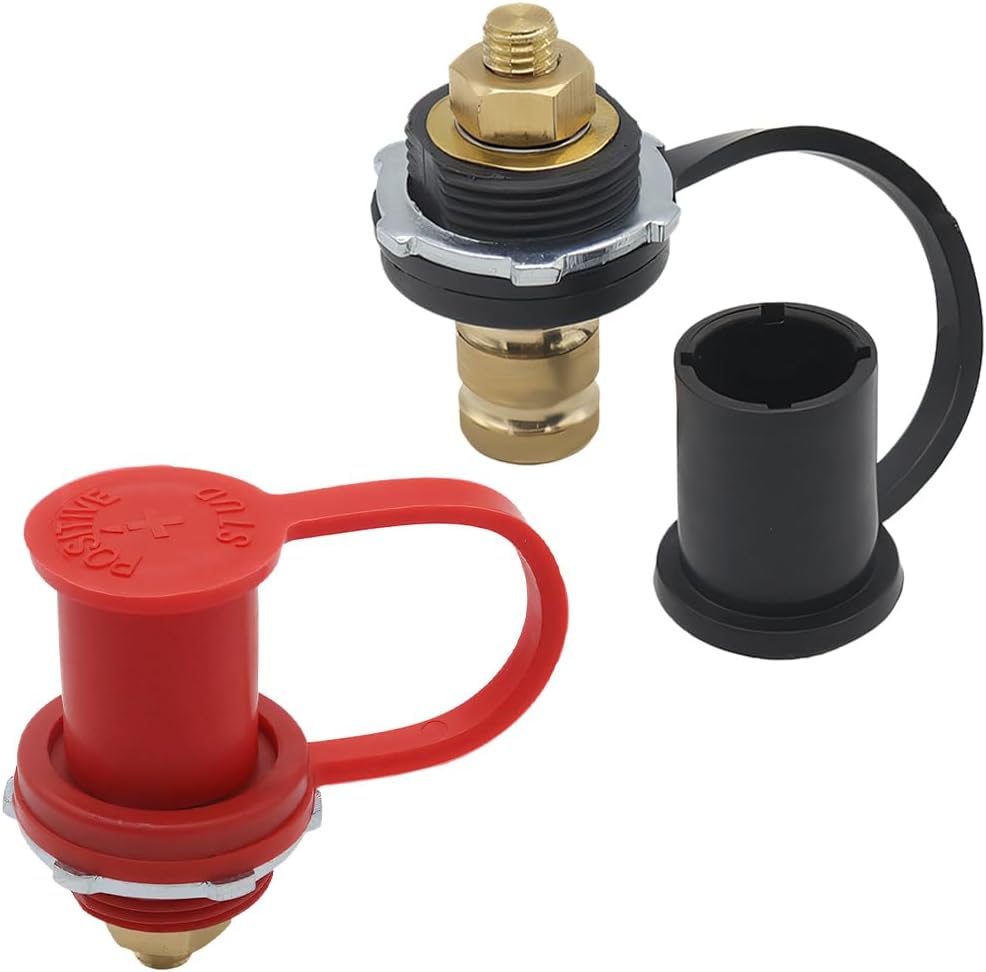
Car Remote Battery Terminal, 2PCS
4.8Editor score
Brass terminals with nylon housings
Handles up to 250A current
Two-post package with caps
Mounts in panels up to 0.3 inches
Remote battery terminals move a battery connection to a more accessible location, making routine charging, jump starting, and electrical servicing faster without working around cramped engine bays or hidden battery boxes. A useful terminal balances robust construction, dependable electrical connections, secure mounting, effective insulation, and compatibility with the cables and equipment it will serve.
We compared the available products by examining their stated materials, current ratings, stud sizes, mounting methods, cable configurations, protective features, package contents, and intended vehicle applications. The list covers complete relocation kits, panel-mounted charging posts, compact copper studs, multi-piece junction kits, and products for which useful listing information was unavailable.
Each review explains who the product is best suited for, the strengths supported by its specifications, and any practical limitations. Ratings and product details can change, and two listings did not provide enough information for a meaningful comparison, so readers should verify current specifications, fitment, and availability before purchasing.
4.8Editor score

4.7Editor score

4.5Editor score
As an Amazon Associate we earn from qualifying purchases.
The comparison highlights the principal differences among complete relocation kits, compact terminal pairs, stud connectors, and multi-piece junction sets, including their materials, current handling, mounting requirements, and practical applications.


This battery relocation kit combines two remote battery terminals with a heavy-duty steel mounting bracket, four-gauge wires, mounting hardware, insulating boots, and heat-shrink tubing. Its 4.7 rating reflects a well-rounded package for vehicle owners who want easier battery access rather than only a pair of basic posts. The included accessories reduce the need to source separate installation pieces.
We may earn a commission when you buy through this link, at no additional cost to you.
The most significant strength is the completeness of the system. Each cable is approximately 53 inches long and rated to carry up to 150A, while the terminal set is described as a 250A charging-post kit. The 3/8-inch studs accept appropriately sized ring terminals, and the red and black protector boots help identify polarity while shielding exposed contacts from dust and accidental contact.
The main trade-off is that the included four-gauge cable system is listed at a lower maximum current than the terminal rating. Buyers using unusually high-output charging equipment should evaluate that discrepancy carefully. The mounting bracket also adds size compared with a basic panel-mounted post, although it simplifies attachment and supports a more purposeful relocation setup.
This is the strongest general recommendation for a car, truck, boat, RV, UTV, ATV, or compatible Can-Am vehicle owner who values a complete installation package. It is especially useful when moving a starting-battery connection to a more convenient location for charging or jump starting. Verify panel clearance, cable routing, and local fitment before installation.
The bracket, cables, hardware, boots, and heat-shrink tubing make this more than a pair of loose posts. That makes it convenient for installers who want the principal components prepared for a remote battery-access installation.
Extending the battery connection to a reachable panel can simplify routine charging and jump starting. Red and black covers improve polarity identification while the terminal boots add protection around exposed connections.
We may earn a commission when you buy through this link, at no additional cost to you.
This two-piece remote battery terminal set has a 4.8 rating and combines brass terminal components with nylon exterior housings and 3/8-inch studs. Each unit measures approximately 2.68 by 3.39 by 1.73 inches, making it relatively compact for panel installation. It is designed for 12-volt systems and current up to 250A.
We may earn a commission when you buy through this link, at no additional cost to you.
Its strongest advantage is straightforward access to a high-current connection without purchasing a full relocation kit. The package includes two terminals, allowing one to be actively used and the other to serve as a spare or support a second connection. Flame-retardant PVC insulating caps help protect the exposed contact when the terminals are not in use.
The mounting method is uncomplicated: each post fits through a 1-1/4-inch opening in a panel up to 0.3 inches thick. That compact installation is convenient, but the maximum panel thickness may exclude thicker body panels, engine covers, or fabricated boxes. The set also does not include lengthy battery cables, so users performing a full relocation must provide suitable wiring separately.
Choose this set if you already have sound battery cables and need accessible, protected posts on a reasonably thin panel. It is well suited to cars, trucks, RVs, and ATVs, and the two-post format adds useful flexibility. Confirm cable lug compatibility, available panel space, and grounding practices before fitting it.
Brass components and a stated 250A capacity make the terminals appropriate for demanding 12-volt charging and jump-starting connections. The solid contact design supports efficient current transfer without requiring a large external housing.
Two complete posts provide more than a single connection point. One can remain in service while the other is reserved, installed elsewhere, or used for a separate battery-related function.
We may earn a commission when you buy through this link, at no additional cost to you.
This Joinfworld set is a 250A, 12-volt remote battery terminal solution built around 3/8-inch brass studs. It holds a 4.7 rating and is positioned as a simple way to bring battery access closer to the user for charging or jump starting. The terminal cover helps shield the contact from dust, water, and accidental contact.
We may earn a commission when you buy through this link, at no additional cost to you.
The 3/8-inch stud is a practical feature for high-current applications because it provides a larger attachment point than smaller studs. The terminals mount through a 1-1/4-inch hole in a panel up to 0.3 inches thick. That arrangement suits owners creating a permanent external charging point in a vehicle panel, battery enclosure, or similar surface.
The main limitation is that the supplied information does not specify a mounting bracket or extension cable length. Buyers who need to relocate a connection across a substantial distance should not assume those pieces are included. Its panel-thickness limit is another important installation constraint, particularly for thicker molded body panels.
This kit is a solid option for automotive, truck, marine, boat, ATV, and Can-Am applications where a protected, accessible charging post is the main requirement. It is especially appealing for users comfortable making their own cable and bracket arrangements. Confirm the full package contents and panel dimensions before ordering.
The 3/8-inch stud gives installers a larger connection surface for suitable battery cables. That can be useful where robust attachment and dependable high-current transfer are priorities.
The cover reduces exposure to dust and water while the post is inactive. It also helps discourage accidental contact with the conductive surface.
We may earn a commission when you buy through this link, at no additional cost to you.
The Jiozermi set consists of two color-coded stud connectors, one red and one black, with a 4.8 rating. Each connector is approximately 1.69 inches long and uses a 1/4-inch stud with a 10-millimeter threaded hole. It is a more compact option than the complete relocation kits in this guide.
We may earn a commission when you buy through this link, at no additional cost to you.
Pure copper forms the terminal blocks, while bakelite provides electrical insulation. Copper is a sensible conductive material for battery and power-distribution hardware, and the stated resistance to rust and corrosion makes these connectors relevant to generators, trucks, welding machines, ships, vehicles, and solar-cell applications. The compact size also allows more flexible placement than a large post-and-bracket assembly.
The listing does not state a maximum current rating, so it should not be assumed to match the 250A posts elsewhere in this comparison. It also does not include extension cables, mounting screws, or protective post covers. These are connector components rather than a complete remote charging-post system, making the user's existing cables and installation hardware essential.
This pair is best for builders creating a custom remote connection with appropriately rated cables. It suits a compact installation where a 1/4-inch stud and color-coded insulated body meet the application. Confirm the cable lug dimensions, current requirements, and environmental exposure before using the connectors as primary battery posts.
These small insulated stud connectors are useful when a full remote terminal housing would consume too much space. They can be incorporated into a tailored panel or enclosure design.
One red and one black body make positive and negative connections easy to distinguish. That visual cue is valuable in crowded engine bays and battery compartments.
We may earn a commission when you buy through this link, at no additional cost to you.
This heavy-duty battery relocation kit includes remote terminals, a mounting bracket, a set of four-gauge cables, and red and black protective covers. Its 4.5 rating is slightly below the leaders, but the package is designed around a full relocation setup and is especially relevant to cars, Can-Am X3 vehicles, UTVs, ATVs, and boats.
We may earn a commission when you buy through this link, at no additional cost to you.
The included bracket removes some of the difficulty involved in placing posts on a vehicle body or custom panel. The approximately 53-inch four-gauge cables provide meaningful routing flexibility, while their stated 150A capacity is suitable for many battery charging and jump-starting tasks. The color-coded covers help maintain correct polarity and protect the posts when they are not connected.
Its main limitation is the 150A cable rating compared with the 250A class of several competing terminal sets. The overall rating is also lower, although ratings alone do not capture installation quality or suitability. Buyers should consider whether their charger, cables, and electrical demands justify the heavier complete-kit format and whether the bracket fits the intended space.
This is a compelling premium-style choice for off-road and powersports owners who want the main relocation components supplied together. It may be particularly useful for a Can-Am X3 or similar vehicle where accessible jump points are valuable. Confirm bracket dimensions, cable terminations, and electrical requirements before installation.
The supplied bracket is intended to make the remote posts easier and faster to position. That is useful where a temporary or improvised panel mount would be less secure.
The long four-gauge leads provide more freedom than short terminal leads when the battery sits deeper inside a vehicle. They can be routed around engine-bay components while preserving a usable external connection point.
We may earn a commission when you buy through this link, at no additional cost to you.
This battery jump post kit targets Can-Am X3 and Polaris RZR vehicles while also being marketed for other UTVs, ATVs, trucks, race cars, trailers, RVs, tractors, lawn mowers, diesel vehicles, and boats. It has a 4.6 rating and includes a complete set of brackets, copper terminals, connecting wires, insulating caps, and mounting screws.
We may earn a commission when you buy through this link, at no additional cost to you.
The cable construction is a standout feature. Each lead is 1.2 meters long, uses 7 AWG wire, and is described as meeting an IP67 waterproof standard with voltage tolerance up to 450V. The red-and-black arrangement reduces confusion and helps prevent crossed connections, while the compact terminals are intended to avoid taking up unnecessary space.
The package also addresses several installation details at once: an insulating bracket, terminal caps, and four mounting screws. The main drawback is that the listing's compatibility language is very broad, so owners should confirm dimensions and connections rather than assuming every listed vehicle is a direct fit. A cable current rating is not stated.
This kit is best for off-road vehicle owners who need an external starting-battery connection that can withstand a more demanding environment. It is particularly attractive when waterproof cable protection and a complete mounting set matter more than having separate long remote-terminal cables. Professional installation is advisable for unfamiliar electrical systems.
The stated IP67 cable protection is valuable in an off-road environment where dust, splashes, and weather are difficult to avoid. Protective components further reduce the chance of accidental contact.
Mounting screws, an insulating bracket, caps, copper terminals, and cables are all listed. This reduces uncertainty about which small installation pieces accompany the main posts.
We may earn a commission when you buy through this link, at no additional cost to you.
This MARSTEK package contains eight remote junction posts: four red and four black. Each uses a 6-millimeter, or 1/4-inch, stud. The 4.5-rated set is positioned for power distribution in welding machines, charging generators, ships, RVs, trucks, automobiles, solar-cell installations, and other electrical systems.
We may earn a commission when you buy through this link, at no additional cost to you.
The kit's detachable design allows terminals to be tightened securely and adjusted as needed. Its brass screw components offer good conductivity and wear resistance, while the insulating material is described as flame retardant, heat resistant, and corrosion resistant. The larger quantity gives installers more options for creating paired or multi-point connections.
These are junction posts rather than a complete vehicle relocation system, and the listing does not provide a maximum current rating. Users would need appropriate cables, mounting provisions, and any protective covers required by their installation. The combination of eight pieces is also more than a basic two-terminal application requires, which may leave extras available for future projects.
This kit is a good fit for electrical builders who need several compact, insulated connection points. It is especially useful for custom power-distribution panels, generator charging, welding equipment, and solar-related wiring. Verify the required conductor size, stud length, and environmental conditions before using the posts in a high-current battery circuit.
Eight posts allow installers to build more elaborate positive and negative distribution points than a conventional two-post arrangement. They can also serve as spares for future maintenance.
The removable construction makes the terminals easier to tighten and replace than permanently molded connectors. That serviceability is valuable in workshop and generator applications.
We may earn a commission when you buy through this link, at no additional cost to you.
The Ammper remote battery terminal is a compact M10 brass binding post designed for 12-volt systems and currents up to 250A. It has a 4.6 rating and is intended for connecting wires during battery relocation, including applications involving cars, recreational vehicles, boats, electrical equipment, and solar cells.
We may earn a commission when you buy through this link, at no additional cost to you.
Its simplest strength is its compact form. The terminal can be mounted in a battery box or panel and connected to internal and external wiring. A two-part nut system allows the installer to extend, tighten, and assemble the connector with less complexity than a larger multi-component remote kit.
The listing recommends professional installation, which is sensible for a high-current connection where correct polarity, cable termination, grounding, and panel support are important. No separate protective cap is mentioned, so the installation may need a suitable enclosure or weather cover. This is also a single-terminal format, making it less convenient for a complete positive-and-negative relocation without another matching component.
Choose this terminal for a compact custom jumper-post installation where the M10 size is appropriate for the cable lug. It offers a strong stated current rating in a small package and can fit vehicle panels, battery boxes, and equipment housings. Have the electrical connection checked by a qualified installer if you are unfamiliar with high-current systems.
The compact M10 terminal can provide a convenient external connection without the footprint of a large battery relocation kit. That is advantageous in restricted battery boxes and crowded panels.
The two-set nut configuration supports flexible assembly during installation. It allows the terminal to be secured and wired in a way that suits the available enclosure or panel.
We may earn a commission when you buy through this link, at no additional cost to you.
The supplied listing for ASIN B0CNYNYLP9 does not include a product title, rating, image, or factual description. As a result, there is no reliable basis for evaluating its materials, current capacity, mounting method, stud size, or intended applications. It is included to preserve the requested ten-product structure rather than as a meaningful recommendation.
We may earn a commission when you buy through this link, at no additional cost to you.
A remote battery terminal can vary enormously in design. Some are bare stud connectors, some are insulated panel posts, and others include brackets, long cables, and protective hardware. Without stated specifications, it is impossible to determine whether this listing offers the same functionality as the documented products in the guide.
The absence of details also prevents an honest assessment of installation requirements and safety features. There is no way to confirm whether the product includes covers, suitable fasteners, or wiring, or whether it is intended for automotive, marine, solar, or general power-distribution use.
Readers should not select this listing based on the roundup alone. Open the direct product page and verify the manufacturer, terminal dimensions, current rating, included components, and vehicle or equipment compatibility before purchasing. It would only become a viable option if its specifications match the panel, cable, and electrical requirements of the intended installation.
A direct product page is available, but the supplied information does not establish what the listing contains. Buyers should review current photographs, descriptions, and customer feedback before treating it as a candidate.
The product cannot be assumed to match the rated posts or complete kits featured elsewhere in the guide. Its electrical and mounting suitability remains unknown until the seller confirms those details.
We may earn a commission when you buy through this link, at no additional cost to you.
ASIN B0FJ1VHDLR has no title, rating, image, or description in the supplied product data. It therefore cannot be compared responsibly on current handling, connection size, material quality, protection, or compatibility. Its inclusion reflects the requested ten-listing format, but the available information does not support a purchase recommendation.
We may earn a commission when you buy through this link, at no additional cost to you.
Remote terminal listings can serve very different functions. A compact insulated stud may be appropriate for a custom junction box, while a vehicle-ready charging post generally needs weather protection, secure panel mounting, and clearly identified positive and negative connections. None of those characteristics can be confirmed here.
Without specifications, there is also no responsible way to estimate compatibility with a 12-volt vehicle, charger, solar system, generator, or welding machine. A visual product page might still be useful, but a buyer should look for documented current ratings, stud dimensions, included hardware, and manufacturer instructions before proceeding.
This entry should remain a research lead rather than a shortlisted recommendation. Check the live listing for current availability, construction details, electrical limits, and installation guidance. If those details do not clearly satisfy the planned application, choose one of the documented alternatives in this guide instead.
Because the supplied record is empty, all meaningful evaluation must be completed through the direct product page. Look for clear dimensions, current limits, mounting details, and package contents.
A terminal should be selected for documented electrical capacity and physical compatibility. Product photos or broad category placement alone are not enough to establish a safe, functional installation.
We may earn a commission when you buy through this link, at no additional cost to you.
Choosing remote battery terminals requires balancing electrical capacity, connection size, mounting method, environmental protection, cable compatibility, and the intended vehicle or equipment. The most important step is matching the hardware to the installation rather than comparing appearance alone.
Choose components whose stated capacity exceeds the expected demand with sensible margin, and never substitute a smaller cable merely for convenience.
Match the post thread exactly to the cable lug, then verify that the stud is long enough to secure the nut without bottoming out.
Measure the panel thickness, hole size, clearance behind the panel, and space needed to attach a cable before selecting a post.
Favor covered or insulated posts for exposed locations, and add an appropriate enclosure when a component offers no meaningful weather protection.
Choose a complete kit for a straightforward relocation, or individual hardware when existing cables and a custom mounting design are already in place.
Confirm system voltage, conductor size, environmental exposure, and manufacturer fitment notes for the exact machine rather than relying on a broad compatibility claim.
Route and support cables so their weight and movement do not pull against the terminal, and leave enough service space to inspect the connection later.
Follow the product instructions and established vehicle-electrical practices, and use a qualified technician when the wiring exceeds your experience.
Begin by identifying the battery, cable polarity, grounding point, and the operating current of the equipment that will use the remote connection. Disconnect power according to the vehicle or equipment procedure before cutting or attaching conductors. Verify that the cable lug matches the post thread and that the cable is long enough to reach without pulling against the mount.
Install the terminal in the stated hole size or use the included bracket where applicable. Keep the mounting surface clean and structurally sound, connect the lug to the correctly sized stud, and tighten the hardware according to the terminal and cable instructions. Route cables away from sharp edges, hot components, moving parts, and standing water. Once installation is complete, check polarity before connecting a charger or jumper.
For routine care, inspect the exposed surfaces for dirt, corrosion, loose nuts, damaged insulation, and cable movement. Keep protective covers installed whenever the posts are not in use, and never work on a connection that may be energized. If discoloration, heating, damaged insulation, or a loose terminal appears, disconnect the equipment, investigate the cause, and replace or service the affected component before returning it to service.
Remote battery terminals move a battery connection to a more accessible panel, box, or bracket. This makes charging, jump starting, and battery maintenance easier when the original battery is hidden or difficult to reach. They can also be used for cable bulkhead connections and compact power-distribution points. The correct current capacity, cable size, and environmental protection must match the application.
Choose the stud size that matches the cable lug, not merely the diameter that appears easiest to install. Common options in this guide include 3/8-inch, 1/4-inch, and M10 terminals. Also confirm that the stud length leaves enough room for the nut and washer while providing a secure crimp. An undersized or incompatible lug can create heat, poor contact, or an unreliable connection.
A 250A terminal rating means the post is specified for that class of current, but it does not guarantee compatibility with every charger or cable system. The charger's output, conductor size, connector design, and instructions all matter. Some kits in this guide list 250A terminals but include cables rated to 150A, so assess the entire connection path before use.
Not all of them offer the same level of protection. Some have covers that reduce exposure to dust, water, and accidental contact, while one kit specifically describes its cable as IP67. A cover can still allow moisture to enter around the stud or cable entry. For a permanently exposed marine or off-road installation, consider a suitably sealed enclosure and corrosion-resistant hardware.
Most documented panel-mount posts require a 1-1/4-inch hole and accept panels up to 0.3 inches thick. Mark the positive and negative positions, check clearance behind the panel, and make sure the mounting surface will not flex under cable pressure. If the panel is thicker or structurally weak, use the supplied bracket or build a properly supported mounting point instead of forcing the terminal into an unsuitable opening.
They are helpful but not universally required. A bracket and long preassembled cables make a relocation faster and easier, especially on a vehicle with a deeply mounted battery. If you already have correctly sized cables, a secure panel, and appropriate fasteners, compact stud connectors may be sufficient. The finished installation still needs strain relief and support so cable movement cannot loosen the post.
Professional installation is advisable when the work involves unfamiliar vehicle wiring, high-current charging equipment, marine environments, or an inaccessible battery. The Ammper listing explicitly recommends professional installation. Even when doing the work yourself, follow the product instructions, confirm polarity, use the correct cable gauge, and have the completed connection inspected if you are not confident in high-current electrical work.
Start with clean, dry mounting surfaces and compatible conductive hardware. Keep protective covers in place when the terminals are idle, avoid leaving them exposed to salt water or persistent dampness, and inspect periodically for green or white deposits, staining, or roughness. A marine installation may require additional sealing and corrosion-protection measures beyond those provided by a standard post cover.
The Joinfworld relocation kit with a heavy-duty bracket stands out as the most complete general-purpose option, combining remote posts, long four-gauge cables, mounting hardware, boots, and protective covers. The two-piece Car Remote Battery Terminal offers the strongest value for panel-mounted projects that already have suitable cables, while the Joinfworld Heavy Duty Kit provides a bracket-based premium-style package for vehicle relocations.
Prioritize the whole electrical system rather than focusing on a headline current rating. Match the stud to the cable lug, confirm that the cable ampacity is adequate, use a mounting surface that can withstand vibration, and add protection for exposed locations. The compact Jiozermi and MARSTEK sets suit custom junction work, while the Ammper terminal offers a high-rated, space-efficient M10 option. The two undocumented listings require further verification before selection.
Before purchasing, check the current listing, manufacturer information, package contents, and product instructions, and confirm that the terminal is compatible with the exact vehicle or equipment. Product specifications, availability, and customer feedback can change over time, so verify the most recent details before completing an installation.