
21-Sheet Wet Dry Sandpaper
4.6Editor score
Seven included grit levels
Silicon carbide construction
Tear-resistant reinforced backing
This guide compares the best sandpaper for 3D prints, including grit ranges, sheet sizes, wet and dry use, and precision sanding tools.
Sanding is one of the most effective ways to improve the look and feel of a 3D print, but choosing the wrong abrasive can leave deep scratches, soften edges, or clog almost immediately. A useful sandpaper set should provide controlled material removal, consistent grit, and enough flexibility for printed layers, corners, and curved surfaces.
This guide compares ten options through their stated grit coverage, sheet dimensions, backing materials, sanding formats, and suitability for detailed or broad surface work. It covers conventional sheets, wet-and-dry abrasive, compact sanding blocks, and narrow sticks designed to reach inaccessible areas around printed features.
Each pick highlights a different practical advantage, such as a broad 16-grit assortment, a focused range for a single finishing stage, or a compact tool for hard-to-reach corners. Product ratings are included for reference, while prices and availability can change, so compare the current listing before purchasing.
4.6Editor score

4.7Editor score
4.8Editor score
The comparison covers abrasive format, grit selection, working size, and special features such as wet sanding, flexible backing, compact blocks, and tapered detailing sticks.


This 48-sheet set is the most versatile option in the group, combining 16 grits from 120 through 5000 with compact 9 x 3.6-inch sheets. Its 4.7 rating reflects a well-rounded product that can handle the rough shaping, layer smoothing, and final polishing stages involved in finishing a 3D print.
We may earn a commission when you buy through this link, at no additional cost to you.
The silicon carbide abrasive is electrostatically coated for even grit distribution, while the reinforced waterproof backing is designed to resist tearing and clogging. Those qualities matter when a printed part has raised layers or when a wet sanding stage is required. Flexible construction also helps the sheets conform to curved and irregular surfaces, and printed grit numbers make selection straightforward.
The main limitation is that the set does not include a sanding block or another rigid support. Very fine grits are also more likely to load with plastic debris after repeated use. Even so, three sheets at every major stage give enough material to work through a sequence without repeatedly reusing the same worn sheet.
This is the strongest all-purpose choice for most makers. It supports coarse cleanup, intermediate surface leveling, and fine polishing, and the range is especially useful for anyone who prints in multiple materials. Buyers working mainly on one stage may prefer a smaller focused set, but this assortment minimizes the need to buy separate grits.
The sixteen-grit range allows users to move from aggressive leveling toward increasingly fine polishing. That flexibility is valuable when the layer texture, print material, and desired finish all vary, because one coarse sheet would otherwise force a choice between excessive removal and insufficient smoothing.
The precut sheets can be trimmed for a palm sander, used by hand, or cut into narrow strips for recesses. Their stated flexibility and ability to reach irregular surfaces make the set more practical for curved prints, overhanging features, and areas between closely spaced parts.
We may earn a commission when you buy through this link, at no additional cost to you.
Honoson's set of 20 water-drop sanding sticks specializes in controlled detail work, with individual grits ranging from 80 to 12,000. The 4.6 rating indicates a versatile precision tool, and its narrow shape is particularly useful for seams, recesses, miniature details, and other printed areas that a full sheet cannot reach cleanly.
We may earn a commission when you buy through this link, at no additional cost to you.
Every stick carries a clear grit label, which helps prevent confusing rough and fine surfaces during a long finishing session. The abrasive is combined with EVA material in a double-sided format, allowing one tool to serve as both a shaping and polishing implement. The sticks can also be used for either dry or wet polishing, adding flexibility when working on different plastics.
These tools are not a replacement for a broad sanding sheet on a large, flat panel. Their narrow profile makes efficient coverage of a big surface difficult, and the smallest high-grit sticks may be more fragile than full-size sheets. The extraordinary 12,000-grit option is also much finer than most 3D-print finishing tasks require, although it can help with final gloss work.
Choose this set for intricate miniatures, figurines, architectural details, and tight printed assemblies. It is particularly appealing to model makers who want a dedicated abrasive for narrow channels and edges without repeatedly cutting conventional sandpaper into thin strips. For general-purpose finishing, the larger sheet kits offer faster coverage.
The slender water-drop profile can enter grooves and spaces that larger sheets bridge over. This makes the sticks especially effective on supports, recessed panels, hard-to-reach seams, and the small negative spaces found around fine printed details.
Because every stick is marked with its grit, the collection is easy to organize and helps prevent accidental over-finishing. A maker can move from a lower grit to a finer one while keeping the correct tool within reach and reducing changes between unrelated supplies.
We may earn a commission when you buy through this link, at no additional cost to you.
This kit combines 180 small aluminum oxide sheets with a 3.5 x 1.1-inch foam sanding block, making it well suited to miniature prints and other small components. Its 4.7 rating reflects a useful combination of a broad nine-grit range, a quick-change holder, and a compact shape made for edges, grooves, and corners.
We may earn a commission when you buy through this link, at no additional cost to you.
The color system separates red coarse grit, yellow medium grit, and gray fine grit, allowing users to select a suitable abrasive without reading every number. A tool-free hook-and-loop attachment changes sheets in seconds, while the ergonomic PU foam block is designed to reduce hand fatigue. Aluminum oxide construction is also stated to resist tearing, clogging, and crumbling on several materials, including plastic.
The product information does not identify the kit as wet-sandable, so it should be treated as a dry-sanding solution unless the manufacturer says otherwise. Its small working face also makes it inefficient for broad panels. Even so, the sheer quantity of sheets and rapid-change system provide a convenient solution for extensive detail finishing.
This is a strong choice for small figurines, tabletop terrain, jewelry prototypes, printed miniatures, and other compact parts. It also works well for 3D prints with tight corners that are difficult to finish using a standard palm sander. The included block makes it more turnkey than a collection of loose sheets.
The hook-and-loop system reduces the friction associated with changing loose abrasive. Makers can move quickly through the included grits as layer lines disappear and the surface becomes smoother, which is especially helpful for a large group of small prints.
The narrow PU foam block follows small contours and reaches recessed corners. Its small face also provides more pressure control than a large sander, helping the user avoid rounding sharp details or removing too much material from thin printed features.
We may earn a commission when you buy through this link, at no additional cost to you.
This 21-sheet assortment offers a focused selection of seven grits from 120 to 2000, with three sheets at each level. Its 4.6 rating and reinforced silicon carbide construction make it a practical budget choice for makers who need several finishing stages but do not require an extensive collection of extreme-fine abrasives.
We may earn a commission when you buy through this link, at no additional cost to you.
The sheets support wet and dry sanding. Wet use is intended to reduce dust and scratches, while dry use provides faster material removal, and the stated anti-clogging properties help maintain a sharp cutting edge. A reinforced backing adds durability, and the flexible sheets can be trimmed for hand sanding, sanding blocks, palm sanders, or sheet sanders.
Three sheets per grit is enough for occasional projects but may be limiting during repetitive production work or when a fine grit clogs quickly. The package also lacks a sanding block, so users will need to supply one if they prefer rigid support. Its highest listed grit is 2000, which covers most practical plastic-finishing stages but does not offer a mirror-level option.
This is a good value for beginners, classroom use, and occasional 3D-print finishing. It covers coarse, medium, and fine work in a manageable assortment and remains versatile enough for general household tasks. Buyers who regularly print many parts may prefer a larger quantity at each grit.
The seven-stage range supports the normal progression from removing prominent layer lines to smoothing the surface before painting or polishing. It provides enough granularity to respond to different filament finishes without carrying the unnecessary complexity of dozens of near-identical fine grits.
Silicon carbide sheets are particularly suitable for wet finishing because the abrasive remains effective while the surface is wet. The process can reduce airborne dust and help reveal whether a print is sufficiently smooth before a filler, primer, or final coat is applied.
We may earn a commission when you buy through this link, at no additional cost to you.
This set uses soft foam sanding blocks instead of loose sheets, with 24 pieces covering 12 listed grit combinations from 80 to 3000. Its 4.6 rating and ergonomic shape make it appealing for anyone who prefers a cushioned grip and consistent contact over a curved 3D-printed surface.
We may earn a commission when you buy through this link, at no additional cost to you.
Each block measures 3.93 x 2.75 x 0.19 inches, offering more surface than a small finger sander but remaining manageable. The foam layer is designed to absorb vibration, reduce hand fatigue, and adapt to irregular geometry. The abrasive works wet or dry, allowing it to handle both quick material removal and cleaner, lower-dust finishing.
Foam blocks can deform under heavy pressure, so they are not ideal when aggressive stock removal is the goal. They also cover less area than full-size sheets, making large flat panels slower to finish. The combined grit labels in the set may require care when identifying the exact face, but the assortment remains broad enough for many workflows.
This option is well suited to rounded parts, organic models, cosplay pieces, and sculptures where the sanding face must follow a changing contour. It is also useful for users who find rigid blocks uncomfortable. For flat panels and production batches, conventional sheets remain more efficient, while narrow sticks are better for recessed details.
The flexible foam face makes even contact more likely across rounded and irregular forms. That helps reduce the tendency to sand only the high points of a curved layer pattern, producing a more even result without relying on a rigid flat block.
The soft buffering layer is intended to absorb vibration and provide a secure, comfortable grip. This makes the blocks more pleasant for lengthy finishing work or repeated hand-sanding tasks, although users should still vary their grip and pressure.
We may earn a commission when you buy through this link, at no additional cost to you.
This 45-sheet pack spans 15 grit levels from 80 through 5000, giving it one of the broadest standard-sheet ranges in the comparison. Its 4.6 rating reflects a versatile, durable option for users who expect to sand a variety of printed materials and want fewer interruptions for replacements.
We may earn a commission when you buy through this link, at no additional cost to you.
The electro-coated silicon carbide is designed for uniform distribution, while the waterproof backing is stated to resist tearing and support wet or dry use. Every sheet can be trimmed to suit a particular tool, and grit markings on the back simplify organization. Three sheets are listed at 5000 grit, providing extra material where the very fine surface is most likely to load or wear.
No sanding block or finger pad is included, so a rigid support must be added if the sheets are not flexible enough for hand use. The wide range can also encourage unnecessary steps if a user has no clear finishing plan. A sensible sequence should move from coarser abrasives to finer ones while avoiding excessive pressure on soft printed features.
Choose this pack for a well-stocked workshop or a maker who regularly alternates between shaping, smoothing, and polishing. It handles conventional 3D-print finishing and many other surfaces, while the wet-compatible construction makes it particularly useful when cleaner sanding and reduced dust are priorities.
Forty-five sheets provide a useful buffer for a workshop that sands many prints. Users can separate grits into stacks, keep a fresh sheet available when one clogs, and avoid repeatedly handling abrasive that has lost its cutting efficiency.
The progression includes intermediate grits such as 1200, 1500, 2000, 2500, and 3000 before reaching 5000. Those finer levels can help refine a print after visible layer lines have already been removed with a coarser sheet.
We may earn a commission when you buy through this link, at no additional cost to you.
This pack includes 50 slim, double-ended sanding sticks with 120-grit and 280-grit surfaces. Its 4.4 rating is the lowest in the group, but the straightforward design addresses a specific need: reaching tight spaces and controlling abrasion around small 3D-printed details.
We may earn a commission when you buy through this link, at no additional cost to you.
The black end provides the rougher 120-grit surface, while the gray end handles finer 280-grit polishing. Tapered ends make it easier to work inside narrow corners, while the smooth wooden handle is designed for comfortable control. The sticks are also positioned as useful for removing glue, wood filler, and rust from small areas.
Only two grit levels are included, so this is not a complete smoothing system by itself. A user who needs to move beyond a basic 280-grit finish will still require finer sheets. Their slim shape is also inefficient for flattening large surfaces, and the product information includes a time-saving claim that should be viewed as a general convenience feature rather than a guaranteed result.
This set is a good inexpensive companion to a broader sanding collection. It works particularly well for figurines, scale models, painted parts, tiny recesses, and localized corrections. Users who sand mostly large prints should center their collection on full-size sheets, while fans of detailed assembly work may value the 50-count supply.
The dual-ended format provides rough and fine options without requiring separate storage for tiny abrasive scraps. Flipping the stick is a simple way to change the level of abrasion while retaining a secure grip.
A narrow stick allows the abrasive to contact a small target area rather than a broad section of the print. This gives the user more control around small greebles, narrow spokes, recessed seams, and fragile projections where a large sheet could overreach.
We may earn a commission when you buy through this link, at no additional cost to you.
Fandeli's 36-sheet set offers grits from 120 to 2500 in a flexible 22.86 x 9.14-centimeter format. Its 4.7 rating and water-resistant paper backing make it a credible choice for printed parts that need both dry smoothing and wet surface refinement.
We may earn a commission when you buy through this link, at no additional cost to you.
The closed silicon carbide structure is designed to support fast sanding and a long working life, particularly in wet applications. The flexible backing conforms to different shapes, and the grit thickness is printed on the back for identification. Sheets can be cut to fit smaller tools or printed features, while the assortment covers 11 distinct grit levels with three or four sheets at each level.
The listing is based on metric dimensions, which may be less convenient for users accustomed to inch-based sanding tools. It also includes no holder. In addition, the paper construction is water resistant rather than necessarily identical to a fully waterproof synthetic backing, so care should be taken to allow wet sheets to dry before storage.
This assortment is attractive for makers who work on curved or irregular parts and want options for automotive-style wet finishing. The mixture of medium and fine grits supports a sensible finishing sequence, while the brand's stated experience in abrasives adds confidence for general users.
Because the sheet is designed to conform to a surface, it can maintain better contact across a rounded object than a stiff sheet. This is useful for smoothing organic models and complex forms where pressure is naturally uneven.
Silicon carbide is well suited to wet applications, where the product information reports a unique finish and strong cutting action. Wet sanding can reduce dust while helping the user inspect the print under stronger light before applying a coating.
We may earn a commission when you buy through this link, at no additional cost to you.
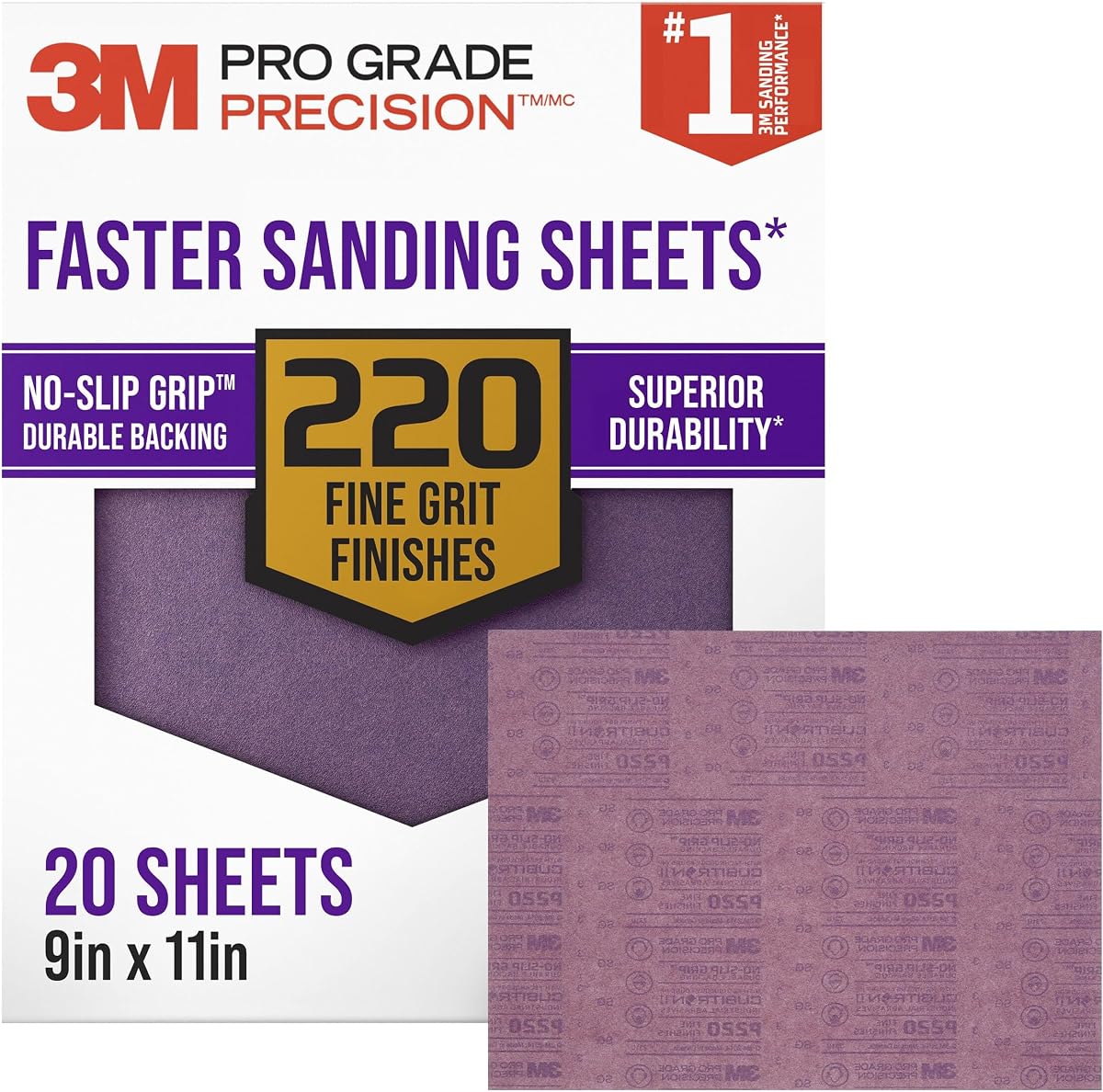
This 20-pack of 3M Pro Grade sheets uses premium mineral grit associated with Cubitron II industrial abrasives and holds the highest rating in the comparison at 4.8. The uniform 220-grit format is a strong choice for controlled surface preparation after a printed part has already been shaped.
We may earn a commission when you buy through this link, at no additional cost to you.
The durable backing is designed to resist tearing, reduce hand fatigue, and provide a no-slip grip. It conforms to the workpiece and supports wet or dry sanding, while the stated non-discoloring paper helps avoid color transfer during the process. At 11 x 9 inches, the sheets offer a generous working area for flat prints and can also be cut for a smaller hand sander.
Because the package contains only 220 grit, it is not a complete finishing system. Users who need a highly polished surface will still need finer abrasives, and 220 grit can leave a texture that requires additional smoothing before paint. The premium construction may also be unnecessary for a single small repair or for prints made from very soft materials.
Choose this option when consistent surface preparation, durable construction, and reduced color transfer are priorities. It is especially attractive for makers who already own lower- and higher-grit sheets and want a dependable 220-grit middle step. The full-sheet format also makes it efficient for larger prints and broader panels.
A 220-grit sheet is useful for leveling obvious layer texture after coarser work without moving directly to a very fine polish. It can also prepare printed surfaces for primer, filler, paint, or bonding, making it a practical bridge between aggressive shaping and final refinement.
The 11 x 9-inch format provides useful coverage for flat and gently curved parts. It can be folded for palm use, wrapped around a sanding block, or cut into smaller sections when more localized pressure is needed.
We may earn a commission when you buy through this link, at no additional cost to you.
This 20-pack provides 180-grit 3M Pro Grade sheets for the early stage of print finishing. Its 4.7 rating reflects a well-made abrasive with a useful balance of efficient removal and surface control, particularly when visible layer ridges need to be reduced before finer work begins.
We may earn a commission when you buy through this link, at no additional cost to you.
The premium mineral grit uses technology also found in Cubitron II industrial abrasives, while the durable no-slip backing is intended to limit tearing and hand fatigue. The sheets conform to the surface, work wet or dry, and are described as non-discoloring. Their 11 x 9-inch size offers good coverage and can be adapted to a hand block or palm sander.
A single-grit pack cannot complete the full smoothing sequence, and 180 grit is intentionally too coarse to serve as a final polishing abrasive. It can also be too aggressive for very thin layers or delicate features if excessive pressure is applied. Users should inspect the print frequently and transition to a finer grit once the ridges have been reduced.
This is an excellent starting point for a staged finishing system, especially for prints with pronounced layer lines or flat surfaces that will later be primed and painted. It is less suitable for someone seeking a ready-to-use all-grit kit, but the same 3M construction and 11 x 9-inch format make it easy to combine with the 220-grit option in a progressive workflow.
The 180-grit level is suited to removing prominent ridges while retaining more control than a very coarse abrasive. It works well as the first step in a sequence that continues through 220 grit and progressively finer sheets.
Once the major texture is removed, a uniform surface is easier to prime, fill, or paint. The conforming sheet and non-discoloring paper help the user work across the part without introducing avoidable color transfer or leaving a harsh, uneven texture.
We may earn a commission when you buy through this link, at no additional cost to you.
The most useful sandpaper for 3D prints balances grit control, material compatibility, sheet flexibility, and the ability to reach the part's geometry. These factors determine whether the abrasive removes layers efficiently without damaging fine details.
Choose a broad range for varied materials, or a focused range for a consistent workflow.
Test the abrasive and pressure on a concealed area first.
Choose wet capability for cleaner refinement and dry use for straightforward correction.
Pick small sheets for detail and large sheets for efficiency.
Flexible, reinforced backing improves contact and durability.
Add a narrow stick or block for recesses and miniature details.
Keep spare sheets at frequently used fine grits.
A matching holder improves control and makes grit changes easier.
Begin by identifying the print material, filling any significant gaps, and allowing the part to cool completely. Clean the surface so loose resin, plastic dust, or oily contamination does not interfere with the abrasive. Start with a lower grit when layer lines are pronounced, and test on a hidden area to confirm that the material sands evenly.
Sand with light, consistent pressure and move in small circular or back-and-forth motions. Follow the contours of the print and check the surface frequently under strong light. For wet finishing, wet the printed area and abrasive thoroughly, rinse away residue, and allow both to dry before changing grit. Move gradually from coarse to fine rather than skipping many levels, because large scratches cannot be repaired by finer paper alone.
After each use, remove accumulated plastic dust and let wet sheets dry completely. Store sheets flat or in a dedicated organizer so they do not curl, fold at sharp creases, or mix with unrelated abrasives. Replace a sheet when it tears, loses its shape, or becomes heavily clogged, and use a separate block for each grit to prevent accidental over-sanding.
Start around 120 to 220 grit for prominent layer lines, then move through 320 or 400 grit to reduce visible scratches. Continue with finer levels such as 600 to 1000 grit when preparing for paint or polish, and use 1500 grit or higher only when the surface already appears smooth. The correct starting point depends on the material and how severe the layer texture is.
Wet sanding can work well with water-resistant silicon carbide sheets and materials that are not damaged by water. It reduces airborne dust and often produces a cleaner, more consistent surface than dry abrasion. Always check the material, use a product explicitly rated for wet use, and dry the print thoroughly before painting or assembling it.
Coarse sanding usually comes first because it levels the overall shape and exposes defects that need filling. After applying filler or primer, move to medium and fine grits to blend the repaired areas into the surrounding surface. A final high-grit pass can then prepare the print for paint or a glossy finish.
Narrow sanding sticks and compact finger blocks are usually best for small details because they reach confined spaces and apply controlled pressure. A thin strip cut from conventional sandpaper can also work. For larger flat parts, standard full-size sheets are faster and provide broader, more even coverage.
Plastic debris can become trapped in the abrasive spaces, reducing cutting efficiency and leaving a smeared surface. Use a fresh sheet, reduce pressure, and work in smaller sections. A coarser grit may remove material more efficiently during initial stages, while a properly lubricated wet-sanding process can help keep the abrasive clear.
Three or four well-chosen levels are often enough: one for rough correction, one or two for intermediate smoothing, and one for final refinement. A larger assortment offers more control but is most valuable when you regularly work with different plastics, fill materials, and surface finishes.
Sanding can reduce or eliminate the visible texture, but it removes material from the print. The layer lines may become more noticeable again if the surface is later viewed under raking light, so a filler or primer is often used to create a uniform substrate. Avoid aggressive sanding on thin or load-bearing features.
The same abrasive may work, but pressure and grit should still be adjusted for each material. Soft or flexible prints can scratch easily, while filled or rougher prints may need more aggressive correction. Keep separate blocks for different materials to reduce cross-contamination and make grit changes easier to track.
The 48-sheet, 16-grit silicon carbide assortment is the strongest all-around selection because it covers leveling, smoothing, and polishing with sheets that can be used wet or dry. The 21-sheet set delivers the most practical budget package, while the 3M 220-grit sheets offer a premium, focused option for consistent intermediate finishing.
The most important choice depends on geometry. Large, flat prints benefit from full-size sheets or foam blocks, while small figures, recessed details, and assembled models are better handled with compact blocks, strips, or tapered sanding sticks. Whichever format you choose, plan a gradual grit sequence and use light pressure to preserve fine printed features.
Ratings, product options, and pricing can change, so check the current listing and seller details before buying. Consider the filament type, the surface condition, and the final finish you want, then choose a set that supports both the necessary grit progression and the areas you need to reach.