
Mount-It! Commercial POS Kiosk Stand
2.0Editor score
Fits 15 to 22-inch monitors
Integrated printer and reader bays
Fixed 30-degree touch angle
Weighted commercial steel base
A self service kiosk POS stand turns a compatible display or tablet into a practical customer-facing station for ordering, check-in, payments, menus, and information. The strongest options combine secure device retention, stable construction, flexible adjustment, useful cable management, and enough room for essential peripherals.
We compared ten stands across compatibility, security, adjustability, mounting options, peripheral support, and intended business use. The list includes monitor-based floor stands, locking tablet kiosks, a wall-and-counter iPad option, and dedicated stations for receipt printers or card readers, giving each type a place.
Each review explains the stand's strongest benefits, practical limitations, and ideal deployment. Product availability and pricing can change, so confirm current specifications and compatibility before purchasing, especially for display weight, VESA measurements, tablet dimensions, and attached accessories.
2.0Editor score

5.0Editor score

4.4Editor score
As an Amazon Associate we earn from qualifying purchases.
The comparison below organizes all ten stands by device type, mounting approach, security, adjustability, and peripheral support, making it easier to identify the right format for a permanent check-in station, flexible ordering kiosk, or compact iPad checkout.



The CTA Self Service Kiosk White is a floor-standing display system designed to organize a complete POS station around one central column. It carries a rating of 2.5 stars, but its specifications make it relevant for restaurants, retail counters, digital signage, and self-service environments where a monitor, compact computer, and receipt printer need a coordinated home.
We may earn a commission when you buy through this link, at no additional cost to you.
Its most appealing feature is the combination of hardware storage. The stand attaches to a display through 75mm or 100mm VESA patterns and supports displays up to 33 pounds. A mini-CPU holder accommodates equipment as large as 7.2 inches wide by 7 inches deep by 1.45 inches high, while the universal printer holder accepts a receipt printer measuring up to 6 inches high by 6 inches wide by 7.6 inches deep.
The heavy-duty metal base includes pre-drilled holes for permanent mounting, which is a meaningful advantage in a public area where a freestanding unit could be moved or tipped. The white finish also fits many bright retail and hospitality environments better than an industrial-looking black enclosure. The trade-offs are the relatively constrained CPU compartment and the stand's modest 2.5-star rating, so buyers should verify every peripheral dimension before ordering.
This is a sensible choice for a permanent kiosk built around a standard VESA display, a small computer, and a receipt printer. It is less suitable for a large tablet-only checkout, a spacious mini-PC installation, or a deployment where quick repositioning is essential. Confirm your display's weight, mounting pattern, and accessory measurements, then use the permanent base mounting for a professional installation.
Keeping the mini CPU and receipt printer off the counter creates a cleaner customer-facing station. It also reduces the number of loose components around the display, making the setup easier to inspect and maintain.
The pre-drilled base offers a more secure installation than a lightweight portable pedestal. That is especially useful in restaurants, retail stores, and other unattended or semi-attended environments.
We may earn a commission when you buy through this link, at no additional cost to you.
The CTA Self Service Kiosk Black offers the same core hardware-management concept as the white version, with a finish suited to darker counters, modern retail interiors, and business environments. It receives a 2.5-star rating and is designed for VESA-compatible displays weighing as much as 33 pounds.
We may earn a commission when you buy through this link, at no additional cost to you.
The stand brings together a display mount, compact CPU holder, and universal receipt-printer shelf. Mini-PC compatibility extends to dimensions of 7.2 inches wide, 7 inches deep, and 1.45 inches high, while the printer compartment supports units up to 6 inches high, 6 inches wide, and 7.6 inches deep. These defined limits are the most important buying considerations.
Compared with a large dedicated kiosk enclosure, this design preserves a relatively open visual profile and directs attention toward the screen. Its heavy-duty metal base and pre-drilled holes support permanent placement, reducing the need for separate furniture around the station. The disadvantages are the same modest rating and the limited internal volume of the CPU and printer areas.
Choose this model when your POS uses a relatively compact computer and printer and you want a straightforward black stand for a fixed installation. It may not suit a full-size desktop computer, a large cash drawer, or an unusually deep receipt printer. Buyers should compare the accessory dimensions against the published limits before ordering.
The black finish recedes visually while the display remains the focal point. Integrated storage prevents the computer and printer from becoming separate counter-level obstacles.
Support for both 75mm and 100mm VESA patterns broadens the range of compatible commercial displays. Display weight must still remain within the stated 33-pound limit.
We may earn a commission when you buy through this link, at no additional cost to you.
The CTA BSF-2205 is the most complete monitor-based option in this guide, combining a 5.0-star rating with all-metal construction, printer storage, and an integrated card reader bracket. It is intended for 21.5-inch and 27-inch displays and is built for professional self-service applications rather than lightweight temporary placement.
We may earn a commission when you buy through this link, at no additional cost to you.
Its 21.3 by 14.6 by 53.7-inch structure weighs 28.7 kilograms, giving it a substantial commercial appearance and a reassuring foundation. The 100 by 100mm VESA interface supports compatible monitors and VESA enclosures, although the monitor and enclosure are not included. A dedicated storage compartment measures 5.9 by 5.9 by 7.87 inches for a receipt printer.
The built-in card reader bracket is especially useful because it creates a more unified checkout station without requiring a separate accessory-support pole. The main compromises are bulk and the narrower VESA compatibility compared with products accepting both 75mm and 100mm patterns. The printer compartment is also large enough for many thermal printers but still requires a dimension check.
This stand is a strong candidate for restaurants, quick-service locations, retail floors, and other installations that need a full-size touch display with payment hardware and printer storage. It is less appropriate for small counters or users who want a compact tablet mount. Its rating, sturdy construction, and integrated accessories make it the most balanced premium-ready option here.
Supporting both 21.5-inch and 27-inch displays gives the station enough screen space for ordering, menus, registration, and customer information. The 100 by 100mm VESA pattern should be confirmed before display selection.
The integrated reader bracket and printer compartment make peripheral placement more orderly. Together, they reduce clutter and create a more convincing self-service station.
We may earn a commission when you buy through this link, at no additional cost to you.
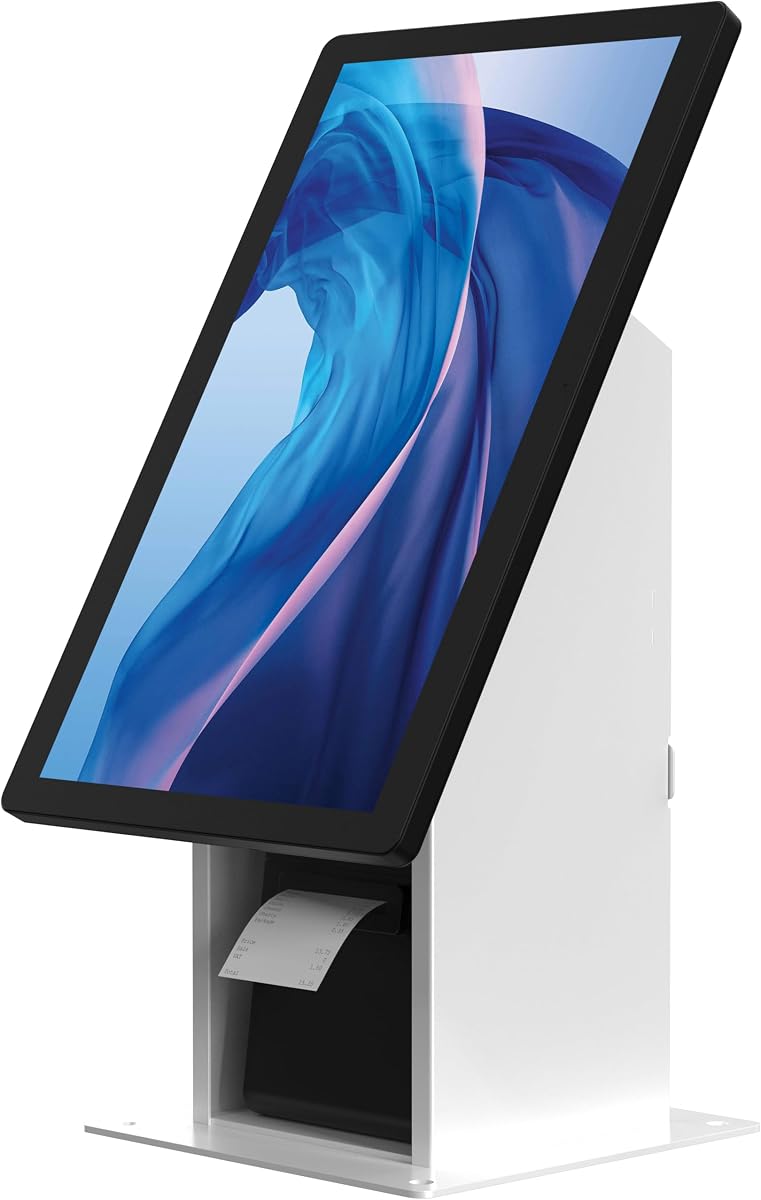
The Mount-It! Commercial POS Kiosk Stand is designed for compact commercial check-in stations using 15-inch to 22-inch monitors. Its 2.0-star rating is the weakest in the roundup, but the stand's focused design includes a printer bay, payment terminal bracket, weighted base, and a fixed 30-degree touch angle.
We may earn a commission when you buy through this link, at no additional cost to you.
The VESA interface supports 75 by 75mm and 100 by 100mm patterns, while the stated screen limit is 22 pounds. The printer bay measures 5.5 inches wide by 5.5 inches deep by 8.6 inches high and is listed as compatible with several Epson, Star, Bixolon, Citizen, and SNBC thermal printer families. The terminal bracket accommodates selected Ingenico, Verifone, and PAX models.
Its fixed 49.1-inch height is optimized for standing use, and the 30-degree angle is intended to improve touch comfort. Heavy-gauge steel and a weighted base provide stability, while installation materials, a product-specific PDF, and an assembly video simplify setup. The principal limitations are the inability to fine-tune height or angle and the low 2.0-star rating.
This product fits permanent restaurant, retail, hotel, healthcare, and reception deployments where operators value a neat fixed position over portability. It is not intended for larger consumer televisions or displays above 22 inches. If the listed angle and height suit the intended users and the included peripherals match your POS, the stand can still provide a polished commercial setup.
The 30-degree display position supports a natural viewing and tapping posture. A fixed angle also reduces the chance of staff or customers accidentally loosening an adjustable joint.
The printer bay and payment bracket save space and keep the counter organized. Their listed compatibility is broad, but exact printer and terminal models should still be verified before installation.
We may earn a commission when you buy through this link, at no additional cost to you.
The Square iPad Self-Service Stand offers one of the simplest ways to create an ordering checkpoint using an iPad and Square's kiosk software. It has a 4.4-star rating and is intended for restaurants, quick-service counters, and other locations where a compact self-ordering experience is more important than a large monitor.
We may earn a commission when you buy through this link, at no additional cost to you.
The mount can be affixed to a wall or countertop, and it can also attach to a 100 by 100mm VESA-compatible support. Installation hardware is included. Its guided LED lights direct customers through checkout, while compatibility with Square Reader hardware supports tap, dip, and swipe transactions when the required components and service are present.
This product is workflow-specific rather than a general-purpose universal stand. The iPad and appropriate app subscription are not part of the hardware package, and the stated transaction model depends on Square's current commercial terms. That dependency should be considered if a business already uses another ordering platform or needs support for multiple payment providers.
For a restaurant adopting Square's self-service ordering, the stand is a convenient choice because it supports wall and counter placement without a full floor pedestal. It is less suitable for a business seeking a device-neutral, security-focused floor kiosk. Confirm the iPad size, app requirements, reader connection, and intended mounting surface before buying.
Wall and countertop configurations help businesses use limited counter space efficiently. A VESA-compatible mounting surface adds flexibility when a permanent pedestal is unnecessary.
The LED guidance reduces uncertainty at the payment step. Combined with Square's ordering interface, it can help shorten the customer journey for routine food orders.
We may earn a commission when you buy through this link, at no additional cost to you.
The AboveTEK Security iPad Floor Stand is a versatile 4.2-star-rated option for retail, office, and general kiosk use. It supports 9.7-inch to 13-inch tablets up to 0.4 inches thick, including iPad, iPad Pro, and iPad Air models, making it broader than stands limited to a specific older generation.
We may earn a commission when you buy through this link, at no additional cost to you.
Height adjustment from 29.5 to 45.3 inches allows the display to suit different users and counter heights. The holder rotates through 360 degrees and tilts from negative 90 to positive 90 degrees, making it useful for portrait ordering, landscape menus, demonstrations, and staff-operated POS tasks. A heavy-duty steel base weighing 5.3 pounds provides freestanding stability.
Security comes from a specialized anti-theft screw and matching wrench, which discourages casual removal without requiring a keyed enclosure. Hidden cable management helps maintain a tidier appearance. On the other hand, the supplied information does not describe pre-drilled floor anchoring, and the device must remain within the stated thickness limit.
This is a good fit for businesses wanting one adjustable tablet pedestal across check-in, product consultation, and ordering workflows. It is especially suitable for newer 10- to 13-inch tablets and settings where operators occasionally change the display orientation. Verify tablet dimensions, make sure the security tool is available to staff, and assess whether the base location needs additional anchoring.
Height, rotation, and tilt adjustment make the unit adaptable to customer and staff tasks. A portrait display can support ordering, while landscape orientation suits menus and demonstrations.
The specialized screw adds a deterrent without fully enclosing the device. It remains effective only when the base is stable and the tablet is fitted securely within the holder.
We may earn a commission when you buy through this link, at no additional cost to you.
The AboveTEK Anti-Theft iPad Stand is a 4.4-star-rated, lock-and-key kiosk pedestal intended for retail and other public environments. It combines a sturdy aluminum-and-steel frame with an enclosure that secures the device, giving it a more theft-resistant profile than an open clamp mount.
We may earn a commission when you buy through this link, at no additional cost to you.
Compatibility is explicitly listed for several 9.7-inch, 10.2-inch, 10.5-inch iPad, iPad Air, and iPad Pro models. The holder tilts from negative 90 to positive 90 degrees and adjusts in height from 27.6 to 45.3 inches, giving operators flexibility for different customer positions and applications.
The attachable base includes screw holes for extra security, and an anti-slip pad supports everyday stability. At 0.16 inches thick and 3 kilograms, the stand combines meaningful mass with a relatively compact footprint. Cable management conceals charging cords, while the keyed enclosure discourages unauthorized access or device removal.
The main drawback is its model-specific compatibility list, which does not cover every current iPad size. This is an appropriate choice for a business that already owns one of the listed tablets and wants a lockable floor station. Check the exact model, dimensions, connector access, and base location before ordering.
The lock-and-key enclosure is designed to deter tampering in retail stores, restaurants, and trade-show environments. It offers a clearer security boundary than a screw-secured open cradle.
The broad height range and wide tilt angle accommodate standing, seated, and service-counter interactions. These adjustments help a single station serve more than one operational role.
We may earn a commission when you buy through this link, at no additional cost to you.
The Mount-It! Universal Tablet Floor Stand is a 4.2-star-rated security kiosk for 7.9-inch to 11-inch tablets. Its open keyed-clamp design is distinctive because it preserves access to the tablet's audio jack, allowing compatible Square, PayPal Here, and other audio-jack card readers to remain attached.
We may earn a commission when you buy through this link, at no additional cost to you.
Device support extends beyond a single brand, including iPad Air, iPad, iPad Pro, and Samsung Galaxy Tab models within the stated dimensional range. The stand adjusts in height while the tablet remains mounted, rotates 360 degrees, and tilts through plus or minus 90 degrees. Portrait suits checkout and registration, while landscape works for menus and product demonstrations.
A 9.4-pound steel stand rests on a 13.6 by 17.4-inch triangular base for freestanding use, while pre-drilled holes allow floor bolting for high-interaction locations. Cable alignment clips route charging and data cords along the pole and keep the charging port accessible. The primary limitation is that the clamp requires a bare tablet and does not support cases.
This stand is a strong option for teams using tablets from different manufacturers or changing device generations. It is particularly helpful when a payment reader attaches through the audio jack, a configuration many enclosed stands obstruct. Buyers should compare the tablet's exact width and height, remove any case, and decide between a weighted base and permanent anchoring before installation.
The adjustable cradle supports a range of Apple and Samsung tablets rather than one rigid device model. This makes the stand useful for organizations that periodically update their hardware.
The open clamp leaves the audio jack reachable, allowing compatible payment hardware to remain connected. That focus makes it particularly practical for tablet-based retail checkouts.
We may earn a commission when you buy through this link, at no additional cost to you.
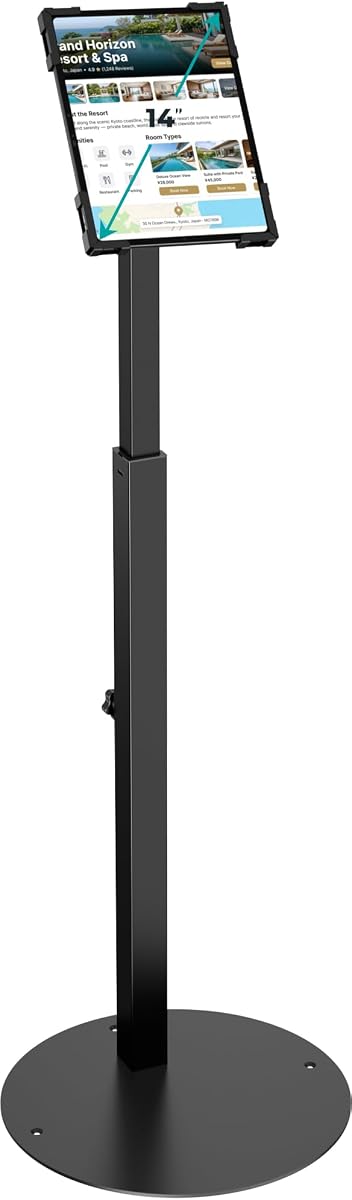
The Anti-Theft iPad Kiosk Floor Stand is a 4.4-star-rated option aimed at larger tablets and professional checkouts. It supports most 10-inch to 14-inch devices up to 0.39 inches thick, including listed configurations of iPad Pro, Galaxy Tab, and Surface Pro models.
We may earn a commission when you buy through this link, at no additional cost to you.
Device retention is handled with specialized security screws and a custom wrench. The 13.78-inch solid steel base has pre-drilled holes for optional floor mounting, making it possible to increase anti-tip stability in a high-traffic location. The pole adjusts from 29.53 to 45.28 inches, and the screen rotates 360 degrees with up to 180 degrees of tilt.
Charging cables can run through the hollow center pole and exit beneath the base, reducing visible wires and trip hazards. The design is more accommodating of large modern tablets than stands limited to 9.7- or 10.5-inch models. The trade-off is that a custom wrench must be secured and available to authorized staff when a device needs removal.
This stand works well for retail checkouts, hotel reception areas, public exhibitions, and corporate information points using larger tablets. It is not the simplest option for frequent device swaps, and the optional floor bolting should be considered for any unattended or high-interaction environment. Measure the tablet and confirm the desired viewing position before installation.
The 10- to 14-inch device range accommodates many current business tablets without relying on older dimensions. Thickness must still remain within the 0.39-inch limit.
The heavy base and optional anchoring reduce movement, while internal cable routing keeps cords away from the walking area. Both features support a professional unattended checkout.
We may earn a commission when you buy through this link, at no additional cost to you.
The CTA Anti-Theft Kiosk Station is a 5.0-star-rated POS stand that brings a tablet, card reader, and receipt printer into one coordinated unit. Its enclosure uses a lock-and-key mechanism to protect the device, making it a natural fit for retail counters, warehouses, point-of-sale locations, and other shared commercial spaces.
We may earn a commission when you buy through this link, at no additional cost to you.
The width-adjustable card reader holder supports different reader sizes and can attach on either the right or left side according to the user's preference. A dedicated front area accommodates a receipt printer, reducing the need to place accessories separately on the counter. That integrated layout is the product's strongest distinguishing feature.
Compatibility covers numerous iPad generations, including 11-inch and 10.5-inch models, as well as listed Galaxy Tab, Galaxy Tab S, and Surface Go devices. The broad list is useful for businesses with varied tablet fleets, although buyers should still confirm physical dimensions and port access. The product also carries a one-year guarantee from CTA.
Choose this station when a tablet checkout needs integrated reader and printer placement with keyed security. It is less suitable for a compact app-only ordering station or any device not represented by the compatibility list. Measure the tablet, reader, and printer, confirm the mounting layout, and review the included components before finalizing the installation.
The bracket can be mounted on either side, allowing the payment device to suit traffic flow and handed operation. Its width adjustment helps accommodate readers with different housings.
Integrating the receipt printer with the tablet stand produces a cleaner customer-facing station. It is especially useful where counter space is limited and every accessory must have a defined location.
We may earn a commission when you buy through this link, at no additional cost to you.
The right kiosk stand depends on your display, payment hardware, operating environment, and need for mobility or permanent security. Measure your equipment first, then prioritize the mounting, security, and adjustment features that match how customers will actually use the station.
Start with the exact device rather than a broad product category. Monitor stands may support 75 by 75mm or 100 by 100mm VESA patterns, and they can impose display-weight limits such as 22 or 33 pounds. Tablet stands may specify a size range, supported models, and a maximum thickness. A stand that looks large enough can still block ports, cameras, buttons, card readers, or charging connections.
Measure screen width, height, and depth, and check the mounting pattern and weight. For tablets, identify the exact generation and check the manufacturer's supported-model list.
Choose only a stand whose published dimensions, weight limit, and VESA pattern match your device.
A self-service station holds valuable equipment within reach of customers, so security deserves careful attention. Screw-secured holders deter casual removal, keyed clamps add a stronger access barrier, and lock-and-key enclosures are preferable for unattended or high-traffic installations. Consider who needs to remove the device, how often it changes, and whether employees can safely store any required tools or keys.
The most secure choice is the one staff can operate consistently without leaving the device exposed. A complicated lock is of little value if every transaction requires an improvised workaround.
Match the security method to traffic and handling frequency, favoring keyed or anchored systems for unattended public use.
Floor stands suit freestanding or semi-permanent deployments where users approach a vertical display. Wall and countertop mounts save space but require suitable surfaces and careful positioning. A pedestal may be unnecessary for a small cafe that can accommodate a compact ordering station on the counter, while a large restaurant may benefit from a full-height display with a printer compartment.
Also consider whether staff need to service the screen, swap tablets, or reposition the station for cleaning. Mobility is convenient in some spaces but can undermine stability in busy locations.
Select the smallest form factor that comfortably accommodates the screen, tablet, and all required accessories.
A kiosk stand becomes more useful when it can carry the components needed for a complete transaction. Look for an integrated receipt printer bay, card reader bracket, mini-PC compartment, or cash-related storage area. Published compartment dimensions are important because receipt printers vary greatly in width, depth, and height, while some card readers project from their housings or require a specific mounting orientation.
Also check whether the stand keeps charging cables organized and leaves power or data connectors accessible. A clean cable route can reduce trip risks and make equipment servicing easier.
List every required peripheral and compare each physical dimension and connection with the stand before purchasing.
Stability depends on the base material, weight, footprint, center of gravity, and whether the stand can be anchored. A wide steel base and low center of gravity help with repeated touch interactions, but larger displays create more leverage. Pre-drilled holes or an attachable base can provide stronger permanent security in restaurants, retail stores, hotels, and public areas.
Freestanding units offer easier relocation, while floor-bolted installations are harder to move but resist shifting or tipping. A heavy base is not a substitute for proper anchoring in every high-traffic environment.
For a permanent public station, favor a stable base with anchoring provisions; for temporary use, assess total weight and footprint.
Height, rotation, and tilt determine whether a kiosk serves standing customers, seated visitors, staff members, or several roles. Adjustable stands are valuable in flexible environments, while fixed angles can offer a more polished appearance and fewer loose joints. Fixed height is acceptable when the intended user population and counter dimensions are already known.
Consider the touch angle as well as the screen height. A display that is technically adjustable but difficult to set may not support staff during daily operations. Confirm that the chosen range accommodates both the hardware and the user.
Choose continuous adjustment for shared or changing roles, but use a fixed position when the workflow is predictable and consistent.
A professional stand should be possible to assemble with the included tools, and the instructions should match the installation. Examine whether the screen, printer, reader, and cables can be installed before the base is finalized. A design that requires awkward cable disconnection or removal of a secured tablet for routine charging may create maintenance problems.
Good cable management keeps charging leads within the pole, along the back, or beneath the base. This reduces visual clutter and protects cables from being caught or stepped on.
Prioritize clear assembly guidance, accessible connectors, and cable routing that remains tidy during continuous operation.
Commercial stands should be supported by a warranty and a responsive support process, especially when permanent installation is involved. Look for stated coverage length, replacement terms, and access to technical assistance. Longer support is particularly valuable if the device is difficult to disassemble, the locking mechanism requires a specific tool, or future tablet replacements depend on brand-specific parts.
Support does not replace compatibility checks, but it can help when assembly questions, hardware fit, or installation requirements arise.
Look for clear warranty terms and dependable support in addition to the physical features of the stand.
Begin by inventorying the display or tablet, payment reader, receipt printer, compact computer, cables, and mounting hardware. Compare each measurement with the stand's compatibility chart, assemble the frame on a level surface, and attach the screen or holder before positioning the base. For a permanent installation, use the provided anchoring holes in the floor or another suitable surface.
After mounting, connect the power and required data cables, then place them inside the pole, behind the display, or through the designated cable-management path. Keep connectors accessible, avoid creating tight bends, and ensure that cables cannot cross a walking area. Install the printer and card reader within their designated bays and confirm that neither interferes with screen movement or touch access.
For daily care, wipe the frame and device with a soft, nonabrasive cloth and avoid allowing liquids to enter vents or seams. Check bolts, locking points, and base stability periodically, particularly in high-traffic locations. Keep specialized security tools secure, and follow the tablet or display manufacturer's cleaning guidance. Test the complete customer workflow regularly so a loose reader, blocked cable, or failed printer is discovered early.
A monitor kiosk stand uses a VESA mounting pattern to support a compatible display, often with a larger column and space for a compact computer or receipt printer. A tablet kiosk stand holds a specific tablet or tablet range with a clamp or enclosure and often provides adjustable height, rotation, tilt, and device locking. The best choice depends on the display hardware you already own or plan to buy.
Yes, but only if the stand has appropriately sized and positioned accessory storage. Several models include a dedicated printer compartment and card reader bracket, while others provide only a pole or frame that requires separate mounting. Check printer width, depth, and height, the reader's connector arrangement, and whether the screen angle affects the payment area before making a selection.
The correct limit is the one published for the exact stand, and that limit may apply to the display, tablet, or entire assembly. Some options support displays up to 22 pounds, while others allow up to 33 pounds. Exceeding the stated limit can affect stability and create safety concerns, so measure the actual device and include any mounted accessories when checking suitability.
It depends on the environment and the stand's design. A sufficiently heavy base may work in moderate-traffic spaces, while restaurants, retail floors, public exhibitions, and unattended kiosks benefit from anchoring. Pre-drilled base holes provide a straightforward way to bolt the unit down. If you cannot anchor it, place it where accidental impacts, cables, cleaning routines, and customer movement are less likely to destabilize it.
The most common patterns included in this category are 75 by 75mm and 100 by 100mm, but compatibility varies by stand. A stand that supports both is more flexible, while others accept only one pattern. Check the mounting specification on the back of the display and compare it with the stand before purchase; screen size alone does not guarantee a proper VESA match.
It is strongly advisable when customers can access the device and no employee is continuously present. Screw-secured holders provide a basic deterrent, while keyed clamps and lock-and-key enclosures provide stronger control. The appropriate level depends on traffic, device value, staffing, and how often staff need to remove or reposition the tablet.
Most can support self-service ordering, but the display must run the required ordering software and the stand must accommodate the correct interface and payment hardware. The Square iPad stand is specifically designed around Square's ordering workflow, while monitor-based and universal tablet stands are generally more flexible. Confirm software compatibility, connector access, and customer-flow requirements before installation.
Route power and data cables through the stand's built-in channels, clips, or hollow pole where possible. Keep connectors accessible for maintenance and avoid leaving long cable loops across the floor. When the device can remain mounted while charging, that reduces wear on the charging port and discourages customers from handling the cable.
The CTA BSF-2205 stands out as the most complete monitor-based option, pairing a 5.0-star rating with an all-metal frame, printer storage, and a card reader bracket. The Mount-It! Commercial POS Kiosk Stand offers a refined fixed-angle configuration with broad peripheral support, while the Square iPad Self-Service Stand provides a compact workflow for businesses committed to Square ordering.
Prioritize exact device compatibility, stable construction, practical security, and the peripherals the station must carry. A larger stand is not automatically better if the screen is difficult to service, and a compact mount is not ideal if it lacks room for the reader, printer, or cable routing required by the operation.
Before ordering, verify VESA measurements, display or tablet dimensions, weight limits, accessory fit, and the intended mounting surface. Current specifications, availability, and pricing can change, so use the product details and manufacturer guidance as the final authority before purchase.