
ROVE R2-4K Dual Dash Cam Front and Rear
4.4Editor score
Dual-band Wi-Fi connectivity
Included 128GB memory card
Built-in GPS and display
The complete Thinkware Dash CAM guide compares ten models for video quality, night performance, parking protection, connectivity, displays, and everyday ease
A Thinkware Dash CAM can provide valuable visual evidence while driving and parking, but the best model depends on your vehicle, coverage needs, and preferred controls. Resolution matters, yet low-light sensitivity, storage support, parking-mode behavior, and dependable power management can make an even bigger difference in everyday use.
This guide compares ten Thinkware and closely related dash cam options across front-and-rear or front-only recording, resolution, viewing angles, night performance, GPS, Wi-Fi, ADAS alerts, parking surveillance, and installation requirements. The selections span compact single-camera designs, dual-camera systems, and advanced models with touchscreens or radar.
Each review explains the standout capabilities, practical trade-offs, and ideal buyer for every listed model. The ARC800 stands out for its rating and 4K front recording, while the ROVE R2-4K DUAL combines dual coverage with a 128GB card. Availability, features, and prices can change, so confirm current listings before purchasing.
4.4Editor score

4.9Editor score

4.1Editor score
This side-by-side overview highlights each model's resolution, camera configuration, low-light technology, connectivity, parking features, and display design, making it easier to identify the right system for daily driving.



The THINKWARE ARC800 4K Dash Cam Front Rear earns a 4.9 rating and stands as the most complete conventional option in this guide. It combines 4K UHD front recording, a Full HD rear camera, a 2.3-inch IPS touchscreen, built-in GPS, Wi-Fi, and advanced parking surveillance in one relatively cohesive system.
We may earn a commission when you buy through this link, at no additional cost to you.
Its front camera can record 4K UHD at 30fps or 2K QHD at 60fps, giving buyers a choice between fine detail and smoother motion. Sony STARVIS 2 sensing, AI image signal processing, AI Night Vision, and Dual HDR improve difficult lighting, while the 147.2-degree front and 124.5-degree rear angles provide broad road coverage.
Parking features include motion detection, impact detection, time lapse, energy saving, and smart parking operation. MicroSD support extends to 512GB, Anti-File Corruption Technology helps protect recordings, and a supercapacitor with thermal protection supports operation in temperature extremes. The principal compromises are the 1080p rear camera and the absence of built-in LTE.
This is the strongest recommendation for drivers who want 4K detail, excellent low-light capability, rear coverage, and direct screen control without moving to a premium remote-access system. Buyers seeking only front-camera simplicity can save money, while those wanting cellular monitoring should examine the ARC900 and its optional LTE module.
The ability to switch between 4K UHD at 30fps and 2K QHD at 60fps makes the ARC800 adaptable to different driving conditions. The higher frame rate can make fast movement look smoother, while 4K provides finer visual detail for signs, vehicles, and other roadside information.
STARVIS 2 and AI Night Vision are especially meaningful after dark or while parked. Multiple parking modes provide different ways to balance surveillance duration, event detection, storage use, and power consumption.
We may earn a commission when you buy through this link, at no additional cost to you.
The THINKWARE ARC900 Dash Cam 4K Front and 2K Rear is the feature-focused premium model here, combining 4K front video, 2K rear coverage, two STARVIS 2 sensors, Dual HDR, GPS, and a large 3.5-inch IPS LCD touchscreen. Its 4.1 rating reflects a capable, modern system with room for additional connected functions.
We may earn a commission when you buy through this link, at no additional cost to you.
Sony IMX678 and IMX675 sensors support sharper daytime recording and improved night performance. Dual HDR on both cameras helps balance bright skies, shaded roads, tunnels, and nighttime scenes. The large display makes playback and configuration more convenient, particularly for drivers who want to review footage without immediately reaching for a phone.
The standout optional feature is LTE compatibility. When paired with the separately sold LTE module and firmware version 1.01.03, the system can support live viewing, remote access, impact notifications, and GPS tracking. This is powerful for vehicles that regularly remain unattended, but it also adds cost, setup complexity, and a need for cellular service.
Choose the ARC900 when image quality, a large touchscreen, and future remote monitoring matter more than simplicity. It is less suitable for buyers wanting a complete cellular solution out of the box. For straightforward 4K recording, the ARC800 delivers similar core resolution with less complexity.
Using STARVIS 2 sensors in both cameras creates a more consistent dual-camera system. Dual HDR can retain more usable information when a scene contains strong brightness and deep shadow at the same time, which is common on roads bordered by buildings, trees, and tunnels.
LTE support is an important distinction for drivers who want to check a parked vehicle remotely. The required module and firmware must both be present, so verify compatibility and complete the latest update before expecting live view or remote notifications.
We may earn a commission when you buy through this link, at no additional cost to you.
The THINKWARE ARC Dash Cam 2K QHD Front and Rear has a 4.1 rating and offers a balanced mix of resolution, physical controls, GPS, and parking protection. Both cameras record 1440p at 30fps with 125-degree viewing angles, giving this model more uniform coverage than many mixed-resolution systems.
We may earn a commission when you buy through this link, at no additional cost to you.
A 2.7-inch IPS touchscreen lets drivers review safety alerts, change settings, and play back recordings without a phone. The external GPS antenna supplies speed and time information, embeds location data, and supports red-light and speed-camera warnings. Front vehicle departure and traffic light change alerts add useful driving assistance.
Super Night Vision 2.0 improves brightness and lowers noise in low-light scenes. Its parking suite includes motion and impact detection, time lapse, smart parking, energy saving, and 20-second incident recording. Thermal sensors, a supercapacitor, and privacy controls show attention to durability and data management.
The ARC is a good fit for drivers who prioritize two-channel QHD footage and a direct touchscreen rather than native 4K. The supplied 32GB card, hardwiring cable, mounting hardware, rear camera, and external GPS antenna make it a broad package, though storage capacity should be expanded for extensive parking use.
Recording 1440p from both cameras keeps detail consistent in either direction. That uniformity is useful when comparing a vehicle ahead with activity behind the car, particularly if the rear recording will also be reviewed during a parking incident.
The IPS touchscreen provides a convenient way to review clips and change common settings, while the external GPS antenna adds speed, location, and time data. Together, these features make the ARC useful for both everyday evidence and route-aware playback.
We may earn a commission when you buy through this link, at no additional cost to you.
The THINKWARE ARC700 Dash Cam 4K Front and 2K Rear combines a 4K front camera with 2K QHD rear coverage and earns a 4.1 rating. It sits between the more resolution-focused ARC900 and the more streamlined ARC800, offering advanced sensors and HDR without a large built-in display.
We may earn a commission when you buy through this link, at no additional cost to you.
The front camera records 4K UHD at 30fps, while the rear captures 2K QHD at 45fps. That rear frame rate is useful for reducing the chance of motion appearing unnecessarily jerky. Dual HDR helps balance exposure, and Sony STARVIS technology improves low-light recording relative to basic sensors.
Built-in GPS embeds speed, time, and location information and enables speed and red-light camera alerts. Wi-Fi connects the system to the THINKWARE DashCamLink App for viewing, downloading, and managing recordings. Parking functionality includes motion and impact detection, time lapse, and smart parking mode.
The ARC700 suits drivers who want detailed front footage and a more capable rear camera than a 1080p unit without moving to the ARC900's large touchscreen. Its principal limitation is a less hands-on interface: most configuration and playback happen through the app rather than a built-in display.
The combination of 4K front recording and 2K rear recording at 45fps creates a useful balance of detail and motion handling. It is particularly attractive for drivers who want more rear detail than Full HD provides.
The DashCamLink App gives access to recordings, settings, and downloads over Wi-Fi. This keeps the physical design simpler than touchscreen-equipped ARC models, although phone-based operation is less convenient when the vehicle is parked and the driver wants quick physical controls.
We may earn a commission when you buy through this link, at no additional cost to you.
The Thinkware Dash Cam F70 PRO is a compact 1080p model for drivers who want uncomplicated front-camera coverage. Its 4.0 rating reflects a focused feature set with Wi-Fi, Smart Parking Mode, Super Night Vision, and a 32GB microSD card included in the package.
We may earn a commission when you buy through this link, at no additional cost to you.
The small unit is designed to remain discreet on the windshield while recording Full HD footage. Wi-Fi supports quick review and transfer through the Thinkware Dash Cam Link app, and Bluetooth makes initial pairing with compatible Android or iOS devices convenient.
Parking protection includes motion and impact detection, 20-second event clips, time lapse, and energy saving. Super Night Vision brightens low-light scenes, while anti-file corruption, thermal protection, a supercapacitor, and a three-axis G-sensor protect recordings and isolate impacts.
The F70 PRO is best for a first dash cam, a compact setup, or drivers who mainly need forward-facing evidence. It does not cover the rear, and its optional GPS antenna is required for speed and red-light camera alerts. Buyers needing two directions should move to a dual-camera system.
Compact dimensions reduce windshield obstruction and make the F70 PRO less conspicuous from outside the vehicle. App-based setup and transfers avoid a crowded physical interface, making the system approachable for less experienced owners.
Motion and impact detection capture relevant events while the car is unattended. The included card and tidy cable clips simplify the initial setup, while supercapacitor and thermal protection help the unit cope with demanding vehicle temperatures.
We may earn a commission when you buy through this link, at no additional cost to you.
The THINKWARE U3000 4K Dash Cam Front and Rear is a sophisticated dual-camera system with a 4.0 rating. It records 4K footage through the front and 2K through the rear, using STARVIS 2 and Super Night Vision 4.0 to improve image quality under difficult lighting.
We may earn a commission when you buy through this link, at no additional cost to you.
Its defining feature is a built-in radar for parking surveillance. Radar parking mode can monitor movement with low power consumption and buffer footage before an incident, preserving 10 seconds of lead-in and 10 seconds after the detected motion or impact. The rear camera also provides continuous 2K coverage.
Wi-Fi and Bluetooth support local pairing through the Thinkware Link App, while the THINKWARE CONNECTED App can provide remote viewing and impact notifications when an internet connection and suitable service are available. An Ambarella processor, adjustable bitrate, and Super Night Vision 4.0 support more refined recording control.
This U3000 is a strong choice for drivers who park in exposed locations or want evidence from before an incident. Radar parking and remote access create added complexity, and the supplied OBD cable is intended to support the relevant installation. Buyers should confirm compatible service and vehicle power arrangements.
The radar can detect approaching movement before a collision becomes visible, allowing the camera to retain context before the event. This is more useful than ordinary post-event clips when a driver needs to understand how a parking incident developed.
The Link App handles nearby pairing and playback, while the Connected App supports remote functions when cellular service is available. This separation gives owners a convenient local workflow with the option of broader monitoring.
We may earn a commission when you buy through this link, at no additional cost to you.
The THINKWARE Q200 Dash Cam is a front-only 2K QHD model rated 3.7. It targets drivers who want sharper recording, assisted driving alerts, wireless management, and parking surveillance without the complexity of a front-and-rear installation.
We may earn a commission when you buy through this link, at no additional cost to you.
Its 2K QHD capture at 30fps, WDR, and Super Night Vision 2.0 are designed to reveal road details in daylight, glare, and low light. A dewarped 125-degree lens provides broad coverage while reducing the fisheye distortion that can make wide-angle footage look stretched at the edges.
The G-sensor automatically protects a 20-second incident clip containing 10 seconds before and after impact. Parking options include motion and impact detection, time lapse, energy saving, and smart parking behavior. A hardwiring cable enables continuous protection, and an optional OBD II cable provides another installation route.
Wi-Fi access through the THINKWARE DASH CAM LINK app allows drivers to preview footage, adjust settings, and download clips from compatible phones. The Q200 is a reasonable middle ground for front-only use, but its lower rating and lack of rear coverage make it less compelling than similarly practical dual-camera alternatives.
2K QHD provides more detail than a conventional 1080p camera without the storage demands of 4K. For many drivers, that is the most useful level of front-facing resolution, particularly when signs, lane markings, or nearby vehicles need to be reviewed.
The Wi-Fi app makes it easy to retrieve clips without repeatedly removing the memory card. ADAS, parking modes, and event locking add functions that can make a single-camera system feel substantially more complete.
We may earn a commission when you buy through this link, at no additional cost to you.
The THINKWARE F200 PRO Dash Cam offers front-and-rear 1080p recording, a 4.4-style feature package, and a 3.7 rating. It is a practical dual-camera option for drivers who prioritize complete installation, GPS information, parking support, and an included memory card.
We may earn a commission when you buy through this link, at no additional cost to you.
Both cameras capture Full HD footage, while the front uses a 140-degree viewing angle and the rear is designed to reduce blind spots. Distortion-reduced video helps keep vehicles and road surroundings more natural, although 1080p cannot match the detail of QHD or 4K alternatives.
The included Cradle GPS records speed, time, and routes and supports speed and red-light camera alerts. ADAS features include lane departure, collision, and front vehicle movement warnings. Wi-Fi allows viewing, downloading, and sharing through the THINKWARE DASH CAM LINK app without removing the card.
Parking mode uses continuous recording with motion and impact detection, and the package includes a hardwire kit. The F200 PRO is compelling for buyers who want a complete two-camera package with fewer separate purchases. Its resolution and 3.7 rating are the main reasons to consider higher-tier ARC models.
Front and rear cameras, a 32GB card, car charger, mount, Cradle GPS, and hardwire kit cover the essentials of a modern installation. This reduces the chance that owners need to identify missing adapters or accessories later.
The GPS cradle supports route, speed, and time information along with camera alerts. Lane departure, collision, and front vehicle movement notifications add support for attentive driving without replacing the owner's responsibility to remain alert.
We may earn a commission when you buy through this link, at no additional cost to you.
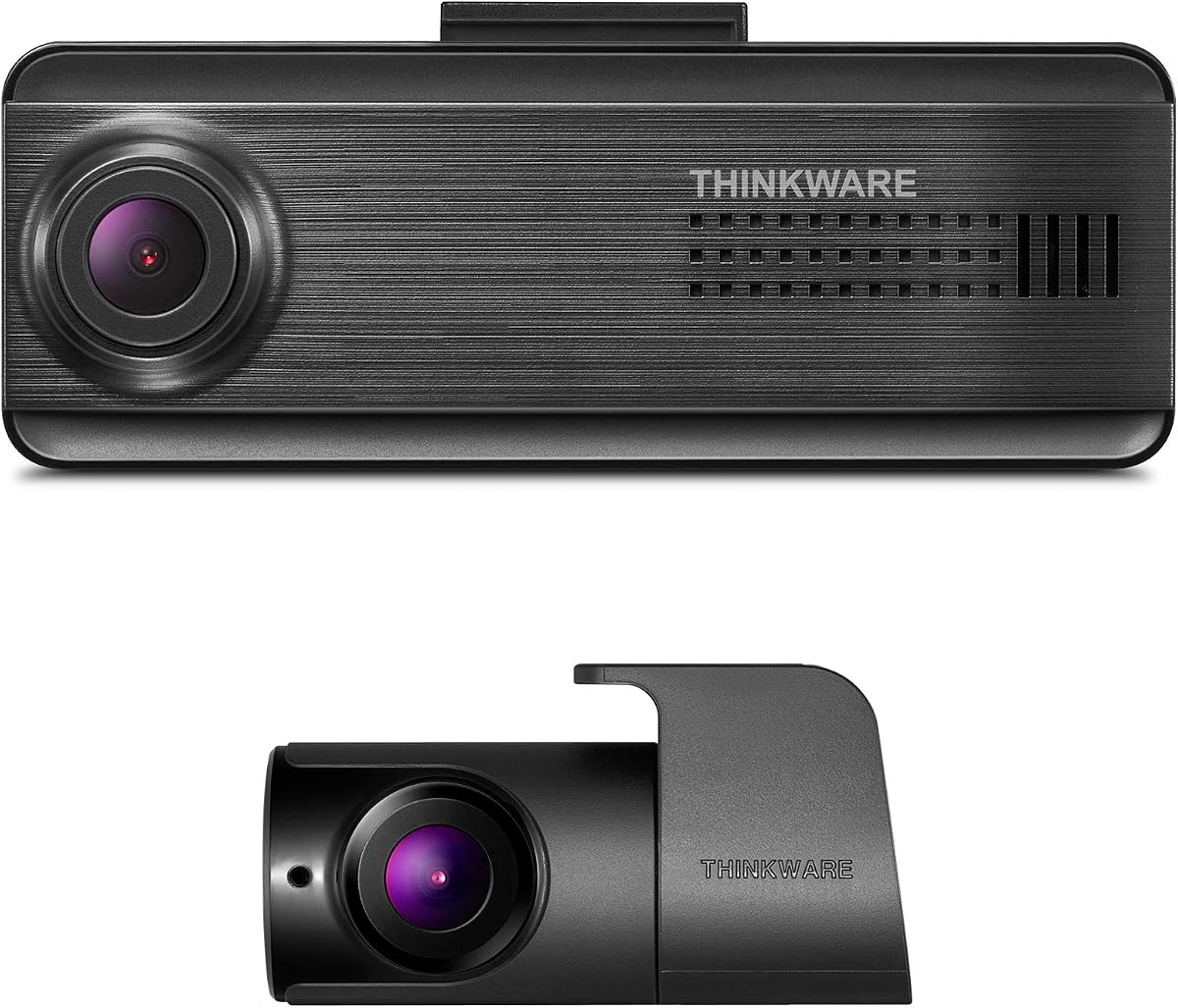
The ROVE R2-4K Dual Dash Cam Front and Rear has a 4.4 rating and brings a generous 128GB card, built-in GPS, a three-inch IPS display, and dual-band Wi-Fi. It is a strong alternative to the premium Thinkware systems for value-conscious buyers.
We may earn a commission when you buy through this link, at no additional cost to you.
Its front camera records 2.5K QHD and upscales to 4K for playback, while the rear camera records 1080p. Because the 4K output is upscaled rather than native, it should be considered a mixed-resolution system. The front Sony STARVIS 2 IMX675 sensor, F1.5 aperture, HDR, and Super Night Vision support better low-light detail.
Dual-band Wi-Fi can deliver downloads at up to 20MB/s through the ROVE app, a useful advantage when retrieving large files. Built-in GPS displays speed and compass direction and stamps routes, locations, and speed onto recordings. The app also provides settings management and over-the-air firmware updates.
Parking options include time lapse, motion detection, and collision detection, with one-minute event recordings, although a hardwire kit must be added separately. This is the best budget-oriented pick for buyers who value storage, fast transfers, and front-and-rear coverage more than native 4K.
The included 128GB card removes the need for an immediate additional purchase, and support for larger cards extends future flexibility. Fast dual-band Wi-Fi makes it easier to move recordings to a phone without leaving the vehicle.
The front camera's 4K playback mode is upscaled from 2.5K QHD, so it is not equivalent to native 4K. It can still present a sharp-looking image, but buyers should judge the stated source resolution when comparing it with true 4K models.
We may earn a commission when you buy through this link, at no additional cost to you.
The THINKWARE U3000 4K Dash Cam Front is a high-resolution forward-facing option with a 4.0 rating. It combines 4K recording, Sony STARVIS 2 sensing, radar parking capability, GPS, WDR, Wi-Fi, and Bluetooth for drivers who prioritize the view ahead.
We may earn a commission when you buy through this link, at no additional cost to you.
The STARVIS 2 sensor is suited to low-light recording, where smaller amounts of captured light can challenge conventional dash cameras. WDR helps balance bright and dark portions of a scene, while the GPS antenna records speed and time and enables red-light and speed-camera alerts.
Bluetooth pairing through the Thinkware Link App provides quick access to recent videos and settings. The THINKWARE CONNECTED App can also support live remote viewing and impact notifications when an internet connection and compatible cellular service are available.
The front-focused format is best for drivers seeking detailed road evidence without a rear camera. Radar parking is useful for unattended monitoring, but remote access is not a completely standalone feature because connectivity requirements apply. Buyers wanting dual coverage should compare the dual-camera U3000 configuration.
Combining 4K resolution with a STARVIS 2 sensor creates a strong foundation for both daytime and nighttime evidence. WDR further improves the camera's ability to retain information when bright and dark areas appear together.
Radar adds another method for monitoring activity while parked, while GPS supports location-based alerts. Local Bluetooth and Wi-Fi functions work alongside optional remote access, giving the system flexibility for different ownership routines.
We may earn a commission when you buy through this link, at no additional cost to you.
The most useful dash cam balances image detail, low-light performance, reliable event capture, convenient power, and realistic storage needs. Comparing these factors by driving and parking habits produces a better match than choosing on resolution alone.
A front-only camera is simpler to install and can keep the windshield less cluttered, but it cannot show what happens behind the vehicle. Front-and-rear systems provide more complete evidence for parking incidents, rear-end collisions, and unexpected lane changes. If another vehicle approaches from behind while the car is stopped at a light, rear coverage can materially change the available context.
Choose dual cameras if the vehicle spends time parked in public areas, carries passengers who may need proof after an incident, or regularly travels in heavy traffic. Select a single camera when simplicity, a smaller footprint, and forward-facing road evidence are the main priorities.
Resolution determines how much fine detail the sensor can preserve, while frame rate influences how fluid moving vehicles appear. The models here range from 1080p to native 4K front recording, with some offering 2K at higher frame rates. A 4K image can make distant signs and vehicles more useful for review, but it also creates larger files that demand compatible high-endurance storage.
Do not treat every 4K label as equivalent. The ROVE R2-4K DUAL explicitly uses upscaled 4K output from a 2.5K source, while the ARC800 and ARC900 provide 4K UHD front capture. Match the actual recording mode, frame rate, and storage capacity to your need for detail.
Night capability depends on more than the resolution printed on the box. Sony STARVIS sensors, wide apertures, HDR processing, and dedicated night-vision features can preserve useful detail when headlights, streetlights, and reflective signs create extreme brightness differences. Consider both forward driving footage and the lighting around a parked car.
Models with STARVIS 2, such as the ARC800, ARC900, U3000, and ROVE R2-4K DUAL, deserve particular attention for nighttime use. Super Night Vision and WDR can further balance images, although actual clarity also depends on lens quality, windshield reflections, mounting position, and the scene itself.
Parking surveillance can include continuous recording, motion activation, impact detection, time lapse, energy saving, and buffered radar detection. No single mode suits every situation. Continuous recording is comprehensive but consumes more storage, while motion or radar activation can extend coverage by recording only when activity is detected.
A hardwire connection is normally required for extended parking operation. Some packages include the hardwire kit, while the ROVE R2-4K DUAL requires one to be added, and the U3000 radar mode can use hardwiring or the included OBD-II cable. Confirm parking-mode compatibility with the power method and your vehicle.
Dash cam footage is only useful if it remains accessible after an incident. Check the maximum supported microSD capacity, included card size, loop-recording behavior, event locking, and anti-file corruption features. The ARC800 supports cards up to 512GB, while the ROVE R2-4K DUAL supports up to 1TB and includes a 128GB card.
Use a compatible high-endurance microSD card and format it according to the manufacturer's instructions. More storage is especially valuable for continuous or parking-mode recording. Supercapacitors and thermal protection also matter because a vehicle interior can become extremely hot and cold during seasonal use.
Wi-Fi makes it convenient to preview, download, and manage footage from a phone, while Bluetooth simplifies initial pairing. The Thinkware Link and DashCamLink apps serve different model families, and the THINKWARE CONNECTED App supports remote functions on compatible U3000 systems. App naming alone should not be used to assume every feature is shared across models.
Remote access is not necessarily included with every dash cam. The ARC900 can use an optional LTE module, but it also requires the specified firmware. The U3000's remote viewing requires an internet connection and may involve carrier service. Check hardware, software, subscription, and network requirements before selecting a model for remote monitoring.
GPS can stamp speed, time, and location into recordings, adding context that can be valuable when reviewing a journey. It can also support speed-camera and red-light-camera notifications. Some systems use an integrated or external antenna, while others include a separate GPS cradle, so verify whether the necessary component is in the box.
ADAS features such as front vehicle departure, traffic light change, lane departure, collision warnings, and front vehicle movement alerts can improve situational awareness. They are assistance tools rather than substitutes for attention. Consider whether audible prompts are useful to you and whether they can be adjusted or disabled.
A built-in touchscreen makes immediate playback and adjustment easier, while a smaller or screenless design encourages phone-based operation. The ARC900 has a 3.5-inch display, the ARC has a 2.7-inch display, the ARC800 has a 2.3-inch display, and the ROVE includes a three-inch IPS screen. Larger screens are convenient but can obscure more of the windshield.
Wide viewing angles help capture adjacent lanes, but extremely wide lenses may introduce edge distortion. Mount the camera behind the rear-view mirror where it does not block sightlines, clean the glass thoroughly, and route cables away from airbags and driver sightlines. Professional installation may be worthwhile for complex hardwired systems.
Begin by reading the model's manual and confirming that the dash cam, memory card, power source, and mounting hardware are compatible. Wash and dry the windshield, choose a location behind the rear-view mirror, and keep the lens clear of stickers, tint, grime, and reflections. Mount the camera securely without blocking the driver or passenger's view.
Format a compatible high-endurance microSD card in the dash cam, install it according to the device instructions, and set the correct date and time. Connect to the appropriate app, complete any firmware update, and adjust resolution, exposure, GPS, parking, and alert preferences. Test both continuous and event recording before relying on the system for evidence.
For parking surveillance, use the specified hardwire or OBD installation method and confirm the parking mode is active. Review footage regularly, check that event clips are being saved, and maintain the lens and card contacts. Remove the device before selling the car, and replace or reformat the memory card if the system reports errors, corrupted files, or repeated recording failures.
No. A 4K camera can preserve finer detail, but a good 1080p model may still provide adequate evidence and use less storage. Resolution should be considered alongside sensor quality, lens performance, HDR, night vision, frame rate, and whether the stated 4K mode is native or upscaled.
It depends on where you park and what evidence you want. A front-and-rear system captures the road ahead and activity behind the vehicle, which can be useful for parking incidents and multi-vehicle collisions. A front-only model is simpler, smaller, and often sufficient for drivers mainly interested in the road ahead.
Yes, supported models offer parking functions such as continuous recording, motion detection, impact detection, time lapse, energy saving, or radar buffering. Most require a hardwired power connection, and the ROVE R2-4K DUAL requires a hardwire kit that is not included. The U3000 radar mode can use hardwiring or the included OBD-II cable.
Wi-Fi features such as nearby preview, file downloads, and settings management generally work through a local connection between the dash cam and phone. Remote live viewing and impact notifications are different: compatible systems need LTE hardware or an active cellular connection, and carrier charges may apply.
Use a compatible high-endurance microSD card with sufficient capacity for the model's supported formats. Check the manual for capacity, speed-class, and formatting requirements. Regular use of continuous or parking recording can fill a card quickly, so maintain a backup and inspect the card for damage or read errors.
No. A dash cam can provide objective video evidence, but acceptance depends on the situation, jurisdiction, insurer, video quality, timestamps, and whether the recording is authentic and properly preserved. Install the camera correctly, keep the lens clean, and retain the original event file rather than only a compressed copy.
No. ADAS and speed or red-light camera alerts are supplementary aids and can produce false positives or miss events. They may also require GPS reception, map-data availability, a correctly configured system, and a current app database. Drivers must continue paying attention and follow traffic laws.
A touchscreen is convenient for quick playback and on-device adjustments, while an app-controlled camera is usually simpler physically and keeps the dashboard uncluttered. Consider how often you expect to review footage, whether you prefer physical controls, and whether your phone will be readily available when the vehicle is parked.
The THINKWARE ARC800 is the strongest all-around recommendation because it combines a 4K front camera, 2K front option at 60fps, a 1080p rear camera, STARVIS 2 low-light technology, GPS, Wi-Fi, a touchscreen, and extensive parking modes. The ARC900 is the premium choice for buyers prioritizing dual STARVIS 2 sensors, a larger display, and optional LTE remote access.
For value, the ROVE R2-4K DUAL stands out with its included 128GB card, dual-band Wi-Fi, built-in GPS, and mixed-resolution front-and-rear coverage. Buyers prioritizing matched QHD recording may prefer the original ARC, while the U3000 leads the list for radar-buffered parking and broader remote monitoring options. Match the system to your coverage, storage, power, and connectivity needs.
Before buying, verify the camera configuration, included accessories, storage limits, parking-mode requirements, and app compatibility for the exact model. Product listings, firmware, optional modules, and prices can change, so check the current Amazon page and Thinkware support information before making a final purchase.