
StarTech 8-Outlet 1U PDU
4.8Editor score
Eight NEMA 5-15 outlets
19-inch horizontal rack fit
Circuit breaker and surge protection
Discover the best Rack Pdu for Server Power Distribution, with 10 expert picks compared for outlet count, mounting, surge protection, cord length, and rack fit.
A rack PDU for server power distribution is the centralized backbone that keeps network and computing equipment connected, organized, and protected within a cabinet. The right model should fit the rack correctly, provide enough NEMA outlets, accommodate the available current, and route power cords without obstructing maintenance access.
This guide compares ten rackmount PDUs across outlet quantity, outlet orientation, mounting options, cord length, housing material, circuit-breaker design, and surge protection. It includes conventional 19-inch models for full server racks, horizontal 1U strips, compact 10-inch units for mini racks, and basic versus surge-protected designs.
Each selection below highlights the strongest use case for a particular rack configuration, from straightforward office installations to dense network cabinets. Ratings reflect the supplied customer feedback, while specifications and limitations come directly from the listed product information. Prices and availability can change, so confirm current listings before purchasing.
4.8Editor score

4.8Editor score

5.0Editor score
The table below compares all ten PDUs by rack size, outlet capacity, electrical features, and installation details, making it easier to identify the right model for a server cabinet, network closet, or mini-rack deployment.


The StarTech RKPW081915 is an eight-outlet, 1U horizontal PDU with a 4.8 customer rating. It is aimed at users who want clean, dependable rack power without filling the enclosure with unnecessary outlets. Its NEMA 5-15 configuration, 120V/15A rating, and six-foot cord suit standard North American server and network-rack installations.
We may earn a commission when you buy through this link, at no additional cost to you.
The strongest qualities are its practical outlet count and integrated protection. A built-in circuit breaker and reset switch help guard connected equipment against overload conditions, while the product is described as including surge protection. LED indicators provide visible information for ground and surge status, reducing the need to inspect the unit during routine checks.
Its rugged steel chassis also makes it feel appropriately suited to an equipment rack rather than a lightweight household power strip. The six-foot attached cord leaves room to position the rack while maintaining a relatively compact installation. The main limitation is capacity: eight outlets may be insufficient for a densely populated cabinet, and the listed design emphasizes horizontal rather than multidirectional mounting.
This is a strong recommendation for a lightly populated 19-inch rack that needs eight outlets, reliable breaker protection, and straightforward 1U installation. Buy it when simplicity and rack fit matter more than maximum outlet density. For larger cabinets, a model with more front and rear connections may reduce the need for power strips and extension leads.
The circuit breaker, reset switch, surge protection, and status LEDs give this small PDU more protection features than a basic power strip. That combination is useful in network closets where unexpected power conditions and quick maintenance checks are important.
The horizontal 1U format fits compatible 19-inch racks at least four inches deep and follows ANSI/EIA RS-310-D mounting standards. A rack administrator can therefore install it without occupying multiple rack units.
We may earn a commission when you buy through this link, at no additional cost to you.
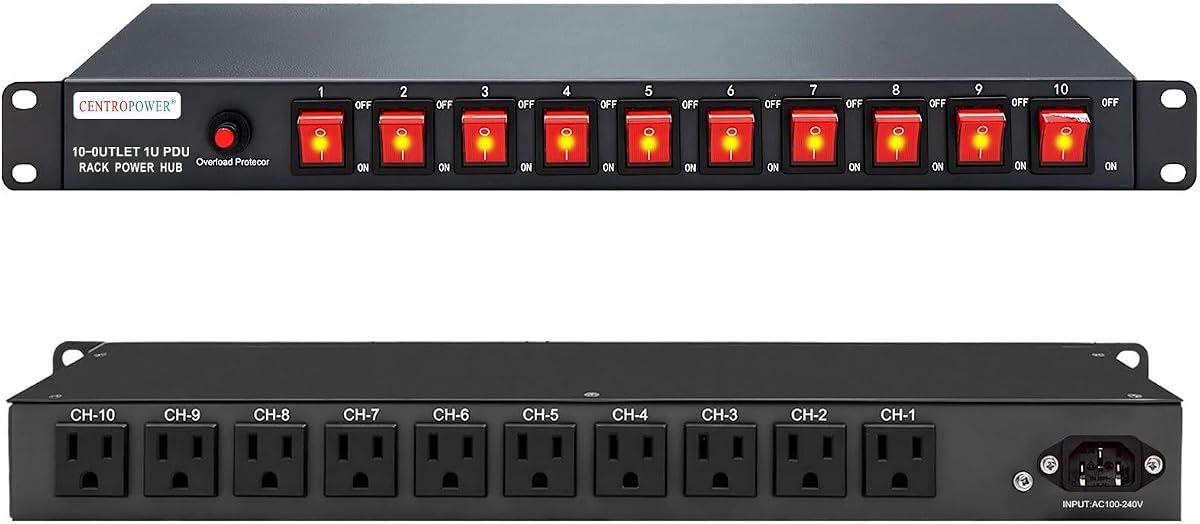
This ten-outlet horizontal rack PDU provides a 4.4 rating and offers a different approach to outlet management: every NEMA 5-15 outlet has an independent LED-illuminated switch. That makes it easier to isolate equipment during maintenance or power down an individual device without disturbing the rest of the rack.
We may earn a commission when you buy through this link, at no additional cost to you.
Its construction emphasizes durability. The description specifies fireproofed housing, industrial-grade metal, pure copper wiring, and a cord retention tray. A built-in circuit breaker and reset switch provide overcurrent protection, while the integrated six-foot cord offers flexibility when installing the strip in compatible 19-inch racks at least four inches deep.
The trade-off is that this model does not lead on customer rating, and its six-foot cord may be shorter than the fifteen-foot cords offered by the CyberPower models. It is also a single-orientation horizontal design, so cable access may be less convenient in installations where front and rear outlets are both needed.
Choose this PDU when individual outlet switching is a priority and you want ten outlets in one rack unit. It is especially attractive for administrators who value a retention tray and rugged housing. Buyers with dense equipment should verify that the six-foot cord can reach the nearest protected wall outlet and that rear cable routing suits the cabinet.
Each outlet has its own illuminated switch, making it easier to control individual devices. This is useful during installation, troubleshooting, and routine shutdowns because equipment can be disconnected one connection at a time.
The resettable circuit breaker protects the distribution circuit, while the cord retention tray helps keep the attached six-foot lead organized. Together, they support a cleaner and more serviceable rack interior.
We may earn a commission when you buy through this link, at no additional cost to you.
The CyberPower CPS1215RMS is a 12-outlet rackmount surge protector with a 4.8 rating. Six outlets face the front and six face the rear, giving technicians access from both sides while supporting more equipment than a conventional eight-outlet strip. It is a versatile option for data centers, network closets, and VoIP systems.
We may earn a commission when you buy through this link, at no additional cost to you.
Installation flexibility is one of its strongest features. The unit can be mounted vertically or horizontally, so it can serve a full-height cabinet, a two-post rack, or a shallow network enclosure. Its long 15-foot NEMA 5-15P cord provides extra reach from distant wall outlets, and the cord retention tray helps prevent accidental disconnection.
Network-grade plugs and receptacles plus an industrial-grade metal housing reinforce its suitability for professional environments. The three-year limited warranty adds reassurance. However, unlike the StarTech models in this list, it does not advertise individually switched outlets, so controlling one device without affecting the entire PDU may not be possible.
This is our editor's choice for buyers who need a balanced combination of outlet capacity, mounting flexibility, and reach. It is especially well suited to racks where front and rear access both matter. Choose it for dependable general-purpose power distribution with surge protection; choose a switched model instead if device-level isolation is a daily requirement.
The split layout places six outlets on the front and six on the rear. This improves service access and lets administrators organize connections according to whether they support front-panel equipment, rear-mounted servers, or network hardware.
Vertical and horizontal mounting make the PDU useful across different rack designs. Its 15-foot cord also reduces the need for extension cords when the cabinet stands farther from a wall receptacle.
We may earn a commission when you buy through this link, at no additional cost to you.
The StarTech 1315B8H-RACK-PDU combines 13 outlets in one rack unit, with 12 facing the rear and one facing the front. Its 4.5 rating reflects a generally positive reception, while the rear-heavy layout is designed for installations where most equipment cords connect behind mounted servers and switches.
We may earn a commission when you buy through this link, at no additional cost to you.
Its 8-foot cord gives administrators more placement flexibility than a six-foot lead, while the included four-way brackets permit horizontal or vertical mounting in EIA-310 19-inch racks or cabinets deeper than four inches. The rugged SPCC steel housing has a powder-coated finish for a professional, durable enclosure.
A user-resettable 15A breaker supplies overload protection, making the unit more appropriate than an unprotected strip for connected IT equipment. The compromise is outlet arrangement: having only one front outlet may be inconvenient if technicians need frequent access to a front-facing device. The supplied information also does not state a specific surge-energy rating.
Buy this model when rear connections dominate and you want 13 outlets without using more than one rack unit. It is a good match for offices, small server rooms, AV racks, and small-to-mid-sized IT environments. Those prioritizing immediate front access should compare it with a model offering a more balanced front-and-rear outlet split.
The high rear outlet count supports servers, switches, and other equipment whose power cords run into the back of a cabinet. The single front outlet remains available for a temporary or frequently serviced connection.
Included four-way brackets support horizontal and vertical positioning. This expands installation options beyond a conventional fixed-orientation power strip while preserving a single-unit footprint.
We may earn a commission when you buy through this link, at no additional cost to you.
The CyberPower CPS1215RM is a basic 10-outlet rack PDU with a 4.8 rating. It delivers 100-125V/15A power to data centers, network closets, and other electrically demanding applications, but it deliberately omits surge suppression. That makes it a functional alternative for environments where upstream surge protection is already provided.
We may earn a commission when you buy through this link, at no additional cost to you.
All ten NEMA 5-15R outlets are positioned on the rear, where equipment power cords typically connect. The unit can be mounted vertically or horizontally, and its long 15-foot cord can bridge the distance from a distant wall receptacle. Network-grade plugs and outlets, a durable metal housing, and a cord retention tray support dependable everyday use.
Its clearest limitation is the absence of surge suppression, as explicitly stated in the product information. It also lacks individual outlet switches, which means the connected group may be controlled together. Users with valuable or sensitive equipment should ensure their UPS or other protective power device is properly configured upstream.
This PDU is best for straightforward distribution in a well-managed rack where surge protection is already handled elsewhere. Choose it for its long cord, strong rating, flexible orientation, and ten rear outlets. It is less appropriate as a standalone surge solution for an unprotected wall circuit or for users who want to isolate individual devices.
The all-rear layout concentrates the connection points behind mounted equipment. That arrangement can produce a cleaner cabinet front and makes server power cables easier to reach during maintenance.
Because this model does not include surge suppression, it works best when the circuit already passes through suitable protection. That focused design avoids paying for features a protected installation may not need.
We may earn a commission when you buy through this link, at no additional cost to you.
The VEVOR 8-Outlet Horizontal 1U PDU combines a 4.6 rating with clearly stated protection specifications. It supports 110-125V/15A loads and provides eight NEMA 5-15 outlets in a standard 19-inch horizontal format, making it suitable for network and server racks with moderate equipment density.
We may earn a commission when you buy through this link, at no additional cost to you.
Its standout electrical feature is the 1,800-joule surge protector, supplemented by overload and lightning protection. An external resettable breaker can cut power during an overload or short circuit without requiring the entire unit to be removed from service. Thickened copper wire cores support conductivity, while the integrated switch provides a central control point.
The reinforced metal casing is described as fire-resistant, adding physical protection beyond that of a household power strip. Installation is simplified by included screws, and the 6-foot 14/3 AWG cord provides flexibility for light pulls. Its limitations are modest: eight outlets may not serve a growing cabinet, and the shorter cord may be less convenient than a 15-foot model.
Choose this PDU when you want a clearly defined surge rating, an accessible external breaker, and a rugged 1U housing without moving to a larger multi-outlet model. It is a sensible option for network racks and compact server installations that already have an upstream UPS or surge-protected circuit.
The stated 1,800-joule rating provides a concrete indicator of the PDU's surge-protection capability. This is useful for buyers who want more than a general surge-protection claim when planning a rack installation.
An external resettable breaker can be operated without dismantling the rack. After removing the fault or reducing the connected load, resetting the breaker is more convenient than replacing the entire PDU.
We may earn a commission when you buy through this link, at no additional cost to you.
This 10-inch rack PDU is designed for mini-racks and half-rack cabinets rather than standard 19-inch enclosures. It provides six NEMA 5-15 outlets, divided between two front and four rear positions, and carries a 4.5 customer rating. Its 125V/15A specification suits standard North American power distribution.
We may earn a commission when you buy through this link, at no additional cost to you.
The unit includes a 1,020-joule surge suppressor, overload and reset switches, and two USB-A ports. The USB connections can be useful for charging or powering compatible low-voltage accessories, although the core function remains AC power distribution. Its industrial-grade metal housing and impact-resistant casing are intended to withstand the handling associated with network cabinets and enclosures.
Its most important advantage is dimensional: the horizontal 10-inch design fits compact mini racks and can also act as a spacer. That creates a dedicated power location in installations where a full-width 19-inch PDU would be incompatible. The trade-offs are a six-outlet limit and the inability to use it in a conventional server rack.
Buy this model for a 10-inch mini rack with only a handful of devices. Its combination of front access, rear connections, surge protection, and USB charging makes it unusually useful in a small cabinet. Before purchasing, verify that the rack accepts 10-inch equipment and that six outlets will meet both current and future connection needs.
Many small network cabinets cannot accept a full-width rack PDU. This unit fits a 10-inch mini rack in one horizontal rack unit and can also provide useful spacing within a compact enclosure.
The 1,020-joule surge suppressor and resettable overload switch protect the distribution function. Two USB-A ports add a convenient charging option without changing the core rack-power design.
We may earn a commission when you buy through this link, at no additional cost to you.
The 10-Inch Eight-Outlet Rack PDU provides 125V/15A power with a stated 1,875-watt maximum. It is designed for 6U-or-larger mini server racks and has a 4.4 rating. Eight rear outlets give it more connection capacity than most compact alternatives while preserving a front-facing control switch.
We may earn a commission when you buy through this link, at no additional cost to you.
Its main organizational benefit is the clean-cabinet layout: the outlets and plugs sit at the rear while the switch is positioned at the front. This keeps the front face uncluttered and provides a straightforward place to view or operate the overload control. The aluminum alloy housing is also described as rugged and long lasting.
A six-foot cord offers flexible placement for many cabinets, though administrators should check available depth and wall-outlet distance. The product information specifically warns that the eight rear extension cords take up extra room. Consequently, it is best for 6U-plus mini racks with adequate internal clearance rather than shallow or tightly packed enclosures.
Choose this PDU when you need more than six connections in a compact rack and value a clean front panel. It is a strong match for small network cabinets and mini server racks with sufficient rear space. Buyers should measure the cabinet interior before ordering, especially if it already contains deep power supplies, cable managers, or storage accessories.
Eight outlets give this mini-rack PDU greater expansion room than smaller six-outlet designs. The result is a more practical connection count for a cabinet containing several networked or computing devices.
All outlets are located at the rear, which supports a tidy appearance but consumes internal depth. The product is specifically recommended for 6U-plus racks with adequate clearance, so cabinet dimensions deserve careful review.
We may earn a commission when you buy through this link, at no additional cost to you.
The StarTech 1415B8H-RACK-PDU-SP is a premium 14-outlet, 1U rack PDU with a 5.0 rating. It distributes 120V power through six front-facing and eight rear-facing NEMA 5-15 outlets, giving it one of the strongest combinations of capacity, balanced access, and surge protection in this roundup.
We may earn a commission when you buy through this link, at no additional cost to you.
Its 3,000-joule surge protection is the most prominent premium feature among the listed units. A user-resettable 15A breaker protects against overloads, while an illuminated power switch with a cover helps reduce accidental shutdowns. That combination makes the PDU well suited to connected IT, AV, edge, and on-premises equipment.
The included four-way brackets allow horizontal or vertical installation on EIA-310 19-inch racks and cabinets deeper than four inches. A rugged, powder-coated SPCC steel housing supports long-term durability, and the 8-foot cord provides good reach. As with any high-density strip, front and rear plug bundles can require deliberate cable management in a shallow cabinet.
This is our premium recommendation for buyers who want substantial outlet capacity and a high stated surge-protection rating without moving beyond one rack unit. Choose it for a moderately to densely equipped 19-inch rack where balanced front-and-rear access matters. Ensure the cabinet has adequate depth and cable-management space before installation.
The 3,000-joule surge rating exceeds the clearly stated figures of the other surge-protected options in this list. It is a meaningful feature for racks containing network, server, AV, or other sensitive electronics.
Six front outlets support quick service access, while eight rear outlets handle routine equipment connections. The covered illuminated switch offers a clear power state while reducing the likelihood of an unintended press.
We may earn a commission when you buy through this link, at no additional cost to you.
The StarTech RKPW161915 delivers 16 NEMA 5-15 outlets in a single rack unit, making it the highest-capacity conventional 19-inch model listed. It has a 4.6 rating and divides the outlets evenly for service purposes: six on the front and ten on the rear.
We may earn a commission when you buy through this link, at no additional cost to you.
The 120V/15A PDU includes surge protection, a built-in circuit breaker, and LED indicators for ground and surge detection. Its steel chassis provides the durability expected in network and data-center racks, while ANSI/EIA RS-310-D standards and horizontal 1U installation simplify compatibility planning.
The 16-outlet count is useful for racks with numerous low-to-moderate-load devices, but the attached six-foot cord can be a limitation when the rack is positioned farther from a wall receptacle. Dense front and rear cord bundles also need careful routing to preserve airflow and access to other components.
Buy this model when maximum outlet density in one rack unit is more important than cord length. It fits compatible 19-inch racks at least four inches deep, including common two-post and four-post network racks. For cabinets positioned farther from a power receptacle, a longer-cord alternative may be more convenient despite having fewer outlets.
This model provides the largest outlet count in the roundup without expanding beyond 1U. It is particularly useful in small racks where several servers, switches, and ancillary devices still need dedicated connections.
LED indicators make surge and ground status visible at a glance. The built-in circuit breaker adds overload protection, giving the unit more safeguards than a basic distribution strip.
We may earn a commission when you buy through this link, at no additional cost to you.
Selecting a rack PDU requires matching the physical rack, expected equipment count, electrical protection, and maintenance workflow. The most important decision is not simply choosing the largest outlet count; it is finding a unit whose dimensions, connector layout, and power cord work cleanly within the intended cabinet.
Most full server racks use the 19-inch mounting standard, but compact network cabinets may use 10-inch equipment. Full-width options in this roundup fit compatible 19-inch racks or cabinets at least four inches deep, while the two compact PDUs are intended for 10-inch mini racks. The 10-inch eight-outlet model is specifically recommended for 6U-or-larger mini racks with adequate internal clearance.
Measure the cabinet width, available rack-unit space, and depth before buying. Also consider the depth of connected plugs and the space required by cable managers. A model that technically fits may still make maintenance difficult if its cords consume the remaining clearance.
Outlet requirements vary with the number of devices and whether each needs a dedicated receptacle. The listed range extends from six outlets on a 10-inch PDU to sixteen on the full-width StarTech model. Layout matters almost as much as total count: front outlets are convenient for quick access, while rear outlets are better for routine server connections.
Choose a model that provides enough capacity for current equipment plus reasonable expansion. Avoid buying so many outlets that the rack becomes crowded with unused plugs and tangled cords. A balanced front-and-rear layout usually offers the best balance of serviceability and appearance.
Most products here are designed for standard North American 100-125V or 120V service at a maximum current of 15A. The ten-outlet unit also lists AC 100-240V input compatibility, but connected equipment must still have compatible power requirements. A PDU's maximum current is a limit for the entire connected load, not a guarantee that every outlet can independently deliver the maximum.
Calculate the combined draw of all connected equipment and include headroom for future devices. Do not use a receptacle for a load above its rating. If the cabinet contains multiple high-power systems, consider how power will be divided across circuits and whether a separate UPS or higher-capacity distribution solution is required.
A circuit breaker protects against excessive current, while surge suppression is intended to absorb transient voltage spikes. Not every basic PDU includes surge protection, as shown by the CyberPower CPS1215RM, which explicitly omits that feature. Other models specify surge capacities of 1,020 joules, 1,800 joules, or 3,000 joules.
For sensitive equipment, confirm that both circuit-breaker and surge protection are present. Also consider whether a UPS already handles surge suppression. The important distinction is that an overload breaker and a surge suppressor address different electrical risks, so one should not be assumed to replace the other.
Attached cord length can determine whether a PDU reaches a nearby wall outlet without an extension. Six-foot leads are common among the compact and lower-capacity models, while the CyberPower models include 15-foot cords and the higher-capacity StarTech models use eight-foot cords. The longer cord is helpful when the rack sits farther from a receptacle.
Plan the route before installation and avoid creating a trip hazard or a tightly bent cord. Longer power cords can make rack relocation easier but may need more management space. Always follow the manufacturer's handling and placement instructions and verify that the plug and rack do not interfere with doors or neighboring equipment.
Most full-width products are horizontal 1U strips, which is standard for server cabinets. Several models support vertical or horizontal mounting, giving administrators more freedom when working with two-post racks, wall cabinets, or unusual rack geometries. The StarTech 13- and 14-outlet models include four-way brackets for multiple orientations.
Check whether the bracket orientation changes outlet access. A vertically mounted PDU may place outlets in a less intuitive direction, while horizontal installation is generally easier for horizontal power leads. Ensure any selected model includes the hardware and clearances required by the cabinet.
The ten-outlet horizontal PDU offers independent illuminated switches for each receptacle, allowing device-level control. Most other models provide a main switch or central power control instead. Neither approach is universally superior: individual switching improves troubleshooting, while centralized control simplifies orderly shutdown of the entire PDU.
These are conventional PDUs without remote monitoring in the supplied specifications. Users who need power telemetry, network management, or automatic outlet control should verify that requirement separately rather than assuming a basic rack strip provides it.
Steel, fire-resistant metal, and aluminum alloy housings are available among the selections. Rugged construction is especially valuable in network closets and data-center environments where equipment may be moved, serviced, or exposed to incidental impact. A cord retention tray also helps keep the attached power lead positioned and reduces stress at the connection.
Look beyond the enclosure material to the practical details that affect maintenance. Included mounting screws, covered switches, front and rear access, and a compact footprint can matter more during routine work. The densest outlet models need careful planning to avoid crowding the front of the cabinet.
Begin by confirming that the PDU matches the rack width, depth, voltage, current, and outlet standard. Mount it securely in the intended orientation, verify that rack ears or brackets are properly fastened, and check that connected plugs do not obstruct doors, airflow, or nearby equipment. Connect the PDU to a suitable grounded circuit before energizing equipment.
Organize connections deliberately. Use front outlets for devices that require frequent service and rear outlets for standard equipment leads. Route cords through managers, avoid sharp bends, and leave enough slack for removal without dragging adjacent connections. Do not exceed the PDU's aggregate current rating or connect loads above the rating of any individual receptacle.
Inspect indicators, switches, plugs, and cables during routine maintenance. If the breaker trips, disconnect the output loads and identify the cause before resetting it. For voltage events or abnormal behavior, stop using affected equipment and consult qualified electrical or IT support. Keep the housing dry, vents unobstructed, and the unit properly grounded.
A basic PDU primarily distributes multiple AC outlets from one input connection and usually relies on an upstream circuit breaker for overload protection. A surge-protected rack PDU adds circuitry intended to absorb transient voltage spikes. Protection features vary by model, so check the specifications rather than assuming every rack strip provides surge suppression.
A 15A PDU can power many server and network configurations, but suitability depends on the combined current draw of every connected device. The rating applies to the PDU's total output, and some equipment may require a dedicated circuit. Calculate the expected load, include expansion headroom, and follow the server manufacturer's power guidance.
Choose a 19-inch PDU for a standard server rack, network rack, or cabinet designed around full-width equipment. A 10-inch PDU is intended for compact mini racks and half-rack enclosures. The ten-inch models in this guide provide fewer outlets, so verify both the rack dimensions and expected equipment count before ordering.
Front outlets provide quick access for devices that may need frequent service, while rear outlets simplify connections to servers and equipment mounted deeper in a cabinet. A split layout can also reduce visible cable clutter. The best balance depends on the rack design and how technicians routinely access its components.
It depends on the UPS model and the protection already present in the installation. A UPS can provide some transient-voltage protection, but not every unit combines battery backup with comprehensive surge suppression. Review the equipment specifications and confirm that the full power path has suitable protection for connected systems.
Leave enough room for plugs, cable bends, rack doors, and service access. Compact cabinets may be especially constrained because eight rear cords can occupy considerable depth. Measure the available interior and review the PDU's space requirements before installing it, especially in 10-inch mini racks.
No. Only models whose specifications explicitly permit vertical installation should be mounted that way. The CyberPower CPS1215RMS and CPS1215RM support vertical or horizontal mounting, while the StarTech 13- and 14-outlet models include four-way brackets for multiple orientations. Other units may be designed exclusively for horizontal 1U placement.
First disconnect the connected output loads and determine why protection activated. For models with an external or front-mounted reset control, restore the switch only after the fault or excess load has been removed. One listed model specifically instructs users to unplug rear output plugs and manually reset its overcurrent protection before use.
The strongest general-purpose choice is the CyberPower CPS1215RMS because its 12 front-and-rear outlets, flexible mounting, long cord, and 4.8 rating cover many rack configurations. The StarTech eight-outlet model stands out as a compact, well-reviewed option, while the 14-outlet StarTech surge PDU provides the highest customer rating and the strongest stated surge capacity.
Prioritize exact rack fit before outlet count. A 19-inch PDU will not suit every server cabinet, and 10-inch mini-rack users need a physically compatible unit with enough depth for plugs. Next, compare outlet orientation, cord length, overload protection, surge suppression, and mounting orientation according to the equipment and maintenance routine.
Current ratings and specifications are useful comparisons, but product availability and prices change. Before purchasing, confirm the model details, outlet requirements, electrical rating, rack dimensions, and current listing. Taking those final checks seriously helps avoid a mismatch that could lead to crowded cables, inaccessible connections, or an undersized power distribution solution.