
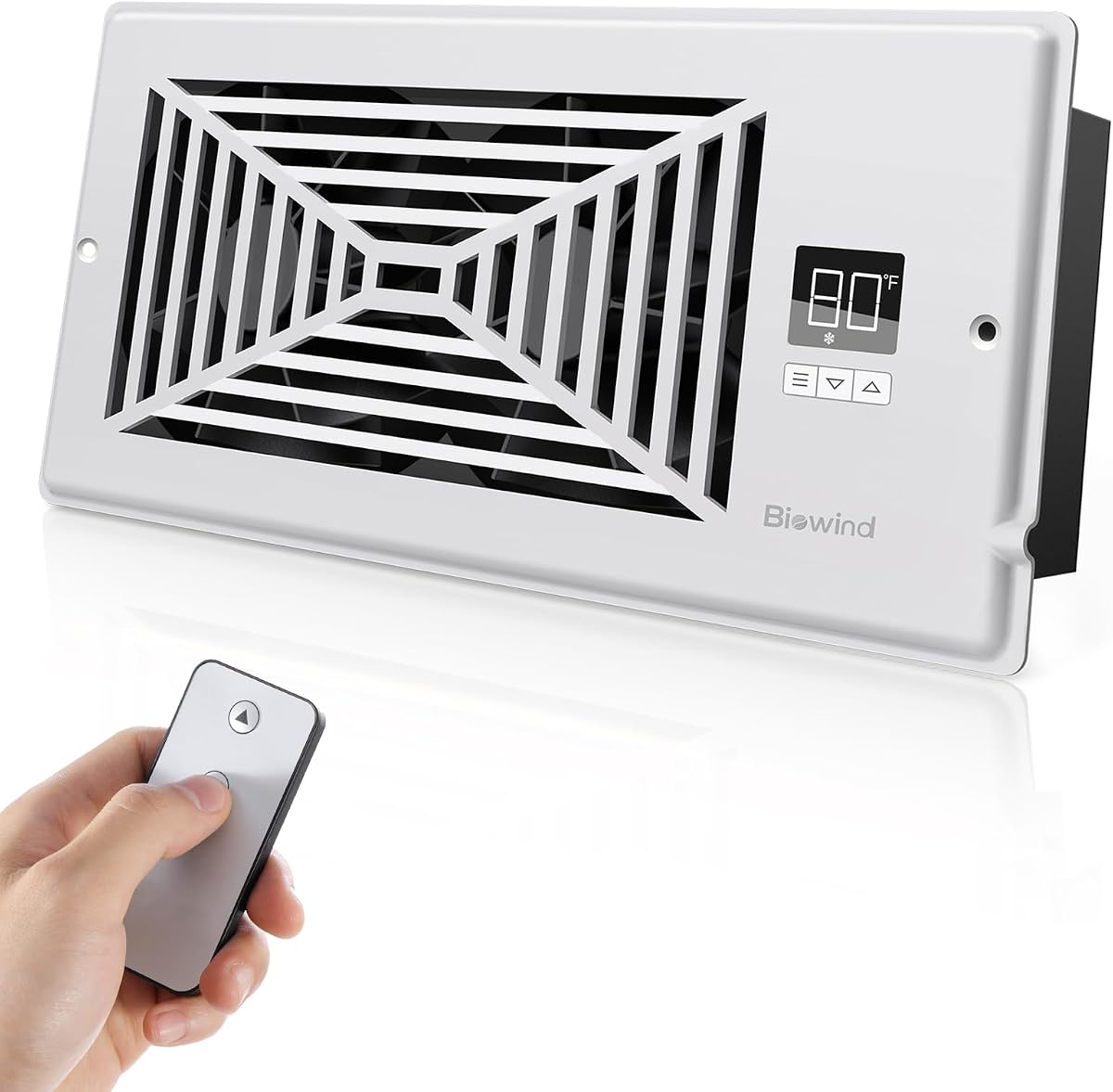
BIOWIND Quiet Smart Register Booster Fan 4×12
4.3Editor score
Six-watt rated power
Sixteen dBA noise rating
Ten-speed remote control
Automatic temperature response
Smart motorized HVAC register vents add room-level control to a central heating and cooling system by opening, closing, or boosting airflow in response to temperature readings and user commands. The best options pair accurate sensing with quiet motors, practical scheduling, reliable app or remote controls, and a fit for the register opening already in your home.
The products in this guide were compared using the information supplied for each model, including control methods, operating features, airflow ratings where available, noise levels, installation needs, and designated vent sizes. The list covers both room-by-room damper-style vents and powered register booster fans, giving readers several ways to address uneven temperatures.
Each review explains where a product stands out, where its requirements or specifications deserve a closer look, and whom it is best suited for. Product configurations and seller information can change, so confirm the current dimensions, compatibility, included accessories, and listing details before buying, as prices and availability also fluctuate.
4.3Editor score

4.3Editor score

3.8Editor score
As an Amazon Associate we earn from qualifying purchases.
The comparison below highlights each motorized vent's control style, sensing capability, physical installation, and fit requirements, helping you distinguish true room-control systems from smart register booster fans.


The Flair Smart Vent 4×12 is a motorized register cover designed to manage airflow at the room level rather than simply leaving a vent fully open. Its 3.8 rating reflects an established concept with specific ecosystem requirements. The strongest appeal is its integration with thermostat and temperature-sensor data, allowing the vent to open and close automatically as room conditions change.
We may earn a commission when you buy through this link, at no additional cost to you.
Installation is comparatively straightforward because the vent replaces an existing floor, wall, or ceiling register without drilling or wiring. Once the broader Flair system is configured, the hvacOS software supports individual seven-day schedules, remote management, and the ability to mark rooms inactive. It also works with an existing smart or traditional thermostat and supports voice-assistant control for compatible systems.
The principal trade-off is that this is not a standalone smart vent. A Flair Bridge is required but sold separately, and every room using a Flair Smart Vent also needs a temperature sensor. That can make a single-vent purchase less economical than a powered booster, but it also creates a more integrated system for homeowners committed to room-level automation across multiple rooms.
This model is best for someone who wants a central HVAC system to allocate heating and cooling between rooms rather than simply push more air into one space. It is especially relevant for households with long corridors, upper floors, or rooms that stay uncomfortable despite a central thermostat. Buyers should treat the complete Flair ecosystem, not just the register, as the deciding factor.
By reading smart thermostat and room-sensor information, the Flair system can redirect conditioned air toward rooms that need it and close vents serving rooms that are already comfortable. This is a more systematic solution to uneven temperatures than adding a fan to a single register.
Individual seven-day schedules make it possible to define different operating patterns for occupied and inactive rooms. The app-guided setup also makes the vent suitable for homeowners who want centralized control without a complicated wall-wiring project.
We may earn a commission when you buy through this link, at no additional cost to you.
The Flair Smart Vent 6×10 is the wider-register version of Flair's room-control approach, intended for homes with a 6-by-10-inch opening. It carries a 3.8 rating and focuses on the same core benefit as the 4-by-12 model: using temperature information to regulate central-system airflow on a room-by-room basis.
We may earn a commission when you buy through this link, at no additional cost to you.
Its replacement-style installation avoids drilling and wiring, while the Flair app walks users through device connections and setup. The vent can draw operating data from a Flair Puck, an integrated smart thermostat, or another compatible room sensor. That sensor information lets it determine when to open, close, heat, or cool the room instead of remaining permanently open.
As with the other Flair vents, the main limitation is the need for a Flair Bridge and a suitable temperature sensor in each controlled room. A homeowner interested in only one room may find a powered booster easier to deploy. Those building a whole-home room-control system gain a more complete method for managing airflow and inactive spaces.
The 6×10 size makes this vent a strong candidate for bedrooms, offices, and living areas that use larger rectangular floor or wall registers. It is best for buyers willing to adopt the Flair ecosystem and value scheduled, sensor-driven control over the simplicity of a standalone fan. Measure the duct opening before ordering and verify that the required bridge and sensor will support the installation.
The six-by-ten format gives this model an advantage in rooms where a standard narrow register would not cover the available opening. Its flush vent-cover design preserves the look of a conventional register while adding motorized room control beneath the surface.
Compatibility with smart or traditional thermostats is helpful because the vent does not require the entire HVAC system to be replaced. Voice-assistant support can also make room-level adjustments more convenient for compatible smart homes.
We may earn a commission when you buy through this link, at no additional cost to you.
The BIOWIND Quiet Smart Register Booster Fan for a 6-by-10-inch opening combines temperature sensing, automatic fan operation, and a remote-controlled motor. Its 4.3 rating is among the highest in this group, and its 200 CFM airflow specification makes it a practical option for strengthening delivery through a medium-sized floor or wall opening.
We may earn a commission when you buy through this link, at no additional cost to you.
A high-precision temperature sensor and programmable LED controller allow the fan to turn on or off according to the room's heating or cooling needs. Users can also choose among ten speed levels with the included remote, balancing stronger circulation against quieter operation. Dynamic fan balancing, motor start-up verification, and noise and vibration screening are cited as part of the stability upgrade.
The booster does not close the central vent or independently create a full room-control ecosystem. Instead, it increases the amount of conditioned air entering the room and continues briefly after the HVAC system shuts down. It also requires access to electrical power, and the exact 6-by-10-inch duct opening—not merely the visible cover—must be measured before ordering.
This is the most balanced pick for a homeowner who wants smart temperature response and manual speed control without assembling a multi-device Flair system. It suits upstairs bedrooms, basements, and living spaces where the existing central system reaches the register but the room still needs better circulation. Its strongest advantages are useful airflow, a relatively low six-watt rating, and straightforward plug-in power.
The built-in temperature sensor can trigger the fan when the room needs additional warm or cool air. This reduces the need to operate the unit manually, while the remote preserves direct control over speed and timing.
A listed airflow of 200 CFM gives the unit meaningful delivery capacity for a 6-by-10-inch register. Its 18 dBA specification and ten speed levels offer flexibility for balancing movement against bedroom or living-room acoustics.
We may earn a commission when you buy through this link, at no additional cost to you.
The BIOWIND Quiet Smart Register Booster Fan for a 4-by-12-inch opening is a value-oriented option for narrow but long rectangular registers. It has a 4.3 rating and combines a temperature sensor, automatic on-off behavior, and a ten-speed remote in a plug-in design.
We may earn a commission when you buy through this link, at no additional cost to you.
The listed 140 CFM airflow and 16 dBA noise level distinguish it from the 6-by-10-inch BIOWIND model, which provides more airflow at a slightly higher noise specification. For a room that needs moderate movement, quieter operation may be more useful than maximum delivery. A programmable LED controller provides feedback, while the remote lets users fine-tune the speed.
The product includes a wall adapter, plug, and installation hardware for relatively quick setup. The neck insertion depth is listed as 1.96 inches, while the face sits over the surrounding wall or floor surface. As with the other BIOWIND boosters, ordering depends on the actual duct cutout rather than the dimensions of the old vent cover.
This model is well suited to bedrooms, offices, and other spaces where a 4-by-12-inch opening is present and low noise is a priority. It is also a sensible starting point for a single-room improvement because it offers automatic comfort features without requiring a separate smart-home hub. Its main limitation is that 140 CFM is less output than the 200 CFM available from the 6-by-10 and 6-by-12 versions.
At a listed 16 dBA, this model is among the quietest options identified in the guide. That makes it particularly relevant for bedrooms, nurseries, and offices where continuous background noise would be unwelcome.
The included plug and wall adapter make the booster approachable for a single room. Automatic temperature response adds intelligence without requiring a bridge, hub, or separate ecosystem sensor.
We may earn a commission when you buy through this link, at no additional cost to you.
The Flair Smart Vent 4×10 is a compact room-control register for homes with a 4-by-10-inch opening. Its 3.8 rating reflects a product built around integrated HVAC management rather than powered air movement alone. The vent can use sensor information to open or close and help direct heating and cooling to the right rooms.
We may earn a commission when you buy through this link, at no additional cost to you.
Flair's hvacOS supports individual seven-day schedules for each room, remote control, and room-inactive settings. It can draw on data from a Flair Puck, an integrated smart thermostat, or a compatible room sensor, allowing the system to respond to actual conditions. Compatibility with voice assistants adds another route for controlling compatible rooms.
The installation process is designed around removing an old register and dropping in the smart vent, which avoids drilling and wiring. The significant drawback is that a Flair Bridge and temperature sensor are sold separately. As a result, the total system involves more components and setup than a self-contained booster fan.
This model is a strong fit for owners who are standardizing a Flair-based room-control system across differently sized rooms. It is particularly useful in a home where occupied and unoccupied zones have very different comfort needs, allowing each area to follow its own schedule. The 4-by-10 size is the critical buying factor, so the duct opening should be measured before ordering.
Separate weekly schedules are valuable in homes where bedrooms are used at night and living spaces are occupied mainly during the day. Marking a room inactive can help redirect the central system without leaving every vent fully open.
Dropping the unit into an existing register opening makes it a practical retrofit. App-guided setup and dedicated support availability help reduce the learning curve, although separate ecosystem components still need proper configuration.
We may earn a commission when you buy through this link, at no additional cost to you.
The Flair Smart Vent 10×10 is the largest-register option in this guide and provides a more complete room-control solution for compatible wall or ceiling openings. Its 3.8 rating matches the other Flair models, while the 10-by-10-inch format makes it distinctive for larger square vents.
We may earn a commission when you buy through this link, at no additional cost to you.
Like the rest of the Flair range, it uses smart thermostat and temperature-sensor data to adjust airflow and automatically open or close the register. Individual room schedules, inactive-room settings, central app management, and voice-assistant compatibility are all part of the hvacOS experience. The system can also operate alongside an existing smart or traditional thermostat.
Its premium position comes from the sophistication of a coordinated room-level HVAC platform, not from added airflow specifications. A Flair Bridge is required, each controlled room needs a temperature sensor, and the installation still depends on having a compatible 10-by-10-inch opening. The listing specifically identifies wall and ceiling use, so it is not the appropriate choice for every floor register.
This vent is best for a homeowner building a comprehensive Flair system in a home with large square wall or ceiling registers. It offers the most extensive scheduling and integration story in the guide, but the value depends on the broader ecosystem. Prospective buyers should confirm opening dimensions, installation location, bridge availability, and room-sensor coverage before making a decision.
The 10×10 model fits naturally into a Flair installation that uses different vent formats across the house. Consistent software, scheduling, and room sensor support make it easier to manage the property through one interface.
The ability to work with an existing thermostat reduces the need to replace central HVAC controls. Homeowners can gain room-level behavior while retaining a familiar primary control for the entire system.
We may earn a commission when you buy through this link, at no additional cost to you.
The BIOWIND Quiet Smart Register Booster Fan for a 6-by-12-inch opening is designed for homes with a larger rectangular duct where stronger delivery is desirable. It earns a 4.3 rating and shares the BIOWIND design language of a flush anodized aluminum frame, a high-precision temperature sensor, and automatic on-off control.
We may earn a commission when you buy through this link, at no additional cost to you.
Its listed airflow of 200 CFM matches the 6-by-10 model, while the larger face accommodates a 6-by-12-inch opening. The remote offers ten speed levels, allowing users to select a softer circulation setting or a stronger boost. The booster can also continue running briefly after the central HVAC system stops, helping move remaining conditioned air into the room.
The product is rated at six watts and operates on a 100-to-240-volt AC input. A wall adapter and plug are included, simplifying setup, though the unit does need a nearby outlet. The measurement warning is important: the listed size refers to the duct cutout, and the face frame sits on the surface while the neck inserts into the opening.
This model is a good choice for upstairs bedrooms, basements, living rooms, and other larger spaces with weak or uneven airflow. It is particularly attractive when 200 CFM of listed output is more valuable than having a longer, narrower neck. The trade-off is that it boosts delivery rather than closing the vent, so it complements central control but does not provide Flair-style whole-home room allocation.
A listed 200 CFM output can help rooms that receive conditioned air but still feel drafty or uneven. The booster increases circulation at the register rather than adding a separate cooling or heating appliance.
The anodized aluminum frame and CNC-machined details are intended to create a modern, flush appearance. That matters in finished living spaces where an oversized utility fan could look conspicuous or awkward.
We may earn a commission when you buy through this link, at no additional cost to you.
The AC Vent Booster Fan for a 6-by-12-inch register combines a boosted fan, temperature-based operation, remote control, an LCD display, and timers. Its 3.9 rating reflects a versatile approach to uneven airflow, particularly in upstairs rooms, basements, and larger living spaces that receive some central HVAC air but do not circulate it effectively.
We may earn a commission when you buy through this link, at no additional cost to you.
Ten adjustable fan speeds allow the user to choose between gentle circulation and a stronger boost. Automatic thermostat airflow adjustment can alter operation according to the room, while two-hour and four-hour timers provide convenient control for common use periods. A built-in aroma pad adds a discretionary comfort feature for essential oils, although those oils are not included.
The fan is specified at 18 dBA and can be used with floor, wall, or ceiling registers. Installation still requires a nearby outlet and deliberate cable routing, and the duct opening rather than the visible register face should be measured. The product does not list app-based remote access, so its intelligence is centered on the thermostat and physical controls.
This is a practical choice for someone who wants several control options without establishing a full smart-vent ecosystem. The LCD, remote, timers, and speed selection make it especially approachable, while the aroma pad differentiates it from conventional register fans. It is best for users who are comfortable placing a power adapter near the register and controlling settings from the remote.
The two-hour and four-hour timers are useful for short, predictable boosts, while the LCD provides a clear way to review the selected mode. This is helpful in rooms where stronger airflow is needed only during a limited period.
The integrated aroma pad allows compatible essential oils to be added while air circulates. It does not replace the primary function of the booster, but it can make bedrooms, offices, and living spaces feel more pleasant.
We may earn a commission when you buy through this link, at no additional cost to you.
The Super Quiet Smart Register Booster stands out for its Wi-Fi app control, dual intelligent thermostat system, and button controls. Its 4.0 rating reflects a feature-rich alternative to remote-only register fans, with automatic temperature monitoring intended to optimize heating and cooling delivery in real time.
We may earn a commission when you buy through this link, at no additional cost to you.
The upgraded thermostat controller can turn the fan on or off and adjust speed according to sensed conditions. Users can manage the unit through a mobile app over Wi-Fi, which is helpful for adjusting airflow while away from home, or use the onboard buttons for local operation. PWM control and hydro-mechanical blades are listed to support efficient movement even under high static pressure.
The lowest operating setting is listed at under 16 dBA, while airflow is stated as 140 CFM. The durable two-millimeter steel fan panel is listed as supporting up to 300 pounds, and the two-way airflow design is intended to widen room coverage. An important caveat is that the title references a 6-by-12-inch register while the supplied description says it fits only a 6-by-10-inch vent.
Because of that size inconsistency, this model should be considered only after contacting the seller or measuring the opening and confirming the current product configuration. The product is otherwise well suited to homeowners who want app access, automatic temperature response, and very quiet low-speed operation. It is best for a verified 6-by-10-inch opening based on the detailed specification, pending clarification of the conflicting title.
Wi-Fi app control is a major distinction from models controlled only by a remote. It allows users to monitor or change the booster from different locations when the device is connected to a compatible network.
The dual thermostat system is designed to monitor conditions and adjust fan speed as needed. This can reduce manual intervention while helping deliver conditioned air more consistently across the room.
We may earn a commission when you buy through this link, at no additional cost to you.
The BIOWIND Quiet Smart Register Booster Fan for a 4-by-10-inch opening is a compact option for rooms with one of the smaller standard openings. It carries a 4.3 rating and combines a high-precision temperature sensor, automatic on-off behavior, and a remote with ten speed selections.
We may earn a commission when you buy through this link, at no additional cost to you.
The unit delivers a listed 140 CFM at 16 dBA and uses a six-watt motor. Its neck insertion depth is 1.96 inches, and the compact frame is designed to fit within a 4-by-10-inch duct cutout while the face rests on the surrounding surface. A wall adapter and plug support quick setup without hardwiring.
Although the product is described as a smart register vent, its listed controls are local rather than app-based. The remote and programmable LED controller provide the main interface, while the sensor allows the fan to respond to heating or cooling needs. The fan can also run briefly after the central HVAC system shuts down to draw remaining conditioned air into the room.
This booster is best for a bedroom, office, or smaller room with a confirmed 4-by-10-inch duct opening. It offers a favorable balance of quiet operation, modest energy use, and automatic comfort at a lower-impact installation than a full motorized damper system. Buyers should measure the cutout carefully and ensure the available space and outlet placement suit the face and power cable.
The 4-by-10 format is useful where a larger booster would not fit. Its relatively small face and one-point-nine-six-inch insertion depth help keep the installation compact in tight floor or wall locations.
The six-watt rating and 16 dBA specification support use in rooms where low noise and modest electricity use matter. Ten speed levels provide finer control than a simple on/off register fan.
We may earn a commission when you buy through this link, at no additional cost to you.
Choosing a smart motorized register vent requires balancing the existing duct size, desired control method, room layout, power access, and central HVAC configuration. The following factors help narrow the field before installation.
The most important starting point is the actual duct opening, often called the cutout. Some products replace the entire register face, while others insert a neck into the opening and place a new face over the surrounding surface. Measure width, height, and available insertion depth rather than relying on the dimensions of the old cover. A product that lists a nominal 4-by-10 size may still require enough surrounding space for a wider face.
Flair Smart Vents act as motorized room-control registers that use sensor data to open and close and redirect central-system airflow. BIOWIND and similar booster fans primarily increase how much conditioned air exits an individual register. The former is better for a coordinated room-allocation system; the latter is usually simpler and more appropriate when one room needs stronger delivery.
Smart control can mean a temperature sensor, programmable scheduling, a remote, an LCD, an app, or compatibility with a larger HVAC platform. App-connected products offer remote access but require a suitable network and setup. Remote-controlled boosters are simpler and often more appropriate for a single room. Integrated systems provide deeper scheduling but may require bridges, sensors, or other separately sold accessories.
Two useful figures appear among the listed boosters: airflow in cubic feet per minute and sound level in decibels. Higher airflow can improve delivery through a weak register, while a lower noise figure is valuable in bedrooms and offices. The 200 CFM BIOWIND models offer greater listed output than the 140 CFM versions, but the 16 dBA variants are specified as quieter. No single figure tells the whole story because room duct resistance and installation also affect results.
Powered boosters need a nearby outlet, a suitable place for the adapter, and a route for the power cord. Flair Smart Vents are designed as register replacements without drilling or wiring but still require their ecosystem's bridge and room sensors. Consider where the power connection will be visible, whether the cord can remain unobtrusive, and whether the outlet or power adapter has sufficient room.
A smart vent can only make informed room-level decisions when it receives reliable temperature data. Flair requires a temperature sensor in every room with a Flair Smart Vent, although a Flair Puck, integrated smart thermostat, or compatible room sensor may provide that function. BIOWIND models include a temperature sensor in the fan itself, while the other boosters also use thermostat-based automatic operation.
The product's intended location matters as well. Flair 4-by-12, 6-by-10, and 4-by-10 models are described for floors, walls, and ceilings, while the Flair 10-by-10 model is identified for walls and ceilings. BIOWIND boosters are described for wall and floor vents, and the general 6-by-12 booster supports floor, wall, or ceiling registers. Check both the opening and the physical orientation before purchase.
The best control method depends on when and why the room needs extra airflow. An occupied bedroom may benefit from sensor-based automatic operation or a quiet low setting, while a room used only for short periods may be better served by two-hour or four-hour timers. Flair's individual weekly schedules are valuable for regularly occupied and inactive zones. Remote-only models are useful when direct, occasional adjustments are sufficient.
Begin by confirming that the product is intended for the exact duct opening and installation location. Turn off the central HVAC system, remove the old register carefully, and clear debris from the duct opening without damaging the surrounding surface. For booster fans, insert the neck to the specified depth and seat the face evenly. For Flair Smart Vents, remove the old cover and position the replacement register according to the app instructions.
Power powered models using the included adapter and route cords away from walking areas, furniture, and moisture. Configure the temperature sensor, schedules, fan speeds, timers, or app permissions before relying on automatic operation. Start with a moderate speed, listen for unusual vibration, and confirm that the fan starts and stops as intended. If using Flair, install the required bridge and place a compatible temperature sensor in each controlled room before creating room schedules.
For ongoing care, dust the grille and fan area regularly while the unit is disconnected or safely powered down. Keep the sensor unobstructed and inspect the connection between the register face and duct. Test automatic response during both heating and cooling cycles, and review schedules or timers after any thermostat change. If a motor sounds rough, airflow becomes weak, or the unit vibrates, stop using it and follow the manufacturer's troubleshooting guidance.
Choose the model that exactly matches the actual duct opening rather than the outside dimensions of the existing cover. Measure the width and height of the cutout, then compare those figures with the product's listed opening size. Also verify the face dimensions, insertion depth, and available space around the register before ordering.
Not necessarily. Flair Smart Vents are described as compatible with existing smart or traditional thermostats, while the system adds room-level behavior through a bridge and temperature sensors. Powered boosters usually operate alongside the central thermostat and enhance airflow at one register rather than controlling every room.
They can be, provided the operating noise is appropriate for the room. Products with 16 dBA specifications are designed for quieter operation, while some 18 dBA models still provide multiple speed levels. Placement, vibration, and the selected speed can affect perceived sound, so a low setting is advisable for sleep or work.
It depends on the control system. App-connected models require a compatible Wi-Fi connection and app setup, whereas remote-controlled products can operate locally. Flair's central platform is designed for remote control through hvacOS and requires its bridge, compatible temperature sensors, and network configuration for those features.
A booster fan primarily moves air that is already supplied through the HVAC duct; it does not manufacture cooling. It can make a room feel more comfortable and distribute conditioned air more effectively, but it cannot provide genuine cooling in a home without a central source of cool air.
The opening must accommodate the product's neck, while the face typically sits over the wall, floor, or ceiling surface. Because some models have long but narrow faces, check both the stated opening and the overall face dimensions. This is especially important for 4-by-10 and 4-by-12 configurations installed near trim, molding, or obstacles.
A smart vent can open and close as part of a room-level HVAC control system, directing central airflow among rooms. A smart booster fan generally leaves the register open and accelerates the air moving through it. The former is better for coordinated whole-home balancing, while the latter is generally easier to add where one room needs more circulation.
Disconnect or shut off power before cleaning a powered unit, and turn off the HVAC system before handling a motorized register. Remove dust from the grille, sensor, and accessible fan surfaces with a soft brush or suitable cleaning method. Avoid pushing debris into the duct, wetting the sensor, or using chemicals that could damage electronic components.
The BIOWIND Quiet Smart Register Booster Fan 6×10 is the most balanced choice for a single room, combining automatic temperature response, a ten-speed remote, 200 CFM of listed airflow, and straightforward plug-in power. The BIOWIND 4×12 is an attractive budget-oriented alternative when quieter 16 dBA operation matters, while the Flair Smart Vent 10×10 offers the most comprehensive room-control platform for a compatible larger installation.
The right product ultimately depends on the problem you want to solve. Choose a Flair Smart Vent when you are building coordinated room-by-room schedules and can add the required bridge and sensors. Choose a smart booster when one room needs stronger delivery, a local remote is sufficient, and a nearby outlet is available. Measure the duct opening, compare noise and airflow, and check every accessory before ordering.
Current product details, seller information, and prices can change over time, so verify the live listing before making a purchase. In particular, confirm the product size, installation location, included power components, app or hub requirements, and the current seller-provided dimensions. Taking those final steps will help ensure the selected smart motorized HVAC register vent fits both the duct and the way you want to use it.

