
Soundcore V20i
4.4Editor score
Four adjustable fit positions
Open-ear situational awareness
16mm titanium-coated drivers
Discover the best earbuds that stay in ear while running, compared for secure fit, sound, calls, battery life, water resistance, and comfort.
Earbuds that stay in ear while running must balance a secure grip with comfort, reliable sound, and useful awareness of the surrounding environment. The best models for runners combine earhooks, wings, adjustable tips, or open-ear clips to reduce slipping during repetitive foot movement. They also need to withstand sweat, rain, wind, and the repetitive pressure created by running.
This guide compares ten running-focused earbuds using the features most likely to affect a runner’s experience: fit mechanisms, water-resistance ratings, sound quality, microphone performance, controls, battery life, connectivity, and situational awareness. The list includes conventional in-ear models, secure-hook designs, and open-ear alternatives for people who dislike earbuds blocking their ear canals.
Each review explains how the product approaches fit, what stands out about its feature set, and where trade-offs may arise for a particular runner. The top three picks represent a budget choice, an editor-selected all-rounder, and a premium option. Product listings and promotions can change, so confirm current specifications, features, and availability before purchasing.
4.4Editor score

3.9Editor score

4.1Editor score
This side-by-side comparison highlights each model’s fit system, sound drivers, environmental controls, and workout protection, making it easier to identify the running earbuds that align with your priorities.




The Soundcore V20i combines an open-ear format with four adjustable positions, making it an appealing choice for runners who want their earbuds to remain in place without the pressure of a deep in-ear seal. Its 4.4 rating reflects a generally favorable balance of comfort, features, and sound. The design also supports awareness of traffic, training partners, and environmental sounds.
We may earn a commission when you buy through this link, at no additional cost to you.
The adjustable structure is the model’s most important feature for active use. Rotating each earbud helps locate a stable and comfortable position, while the open-ear approach avoids blocking the ear canal. Audio comes from 16mm drivers with titanium-coated domes and BassUp technology, giving the earbuds more substance than many minimal fitness-oriented models without requiring a sealed fit.
Four microphones and AI enhancement support clearer calls, while the soundcore app provides HearID, EQ modes, Spatial Audio, and firmware updates. The tune-synced lights add personality but may not appeal to every runner. Since the supplied details do not state a formal water-resistance rating, cautious users should avoid exposing the V20i to heavy rain or submersion.
The Soundcore V20i is a strong budget recommendation for runners who prioritize a comfortable open fit, environmental awareness, adjustable positioning, and useful app-based personalization. Those who want maximum bass isolation or a documented waterproof rating may be better served by a sealed sport model with an IP rating.
Four rotating positions let the earbuds settle into a runner-specific sweet spot. Because the open design leaves the canal unobstructed, it can also reduce the plugged sensation some people notice during long runs.
The 16mm drivers provide a more substantial open-ear presentation, while HearID, EQ modes, and Spatial Audio expand the customization available through the soundcore app. Four microphones and AI enhancement strengthen their usefulness for calls.
We may earn a commission when you buy through this link, at no additional cost to you.
The JBL Endurance Peak 4 is built around the kind of feature set runners tend to prioritize: a secure TwistLock design, IP68 protection, adaptive noise cancellation, Smart Ambient, and up to 48 hours of total playback. Its 3.9 rating is the lowest among the products reviewed here, but the underlying design is comprehensive and well aligned with demanding workouts.
We may earn a commission when you buy through this link, at no additional cost to you.
The liquid-silicone hook uses a memory wire to adapt to different ear sizes and remain secure without relying on an aggressive in-ear seal. JBL’s 10mm dynamic drivers deliver Pure Bass sound, and Personi-fi 3.0 offers a quick ear-related hearing test for personalization. Three microphones on each earbud support call clarity, including a windproof design intended to reduce distortion outdoors.
Noise cancellation can reduce distracting gym noise, while Smart Ambient lets runners monitor traffic or speak to someone without removing the earbuds. The JBL Headphones app provides activity presets and Relax Mode, while multi-point connection and Google Fast Pair improve everyday usability. Some runners may find the hook assembly bulkier than a compact in-ear design.
The Endurance Peak 4 is best for runners seeking a proven sport-oriented construction, dependable weather resistance, and flexible control between isolation and awareness. It is particularly suitable for gym sessions, variable-weather routes, and users who regularly switch between an exercise device and a phone.
The memory-wire silicone hook is designed to remain stable while the ear changes position during running. It also provides a different kind of hold from conventional ear tips, which can make it useful for people who cannot keep sealed earbuds seated.
Adaptive noise cancellation and Smart Ambient give runners a choice between concentrating on audio and hearing the world around them. The JBL Headphones app allows the ambient level to be adjusted, which is particularly useful near roads and shared paths.
We may earn a commission when you buy through this link, at no additional cost to you.
The JBL Endurance Race 2 pairs a TwistLock wing enhancer with IP68 protection, creating a straightforward sport-focused option for runners. Its 4.0 rating reflects a balanced feature set, and the compact construction makes it less visually substantial than some hook-based alternatives. The earbuds also provide active noise cancellation, Smart Ambient, and app-based workout modes.
We may earn a commission when you buy through this link, at no additional cost to you.
The ergonomic wing is intended to improve the seal and stability during movement, while the earbuds offer 12 hours of playback with noise cancellation off and up to 48 hours with three additional case charges. A ten-minute charge adds four hours of playback. JBL Pure Bass comes from 6.8mm dynamic drivers, and the JBL Headphones app includes six Sports Modes, custom settings, and Relax Mode.
Four microphones use beamforming to isolate the user’s voice during calls, making them suitable for handling a phone while out on a route. Multi-point connection supports two devices, while Fast Pair by Google and Swift Pair by Microsoft simplify setup with compatible phones and computers. The included cable should be preferred for charging, according to the supplied guidance.
The Endurance Race 2 is a good fit for runners who want a wing-based hold without the larger profile of a full earhook. Its main care consideration is keeping both earbuds and the case dry before charging, because the earbuds’ IP68 protection does not extend to the case.
The wing enhancer adds retention without extending around the back of the ear. This may appeal to runners who prefer the lower visual profile and lighter feel of a conventional in-ear sport model.
Six default Sports Modes organize noise control and EQ around activity intensity. A custom mode adds further flexibility, while Relax Mode offers five ambient sounds for cooldown listening.
We may earn a commission when you buy through this link, at no additional cost to you.
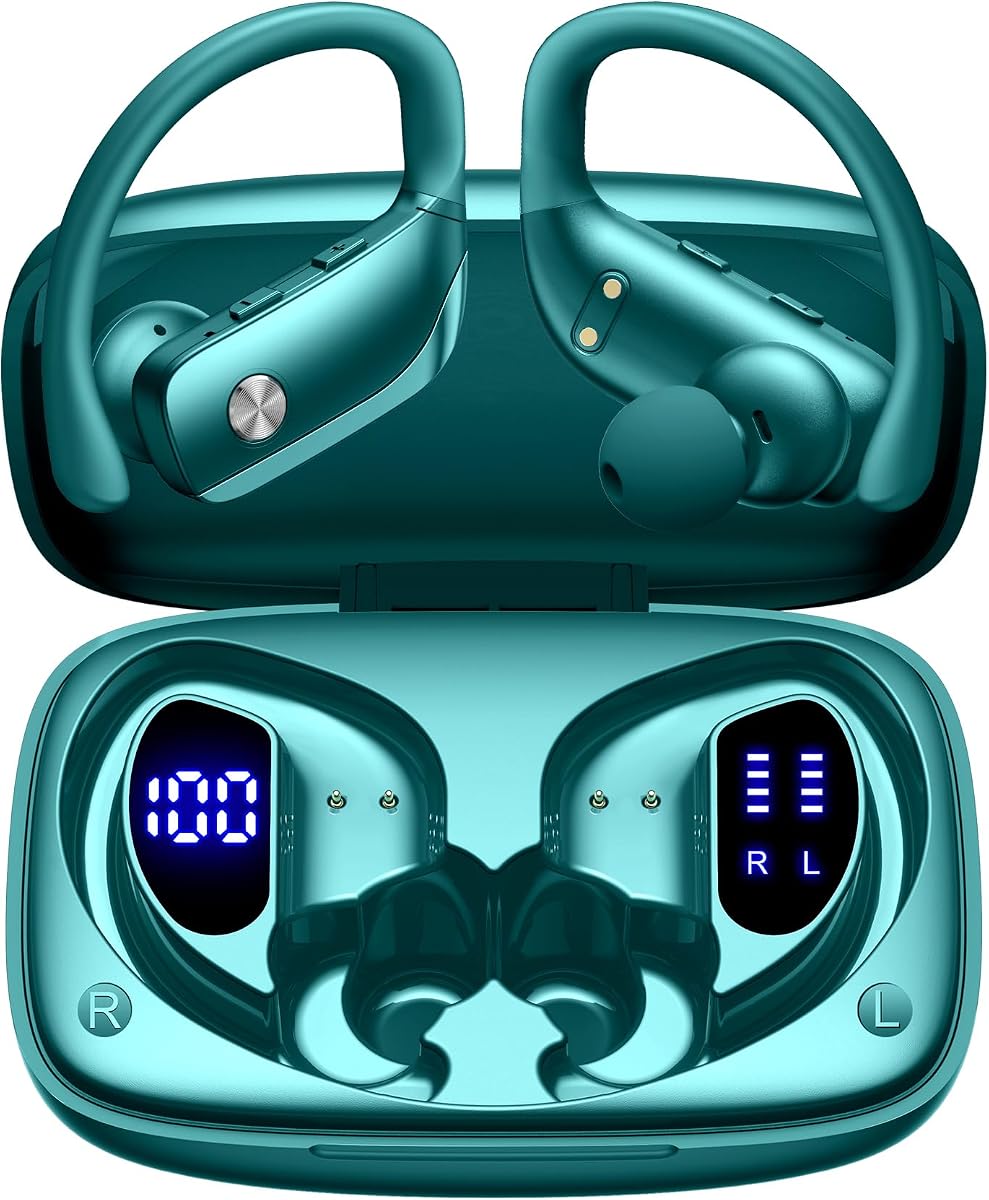
These wireless sports earbuds emphasize secure retention through flexible silicone earhooks that follow the wearer’s ear contour. They carry a 4.4 rating and are particularly interesting for runners with smaller ear canals, people who wear glasses, or anyone prone to fatigue from conventional sealed earbuds. The pressure-distributing shape is designed to reduce the need for mid-workout adjustments.
We may earn a commission when you buy through this link, at no additional cost to you.
Audio comes from 13mm dynamic drivers with a bass-forward presentation intended to motivate active sessions. Integrated ENC microphones isolate vocal frequencies for calls in gyms, on busy streets, or around traffic. The battery system provides up to eight hours of playback per charge and a claimed total of 48 hours through the case, with a dual LED display showing case and earbud battery levels.
Bluetooth 5.3, automatic reconnection, and broad compatibility with iOS, Android, tablets, and laptops make the model practical for mixed use. Touch panels control playback, volume, calls, track changes, and voice assistants. IPX7 protection supports exposure to sweat, rain, and humidity, but the stated design is not intended for swimming or prolonged underwater use.
This is a compelling option for runners who place retention and comfort above brand-specific app features. Its performance cannot be judged against a premium tier solely by driver size, but the secure hook geometry, clear battery display, and call-oriented microphone system address the main practical needs of active users.
The flexible hooks adapt to the wearer’s contour and distribute pressure rather than relying entirely on a deep ear-tip seal. That approach is especially relevant for smaller canals and runners who wear glasses.
A high-contrast dual LED display shows charging information for both the case and earbuds. ENC microphones help separate speech from surrounding noise, making the earbuds more useful for calls taken during a run.
We may earn a commission when you buy through this link, at no additional cost to you.
The bmani Ear Buds stand out for their claimed 80-hour total playback and straightforward physical controls. They have a 4.3 rating and use adjustable over-ear hooks to remain stable during running, cycling, and gym workouts. The approach prioritizes endurance, ease of operation, and a secure fit rather than elaborate fitness tracking.
We may earn a commission when you buy through this link, at no additional cost to you.
Each earbud is rated for up to eight hours of playback per charge, with the case extending total use to 80 hours. Separate left and right LED indicators show earbud charging, while a digital display on the case shows its remaining power. The large battery reduces the likelihood that a runner will need to carry a charging cable for routine training.
Ten-millimeter dynamic drivers produce stereo audio, and dual microphones are intended to capture the user’s voice with less surrounding noise. Physical main and volume buttons offer a more tactile alternative to touch gestures, which can be advantageous when moving and sweating. The earbuds also reconnect automatically to the last paired device after leaving the case.
The bmani Ear Buds are best for long-distance runners, frequent travelers, and users who dislike touch controls. The lack of a stated numeric water-resistance rating and limited information about advanced app features should be weighed against the otherwise generous battery life and secure hook design.
The stated 80-hour total runtime is the model’s defining advantage. It makes the earbuds well suited to repeated workouts, travel, and users who prefer not to recharge the case frequently.
Separate main and volume buttons reduce the chance of accidental changes from touch gestures. Their tactile feedback is useful when the user is running, cycling, or wearing gloves.
We may earn a commission when you buy through this link, at no additional cost to you.
The Wireless Earbuds 75H use elastic TPU hooks designed specifically to prevent falling out while running. They earn a 4.3 rating and combine a claimed 75-hour total playback time with 14.2mm drivers, physical buttons, and Bluetooth 5.4. The result is a focused sports package without a large learning curve or app-dependent controls.
We may earn a commission when you buy through this link, at no additional cost to you.
The earhooks are designed to remain comfortable while resisting sweat and rain. A nano-coated waterproof material helps prevent splash damage, and the IPX7 rating supports use in wet workout conditions. A dual LED display indicates case power and earbud charging status, while the case can provide five to six additional charges.
Bluetooth 5.4 is compatible with the A2DP, HFP, HSP, and AVRCP profiles, and the stated stable connection distance reaches up to 33 feet. The earbuds automatically pair with a previously connected device when the case opens. Physical buttons handle playback, track navigation, volume, calls, and voice-assistance activation.
The Wireless Earbuds 75H are a strong choice for runners who want a high-capacity battery, easy controls, and a prominent hook that resists slipping. They lack active noise cancellation and a formal ambient-awareness mode, so runners who need to hear traffic consistently should account for that limitation when comparing them with the JBL models.
The flexible TPU hooks are shaped to stay attached during jogging and other high-motion activities. Their material is also described as comfortable and anti-allergic, although individual comfort will vary.
Up to 15 hours of continuous use per charge and a case that supports five to six recharges produce the stated 75-hour total. The dual LED display gives users a quick visual check of remaining power.
We may earn a commission when you buy through this link, at no additional cost to you.
The GNMN V7 combines customizable ear tips, soft earhooks, active noise cancellation, transparent mode, and a claimed 96-hour total battery life. Its 4.4 rating is among the strongest in the group, and the feature set makes it a credible option for runners who want a sealed in-ear presentation plus environmental controls.
We may earn a commission when you buy through this link, at no additional cost to you.
Active noise cancellation is stated to reach a depth of up to 45dB, while transparent mode lets the user hear outside sounds without removing the earbuds. Sixteen-millimeter drivers use a large acoustic chamber to produce clear highs, rich mids, and deep bass. The combination of replaceable-style tips and earhooks allows the fit to be adjusted for both retention and passive isolation.
A single charge provides up to eight hours of playback, while the case extends total use to 96 hours. Dual LED displays monitor both the case and individual earbuds, and Type-C charging supports convenient recharging. Fast automatic pairing, low-latency operation, stereo mode, and single-ear use broaden the everyday feature set beyond running.
The GNMN V7 is best for runners who want strong isolation, adjustable in-ear retention, and a long battery. Those who prefer to hear traffic and other environmental cues without switching modes may favor an open-ear model. The large claimed specification figures also make it important to consider the product’s actual fit and controls alongside its specification list.
Active noise cancellation can reduce distracting environmental sound, while transparent mode makes nearby traffic, training partners, or conversation easier to hear without removing the earbuds.
Customizable ear tips establish the in-ear seal, while soft hooks help keep the housings from moving. This combination is useful on runs involving hills, faster cadence changes, or repeated impact.
We may earn a commission when you buy through this link, at no additional cost to you.
Beats Powerbeats Pro 2 are premium workout earbuds built around a flexible nickel titanium earhook, active noise cancellation, heart-rate monitoring, and up to 45 hours of total playback. The earhooks were tested across athletes with varied ear shapes and workout intensities, making the retention claim one of the model’s central selling points.
We may earn a commission when you buy through this link, at no additional cost to you.
Built-in sensors measure heart rate more than 100 times per second without requiring a chest strap or watch. The earbuds offer transparency mode, adaptive EQ, and Personalized Spatial Audio with head tracking on Apple devices. Six microphones support voice clarity, while physical buttons, tactile volume rockers, and voice controls remain accessible during movement.
Five ear-tip sizes help establish a personalized seal, and the earhooks are described as 20% lighter than the previous generation. The IPX4 rating covers sweat and water resistance. A five-minute Fast Fuel charge adds 1.5 hours of playback, while the wireless Qi charging case supports convenient top-ups. One-touch pairing, automatic device switching, and hands-free Siri make the package especially convenient for Apple users.
Powerbeats Pro 2 are best for serious runners who value secure retention, heart-rate data, excellent call handling, and battery life. Android users also receive customization and battery widgets through the Beats app. Buyers should note that the USB-C charging cable is sold separately and that the included ear tips, rather than the hook, determine the acoustic seal.
The built-in heart-rate sensors provide real-time tracking directly from the earbuds. That removes one accessory from a running setup and can be convenient for runners who prefer minimal gear.
A nickel titanium earhook adds strength and flexibility, while five tip sizes allow the acoustic seal to be adjusted. Physical buttons and tactile volume rockers are easier to operate blindly than small touch controls.
We may earn a commission when you buy through this link, at no additional cost to you.
The Soundcore C50i uses a compact clip-on format designed for running and gym sessions. Instead of entering the ear canal, the earpieces sit over the ears, and the memory titanium FlexiClip adapts to different shapes. Its 4.2 rating reflects a compelling open-ear design with a documented IP55 rating and a more discreet appearance than many hooked sport models.
We may earn a commission when you buy through this link, at no additional cost to you.
Custom 12mm drivers deliver bass with a maximum output of 86dB, aiming to provide a more powerful open-ear presentation than bone-conduction alternatives. The design leaves the ear canal open, which supports awareness of the environment. AI processing filters background noise during calls, making the C50i practical for users who take calls while running or commuting.
A single charge provides eight hours of playback, and the case extends total use to 28 hours. Bluetooth 6.0 is designed for a stable connection, while IP55 protection helps guard against sweat and rain. The soundcore app adds HearID, EQ modes, Spatial Audio, and over-the-air firmware updates.
The Soundcore C50i are best for runners who want a small, light, unobstructed listening experience. They are less suitable for anyone seeking a sealed bass profile, active noise cancellation, or the strongest possible low-frequency isolation. Their main advantage is delivering stable open-ear playback in a particularly compact format.
The FlexiClip wraps over the ear without entering the canal, reducing the plugged sensation associated with sealed in-ear models. Its memory titanium construction is intended to maintain both stability and comfort.
An IP55 rating supports use around sweat and rain, making the earbuds suitable for outdoor sessions. Bluetooth 6.0 provides the connection foundation, while the charging case extends playback for longer training cycles.
We may earn a commission when you buy through this link, at no additional cost to you.
The Bose SoundSport is a long-established sports earbud built around the Stay Hear Plus tip system, sweatproof construction, and simple wireless operation. It carries a 4.4 rating, matching several newer products despite its more basic feature set. For runners, the most important consideration is the way its tips and housings remain seated during activity.
We may earn a commission when you buy through this link, at no additional cost to you.
Stay Hear Plus tips are designed to keep the earbuds comfortably in place while reducing the need to push them deeply into the ear canal. Bose advises selecting the tip size that produces a snug fit because an incorrect size can affect both sound quality and call performance. The lightweight, conventional in-ear format may be more familiar than open clips or large earhooks.
Active EQ keeps the sound balanced at different listening levels, and Bluetooth pairing is assisted by voice prompts and NFC compatibility. The product is sweatproof for sports use. However, it does not offer the active noise cancellation, transparent awareness modes, modern app-based workout presets, or multi-device features found among newer options in this guide.
The Bose SoundSport is best for runners seeking a simple, comfortable sports fit without unnecessary complexity. It can also be a sensible choice for someone who prefers a sealed earbud and does not need advanced fitness sensors. Buyers should consider newer alternatives if long battery life, noise cancellation, or wireless case charging is important.
Stay Hear Plus tips use a different shape from basic silicone tips to improve stability during workouts. Choosing the correct size is essential, and the earbuds should be inserted and worn as intended.
Active EQ maintains a balanced presentation at varying volumes. While newer rivals offer more controls and environmental modes, the SoundSport keeps the core experience focused on music, calls, and a secure sports fit.
We may earn a commission when you buy through this link, at no additional cost to you.
The right running earbuds depend on ear shape, route conditions, training habits, and tolerance for sealed or open listening. Evaluate retention, protection, sound, and controls together rather than focusing on a single headline specification.
A running earbud must resist vertical movement, head turns, and the repeated impact of foot strikes. Wing enhancers, memory-wire hooks, flexible clips, and Stay Hear Plus tips use different geometries to distribute force. Earhooks generally wrap around the outer ear for broad support, wings press against the inner ridge, open clips avoid the canal entirely, and shaped tips create a seal that helps keep the housing from rotating. The right mechanism depends partly on ear anatomy, so a design that works for one runner may not fit another.
Choose retention that matches your ears and preferred wearing style, then confirm that the earbud can be repositioned comfortably without reaching for a phone.
Open-ear models leave the ear canal unobstructed, making it easier to hear traffic, training partners, and environmental cues. They can also feel less plugged during long sessions. Sealed in-ear models generally deliver stronger perceived bass and isolation because the tips form a physical barrier. The trade-off is that conventional earbuds can feel invasive, particularly for users with small ears or a dislike of deep insertion. Clips offer a middle path by staying outside the canal without extending around the entire rear of the ear.
Decide whether environmental awareness or maximum audio isolation matters more, and choose a fit you can comfortably maintain for the length of a run.
Sweat resistance and waterproofing are related but not identical. An IPX7 rating indicates protection against temporary immersion under specified test conditions, while IPX4 addresses water splashes and sweat. IP68 combines dust protection with a high level of water resistance, but the charging case may have a different rating or none at all. Always dry both earbuds and the case before charging when moisture is present. Ratings also do not make every product suitable for swimming, and open-ear designs may have fewer documented protection specifications.
Prioritize a clearly stated rating for sweat, rain, and dust, and follow the manufacturer’s drying and charging instructions after wet runs.
Running audio should remain clear over footfalls, wind, traffic, and gym noise. Active noise cancellation can reduce the surrounding sound field, while ambient or transparency modes help users remain aware of their surroundings. Some models integrate both into app-controlled workout presets. Driver size can influence full-bodied sound, but fit, seal, tuning, and environmental processing also shape the result. Open-ear designs generally offer less isolation than sealed models, while bone-conduction-style approaches usually deliver a different and more restrained sound signature.
Look for a sound profile and awareness controls that suit your route, whether you train alone in quiet areas or run near busy roads.
If you take calls or record running audio while moving, microphone design matters. Beamforming, multiple microphones, and wind-noise reduction can help preserve voice clarity in noisy environments. The GNMN V7 and the two JBL Endurance models include dedicated call features, while the Soundcore models provide AI-assisted call processing. Real-world wind conditions remain difficult for tiny microphones, so placement and voice isolation should be considered alongside the advertised microphone count. A stable fit also matters because movement can shift the microphone’s position relative to the mouth and airflow.
If clear calls are important, prioritize multiple microphones, beamforming, and wind-focused design rather than relying only on a general call-quality claim.
Battery life should be considered in two ways: playback from one charge and total runtime with the case. A long total runtime is useful for people who train several times per week without charging the case after every workout. The case itself may take the earbuds from depleted to ready for a short run, so a model that lasts five hours per charge can still be highly practical. Fast charging is another useful feature when a workout begins soon after waking the earbuds. Check whether a cable is included, since the Powerbeats Pro 2 package does not include one.
Choose a battery configuration that matches your charging habits, balancing quick top-ups against the convenience of a high-capacity case.
Physical buttons can be easier to identify while running, especially with sweaty hands or when wearing gloves. Touch controls may offer a cleaner appearance but can create accidental commands. App support can add EQ profiles, spatial audio, workout modes, battery displays, and device switching. Premium models may also include heart-rate sensors and automatically switch between phones, tablets, and computers. These extras are useful only when they match a runner’s priorities; simple buttons, predictable pairing, and a comfortable fit should take priority over a long feature list.
Prioritize controls you can use without looking and features that improve training, then treat advanced app functions as optional extras.
Start with a dry, clean ear and fit the earbuds before beginning your run. For hook or clip models, place the hook or clip in the direction that corresponds to the product’s intended orientation, then rotate or seat the earbud until it feels stable without pressure. For in-ear models, select a tip size that seals comfortably without pain, then perform a gentle movement check by turning your head and shaking lightly. Recheck the fit during the first few minutes because sweat and movement can subtly change how an earbud sits.
Pair the earbuds before leaving for your run, confirm that the correct audio output is active, and adjust the volume conservatively. Learn the controls while stationary, especially if the model has separate buttons, touch panels, or mode switches. Download the relevant companion app to configure EQ, awareness levels, workout presets, and firmware updates. During a run near roads, use transparent or ambient mode when needed, but do not reduce awareness so far that traffic, cyclists, or other hazards become difficult to hear.
After the workout, remove the earbuds, wipe away sweat and dirt, and let them dry completely. Do not place wet earbuds into a charging case unless the manufacturer explicitly permits it, and never charge a case that has become wet. Clean removable ear tips with a soft damp cloth, avoid pushing debris into the microphones or speaker ports, and keep the earbuds away from extreme heat. Store them in the case with the fit components arranged as intended, and periodically check the battery display and charging contacts.
Earbuds with earhooks, wings, or clips generally have more retention mechanisms than basic stem-style models. The most dependable choice depends on ear shape, because a hook that feels secure for one runner may press uncomfortably on another. Look for adjustable components and test the fit while moving before committing to a long run.
Open-ear designs generally make surrounding sounds easier to hear because they do not seal the ear canal. That can help users notice traffic, training partners, or other environmental cues. They may not provide the same bass impact or isolation as sealed earbuds, so the best choice depends on whether awareness or immersive sound is the priority.
Earhooks wrap around the outer ear, while wings press against the inner ridge to resist rotation. Both can improve stability, but they create different pressure points. Runners with glasses should check that the earhook does not interfere with the frame, while those with small ears may need a model with a compact wing.
At minimum, a sweat-resistant rating is useful for frequent workouts, while IPX7 or IP68 provides stronger protection against water. Ratings apply to specific components, and the charging case may have a lower rating or none. Dry the earbuds and case before charging, and avoid swimming unless the manufacturer explicitly states that the product is safe for it.
Most long runs can be covered by several hours of playback, while the case determines how many workouts can be completed before recharging. Some models offer eight hours per charge, while others provide longer or shorter sessions. Consider both per-charge runtime and total case capacity, especially if you travel or train without regular access to power.
Noise cancellation can reduce distracting sounds such as traffic or gym noise, while transparent mode restores awareness without removing the earbuds. The right setting depends on your surroundings. Complete isolation may be undesirable on roads or shared trails, so it is better to use a moderate ambient level when environmental cues matter.
Choose a model with a hook, wing, clip, or retention-focused tip, then make sure it is fitted correctly before starting. Wet skin and movement can change the fit, so tighten or reposition the earbud when necessary. Adjustable components are useful, and a quick head-turn and movement test can reveal whether the earbuds will remain stable.
Physical buttons are often easier to operate without looking, particularly with wet hands, gloves, or sweat on the fingertips. Touch controls may look cleaner and support additional gestures, but accidental inputs can occur. The best option is whichever control method you can identify and press reliably without breaking your stride.
The Soundcore V20i stands out as the best budget option for runners who want a comfortable open-ear design, four adjustable positions, and useful app-based personalization. The JBL Endurance Peak 4 is the most complete all-rounder in the group, combining a secure TwistLock hook, IP68 protection, noise cancellation, Smart Ambient, and long total playback. For premium training features, Beats Powerbeats Pro 2 adds a strong earhook, heart-rate monitoring, adaptive EQ, and extensive battery life.
Prioritize the feature that most often causes frustration: fit. Choose a hook for broad support, a wing for a compact in-ear profile, an open clip for an unobstructed canal, or a shaped tip for a sealed and stable sound. After securing the fit, consider sweat protection, environmental awareness, call quality, controls, and battery life in the order that matters to your training routine.
Specifications, features, and promotions can change over time, so review the current listing before buying. Pay particular attention to the included accessories, water-resistance limits, charging-case rating, companion-app compatibility, and return terms. A comfortable product used consistently is more valuable than a feature-heavy pair that forces repeated adjustments or creates pressure during a run.