
Motovera Self Leveling Laser Level 100ft
4.2Editor score
Green cross-line projection
Self and manual modes
Tripod and carry bag
IP54 protection rating
Our guide compares the best laser levels for cabinets, covering accuracy, beam visibility, mounting options, tripods, and cabinet-specific features.
Laser levels help cabinet installers establish straight reference lines, match finished surfaces, locate studs, and verify whether wall sections are plumb before drilling. A useful cabinet laser should project a clear line, remain stable at working height, and include a practical mounting system for kitchens, bathrooms, workshops, and other installation environments.
We compared the supplied products by accuracy, beam color, self-leveling range, line coverage, mounting hardware, tripod support, power options, protection rating, and included accessories. The list covers compact cross-line tools, full-room 3D lasers, Bosch models, RockSeed bundles, and marker accessories intended to support alignment during cabinet installation.
Each pick highlights a different route to accurate cabinet work, from a complete budget kit to a premium three-plane laser and professional green-beam options. Product ratings and availability can change, and prices vary by retailer and over time, so readers should confirm current specifications, included accessories, and the latest purchase options before ordering.
4.2Editor score

4.6Editor score

4.5Editor score
This side-by-side overview compares the key cabinet-installation capabilities of all ten products, including line orientation, accuracy, mounting provisions, power, and bundled accessories.




The Motovera Self Leveling Laser Level combines a green cross-line projector, self-leveling and manual modes, an adjustable tripod, batteries, and a carry bag. With a 4.2 rating, it stands out as a budget-oriented complete kit for installers who do not want to source a support separately. Its stated indoor visibility reaches 100 feet, making it suitable for marking full kitchen runs and tall cabinet elevations.
We may earn a commission when you buy through this link, at no additional cost to you.
Accuracy is specified at plus or minus 1/9 inch at 33 feet, while the pendulum automatically levels within plus or minus 4 degrees. Four brightness modes and a pulse function offer flexibility in changing indoor conditions. Manual mode is valuable when a cabinet reference must follow a sloping soffit, decorative feature, or other non-horizontal angle. The included adjustable tripod provides a practical starting point for wall layout and toe-kick alignment.
The tool carries an IP54 rating for dust and water resistance, and its stated drop tolerance is up to 30 inches. It also includes a soft-grip, palm-sized body that should be convenient to reposition. One caveat is that outdoor visibility can require a compatible receiver. The product information also notes that tiny gaps may appear in laser lines because of the protective acrylic window, although this does not affect stated accuracy.
This is the most practical choice for a homeowner or beginning installer seeking a full setup in one purchase. It offers more than a bare laser by including the tripod, batteries, and case, making it easier to begin a cabinet project immediately. It is less suited to professionals who require a three-plane rotating laser or the mounting flexibility of a premium 3D system.
The bundled adjustable tripod, batteries, and carry case reduce setup time because the core support system is already included. That convenience is particularly helpful for marking cabinet rails, wall cabinets, and countertop references across multiple rooms.
Green light is described as four times brighter than standard red lasers, improving visibility in well-lit interiors. Self-leveling handles ordinary horizontal and vertical references, while manual mode covers deliberate angled layouts.
We may earn a commission when you buy through this link, at no additional cost to you.
The Huepar HM03CG is the most capable 3D laser in this group, projecting one 360-degree horizontal line and two 360-degree vertical lines. Its 4.6 rating reflects a strong feature set for cabinet layouts requiring simultaneous reference planes. The three-plane arrangement can establish room-wide height and wall alignment without repeatedly rotating or repositioning a conventional cross-line tool.
We may earn a commission when you buy through this link, at no additional cost to you.
Accuracy is stated at plus or minus 1/9 inch at 33 feet, with a working range up to 98 feet under the stated 100-lux condition. Users can turn individual horizontal and vertical lines on or off, reducing visual clutter when only one reference is required. The pendulum self-levels within 3 degrees, and manual mode supports angled lines. A rechargeable battery provides up to eight hours of continuous use and can be charged through its Type-C port.
The included magnetic bracket supports multiple positioning options, including standard mounting threads and two nail holes. That versatility is useful on metal framing, cabinet backs, workbenches, or other suitable surfaces. The hard case also makes storage safer between installation phases. The trade-offs are size compared with a pocket laser and the need for a compatible receiver in bright outdoor conditions.
The product information also warns against reflective surfaces such as mirrors, glass, and glossy tile because laser reflections can create extra apparent lines. Installers should therefore use it where cabinet surfaces do not produce confusing reflections. For serious kitchen and bath projects, this is the most versatile pick here because it can support wall, ceiling, and elevation references simultaneously.
A full horizontal plane plus two vertical planes let the installer transfer a reference between perpendicular walls and the floor or ceiling. This is especially helpful when upper and base cabinet elevations must match around corners.
The strong magnetic bracket offers several thread and fastening options, allowing the laser to sit on a metal surface or be secured with a more conventional mounting arrangement. Included screw holes can help create a fixed reference point.
We may earn a commission when you buy through this link, at no additional cost to you.
The BOSCH GLL50-20G is a focused cross-line laser aimed at installers who prefer a compact professional tool. It has a 4.5 rating and projects bright green horizontal and vertical lines with a stated 50-foot range. The green beam is listed as up to four times brighter than standard red beams, a meaningful advantage in kitchens and bathrooms where overhead lighting can wash out a reference line.
We may earn a commission when you buy through this link, at no additional cost to you.
The Smart Pendulum System self-levels, blinks when the tool is outside its leveling range, and locks when switched off for transport. Accuracy is stated at 5/16 inch at 30 feet. The integrated mount can use magnets or the standard 1/4-20 thread, while the housing has an IP55 rating for resistance to dust and water. The tool accepts two included AA batteries or an optional Bosch battery system.
The main limitation is that this is a two-plane cross-line model rather than a full 3D laser. It does not create an entire 360-degree horizontal plane, so installers working around corners may need to reposition it. No tripod is included, and the optional lithium-ion battery is not part of the standard package. Those considerations matter when comparing convenience rather than pure laser performance.
This is an excellent pick for a professional cabinet installer who already owns a tripod and wants a durable, highly visible line tool. Its straightforward mounting system, strong protection rating, and green-beam clarity also make it suitable for serious DIY work. It ranks just behind the Huepar for layout flexibility but may be more immediately practical for one-wall and one-run installation.
The green beam is particularly useful under bright household lighting and over light-colored cabinetry. A clearer line means fewer interrupted sightlines when transferring elevations between wall sections and assembled cabinet boxes.
An IP55 housing helps the tool tolerate dust and water, while the integrated magnetic and threaded mount provides quick placement. The locking pendulum also helps protect the internal leveling system during transport.
We may earn a commission when you buy through this link, at no additional cost to you.
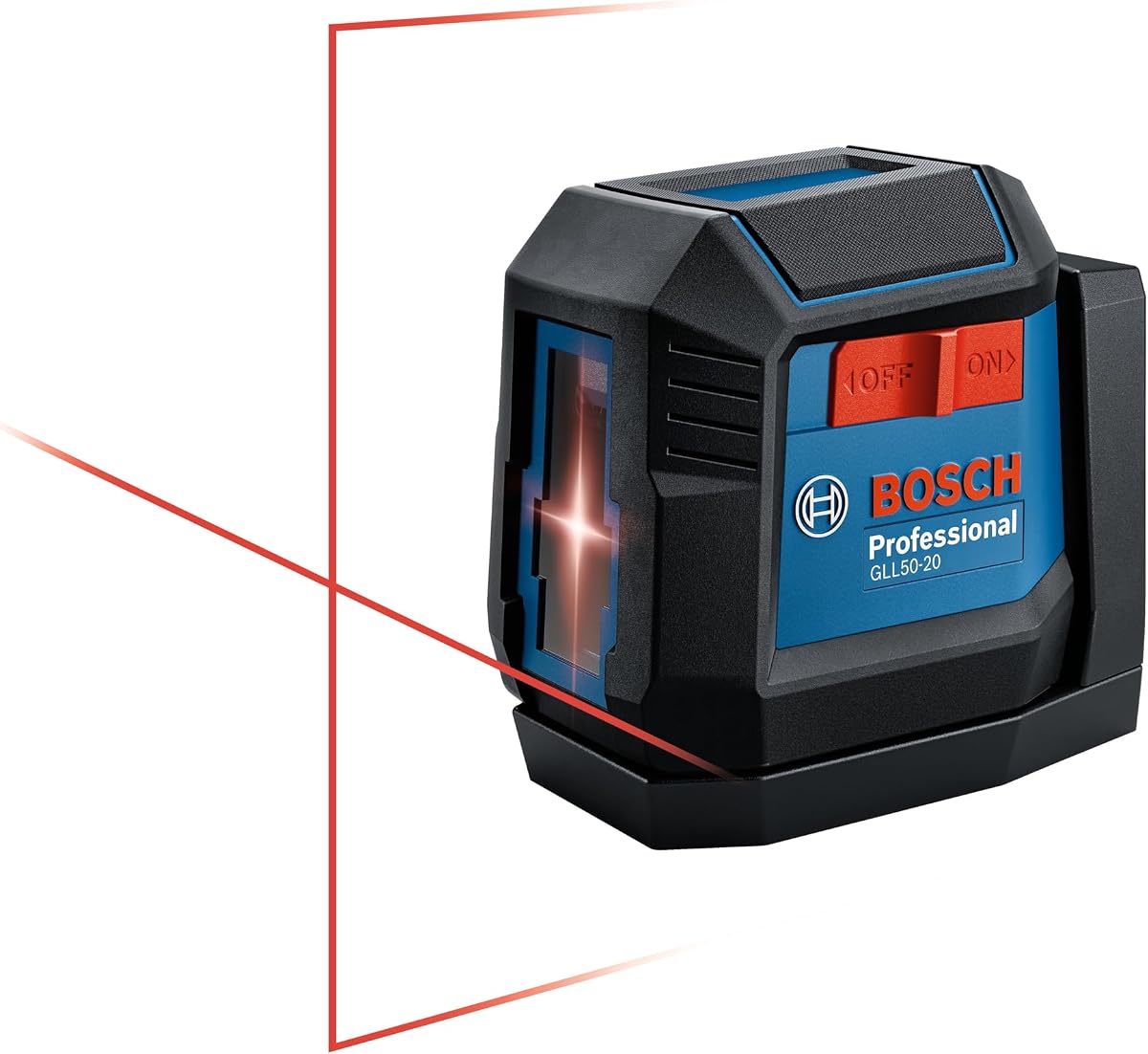
The BOSCH PRO GLL50-20 is built around the same useful cross-line concept as the green-beam GLL50-20G but emphasizes a rugged, compact professional design. Its 4.4 rating and rubber-overmolded housing make it a dependable option for active installation environments. It projects level and plumb lines across a stated 50-foot range, which is adequate for most kitchen wall runs and individual cabinet boxes.
We may earn a commission when you buy through this link, at no additional cost to you.
The stated accuracy is 5/16 inch at 30 feet. A magnetic and 1/4-20 threaded multipurpose mount allows the laser to attach to compatible metal surfaces or a standard tripod. The Smart Pendulum System self-levels, signals an out-of-level condition by blinking, and locks when the tool is switched off. Power comes from two included AA batteries or an optional 3.7-volt lithium-ion battery.
Its IP55 construction offers dust- and water-resistance, while the roll-cage-like rubber protection covers major impact points. Unlike a green-beam model, however, the red lines can be harder to see in bright rooms. The optional battery system may also be unnecessary for users who do not want to add another proprietary power source.
The best buyer is a professional who values a durable, straightforward cross-line laser and already has compatible batteries, mounts, or a tripod. It is less suitable for a complete starter setup because fewer accessories are included. For cabinet work requiring a full room reference, choose a 3D model; for a dependable point-to-point layout tool, this Bosch is a refined choice.
The full rubber overmold protects major impact points without obscuring the compact body. Its easy-to-store shape is useful for moving repeatedly between base-cabinet, wall-cabinet, and countertop reference stages.
Automatic shutoff and pendulum locking support safer transport. Using AA batteries for routine work or an optional rechargeable pack for extended installations gives the installer a choice based on job duration.
We may earn a commission when you buy through this link, at no additional cost to you.
The Huepar BOX-1G combines a green cross-line laser with a 40-inch tripod, batteries, and a carry bag. Its 4.4 rating makes it a compelling all-in-one option for cabinet installers who want fine stated accuracy without buying a separate support. The tool projects a 130-degree horizontal line and a 150-degree vertical line, providing useful coverage for marking rails and tall cabinet faces.
We may earn a commission when you buy through this link, at no additional cost to you.
Accuracy is stated at plus or minus 1/13 inch at 33 feet, one of the tighter figures among the products listed. The pendulum self-levels within 4 degrees, while manual mode allows angled references. Users can select a single line to save power or use the cross-line configuration. Pulse mode can extend the stated operating range to 197 feet when used with a compatible Huepar receiver.
The included aluminum tripod extends from 11.4 to 40 inches and has a three-way pan head with multiple swivel positions. That range helps place the laser near base-cabinet toe kicks or upper-cabinet rails. The product guidance recommends the tripod for indoor use on flat ground in windless conditions, and a larger tripod may be better for exposed outdoor work.
This is a good match for installers who need a highly visible green line and a capable tripod without piecing together a kit. It is less appropriate for projects where the tool must project multiple full 360-degree planes. For typical residential cabinet installation, however, the combination of accuracy, line selection, and included support is especially practical.
The stated plus or minus 1/13-inch accuracy at 33 feet provides a strong basis for aligning upper cabinets, base rails, and countertop reference marks. Its green beam is easier to trace across mixed wall and cabinet surfaces than a conventional red line.
The adjustable three-way head can tilt, swivel, and rotate for portrait or landscape layouts. Extending to 40 inches makes the tool more versatile for cabinet work than a short tabletop-only support.
We may earn a commission when you buy through this link, at no additional cost to you.
The RockSeed 40-Inch Tripod Kit pairs a self-leveling red cross-line laser with a supporting iron tripod, two batteries, a canvas case, and a manual. Its 4.4 rating reflects a useful package for basic cabinet installation. The tool offers horizontal, vertical, and cross-line projections across a 110-degree angle, allowing it to establish perpendicular references for cabinet boxes and wall rails.
We may earn a commission when you buy through this link, at no additional cost to you.
Stated accuracy is plus or minus 1/8 inch at 30 feet. The pendulum self-levels for standard horizontal and vertical layouts, with a listed compensation range of 4 degrees plus or minus 1 degree. Locking it changes the tool to manual mode, which is useful for angled markings but removes the automatic level reference. The laser blinks when it exceeds the self-leveling range, giving the installer a useful warning.
The tripod folds to 16 inches and extends to 40 inches. It includes a dual bubble level, anti-slip feet, quick-release clamps, a center-column knob, and a suspension hook. Those details support stable placement, although a tripod is only as steady as the floor beneath it. The compact housing has an IP54 protection rating and a stated 4-foot collision-protection claim.
Choose this kit for a cost-conscious installer who wants a complete support package and primarily needs red cross lines. It is less suitable when green-beam visibility is a priority or when a full 3D layout is required. For straightforward residential cabinet alignment, the included tripod and carrying case make it a convenient one-package solution.
The dual bubble level helps verify the tripod before the laser is used, while the anti-slip feet and locking hardware support repeatability. Adjustable height allows the same tool to cover toe-kick lines and upper-cabinet references.
Manual mode is helpful for marking non-horizontal cabinet features or transferring deliberate slopes. The important distinction is that these lines are angled by choice and should not be treated as automatically leveled references.
We may earn a commission when you buy through this link, at no additional cost to you.
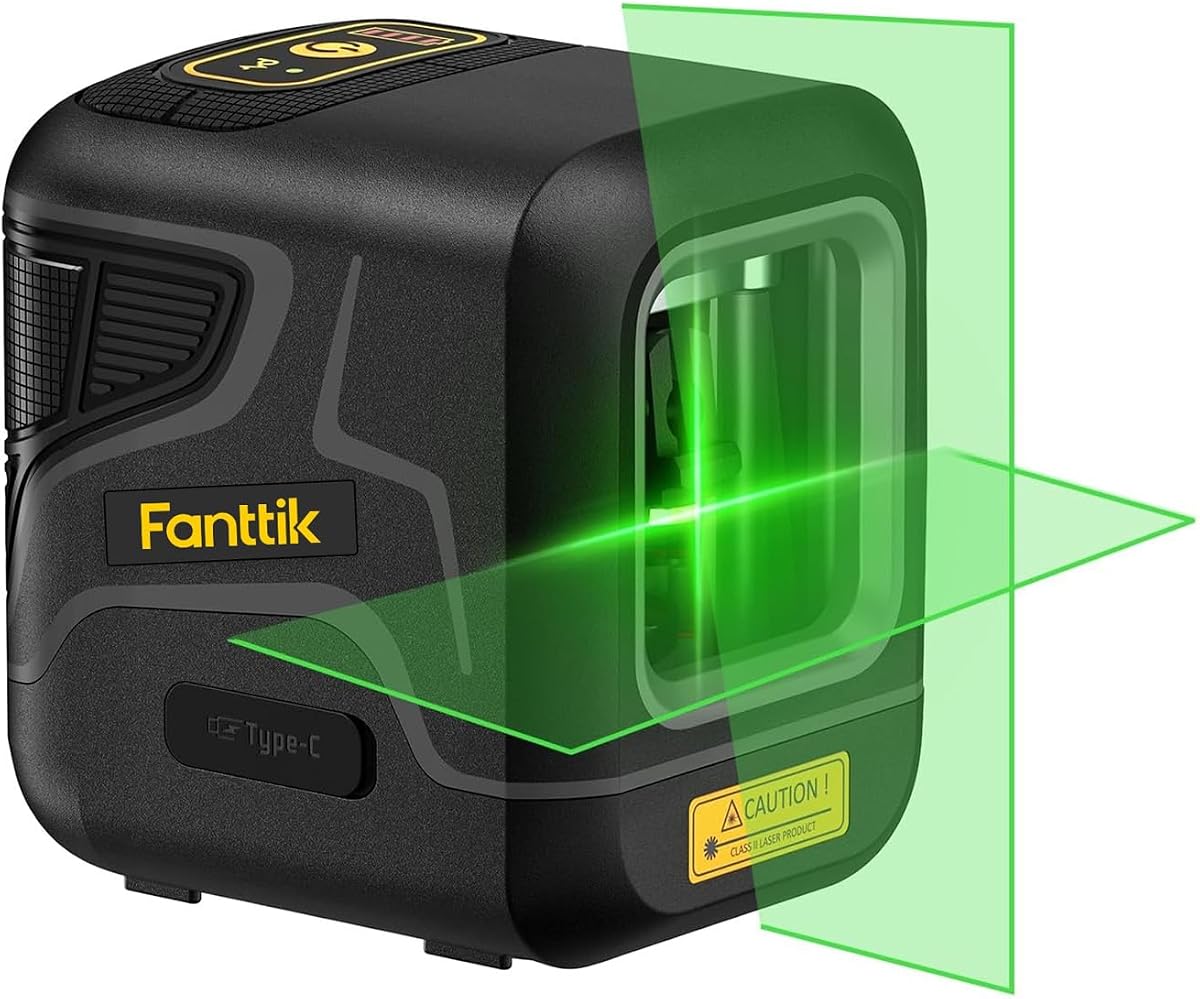
The Fanttik D2 is built for smaller home projects and weighs only 0.56 pounds. Its 4.5 rating, green beam, and rechargeable design make it appealing for installing a few upper cabinets, aligning shelves, or checking a wall run without carrying a full professional setup. It projects both horizontal and vertical lines through a compact body protected by TPE rubber.
We may earn a commission when you buy through this link, at no additional cost to you.
Accuracy is stated within 1/8 inch at 30 feet, suitable for common residential alignment tasks. The 2,200 mAh battery provides up to 10 hours of continuous operation and is rechargeable through USB-C. Self-leveling operates within 4 degrees, while a locked pendulum provides manual alignment at deliberate angles. The magnetic bracket allows 360-degree positioning on suitable metal surfaces.
Pulse mode supports outdoor use with a receiver, but the receiver is not supplied and the laser can be difficult to see in strong sunlight. The tool also does not include a tripod, so the bracket or another support must be used. The protective rubber improves grip and drop resistance, although the compact format is less suitable for sustained professional work than the larger 3D model.
This is the best choice for a homeowner who wants a pocketable reference for a small cabinet project or a weekend installation. It offers a long runtime and quick magnetic setup without asking the user to manage disposable batteries. Professional installers working on long kitchen runs may prefer a larger stand-mounted model, but for occasional cabinet alignment the D2 is notably convenient.
The magnetic bracket and 360-degree rotation make it simple to move the reference between a cabinet side, metal support, and nearby wall. Its small size is helpful when working in tight spaces or changing reference points frequently.
The integrated battery removes the need for a separate power pack during ordinary use. Its stated 10-hour runtime can cover a full installation day, while USB-C charging adds convenience between jobs.
We may earn a commission when you buy through this link, at no additional cost to you.
The Cabinet Laser Marker Set is an accessory rather than a projecting laser, but it directly supports cabinet and countertop installation. Its 4.7 rating is the highest in the list, and its eight stainless steel targets provide multiple reference points along a wall or floor. Installers can use them to catch a red or green beam and confirm that heights match across a long cabinet run.
We may earn a commission when you buy through this link, at no additional cost to you.
Each target combines a weighted stainless steel body with a black ring that creates high contrast where the laser line crosses. An integrated green bubble level adds a local check for floor flatness or wall plumb before the beam is fired. The magnetic base can attach to metal studs, framing, or iron pipe, allowing hands-free placement when a separate laser is already established.
The primary limitation is that this set does not generate a beam, establish a level reference by itself, or replace a self-leveling laser. It is most effective alongside one of the cross-line or 3D lasers in this guide. The number of markers also depends on the cabinet layout, so complex rooms may still need careful placement rather than a single continuous run of targets.
This is a worthwhile companion for installers who repeatedly install cabinetry, countertops, tile, or trim and want a dependable visible target at several points. It can reduce interpretation errors when the beam is faint or interrupted by wall texture. It is not the right primary purchase for a first-time homeowner who still needs a laser projector, but it is a strong supporting tool for an established kit.
The black ring provides a distinct point at which to read the laser line. Several targets spread across a cabinet run make it easier to spot a gradual height discrepancy that might be missed when viewing only one wall location.
The built-in bubble level gives each marker a secondary verification function. Checking the target before trusting a beam can reveal whether the support surface itself is tilted.
We may earn a commission when you buy through this link, at no additional cost to you.
The RockSeed 47-Inch Tripod Kit provides a cross-line laser and a taller support package for cabinet work. It shares the same stated plus or minus 1/8-inch accuracy at 30 feet and 110-degree projection angle as the related 40-inch RockSeed bundle. The principal distinction is the included tripod, which is identified as 47 inches in the product title and package description.
We may earn a commission when you buy through this link, at no additional cost to you.
The product listing contains an inconsistency in its tripod dimensions: the title specifies 47 inches, while the bullet text says it can extend to 40 inches and fold to 16 inches. Buyers should confirm the actual assembled and extended dimensions before purchasing. The described features include a dual bubble level, precise center column knob, anti-slip feet, quick-release clamps, height locking, and suspension hooks.
As a laser, the tool supports self-leveling horizontal, vertical, and cross-line modes. The pendulum automatically levels within the stated 4-degree range and alerts the user with flashing when it cannot. Manual mode allows deliberate angled layouts. The housing has an IP54 protection rating, and the package includes two AA batteries, a canvas carry case, and a manual.
This bundle can be attractive to installers who want a single purchase that includes a relatively tall support. It may be particularly useful for projecting a reference at upper-cabinet height without relying on furniture or a workbench. The dimension inconsistency and red-beam visibility should be weighed against a clearly specified green-beam kit, but the overall package is capable for ordinary cabinet layouts.
A taller support can place the laser closer to upper-cabinet and crown-molding reference heights. The adjustable center column and pan head allow the installer to fine-tune the beam after the tripod is set.
Because the supplied product information uses both 47-inch and 40-inch extended-height descriptions, buyers should check the actual dimensions and package contents. That step avoids surprises regarding working height and compatibility.
We may earn a commission when you buy through this link, at no additional cost to you.
The RockSeed Green Cross-Line Laser is a compact standalone option for cabinet installers who want a brighter green beam without purchasing a tripod bundle. It has a 4.2 rating and projects horizontal, vertical, and cross-line references through a stated 110-degree angle. Accuracy is listed at plus or minus 1/8 inch at 30 feet.
We may earn a commission when you buy through this link, at no additional cost to you.
The pendulum provides self-leveling for ordinary references and alerts the user when the tool is tilted beyond its range. Locking the pendulum enables manual mode for deliberately angled cabinet features. The housing has an IP54 protection rating and a stated 4-foot collision-protection claim, while its compact body should be easy to carry between installation areas.
Two AA batteries and a canvas carry case are included. A magnetic bracket can be used for positioning, but the product information states that this bracket is sold separately. No tripod is included, so users must already own a suitable support or plan to work with the magnetic mount. That makes the package less convenient for a first cabinet project than the bundled RockSeed alternatives.
This laser is a sensible pick for an installer who already owns a tripod or magnetic positioning system and prefers a green line to a red one. Its compactness also makes it easier to store between jobs. However, the separate bracket requirement and lower rating place it behind the more complete green-beam kits for shoppers who want a ready-to-use system.
The standalone format is useful for people who already own a 1/4-20 tripod or a suitable magnetic bracket. It provides green-beam visibility without adding the size and weight of a full support kit to the purchase.
Self-leveling handles the horizontal and vertical references used in most cabinet alignment, while manual mode covers angled layouts. Understanding the distinction helps prevent an intentional angled line from being mistaken for a level reference.
We may earn a commission when you buy through this link, at no additional cost to you.
The right cabinet laser depends on the room, installation method, and degree of layout complexity. Beam visibility, accuracy, mounting stability, and included support should be considered together rather than as isolated specifications.
Accuracy figures indicate how closely the projected reference follows its intended line, while the self-leveling range determines how far the tool can be tilted before the pendulum cannot compensate. Cabinet work often involves imperfect floors and walls, so a useful self-leveling range is more important than a headline range alone. A manual mode is useful for deliberate angles, but it should not be confused with an automatically level reference.
Choose a clearly specified accuracy and verify that the pendulum self-levels within the amount of tilt expected on site. For finished residential cabinetry, the tighter stated figures among these products offer a useful margin, while a wider range can help the tool adapt to uneven setups.
Green lasers are generally easier to trace than red lasers under bright indoor lighting, particularly across light walls, pale cabinet boxes, and glossy surfaces. The products described as green-beam options state brightness or visibility advantages, which can reduce errors when a line is faint or interrupted by texture. Visibility matters more during cabinet installation than during occasional short measurements because installers must follow the line repeatedly.
If work occurs outdoors or in direct sunlight, a green beam still may require a compatible receiver. Choose based on the actual environment rather than assuming a brighter color solves every distance problem.
A conventional cross-line laser projects horizontal and vertical lines from a fixed position, while a 3D laser adds rotating planes that cover a room in three dimensions. Two-plane models are often sufficient for a single cabinet wall, but a three-plane tool is more efficient when the installer must transfer references around corners, across walls, and between floor and ceiling elevations.
Choose a cross-line for simplicity and lower size. Choose a 3D model for complete-room layouts, multiple installers, or complex kitchen geometry that requires simultaneous room-wide references.
A laser cannot produce a dependable reference if it moves. Magnetic mounts provide quick placement on suitable metal surfaces, while 1/4-20 threaded mounts allow use with standard tripods. The included bracket should have sufficient holding force, and the tripod should stand on a flat surface. A dual bubble level can help confirm that the support itself is stable.
Look for a combination of magnetic and threaded mounting when the project includes both finished walls and open framing. Check whether a tripod and bracket are included, because some packages require a separate purchase before the laser can be used.
Tripod height determines how comfortably the beam can be positioned at toe-kick, countertop, backsplash, and upper-cabinet heights. An adjustable model that can be raised above furniture offers more flexibility than a short tabletop stand. The complete package should also be checked for batteries, a charging cable, a carry bag, and any power packs or receivers.
For beginning homeowners, a complete bundle is usually the simplest option. For experienced installers, an existing tripod and preferred power system may make a standalone laser more useful.
Disposable batteries are convenient because replacements are widely available, while rechargeable systems reduce routine battery waste and can simplify extended jobs. Runtime should be considered alongside LED brightness and selected line mode, because operating multiple lines or a pulse mode generally changes power consumption. Type-C charging and removable batteries offer different convenience depending on the installer.
Choose a rechargeable model if you work for long periods and value a consistent battery system. Choose AA or AA-compatible models if you prefer inexpensive replacements and do not want to manage a proprietary charging setup.
Kitchen and bath installation sites can expose tools to dust, moisture, paint, and accidental impacts. An IP54 rating indicates protection against dust and water, while IP55 offers a comparable jobsite-oriented level of resistance. Housing materials, grip, and transport locking also matter because a laser is often carried between rooms or placed in a crowded van.
For occasional indoor cabinet work, either protection level may be sufficient. For contractors working around active construction sites, a rugged housing, protected laser window, and secure transport lock are worthwhile priorities.
A highly visible line can still be difficult to read against textured paint, dark cabinetry, or reflective tile. High-contrast laser markers can provide a defined target at multiple points along a cabinet run, while local bubble levels help verify the condition of the supporting surface. Glossy or mirror-like materials can also generate extra reflections, so a clean, non-reflective reference area is preferable.
Consider marker pins when the same installer works on cabinets repeatedly or needs to compare several points at once. Remember that the markers do not project a line; they complement a laser rather than replace one.
Begin by identifying the reference planes required for the installation, then set the tool on a stable, clean surface or a correctly tightened tripod. Allow the pendulum to settle before reading the line, and confirm that the tool is in self-leveling mode when using a line as a level reference. If it flashes continuously, do not treat the line as level; reset the tool within its compensation range or switch deliberately to manual mode for an angled feature.
Mount the laser at a practical height, lock its controls, and use a bubble level or the tool's own indicators to check the support. Mark only a short section of the line at each cabinet or wall reference rather than assuming the entire room is level. For cabinet elevation transfers, compare several points with a tape measure and use contrasting target markers where the beam becomes difficult to read.
After the project, switch the tool off so the pendulum can lock for transport, remove the batteries from models that use disposables, and clean the laser window with a soft dry cloth. Protect the glass or acrylic window from scratches and avoid exposing the tool to excessive impact or moisture beyond its stated rating. Store rechargeable units in the supplied case, and store loose accessories together so a tripod mount or cable is not lost between jobs.
A 3D laser is not essential for a simple straight cabinet wall, where a cross-line tool can handle horizontal and vertical references. It becomes more valuable when the installation wraps around corners, spans multiple walls, or requires simultaneous floor, wall, and ceiling planes. A cross-line model is generally simpler and less demanding to position, while a 3D tool can reduce repeated repositioning in a complex room.
Green is usually easier to see in bright indoor rooms, which can be valuable when marking cabinet elevations over light walls or pale finishes. Red remains adequate for controlled lighting and controlled spaces. Brightness also depends on line mode, surface finish, and distance, and neither color should be expected to remain clearly visible in direct sunlight without a receiver.
A tripod is useful whenever the required reference line is above furniture, below eye level, or needs to remain fixed while both hands are used for installation. It also provides a more repeatable height than placing the laser on a countertop or workbench. If the laser includes a strong magnetic bracket, that can work for temporary references, but a tripod generally offers better stability over a long cabinet run.
Continuous flashing usually indicates that the tool is outside its self-leveling range. Reposition it until the pendulum can level, or manually adjust the tool to the required angle if the feature is intentionally sloped. In manual mode, periodic flashing is generally a reminder that automatic leveling is disabled rather than a sign that the tool has failed.
A laser level projects reference lines; it does not inherently detect wall framing. A stud finder is the appropriate tool for locating studs behind finished surfaces. A laser becomes especially useful after studs are marked, helping the installer transfer level and plumb references accurately from those points to cabinet locations.
The appropriate tolerance depends on cabinet type and how visible the final differences will be. A stated accuracy near one-eighth inch is common among these products, while several offer tighter figures. For crown molding, tall wall cabinets, and long runs, a tighter specification and a stable support can help reduce visible offsets that accumulate along the installation.
Yes, provided the reference plane remains stable and the line is transferred accurately. Mark each cabinet from the same established level, checking more than one point to detect wall or floor variation. If the room is complex or several workers need the reference simultaneously, a 3D model with multiple visible planes is more efficient than repeatedly repositioning a cross-line tool.
They are optional, but they can make a beam easier to read on textured or dark surfaces and allow multiple cabinet points to be checked at once. The stainless steel marker set is a companion accessory rather than a projecting laser, so it works best alongside a cross-line or 3D laser. It is especially useful for professional installers who repeatedly align cabinetry, counters, tile, or trim.
The Motovera 100ft Green Laser is the best budget complete kit for a homeowner who wants a tripod, batteries, and a case alongside a capable green cross-line. The Huepar HM03CG is the editor's choice because its three rotating planes provide the most flexible room-wide layout, while the BOSCH GLL50-20G stands out as the premium professional option with green-beam clarity and an IP55 housing.
For most single-wall cabinet installations, a cross-line laser with stable mounting is enough. Choose a 3D model when references must span several walls or planes, prioritize green visibility in bright rooms, and confirm the accuracy, power system, and included accessories before buying. Existing tripod ownership, outdoor receiver requirements, and reflective surfaces can materially change which model is most suitable.
Ratings, bundle contents, and product availability can change, and prices also vary over time and between sellers. Review the current listing and manufacturer details before checkout, especially when the package includes a tripod, battery, magnetic bracket, receiver, or other accessory that materially affects the tool's cabinet-installation performance.

