
50W Reptile Heat Lamp
4.4Editor score
Low-wattage supplemental heat
Invisible infrared heating
Two-bulb backup pack
Explore ceramic heat emitter bulbs for reptiles, amphibians, incubators, and brooders, with a detailed comparison of power, heat output, and safety features.
Ceramic heat emitter bulbs provide concentrated infrared warmth without visible light, making them especially useful in reptile and amphibian habitats that require nighttime heating. A good emitter should deliver consistent heat, fit a suitable ceramic-rated fixture, operate at the correct voltage, and provide a safe distance between its hot surface and the animal.
This guide compares ten ceramic heat emitter bulbs ranging from 25W to 250W, with one- and two-packs for terrariums, brooders, incubators, and other small-animal environments. The comparison considers wattage, voltage, E26 compatibility, heat-up behavior, construction, claimed service life, light emission, and the safety guidance supplied by each manufacturer.
Each review explains the product's most useful qualities, practical trade-offs, and best-fit applications. The shortlist highlights a budget model, a versatile editor's choice, and a higher-capacity premium option, while the complete ranking covers the broader range of ceramic heat emitter bulbs. Product availability and prices can change, so confirm the current listing details before purchasing.
4.4Editor score

4.7Editor score

4.4Editor score
The table below compares all ten ceramic heat emitter bulbs by output, pack size, construction, light behavior, and practical application, helping readers find a model suited to their enclosure and safety requirements.
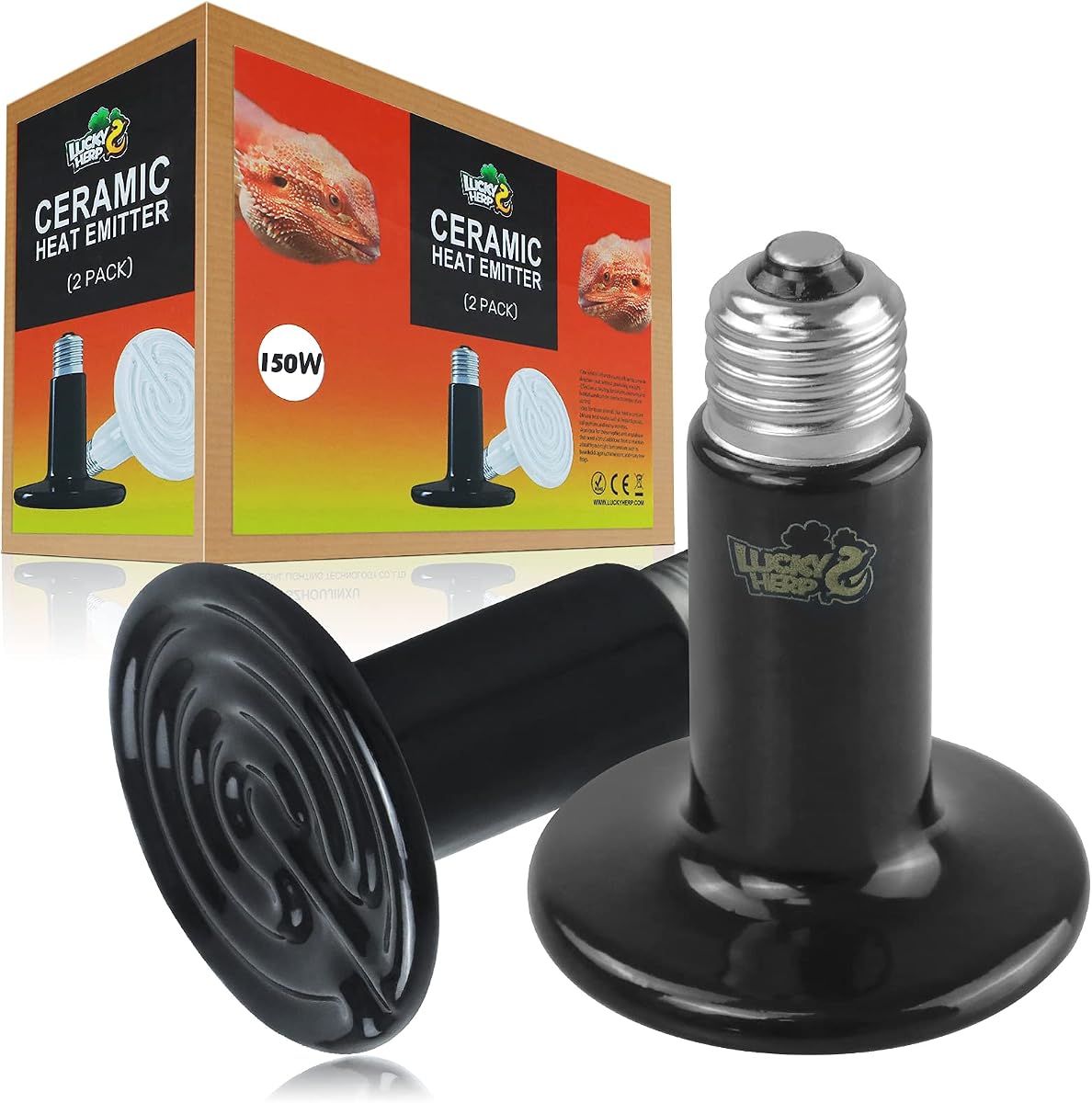


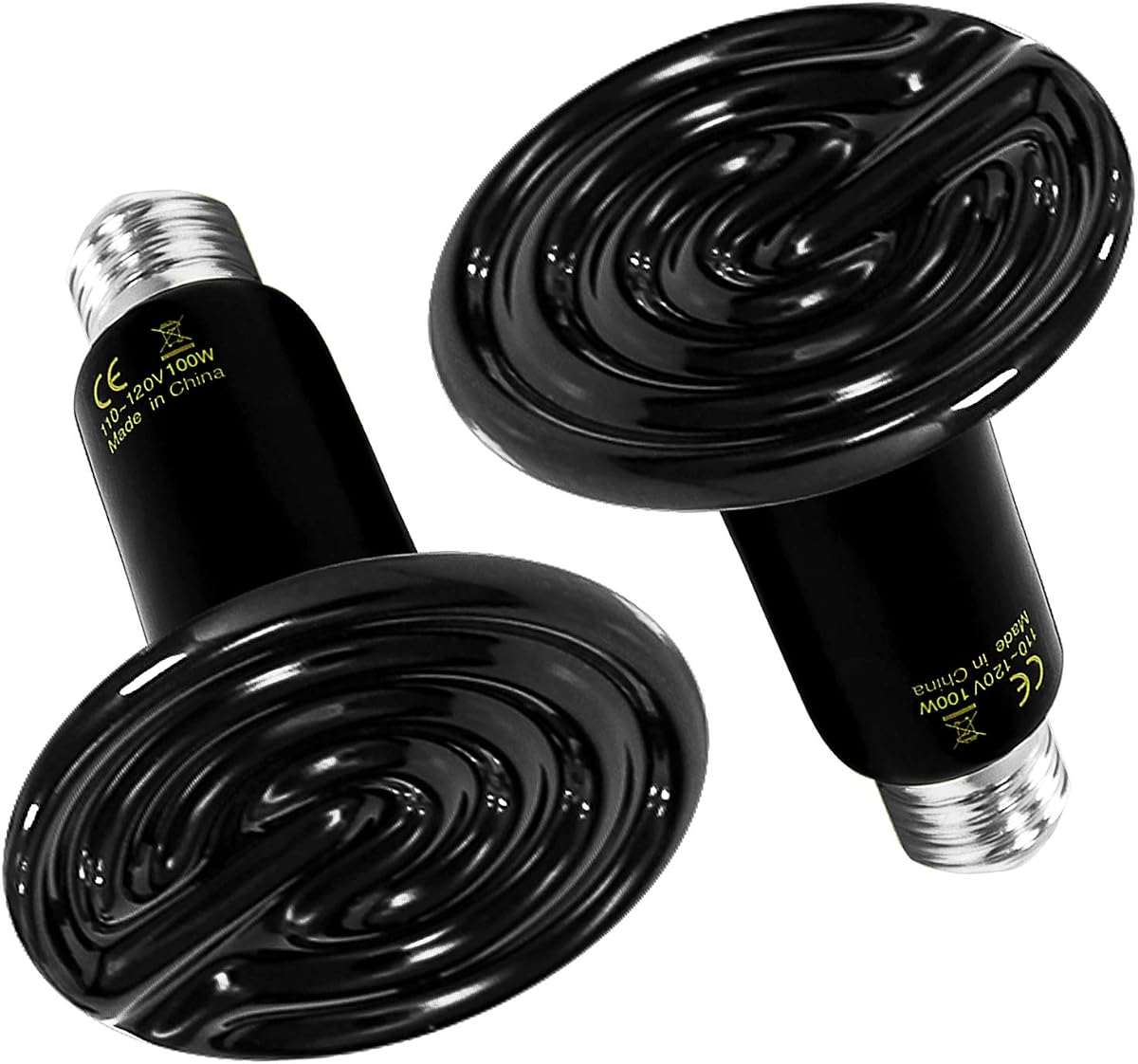

The LUCKY HERP 150W Ceramic Heat Emitter combines a substantial heat output with a two-bulb pack, giving it broad appeal for reptile owners, poultry brooders, and users who want a spare emitter available. It carries a 4.6 customer rating, and its most important feature is the balance between rapid heating, no visible light, and straightforward E26 installation.
We may earn a commission when you buy through this link, at no additional cost to you.
The manufacturer reports a noticeable temperature rise within 10 seconds and says the bulb reaches its rated temperature in approximately four minutes. Its thick ceramic shell is described as stronger and more durable than an ordinary heating-lamp shell, with a service life of up to 10,000 hours. Because it produces heat without visible light, it is well suited to nocturnal animals, overnight heating, or a setup that already has separate daytime lighting.
The trade-off is that 150W is a powerful operating level, and the surface becomes hot enough to require careful placement. The instructions specify a quality ceramic lamp holder, a distance of more than 30 centimeters from reptiles, and avoidance of frequent on-and-off cycling. It also requires 120 volts, so it is less convenient for owners with lower-voltage electrical systems. These are meaningful safety and installation constraints rather than defects.
This is a strong overall recommendation for a medium-to-large enclosure that genuinely needs a powerful heat source. It is particularly useful for bearded dragons, turtles, lizards, amphibians, young chickens, puppies, or kittens when the fixture, wiring, and enclosure are sized appropriately. Buyers who need only gentle warmth in a compact habitat should choose a lower-wattage option instead.
This emitter is attractive for overnight heating because it provides radiant warmth without adding visible light to the enclosure. The stated rapid heat-up behavior also makes it practical when establishing a warm zone shortly after the lamp is switched on.
Two bulbs allow one to serve as a backup or support two separate heat zones. They can also be used in rotation, provided the manufacturer guidance about cooling and frequent switching is followed.
We may earn a commission when you buy through this link, at no additional cost to you.
This 50W two-pack offers one of the most approachable ways to add non-light-emitting warmth to a terrarium, brooder, or incubator. Its 4.4 rating reflects a generally favorable reception, while the lower wattage makes it a practical option for smaller habitats that do not require the output of a 100W or 150W emitter.
We may earn a commission when you buy through this link, at no additional cost to you.
The product uses industrial-grade ceramic and a pure tungsten filament, with the manufacturer claiming a service life five times longer than standard bulbs and energy savings of 30 percent compared with standard heat lamps. Its non-light-emitting output is intended to avoid disrupting day-and-night cycles, making it appropriate for nocturnal reptiles and animals that are sensitive to visible light.
The key limitation is that 50W will not create the same broad or intense heat zone as the higher-output models. A small enclosure may reach a suitable temperature more readily, but a larger terrarium may need a more powerful bulb or a different heating strategy. Like every ceramic emitter, it still becomes very hot and needs a proper fixture, adequate distance, and separation from flammable materials.
This is the best budget-oriented pick for compact reptile habitats, leopard geckos, small lizards, turtles where supplemental warmth is sufficient, chicks, birds, amphibians, and small-mammal habitats. It is also useful for incubators that need steady heat without visible illumination. It is not the first choice for a large reptile enclosure requiring a broad thermal gradient, but it offers a sensible lower-output starting point.
The 50W rating makes this model easier to integrate into compact spaces where 100W or higher could create excessive heat. Distance can be adjusted to produce the appropriate thermal balance without overpowering the enclosure.
The two-pack provides more flexibility than a single emitter. One bulb can act as a reserve during an important heating period, or each bulb can serve a different enclosure or zone.
We may earn a commission when you buy through this link, at no additional cost to you.
The single-bulb LUCKY HERP 100W offers a versatile middle ground between the compact 50W model and the more powerful 150W and 250W options. Its 4.6 rating indicates strong customer satisfaction, and the combination of 100W output, rapid heating, and no visible light makes it suitable for many common habitat applications.
We may earn a commission when you buy through this link, at no additional cost to you.
The manufacturer says the bulb begins producing a noticeable temperature increase within 10 seconds and reaches its rated temperature in four minutes. Its durable ceramic construction is claimed to last up to 10,000 hours. Installation uses a standard E26 lamp holder, while the listed operating range is 110 to 120 volts. The product can support reptiles, amphibians, poultry brooders, eggs, and young puppies.
Because this is a single pack, it does not provide an immediate backup if the bulb fails. That can be inconvenient for brooding setups or critical husbandry periods. Its safety guidance also calls for a high-quality ceramic lamp base and at least 30 centimeters of separation from reptiles, so a secure fixture and careful positioning are essential.
This model is best for a standard terrarium that needs moderate, continuous radiant heat and where only one fixture is required. It is a good fit for bearded dragons, chameleons, turtles, and general reptile or amphibian care when combined with appropriate lighting and temperature monitoring. Choose it when a single-bulb format is preferable to the added complexity of a multipack.
At 100W, this emitter offers enough capacity for many everyday enclosures without reaching the surface-heat intensity associated with the 150W and 250W products. It remains a powerful heat source and should not be treated as a low-heat fixture.
The same non-light-emitting format works for daytime supplemental warmth, overnight heating, reptile and amphibian habitats, and poultry brooders. It can be paired with a separate daytime heat lamp when a clear light-dark schedule is needed.
We may earn a commission when you buy through this link, at no additional cost to you.
The REPTI ZOO 60W two-pack is aimed at owners who want more heat than the entry-level model offers without moving to the highest wattages on the list. It has a 4.6 rating, a two-bulb format, and a non-light-emitting design suited to nighttime heating and day-and-night supplemental warmth.
We may earn a commission when you buy through this link, at no additional cost to you.
Its ceramic body is made from high-purity material and described as crack-resistant, including in high-humidity glass terrariums. The manufacturer lists a 10,000-hour lifespan and says the emitter lasts three times longer than traditional heat lamps. It is also CE-certified and RoHS-compliant, which can be reassuring for buyers who pay attention to compliance markings.
Sixty watts is still capable of producing a very hot surface, and its suitability depends heavily on enclosure size, ventilation, distance, and the target temperature. It may be insufficient for a large habitat needing a broad warm zone. Consumers should also avoid assuming that a ceramic bulb housing is automatically safe; the fixture, ceramic socket, and wiring must all be appropriate for the load.
This two-pack is a good match for turtle, bearded dragon, gecko, lizard, snake, and chicken applications where moderate radiant heat is appropriate. It is also helpful for users who want a spare emitter without moving to a 100W output. For compact habitats and controlled brooding applications, it offers a useful middle ground between lower and higher power.
The high-purity ceramic construction is presented as resistant to cracking and suitable for humid terrarium conditions. Fixture placement and enclosure ventilation remain important because moisture does not eliminate the risk of burns or overheating.
Infrared heat without visible light allows the bulb to support thermoregulation without adding illumination during rest periods. This is especially useful for nocturnal species and enclosures that already have separate daytime lighting.
We may earn a commission when you buy through this link, at no additional cost to you.
The DOMICA 150W two-pack is designed for substantial supplemental heat in larger reptile habitats and related applications. Its 4.5 rating reflects a favorable overall response, while the claimed ability to withstand temperatures up to 500°F reinforces its positioning as a robust, high-temperature ceramic emitter.
We may earn a commission when you buy through this link, at no additional cost to you.
The bulb uses a high-density ceramic body and is described as more heat-tolerant than plastic-base heat bulbs. It emits infrared warmth without visible light, preserving the natural photoperiod when used alongside daytime lighting. Its stated dimensions of 3 by 3 by 4.3 inches are designed to fit many enclosures without taking up as much room as a bulky setup.
The important caveat is that its significant surface heat demands careful installation. The manufacturer explicitly requires a fixture rated for 150W or higher and warns against placing the emitter close to flammable materials. A larger output does not automatically mean better husbandry; an animal that can move between warm and cooler zones usually benefits more from proper placement than from maximum output.
This option suits owners of large terrariums housing bearded dragons, ball pythons, turtles, lizards, snakes, or amphibians. It can also support birds and brooder applications when the equipment is appropriately rated. It is best for a setup that needs concentrated infrared heat and can safely accommodate a high-wattage ceramic fixture.
The stated 500°F tolerance and high-density ceramic shell make this model relevant to demanding high-heat installations. A high tolerance does not remove the need for safe distance, ventilation, and a correctly rated socket.
The emitter concentrates infrared heat toward the enclosure, which can create a defined basking or warming area. Its listed dimensions make it easier to incorporate into many setups than a larger external heater assembly.
We may earn a commission when you buy through this link, at no additional cost to you.
The MIXJOY 250W is the highest-output product in this guide and is intended for setups that need powerful, concentrated heat. It holds a 4.4 rating and includes two emitters, making it a premium option for large habitats, specialized brooding arrangements, or owners who want backup capacity at a high operating level.
We may earn a commission when you buy through this link, at no additional cost to you.
Its non-light-emitting ceramic design provides continuous radiant warmth without disturbing the sleep cycle. The manufacturer states that a noticeable temperature increase occurs within 10 seconds and that optimal temperature is reached in approximately three to five minutes. A temperature-display sticker is included to remind users when the emitter is hot, while the high-purity ceramic is described as crack-resistant and moisture-resistant.
The major consideration is heat management. At 250W, the bulb produces a significant amount of surface heat and may be excessive for a small enclosure. It requires 110–120V power, a standard E26 base rated for the load, secure mounting, and careful clearance from animals and flammable materials. The listed dimensions are 105 millimeters in diameter and 115 millimeters in length, so fixture clearance should be checked.
This is the premium choice for large reptile habitats, high-demand brooders, egg incubators, and other installations where substantial heat output is necessary. It is also supported by a six-month warranty and 24/7 online support. Owners should choose it based on measured enclosure needs rather than simply selecting the highest wattage available.
The 250W rating provides considerably more heating capacity than the other models, which can be useful in large or cold environments. Distance from the animal must be adjusted carefully because the high output can create excessive warmth.
The manufacturer identifies the ceramic body as moisture-resistant and suitable for humid terrarium environments. This makes the emitter relevant to reptile habitats where condensation and elevated humidity are normal.
We may earn a commission when you buy through this link, at no additional cost to you.
The Simple Deluxe 100W two-pack is a straightforward option for continuous, invisible heat in reptile and amphibian terrariums or poultry brooders. Its 4.6 rating and long-standing product format suggest a well-regarded choice, while the 100W rating occupies a versatile middle position in this list.
We may earn a commission when you buy through this link, at no additional cost to you.
The bulb is built from ceramic, metal, and NiCrAl and is rated for up to 10,000 hours. It uses a standard E26 lamp base and runs on AC 110–120V. Because it emits no visually detectable light, it can provide overnight or continuous warmth without adding another visible source to the habitat's day-and-night cycle.
The safety guidance is especially direct: allow the ceramic lamp to cool for at least one hour after turning it off, keep an appropriate distance from pets and flammable materials, and never test its surface temperature by hand. These cautions are not unusual for radiant heaters, but they demand deliberate placement. The hot surface could also make frequent switching or rapid repositioning less convenient.
This two-pack is a good choice for a standard enclosure that benefits from two 100W heat sources, a primary emitter with a backup, or separate reptile and brooder applications. It is especially suitable for animals needing steady warmth overnight, such as certain geckos, snakes, and other reptiles, provided the enclosure provides an appropriate thermal gradient.
The absence of visible light makes continuous use more practical for nocturnal animals and nighttime husbandry. Temperature monitoring remains essential, but the emitter can complement the enclosure's lighting schedule without adding illumination.
The explicit one-hour cooling recommendation is useful because it discourages unsafe handling of a recently switched-off bulb. A stable mounting position also reduces the temptation to move the emitter while it is still hot.
We may earn a commission when you buy through this link, at no additional cost to you.
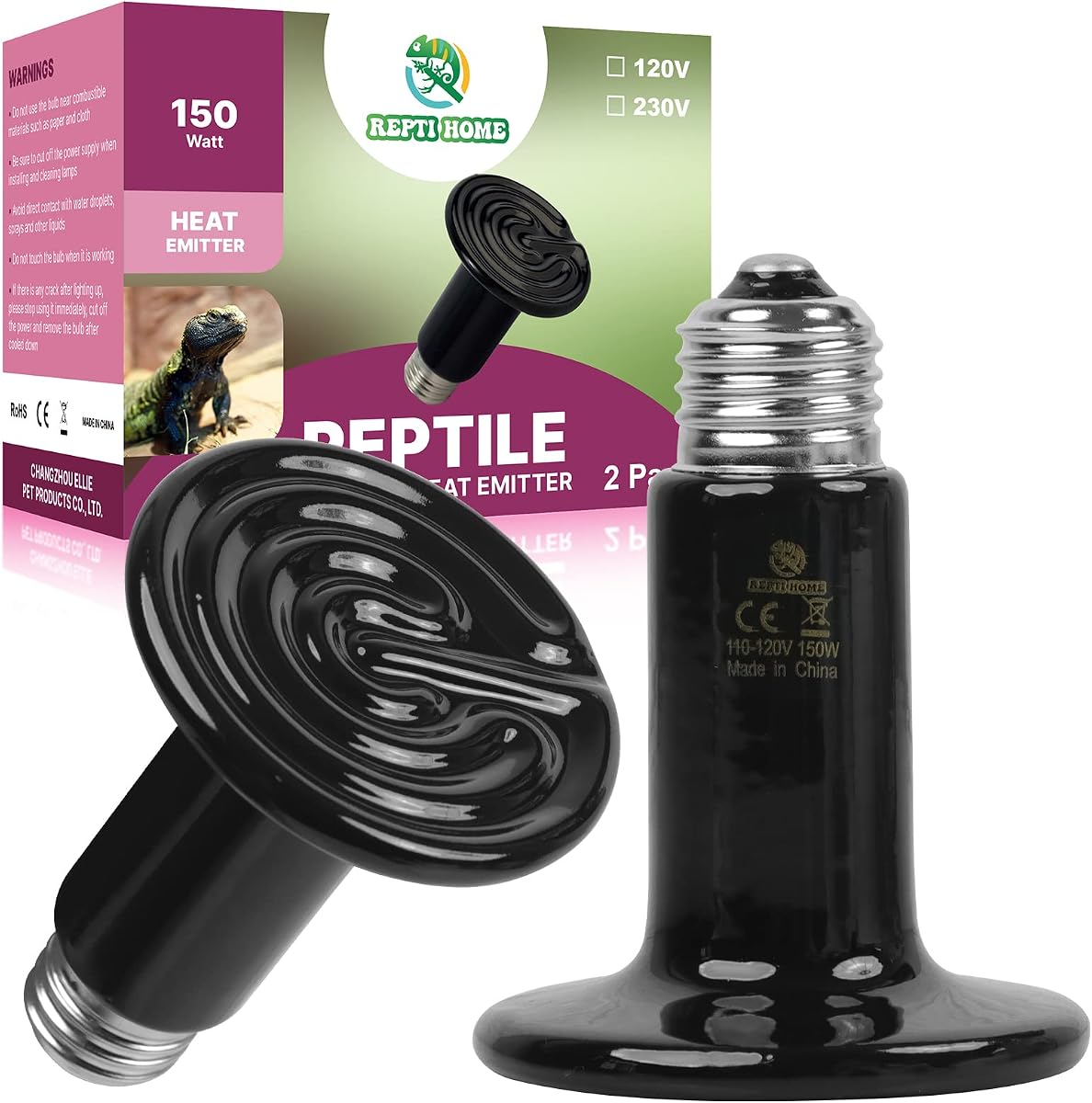
The REPTI HOME 150W Ceramic Heat Emitter is a versatile two-pack for reptiles, amphibians, brooders, and young household animals. It has a 4.6 rating and combines a high-output, no-light design with a simple E26 installation format, making it a practical choice for owners with varied heating needs.
We may earn a commission when you buy through this link, at no additional cost to you.
Its solid ceramic element is described as stronger and more durable than ordinary heating-lamp shells, with a claimed service life of up to 10,000 hours. The product provides directional infrared heat without visible light and can be used with temperature control. Like the similarly powerful LUCKY HERP option, it is reported to begin warming quickly and reach its rated temperature in about four minutes.
The safety requirements are substantial. Owners must use a quality ceramic holder, keep the bulb more than 30 centimeters from reptiles, avoid testing temperature with a hand, and avoid turning the lamp on immediately after switching it off or cycling it excessively. The product's 120V requirement also limits compatibility with other electrical systems.
This two-pack is well suited to medium or large habitats for ball pythons, bearded dragons, chameleons, tree frogs, turtles, and similar animals. It can also support poultry incubation, puppies, or kittens when the enclosure is safe and the animals can move away from the hot zone. It is a flexible higher-output choice rather than a gentle, low-heat bulb.
The emitter focuses radiant heat into a defined zone, which is useful for reptiles that benefit from a clear warm area. Pairing it with an appropriate cool zone gives the animal room to regulate its body temperature.
The broad application list includes terrariums, vivariums, habitats, poultry coops, and homes with young animals. The same two-pack can support a primary setup and a backup installation when compatible fixtures are available.
We may earn a commission when you buy through this link, at no additional cost to you.
The HealSmart 100W two-pack stands out for its strong 4.7 rating, the highest customer score among the products reviewed. It combines a versatile 100W output with rapid heating, no visible light, and a two-bulb configuration, making it an especially balanced option for many reptile, amphibian, and brooder environments.
We may earn a commission when you buy through this link, at no additional cost to you.
The emitter uses high-purity pottery clay and a Ni-Cr-Alloy resistance wire, with a threaded heating section designed to improve efficiency and speed the temperature rise. It is described as crack-prevention and moisture-resistant, which is relevant to humid glass terrariums. Each bulb measures 85 millimeters in diameter and 100 millimeters in length and fits a standard E26 base.
Its principal trade-off is the same one shared by all radiant ceramic heaters: a high surface temperature. The manufacturer advises against checking the temperature by hand, warns that excess closeness can overheat the habitat, and says the bulb should remain away from flammable materials. The 100W output may still be too strong for a very small enclosure, so distance and enclosure size must be evaluated.
This is a strong recommendation for a standard reptile terrarium, including setups for bearded dragons, lizards, turtles, and snakes, as well as amphibian habitats, poultry brooders, egg incubators, and areas where young cubs need warmth. It is particularly attractive when a 100W output is sufficient but two bulbs provide welcome flexibility.
The clear threaded heating element is intended to deliver a faster temperature rise than a conventional arrangement. This makes the emitter useful when a habitat needs to become comfortably warm soon after activation.
One emitter can heat a main zone while the other serves as a spare or supports a second enclosure. This flexibility is helpful during incubation, brooding, or other periods when uninterrupted warmth is important.
We may earn a commission when you buy through this link, at no additional cost to you.
The Simple Deluxe 25W two-pack is the gentlest output in this guide and is intended for small habitats needing supplemental radiant heat rather than intense warming. Its 4.6 rating indicates a favorable response, and the 25W rating makes it a logical option for smaller terrariums, delicate young animals, and compact brooder applications.
We may earn a commission when you buy through this link, at no additional cost to you.
The bulbs use ceramic, metal, and NiCrAl, operate on AC 110–120V, and fit standard E26 lamp holders. Their heating surface measures 75 millimeters in diameter, and they are rated for up to 10,000 hours. No visually detectable light is emitted, so they can support overnight heating without adding visible illumination to the enclosure.
Lower wattage should not be mistaken for a cool surface. The product still warns that the ceramic lamp generally reaches a high temperature and should be kept away from pets and flammable materials. It also recommends waiting at least one hour after switching off to avoid a scald. In addition, 25W may not produce enough heat for a large enclosure or cold room without careful placement.
This model is best for a small terrarium, a localized warm zone, a young-animal brooder, or an incubator requiring low-to-moderate heat. It can also provide gentle overnight warmth for a suitable amphibian or reptile habitat. Buyers needing broad coverage or a strong basking zone should move to a higher-wattage option.
The 25W output is useful when a broad, intense heat zone would be excessive. It can supply a controlled warm area in a small habitat when placed and monitored carefully.
A 75-millimeter heating surface and no visible light make this bulb suitable for compact environments where space and undisturbed sleep are priorities. The enclosure must still provide a safe temperature gradient.
We may earn a commission when you buy through this link, at no additional cost to you.
The right ceramic heat emitter depends on enclosure size, required temperature, electrical system, animal behavior, and fixture compatibility. Compare the available wattage and safety requirements before choosing a model, because a stronger bulb is not automatically better for every habitat.
In short, start with the lowest output that reliably maintains the required temperature and increase distance before increasing power.
In short, match both wattage and voltage to a properly rated ceramic fixture before purchasing.
In short, a heat-rated socket and enclosure-safe mounting system are essential, not optional accessories.
In short, create a measurable thermal gradient and make sure the pet can voluntarily leave the heated area.
In short, use ceramic emitters for invisible radiant heat, then add the lighting required by the species and enclosure.
In short, use humid-resistant bulbs carefully while keeping electrical components dry and the enclosure properly ventilated.
In short, choose a two-pack when redundancy or two-zone heating adds value, and choose a single pack for simplicity.
In short, let the bulb warm and cool as directed, and never touch the ceramic surface to check its heat.
Before installation, confirm that the fixture is rated for the bulb's wattage and voltage, inspect the ceramic body for cracks or damage, and make sure the socket is secure and suitable for sustained high heat. Do not use a bulb with a chipped, cracked, or discolored ceramic shell. Mount the emitter in a stable heat-safe fixture, preferably with a suitable guard or reflector, and keep electrical parts away from moisture.
Position the bulb outside the animal's reach and maintain the clearance specified by the manufacturer. A warm zone should be paired with a cooler area so the pet can regulate its temperature. Monitor the enclosure with a dependable thermometer, allow time for the stated warm-up period, and avoid frequent switching. If the habitat becomes too warm, increase the distance or reduce the output rather than improvising around the fixture's safety limits.
Switch off the emitter and allow it to cool fully before replacement or adjustment. Several products specifically advise waiting at least an hour, and all ceramic emitters should be treated as hot even after visible activity stops. Keep the bulb away from flammable enclosure decorations, do not use water to cool it, and disconnect power before changing a damaged bulb. Clean the surrounding fixture according to its manufacturer's instructions while the bulb is cool and disconnected.
The products in this guide are specifically described as non-light-emitting or as producing no visually detectable light. They provide infrared radiant heat without adding visible illumination, which makes them useful during nighttime hours or for nocturnal and light-sensitive animals. They do not replace UVB, daylight, or full-spectrum lighting that may be required for the animal's health.
The correct wattage depends on enclosure size, room temperature, ventilation, and the target heat range. A 25W or 50W emitter may suit small habitats and localized warmth, while 100W is a versatile middle ground. Higher-output 150W and 250W models are better suited to larger or colder setups. Always provide a cooler area and monitor actual habitat temperatures.
An E26 shape may fit a household socket physically, but the socket and fixture must also be rated for sustained heat and the bulb's wattage. Use a quality ceramic lamp holder and a heat-resistant fixture. A standard household socket or dimmer that cannot tolerate the load can become a serious safety hazard.
Several products specify a distance of more than 30 centimeters, but the safe distance also depends on wattage, enclosure dimensions, and measured temperature. Start with the manufacturer's guidance and adjust while monitoring the habitat. The animal should always be able to move away from the heated area, and the bulb should remain well separated from flammable materials.
Many of the products are described as suitable for continuous or 24-hour heating. Continuous use is reasonable when the fixture is correctly rated, the habitat is monitored, and the emitter has adequate clearance. A separate daytime light can provide a visible basking period while the ceramic emitter maintains invisible warmth overnight.
The listed products are marketed for poultry brooders, egg incubators, young chicks, puppies, kittens, and other small animals. The key is matching the output to the enclosure and monitoring the temperature in the area where the animals spend their time. A hot ceramic surface and an unevenly warmed enclosure still require appropriate placement and ventilation.
The ceramic element retains substantial heat after power is removed. Some products recommend waiting at least an hour before handling, and all emitters should be allowed to cool fully. Do not test the surface with your hand, place the bulb near flammable material while cooling, or attempt to speed cooling with water.
Disconnect the fixture and stop using a cracked or damaged emitter. A damaged ceramic body may fail unpredictably and can expose internal heating components. Replace it with a correctly rated bulb, inspect the socket and fixture, and check whether a separate moisture or physical impact caused the damage before installing another unit.
The LUCKY HERP 150W is the strongest all-around option in this guide, combining a two-pack, rapid heating, no visible light, and broad application potential. The 50W Reptile Heat Lamp is a budget-minded choice for smaller habitats, while the MIXJOY 250W two-pack delivers the highest output for large or demanding installations. The HealSmart 100W stands out with the strongest customer rating and balanced everyday performance.
Prioritize safe installation, correct voltage, an appropriate wattage, and a clear thermal gradient over raw heating power. A ceramic emitter must use a properly rated ceramic socket, remain away from the animal and flammable materials, and be positioned so the pet can retreat from the warmest area. Temperature monitoring is essential because enclosure conditions and seasonal changes can alter heat distribution.
Product listings and prices can change, so review the current specifications, compatibility details, and manufacturer instructions before ordering. This guide is intended to simplify product comparison, but the final decision should reflect the enclosure, animal, and heating arrangement in your specific home.