
Intel 82576 Dual-Port Gigabit NIC
4.4Editor score
Dual 1GbE RJ45 ports
Intel 82575/82576 controller
PXE and iSCSI support
Compare 10 top-rated dual RJ45 port network cards for speed, controllers, PCIe fit, OS support, cabling, and server features in this expert buying guide.
A dual RJ45 port network card adds two wired Ethernet connections to a desktop, workstation, or server through a PCI Express slot. The right model should balance link speed, controller capability, operating-system support, physical dimensions, and features such as PXE, iSCSI boot, QoS, and virtualization compatibility.
This guide compares ten dual-port adapters spanning 1GbE, 2.5GbE, and 10GbE. We evaluated the supplied specifications for controller chipset, PCIe interface, supported operating systems, cable requirements, bracket options, remote-boot functions, and server-oriented capabilities, with particular attention to compatibility caveats.
Each review identifies the use cases that best suit the card and the compromises buyers should understand. The leading choices include a versatile 2.5GbE model, a well-equipped 10GbE option, and a value-oriented dual-gigabit adapter. Product availability and pricing can change, so confirm current details before ordering.
4.4Editor score

4.6Editor score

4.6Editor score
The comparison below highlights the principal hardware differences among all ten adapters, including link speed, controller family, PCIe lane configuration, and operating-system coverage. Review the shortlist against your server hardware, cabling, and virtualization requirements.


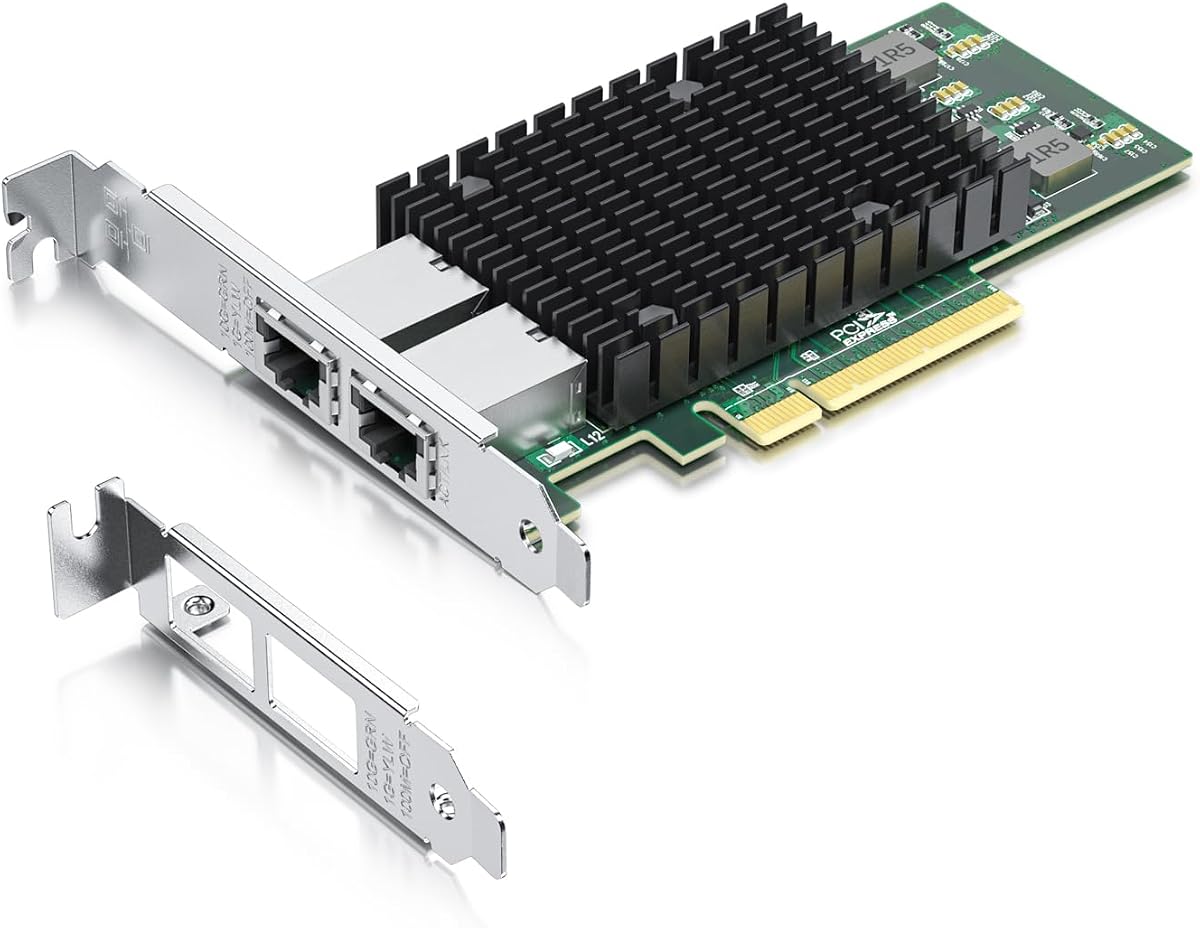

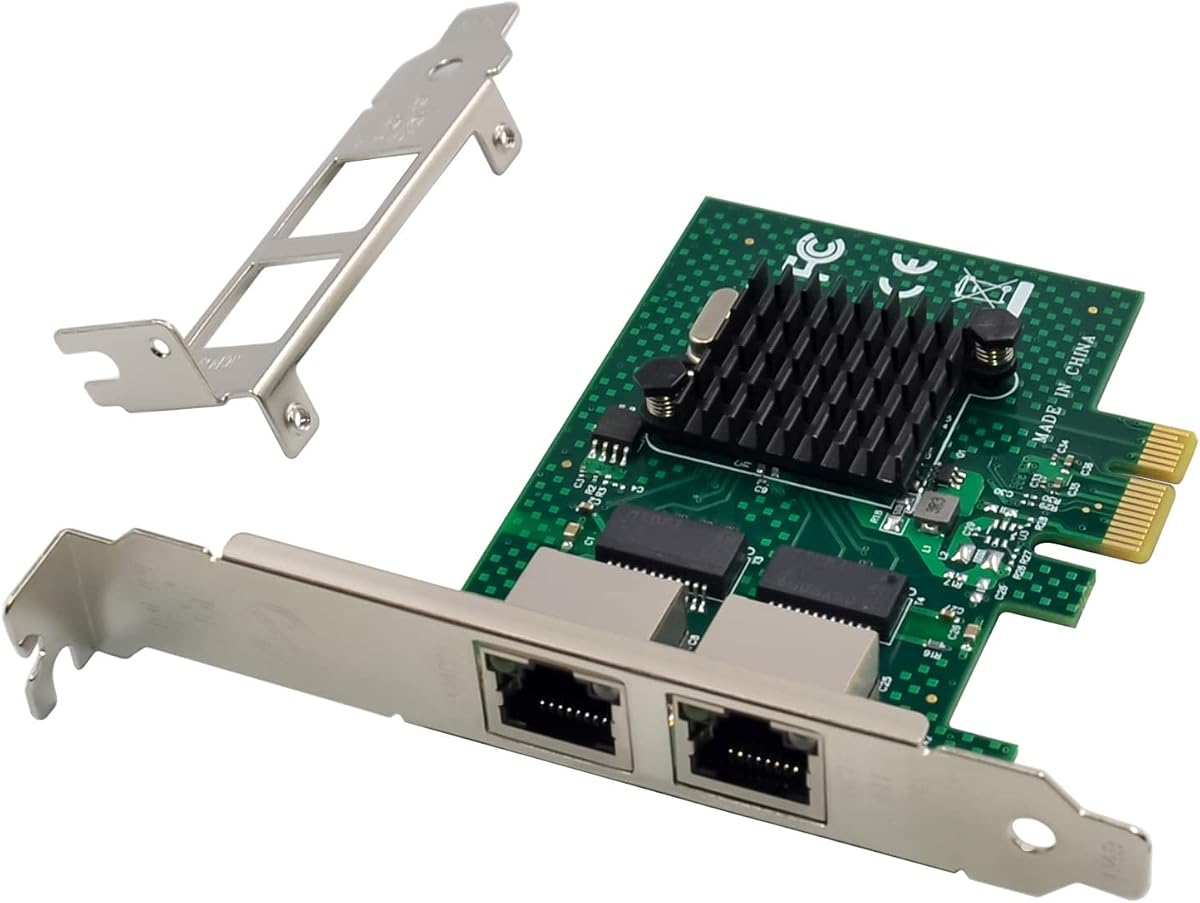
The 10Gtek Intel X540 adapter is a dual-port 10GbE card built around the original Intel X540 controller. It carries a 4.1 rating and stands out for offering two copper RJ45 connections at a 10Gbps target rate. That combination makes it relevant to servers, high-end workstations, and virtualization hosts that need considerably more headroom than conventional dual-gigabit adapters.
We may earn a commission when you buy through this link, at no additional cost to you.
Its primary strength is the X540 controller's support for server-oriented functions, including intelligent offloads, iSCSI, FCoE, and NFS. The card uses a PCI Express 2.1 x8 interface and works in PCI Express x8 or x16 slots. Category 6A cabling can carry the full 10Gbps rate over distances of up to 100 meters, while Category 6 is listed as usable up to 55 meters.
The operating-system list is extensive, covering Windows Server editions, Windows 7 through 10, Linux, and ESX or ESXi. Windows 11 can also be used, although the product information specifically says it requires manual setup and recommends contacting the seller for an installation guide. A full-height bracket is supplied, and a separate low-profile bracket supports compact servers and small-form-factor systems. Hot swapping is not supported.
This is a sensible choice for buyers who specifically want 10GbE over copper but do not need the newest controller generation. The most important checks are motherboard slot availability, physical clearance, operating-system driver support, and the quality of the network switch and cabling. Buyers seeking straightforward plug-and-play behavior on current desktops may prefer the newer 2.5GbE I226-V option.
Two independent 10GbE RJ45 ports provide useful bandwidth for storage traffic, virtualized workloads, and multi-tenant server connectivity. The X540 controller's intelligent offload capabilities can reduce unnecessary host processing and help stabilize demanding network workloads.
Category 6A can support the advertised 10Gbps connection over the stated 100-meter distance, which is useful in offices and data centers where fiber infrastructure is unavailable. Category 6 remains possible for shorter runs, but cable quality and installation should be checked carefully.
We may earn a commission when you buy through this link, at no additional cost to you.
The Intel I226-V dual-port adapter is the most versatile option in this guide, combining 2.5GbE throughput with broad platform support and a compact PCI Express footprint. Its 4.6 rating reflects a favorable balance of performance, compatibility, and hardware practicality. Each RJ45 port supports 2500BASE-T as well as 1000BASE-T, 100BASE-TX, and 10BASE-T, allowing the card to work with a wider range of switches and network devices.
We may earn a commission when you buy through this link, at no additional cost to you.
The seller describes the I226-V as the successor to the discontinued I225-V, with identical general functionality and improvements in error rates, packet stability over longer cables, transmission accuracy, and active power consumption. The card uses PCIe 3.1 with a 5GT/s x1 lane configuration. Because it has only one lane, it can fit systems that lack a wide x8 or x16 slot while still offering two physical connections.
Windows 10 and 11, Linux kernels, RHEL, Ubuntu, FreeBSD, VMware ESXi 7 and 8, DPDK, OpenWrt, Unraid, and Proxmox are listed as supported. PXE operation is also included. A low-profile bracket is provided for compatible desktop, server, and workstation cases. Most importantly, the product information recommends checking the motherboard compatibility list and BIOS before purchase, because the operating system alone does not guarantee that the I226-V will be recognized by the platform.
This card is the strongest general recommendation for a user who wants more than 1GbE without jumping directly to 10GbE equipment. It suits NAS systems, compact servers, editing workstations, and virtualization hosts that can also use 1GbE equipment during a gradual network upgrade. Pair it with a switch and clients that support 2.5GbE if the goal is to realize its headline speed.
The 2.5GbE rate offers a meaningful improvement for large file transfers, network storage, and busy virtualized hosts without demanding a complete 10GbE infrastructure. Backward-compatible 1GbE operation makes the card useful during phased upgrades.
A PCIe x1 footprint makes this adapter easier to accommodate than many dual 10GbE cards, while the supplied low-profile bracket expands its usefulness in compact systems. Verify slot layout, clearance, and chipset support before installation.
We may earn a commission when you buy through this link, at no additional cost to you.
The VIMIN 10G card combines the Intel X540-T2 with two 10GbE RJ45 ports and earns a 4.5 rating. It targets high-speed data transmission in servers and high-end devices, making it most appropriate where a switch, cabling, and endpoints can support 10Gbps. Its full 10GbE positioning is a deliberate choice rather than a general-purpose multigigabit design.
We may earn a commission when you buy through this link, at no additional cost to you.
The adapter supports PCI Express x8 and x16, allowing it to operate in either type of slot. Its gold-finger connector is intended to support reliable electrical contact and resistance to oxidation. A heat sink is included to control temperatures during heavy use, and both standard and slim brackets are supplied to accommodate different server and device heights.
Compatibility is listed across Windows and Windows Server, Linux, and VMware. A significant limitation appears in the product details: 2.5Gbps and 5Gbps speeds are not supported. If connected equipment uses one of those rates, the card falls back to 1Gbps. This makes a careful check of every intended switch, router, and client especially important.
The VIMIN is a solid alternative for users who want the X540 platform and dual copper 10GbE ports in a straightforward server adapter. It is less appropriate for a mixed-speed office network still transitioning to multigigabit Ethernet. Buyers should match it to 10GbE-capable infrastructure and confirm that the host supports the appropriate driver and physical bracket arrangement.
The included heat sink helps the adapter maintain appropriate operating temperatures under sustained traffic. This is particularly relevant in server environments where a card may handle continuous transfers rather than occasional desktop connections.
The lack of 2.5GbE and 5GbE modes simplifies performance expectations but limits flexibility with mixed equipment. A network designed around 1G and 10G endpoints will benefit most from this card.
We may earn a commission when you buy through this link, at no additional cost to you.
This dual-port Intel 82575/82576 adapter delivers two 1GbE RJ45 connections at a focused, budget-friendly level. Its 4.4 rating makes it a practical choice for adding ports to a compatible server or workstation without paying for 10GbE hardware. The card is especially interesting for management tasks, operating-system deployment, and environments where two independent gigabit links are more important than extreme throughput.
We may earn a commission when you buy through this link, at no additional cost to you.
The PCI Express 2.1 interface operates at 2.5GT/s with an x1 lane, and the card can be installed in x1, x2, x4, x8, or x16 physical slots. Standard and low-profile configurations are listed. Server-oriented capabilities include IPMI pass-through through SMBus or NC-SI, iSCSI boot, Wake-on-LAN, PXE remote boot, VLAN filtering, SNMP, and RMON.
Operating-system support spans Windows versions from XP through Windows 8, several Windows Server releases, Linux, FreeBSD, DOS, Novell NetWare, UnixWare or OpenUnix, Sun Solaris x86, and OS Independent VMware ESX. The seller specifically notes that VMware ESXi 7.0 and later are not supported. That restriction should be checked against any planned virtualization platform.
For a buyer adding redundant management connectivity, a dual-port 1GbE adapter, or remote deployment support, this is a sensible selection. It is not intended to replace multigigabit or 10GbE networking. The included alloy heat sink assists with temperature control, while the compact PCIe interface makes installation easier in older and mid-range server systems.
PXE boot, iSCSI boot, Wake-on-LAN, and IPMI pass-through make this card more useful than a basic desktop expansion adapter. These functions are valuable when technicians need remote installation, out-of-band management integration, or segmented network access.
The x1 lane and broad physical-slot compatibility allow use in systems that lack modern expansion bandwidth. Legacy operating-system support is extensive, but newer ESXi releases are an explicit exception.
We may earn a commission when you buy through this link, at no additional cost to you.
The 10Gtek Intel 82576 card provides dual 1GbE RJ45 connectivity in a PCIe form factor and holds a 4.4 rating. It is based on the original Intel 82576 controller with intelligent offload support, making it a familiar option for extending an older server or workstation. The card is compared with the Intel E1G42ET in the supplied product information.
We may earn a commission when you buy through this link, at no additional cost to you.
Both copper ports can work with Category 5 or better cable over distances of up to 100 meters. The card uses PCI Express 2.0 with 2.5GT/s and an x1 lane. A standard profile bracket is included along with a low-profile bracket for small-form-factor computers and servers. Hot swapping is not supported, so network cables should be connected or moved only when appropriate for the system.
The listed operating systems include Windows Server 2003, 2008, and 2012, Windows 7, 8, 10, Vista, and XP, Linux, and VMware ESX. The product information explicitly states that VMware ESXi 7.0 and above are not supported. Drivers may be downloaded from Intel's website, providing a familiar route for administrators familiar with this controller family.
This adapter is best for adding reliable dual-gigabit access to a compatible system, particularly when existing cabling is already suitable. It lacks the speed of the 2.5GbE and 10GbE alternatives but can be a more effective fit where port count, remote-management functions, or legacy support matter more. Confirm current ESXi and driver requirements before ordering.
The 82576 controller is well established in dual-port server networking. Its intelligent offload support can help offload routine packet processing, improving host efficiency while maintaining straightforward compatibility with common enterprise systems.
Support for Category 5 cabling over the full stated 100-meter range makes installation easier where established copper infrastructure is already in place. The low-profile bracket helps the card fit compact server and workstation chassis.
We may earn a commission when you buy through this link, at no additional cost to you.
This 10Gtek dual-NIC combines the Intel 82576 controller with two gigabit RJ45 ports and a 4.5 rating. It is positioned as a straightforward way to add dual connectivity to a desktop, server, or compatible workstation. The controller supports Quality-of-Service technology, intended to prioritize appropriate traffic and improve the consistency of network-dependent applications.
We may earn a commission when you buy through this link, at no additional cost to you.
The ports support 10, 100, and 1000Mbps data rates over Category 5e or better cable up to 100 meters. The PCI Express 2.0 interface uses an x1 lane but fits physical x1, x4, x8, and x16 slots. Both low-profile and full-height brackets are included, making this one of the more mechanically adaptable options in the guide.
The operating-system list is extensive: Windows 7 through 11, several Windows Server versions from 2008 through 2019, CentOS and RHEL, Ubuntu, Debian, FreeBSD, VMware ESXi 5 and 6, and SLES 11 and 12. Mac OS and bypass mode are not supported. Importantly, the manufacturer recommends obtaining drivers from Intel's website or scanning the QR code printed on the card.
The card is a sensible recommendation for users who need dual 1GbE ports and values broad platform support. It fits well in a management server, general-purpose office system, or compact workstation where two wired links provide more organization than a single port. Those wanting a substantial bandwidth increase should move to the 2.5GbE I226-V or a 10GbE X540 model instead.
Quality-of-Service support is a useful addition for environments where selected applications need more predictable handling than ordinary traffic. The card's two-port layout also permits separate physical network connections.
Including both full-height and low-profile brackets reduces the chance of a mechanical mismatch. Buyers should still compare the card's dimensions, slot position, and clearance with their system before purchase.
We may earn a commission when you buy through this link, at no additional cost to you.
The Gigaplus X540-T2 is a premium-oriented dual 10GbE adapter with a 4.6 rating and a broad server feature set. It uses an Intel X540 controller to provide two independent RJ45 connections rated up to 10Gbps. That makes it a strong candidate for servers, storage systems, and advanced workstations that handle sustained high-volume traffic.
We may earn a commission when you buy through this link, at no additional cost to you.
The card uses PCI Express 2.0 with a 5GT/s x8 interface and is compatible with x8 and x16 physical slots. It supports 100Mbps, 1Gbps, and 10Gbps rates, with 10GbE as the headline mode. A standard bracket and a low-profile bracket are included, allowing use across desktops, workstations, servers, and mini-towers. Drivers can be installed through a QR code or obtained from Intel's website.
Compatibility includes Windows Server 2003, 2008, and 2012, Windows 7 through 11, Linux, VMware, ESX, and ESXi. The card description refers to multiple independent Ethernet ports and highlights stable 10GbE connectivity for server applications. Lifetime technical support is also offered, adding useful reassurance for a component intended for infrastructure rather than casual browsing.
Among the 10GbE choices, this is a compelling all-around package because it combines the familiar X540 architecture, 10G copper connectivity, broad OS coverage, and two bracket options. Its main limitation is infrastructure cost: all intended endpoints and switches should support 10GbE, or links will negotiate at the supported lower rates. It is best for users who have already planned a 10GbE network.
Separate 10GbE ports can support multiple network roles, segmented management access, or a multi-connection storage plan. The X540 platform is particularly well suited to servers that already use Intel networking components.
The two included brackets and x8 or x16 slot compatibility give administrators more installation options than a narrow workstation-only card. Verify airflow, slot spacing, and operating-system driver requirements in the target machine.
We may earn a commission when you buy through this link, at no additional cost to you.
The H!Fiber X540-BT2 offers two 10GbE copper ports and a 4.5 rating, combining server-oriented capabilities with broad platform support. Its Intel X540-BT2 controller supports Quality-of-Service functionality and is presented as a comparison to the Intel X540-T2. It is aimed at systems that need more than ordinary gigabit throughput without requiring SFP-based networking.
We may earn a commission when you buy through this link, at no additional cost to you.
The adapter uses PCI Express 2.1 with a 5GT/s x8 lane and fits x8 or x16 slots. It supports 10Gbps, 1Gbps, and 100Mbps, while 2.5Gbps and 5Gbps are explicitly excluded. Category 6A cable is supported, allowing the card to integrate with conventional copper network infrastructure where appropriate cable quality and distance are maintained.
Listed operating systems include Windows 7, 8, and 10, Windows Server 2008, 2012, 2016, and 2019, CentOS and RHEL, Ubuntu, Debian, FreeBSD, VMware ESXi 6 and 7, and SLES 11 and 12. Mac OS and bypass mode are not supported. Windows 11 can work when its driver is set up correctly, but the product details direct buyers to the main images or video for that procedure.
This H!Fiber card is a good option for a server needing two 10GbE RJ45 ports, particularly where the infrastructure already uses Category 6A cabling. The absence of intermediate multigigabit rates means it should be matched carefully to network equipment. Its bracket selection, OS breadth, and QoS support make it more server-ready than a simple dual-port desktop adapter.
The controller's QoS support can help administrators give selected applications more predictable network treatment. This is useful in servers carrying mixed voice, management, storage, and ordinary data traffic.
Cat6A support makes 10GbE over copper practical across a wider portion of an existing building network. Cabling certification, patch-panel quality, and connector installation remain important to achieving reliable results.
We may earn a commission when you buy through this link, at no additional cost to you.
The Intel 82576 dual-port card distinguishes itself with SR-IOV support, making it particularly interesting for virtualized servers. It carries a 4.5 rating and uses a PCI Express 2.0 x4 interface, providing a wider lane configuration than many competing dual-gigabit adapters while retaining compatibility with x4, x8, and x16 physical slots.
We may earn a commission when you buy through this link, at no additional cost to you.
Both RJ45 ports operate at 1GbE, but the controller's broader management feature set is the important consideration. SR-IOV enables direct assignment of network functions to virtual machines in compatible environments. The card also supports IPMI pass-through through SMBus or NC-SI, iSCSI boot, Wake-on-LAN, PXE remote boot, VLAN filtering, SNMP, and RMON. An alloy heat sink is included for thermal management.
The operating-system list includes Windows 7 and 8, Windows 2000, XP, Vista, several Windows Server editions, Novell NetWare, Linux, FreeBSD, DOS, SCO Open Server, UnixWare or OpenUnix, Sun Solaris x86, and OS Independent VMware ESX. As with several older dual-port listings, VMware ESXi 7.0 and later is explicitly not supported.
Choose this card when server virtualization and remote deployment are the priorities, not raw throughput. It can suit a lab, cluster node, or legacy virtualization environment in which SR-IOV passthrough is valuable and 1GbE links are adequate. Buyers running a modern ESXi 7 or 8 environment should instead consider one of the listed cards with explicit current-version support.
SR-IOV can provide virtual machines with more direct access to network functions when the host operating system, hypervisor, motherboard, and device configuration all support the feature. It is a meaningful advantage in carefully designed enterprise virtualization deployments.
PXE boot and iSCSI boot simplify operating-system deployment and network-booted services, while IPMI pass-through and SNMP improve integration with remote infrastructure management. These features make the card useful beyond basic file transfer.
We may earn a commission when you buy through this link, at no additional cost to you.
The Broadcom NetXtreme BCM5720-2P is a dual-port 1GbE server adapter with a 4.6 rating and one of the clearest modern operating-system roadmaps in the group. It provides two RJ45 connections through a compact PCI Express x1 interface and includes a low-profile bracket, making it practical for servers and compact systems that need basic network expansion.
We may earn a commission when you buy through this link, at no additional cost to you.
The card is compatible with x86 and x64 servers using PCIe 1.x and 2.x interfaces. Its physical PCIe x1 connector can also be used in x2, x4, x8, and x16 slots, according to the supplied information. That flexibility makes it useful in older chassis that may not offer a modern high-lane-count expansion card.
The operating-system coverage is a major strength. Listed platforms include CentOS, Debian, Microsoft Windows, Oracle Linux, Oracle Solaris, Red Hat Enterprise Linux, SUSE Linux Enterprise Server, Ubuntu, VMware, VMware ESX with ESXi 5 through 8, VMware vSphere, Windows Hyper-V, and Windows Server. This explicit support for current ESXi generations distinguishes it from several older Intel 82576 listings.
Potential applications include cloud and web servers, private-cloud systems, database servers, machine-learning clusters, high-performance computing environments, multi-node container platforms, and NVMe storage disaggregation. The card does not provide 10GbE, so it is most appropriate where a stable dual-gigabit connection matters more than maximum bandwidth. A 180-day warranty and customer support are also listed.
Explicit support for VMware ESXi 5 through 8, vSphere, and Hyper-V makes this adapter a safer server-oriented choice than older models with limited hypervisor caveats. The host platform must still provide the appropriate driver and device support.
The two 1GbE ports can support management, storage, replication, and public-facing connectivity in appropriate network designs. For data-intensive workloads requiring much greater bandwidth, a 2.5GbE or 10GbE card would be a better fit.
We may earn a commission when you buy through this link, at no additional cost to you.
Selecting a dual RJ45 network card requires matching link speed, controller, PCIe bandwidth, physical design, and software support to the host system. The most important step is to inventory the network equipment and operating system before choosing an adapter.
Begin with the speed of the switches, routers, storage devices, and client machines that will connect to the card. A 1GbE adapter cannot exceed a 1Gbps link and may negotiate at 100Mbps when paired with older or lower-capacity equipment. The 2.5GbE I226-V model supports 2.5Gbps plus 1Gbps, 100Mbps, and 10Mbps, making it suitable for networks that are still transitioning. The X540-based 10GbE options are much faster, but they do not support the intermediate 2.5Gbps or 5Gbps rates, so mixed-speed infrastructure can reduce performance unexpectedly.
The controller determines supported link modes, offload features, operating-system compatibility, and the likelihood that existing management tools will recognize the card. Intel 82576 designs are familiar in older server fleets, while the Intel I226-V offers a newer multigigabit option with explicit compatibility warnings. X540-based cards are oriented toward 10GbE server use. Broadcom BCM5720-2P provides a different controller family with strong listed coverage for modern enterprise platforms. Drivers may be downloaded from Intel or accessed through a QR code, but the exact operating system and kernel version still need confirmation.
PCIe lane width is a common source of confusion. A card designed for an x1 lane can normally operate in a larger physical slot, while an x8 card needs a slot with at least eight usable lanes. The listed I226-V card uses PCIe 3.1 x1, making it a practical choice for compact systems. The 82576 options range from x1 to x4 designs, while the 10GbE X540 cards use x8 and are intended for x8 or x16 slots. Also consider the physical size and location of the connector because full-size server cards can interfere with adjacent expansion hardware.
A server adapter may need more than basic IP connectivity. PXE boot enables network installation or recovery, iSCSI boot can boot systems from network storage, and Wake-on-LAN supports remote power access. IPMI pass-through through SMBus or NC-SI can help integrate the adapter with out-of-band management. VLAN filtering, SNMP, RMON, QoS, and SR-IOV are relevant to segmented enterprise networks and virtualized environments. The 82576 cards provide a strong collection of these features, while the Broadcom model stands out for broad hypervisor support and the X540 options emphasize 10GbE performance.
The card must fit both the PCIe opening and the chassis. Full-height or standard brackets suit many tower servers and desktops, while low-profile brackets are needed in many workstations and small-form-factor systems. Several products include both, but the included hardware does not guarantee compatibility with every enclosure. Check the slot spacing, card height, airflow path, and whether adjacent components obstruct the RJ45 sockets. A heat sink is also useful in sustained-load server environments, particularly for a 10GbE controller operating at its full advertised rate.
RJ45 adapters use twisted-pair copper cabling, and the required category depends on the link rate. The 1GbE cards support Category 5e or better over the stated 100-meter distance. For 10GbE, the X540-based products list Category 6A for up to 100 meters, while Category 6 is listed for shorter distances on the 10Gtek X540 card. Cable quality, patch panels, couplers, and terminations can all affect performance. Avoid unnecessary adapters in high-speed paths and test each cable run when moving to a faster network tier.
Desktop support is not equivalent to server or hypervisor support. Several adapters list older Windows and Linux versions while excluding current ESXi releases. The H!Fiber X540-BT2 lists ESXi 6 and 7, the I226-V model lists ESXi 7 and 8, and the Broadcom BCM5720-2P lists ESXi 5 through 8. Windows 11 may also require special installation steps on older X540 designs. Review the precise product notes, confirm the host's supported driver version, and check BIOS settings before considering the purchase complete.
The advertised port rate is only one part of sustained performance. A card used for file transfers, storage replication, virtual machines, or aggregation can run warm under continuous traffic, making the heat-sink design and case airflow important. The VIMIN and Intel 82576 options specifically mention heat-dissipation features. Ten-gigabit cards also require switches with enough backplane capacity and a topology that avoids oversubscribed uplinks. For light office use, a 1GbE or 2.5GbE card may provide more bandwidth than the host can consume, while storage and virtualization environments benefit from faster links.
Before installation, power down the computer or server, disconnect the power cable, and open the chassis according to the manufacturer's instructions. Identify a compatible PCI Express slot, check whether it is physically x1, x4, x8, or x16, and select the correct bracket for the case. Connect the card to the slot with even pressure, secure the bracket, and reinstall the cover before restoring power.
Install the appropriate operating-system or hypervisor driver. Some cards allow a QR code or Intel website download, while other products use a standard system-recognized driver. If Windows 11 or a virtualization platform requires special configuration, follow the product's installation instructions and confirm that the BIOS or firmware exposes the NIC interface. After installation, connect the RJ45 cables and verify that the link LEDs and operating-system network panel show the expected activity.
Use both ports as separate network interfaces rather than assuming they automatically create one combined connection. The operating system, switch configuration, and application must be configured for link aggregation, bridging, teaming, or traffic separation as needed. For care, keep the connectors clean and dry, avoid bending the plug strain relief, and use certified cables that meet the card's speed requirements. Monitor temperatures and driver updates, and do not hot-swap cables on models that explicitly do not support hot swapping.
A dual RJ45 network card exposes two independent Ethernet connectors through one PCI Express card. That can provide separate network paths, management and production networks, host and storage links, or a connection to two different switches. The ports do not automatically combine into twice the bandwidth; aggregation or another special configuration must be supported and configured by the host, operating system, switch, and application.
It depends on the network equipment and workload. A 2.5GbE card is often more practical for NAS systems, compact servers, and office networks because it can connect to 1GbE and 2.5GbE devices. A 10GbE card is preferable for high-volume storage, virtualization, and aggregation workloads. In this group, the 10GbE X540 options do not support the intermediate 2.5Gbps or 5Gbps rates.
Usually not directly, because most laptops do not expose a user-accessible PCI Express expansion slot. Some compact systems use proprietary modules instead of standard desktop cards. Desktop PCs, servers, and workstations with an accessible PCIe slot are the primary targets for these products. Confirm the chassis design, slot availability, and power requirements before attempting an installation.
Not always. The listed cards range from PCIe x1 and x4 designs to x8 10GbE models. A smaller-lane card may fit in a physically larger slot, while an x8 card requires a slot with at least eight usable lanes. Physical x16 connectors are common on servers, but the key requirement is the number of active lanes, not merely the shape of the slot.
Category 6A is the safest choice for full 10Gbps copper links over longer runs, with the 10Gtek X540 listing support for distances up to 100 meters. Category 6 can work over shorter distances, but the 10Gtek card lists support up to 55 meters. Cable certification, connectors, patch panels, and installation quality all matter, particularly for sustained 10GbE traffic.
Several of the listed 1GbE cards explicitly support Windows 11, but the easiest installation experience comes from a model whose product information directly confirms that support and provides a driver path. Older X540-based cards may work in Windows 11 after manual driver configuration. Confirm the exact card, driver source, and installation steps before relying on plug-and-play behavior.
They can, but the usable experience depends on the controller, hypervisor, host configuration, and desired sharing method. The Intel 82576 SR-IOV option explicitly supports SR-IOV, which can provide direct function access in compatible environments. Other cards may rely on virtual switches or shared networking. The Broadcom BCM5720-2P lists ESXi 5 through 8, Hyper-V, and VMware vSphere support.
The card provides two physical RJ45 connections. Each can connect independently to a switch, router, or other Ethernet device, and the host operating system will generally display them as separate network interfaces. They do not create a single 2GbE, 5GbE, or 20GbE connection without supported link aggregation and appropriate configuration on both ends.
The Intel I226-V dual-port card is the most versatile selection in this guide because it combines 2.5GbE, backward compatibility, a compact PCIe x1 interface, and broad platform support. The Intel 82575/82576 dual-gigabit model is the value-focused choice for remote boot, management, and legacy infrastructure, while the Gigaplus X540-T2 is the premium 10GbE option for servers ready to use full 10G copper networking.
Prioritize the network path before the card. Confirm the maximum speed of switches and endpoint devices, check motherboard and BIOS compatibility, verify PCIe lane and bracket requirements, and ensure the operating system or hypervisor has suitable driver support. Users needing intermediate multigigabit modes should strongly consider the I226-V, while those with 10GbE infrastructure can compare the X540 models by bracket support, operating-system list, and management features.
Finally, confirm current product details, availability, and pricing before purchasing because network hardware, driver support, and deals change over time. The most capable card is not automatically the most suitable one. A well-matched dual RJ45 adapter that fits the chassis, negotiates the intended link rate, and works reliably with the host software will provide the most useful result.