
Rokinon DSX85 DSX 85mm T1.5
4.7Editor score
Full-frame 85mm prime
T1.5 to T34 aperture
Nine-aperture-blade iris
Canon EF mount
Our Cine Lens guide compares 10 options for image quality, aperture, focus control, coverage, mounts, and production value.
Cine lenses give filmmakers and videographers dedicated manual-focus optics designed for consistent exposure, smooth focus pulls, and a cinematic visual approach. Important choices include image-circle coverage, maximum aperture, focus rotation, gear positioning, mount compatibility, and whether a prime or zoom better suits your particular production demands.
This guide compares ten cine lenses spanning full-frame and Super35 coverage, single primes, focal-length kits, and a parfocal zoom. We evaluated the supplied specifications, customer ratings, optical design details, aperture ranges, focusing features, physical characteristics, and stated production applications to help creators identify the right tool for their camera system.
Each review highlights the lens that stands out within the list, followed by its most useful strengths, practical limitations, and ideal owner. Ratings and product information reflect the supplied listings, while availability and pricing can change over time, so readers should confirm current details before making a purchase.
4.7Editor score
5.0Editor score

5.0Editor score
The comparison below places all ten lenses side by side, focusing on the practical distinctions that matter most: coverage, aperture, mount, optical construction, and focusing workflow.



The Rokinon Cine DS DS85M-C 85mm T1.5 is a full-frame Canon EF prime built for filmmakers who want strong background separation and a traditional cinema-style image. Its supplied customer rating is 4.5, and its most appealing attributes include a broad T1.5 aperture, full-frame coverage, and an eight-blade diaphragm designed to produce attractive bokeh when the situation allows.
We may earn a commission when you buy through this link, at no additional cost to you.
The DS range is engineered with color matching, unified gear positions, and consistent aperture placement across compatible Rokinon Cine DS lenses. Those details can simplify a multi-lens production by reducing the need for adjustment between lenses. This particular optic provides a 28.3-degree angle of view on full frame and 17.7 degrees on APS-C, with a minimum focusing distance of 3.6 feet and a 72mm filter size.
The main tradeoff is that the lens is manual-focus and limited to Canon EF. Its T1.5 aperture is extremely useful in dim locations, but shallow depth of field can make precision focus pulls demanding. The eight-blade iris also does not offer the same naturally rounded out-of-focus highlights associated with more rounded blade counts, although it can still deliver a pleasing cinematic texture.
This is an attractive option for portraits, narrative work, interviews, and any Canon EF production that benefits from a compressed 85mm perspective. It is particularly suitable for creators building a matched DS lens set. Buyers who work across several camera systems should consider a lens with an interchangeable or more broadly supported mount instead.
The T1.5 maximum aperture gives the 85mm prime a strong low-light advantage and allows a shallow depth of field. That makes it useful for isolating faces, product details, and foreground elements from a visually active background.
Color matching and unified gear and aperture positions are especially valuable when the lens joins other Rokinon DS optics. These shared physical characteristics support a more consistent setup and reduce unnecessary changes during a shoot.
We may earn a commission when you buy through this link, at no additional cost to you.
The ROKINON CINE DS T1.5 Cinema Lens Kit provides 24mm, 35mm, 50mm, and 85mm primes for Canon EF full-frame cameras. It carries a supplied customer rating of 4.9 and stands out as the most complete focal-length selection in this guide, giving creators a practical core set without requiring four separate lens purchases.
We may earn a commission when you buy through this link, at no additional cost to you.
Every lens in the kit shares a T1.5 maximum aperture, extends to T22, and uses a multi-layer coating intended to reduce flare. Dual-side focus scales, T-stop markings, and de-clicked aperture rings support smooth manual operation. Because the set spans wide, normal, short telephoto, and portrait-oriented perspectives, it can cover establishing shots, interviews, movement, and portraits.
The trade-off is that a four-lens kit is less flexible than choosing only the focal lengths you need. It is also restricted to Canon EF, so it does not serve mirrorless shooters unless they have an appropriate adapter. As with other manual cinema primes in the list, accurate focus and deliberate aperture changes require practice.
This kit is best for a Canon filmmaker who wants a broad working set for narrative, documentary, or commercial productions. Its matched design and broad focal range may offer more immediate creative flexibility than a single 85mm, 35mm, or 24mm lens.
The 24mm, 35mm, 50mm, and 85mm options cover commonly used documentary and narrative angles. This reduces lens changes and gives a small crew a practical range of compositions with the same T1.5 exposure baseline.
De-clicked aperture rings and clearly marked T-stop scales are designed for deliberate exposure changes. These controls suit operators who want consistent, repeatable manual adjustments rather than camera-managed aperture behavior.
We may earn a commission when you buy through this link, at no additional cost to you.
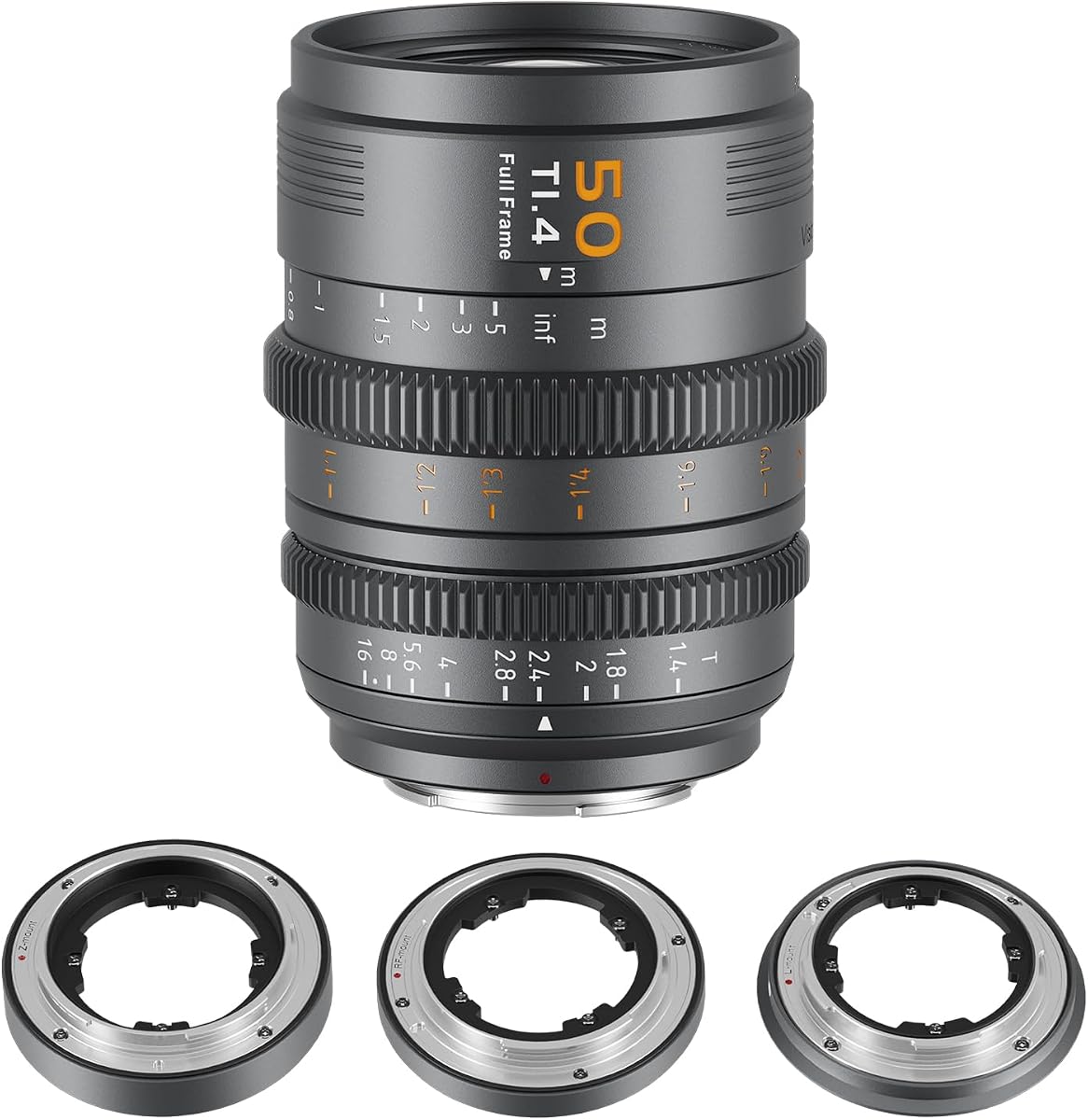
The SIRUI VP-1 Vision Prime 1 50mm T1.4 combines full-frame coverage with a flexible interchangeable mount system, and its supplied rating is 5.0. It is the most broadly adaptable prime in the list, with a preinstalled E mount and user-interchangeable RF, Z, and L options for supported camera systems.
We may earn a commission when you buy through this link, at no additional cost to you.
The optical design incorporates aspherical elements, advanced ED glass, and HRI glass to target sharpness and control distortion and chromatic aberrations for high-resolution workflows. Its T1.4 aperture supports low-light shooting, subject separation, and soft bokeh. The lens also joins a standardized set with a shared 67mm filter thread, 72mm outer diameter, matched color temperature, and uniform gear positioning.
The principal compromise is the manual-focus workflow, which demands coordination of the focus ring, aperture, and camera exposure. Switching mounts also means handling a removable lens rather than using a permanently attached model. At around 600 grams, the aluminum body is designed to remain portable for travel, documentary work, and handheld or gimbal operation.
This lens is a strong recommendation for a creator who changes camera ecosystems or wants one modern 50mm prime to cover many systems. It is also compelling for compact full-frame builds where a standard T1.5 lens may feel too large or restrictive.
The interchangeable mount concept is particularly useful for mixed production environments. Rather than committing to one camera brand, a creator can change the lens mount to suit supported E, RF, Z, or L bodies.
Aspherical, ED, and HRI elements form a modern optical strategy aimed at high-resolution output and aberration control. That makes the prime relevant to filmmakers working with 8K cameras or demanding delivery formats.
We may earn a commission when you buy through this link, at no additional cost to you.
The Rokinon 35mm T1.5 Cine DS is a full-frame Canon EF prime with a supplied rating of 4.6. Its 35mm focal length offers a balanced field of view for documentary work, interviews, handheld production, and scenes that need enough perspective to establish an environment without the exaggeration of an ultra-wide lens.
We may earn a commission when you buy through this link, at no additional cost to you.
The T1.5 to T22 aperture range, unified DS gear and aperture positions, and color matching allow it to work efficiently alongside other Rokinon Cine DS lenses. It has a 63.1-degree angle of view on full frame and 40.8 degrees on APS-C. A minimum focusing distance of 12 inches gives the lens useful close-focus potential, while its filter size is 77mm.
The tradeoff is that the broad T1.5 aperture and close focusing distance can create a very thin depth of field, making manual focus more exacting. The Canon EF mount also limits native compatibility compared with the SIRUI VP-1's interchangeable system. Those constraints may matter for crews working across multiple camera brands.
The 35mm is a compelling choice for Canon EF filmmakers who need a versatile focal length, low-light capability, and the practical benefits of a matched DS set. It is especially useful for interviews, observational sequences, run-and-gun documentary work, and compact productions.
A 35mm lens can accommodate a person and meaningful environmental context without the extreme spatial exaggeration of a very wide prime. This makes it a versatile focal length for interviews, establishing shots, and moving cameras.
The listed 12-inch minimum focusing distance allows the lens to work with nearby subjects. It can provide detail-oriented compositions and reduce the need to switch to a dedicated close-up lens for many production situations.
We may earn a commission when you buy through this link, at no additional cost to you.
The SIRUI Night Walker 35mm T1.2 is a Super35 manual-focus cine prime for Sony E cameras, with a supplied rating of 4.4. Its defining feature is the T1.2 maximum aperture, which offers exceptional light gathering for night scenes, available-light work, and portraits with pronounced background separation.
We may earn a commission when you buy through this link, at no additional cost to you.
The lens is described as equivalent to a 49mm full-frame lens in its intended S35 use. It includes 11 elements in 10 groups, a 12-blade aperture, a 0.4-meter minimum focus distance, a 270-degree focus-ring rotation, and a 67mm filter specification. The listed dimensions are 79mm in maximum diameter and 84mm in length.
Its limitations are equally clear. This is an S35 lens rather than a full-frame model, and it uses a fixed Sony E mount. The very wide T1.2 aperture also produces a shallow depth of field, so the 270-degree focus ring must be operated with care. The stated low-noise benefit assumes the camera is exposed appropriately rather than relying on a high ISO setting.
This Night Walker is a compelling match for Sony E filmmakers who regularly work in low light or want a natural 35mm field of view on an S35 sensor. Its light weight and fast aperture also suit travel, documentary, and compact-camera productions.
The T1.2 aperture is the defining benefit of this Night Walker model. It can provide a bright exposure in difficult lighting and gives filmmakers more flexibility than a typical kit zoom with a narrower maximum aperture.
The 270-degree focus-ring rotation supports deliberate, fine adjustments. This broad rotation can be helpful when making repeatable focus moves, although it also gives the operator plenty of room to overshoot with rapid movements.
We may earn a commission when you buy through this link, at no additional cost to you.
The SIRUI Night Walker 24mm T1.2 gives Canon RF filmmakers a wide Super35 perspective with a supplied rating of 4.3. It is aimed at landscapes, street scenes, interiors, and environmental storytelling, where a broad field of view can establish location while retaining enough visual control for deliberate compositions.
We may earn a commission when you buy through this link, at no additional cost to you.
The T1.2 aperture gathers substantial light and can create a smooth separation between the subject and background. A 0.3-meter minimum focusing distance allows the operator to work with nearby details, while the 270-degree focus rotation supports precise manual adjustments. Listed compatibility includes the RED KOMODO, EOS R7, R10, C70, and R50.
The central compromise is coverage. This is an S35 cine lens, so it does not offer the full sensor coverage of the Rokinon DS and SIRUI VP-1 models in the list. Its T1.2 aperture and close-focus capability also make depth of field very thin, increasing the importance of measured focus marks and steady camera or lens movement.
The 24mm is best for RF shooters who need environmental width, low-light capability, and close-focus flexibility. It is a natural choice for handheld narrative work, travel films, architectural interiors, and sequences where the setting is as important as the person in front of the camera.
The 24mm perspective gives a production room to include surroundings and create spatial context. It can work for street sequences, interiors, landscapes, and group arrangements without requiring an ultra-wide view.
The T1.2 aperture provides a creative combination of exposure flexibility and shallow focus. It can illuminate dim scenes while allowing the background to fall away softly, though careful focus placement becomes essential.
We may earn a commission when you buy through this link, at no additional cost to you.
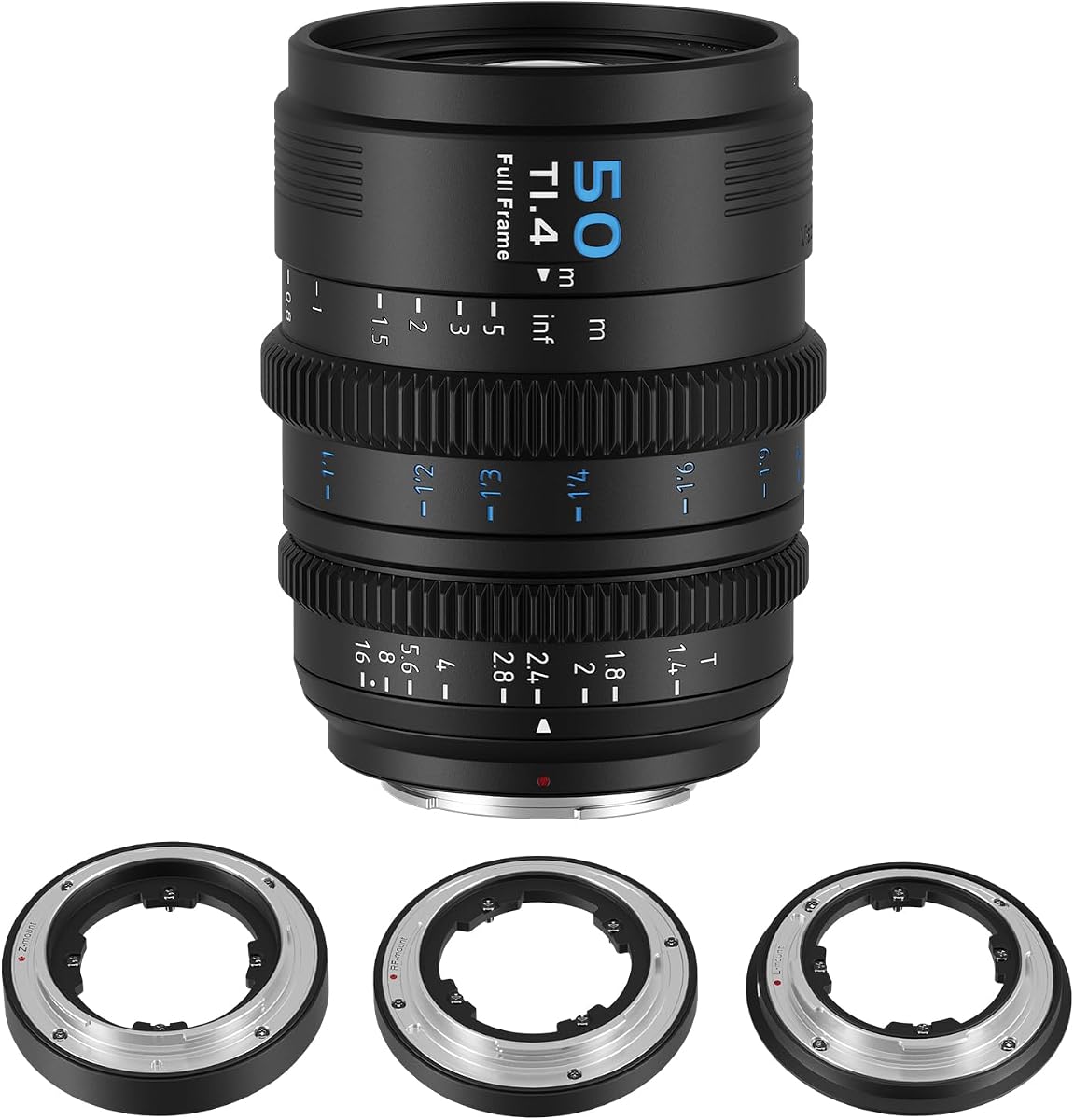
This SIRUI VP-1 Vision Prime 1 50mm T1.4 listing offers the same full-frame, interchangeable-mount concept as the higher-ranked VP-1 entry, but it has a supplied rating of 4.0. The 50mm focal length is a conventional production choice for interviews, narrative scenes, controlled compositions, and a natural perspective on full-frame cameras.
We may earn a commission when you buy through this link, at no additional cost to you.
Its design includes aspherical, ED, and HRI elements intended to deliver edge-to-edge sharpness while minimizing distortion and chromatic aberrations. The T1.4 aperture serves low-light and shallow-depth-of-field applications, while a 67mm filter thread, 72mm outer diameter, matched color treatment, and common gear position support use with the rest of the VP-1 lineup.
This option is not a full-frame cinema lens, so it does not provide the continuous focus adjustment some modern hybrid cameras offer with compatible lenses. It also requires manual switching of E, RF, Z, or L mounts, and the body should be handled carefully during those exchanges. The shared 50mm focal length can be limiting for a creator who needs wide and long alternatives.
The lens is well suited to a creator who values a standard 50mm perspective, modern high-resolution optics, and cross-system compatibility. It is a particularly practical choice for documentary, commercial, and travel work where one strong general-purpose prime needs to cover many situations.
The 50mm focal length is familiar enough to make framing intuitive while retaining a full-frame sense of depth. It works well for people-centered scenes without the exaggerated proportions of a very wide lens.
The roughly 600-gram aluminum design is intended to remain manageable on travel, documentary, gimbal, and handheld builds. Full-frame capability and portable construction make it a practical standard production tool.
We may earn a commission when you buy through this link, at no additional cost to you.
The SIRUI Night Walker 24mm T1.2 for Micro Four Thirds cameras has a supplied rating of 4.9 and a strong proposition for compact, low-light filmmaking. Its 24mm S35 perspective is described as equivalent to a 34mm full-frame lens, giving Micro Four Thirds users more traditional environmental framing than a typical wide kit-lens equivalent.
We may earn a commission when you buy through this link, at no additional cost to you.
The T1.2 aperture supports night scenes and available-light productions while contributing to background separation and expressive bokeh. The optical structure contains 12 elements in 11 groups, and the lens includes a 12-blade aperture, 0.3-meter minimum focus distance, 67mm filter specification, and 270-degree focus-ring rotation. Its aluminum housing is described as sturdy and lightweight, at around 500 grams per lens.
The key limitations are S35 coverage and the fixed Micro Four Thirds mount. Users who need full-frame coverage or routinely switch between camera systems should look elsewhere. The T1.2 aperture also creates a narrow focus plane, making smooth manual operation and accurate marks particularly important.
This lens is a good fit for Micro Four Thirds filmmakers who work with Blackmagic, Panasonic, or Z Cam bodies and want a fast, wide cinema prime. It can be especially useful for travel, documentary, nighttime narrative, and compact gimbal-based work.
The stated 34mm full-frame-equivalent perspective provides a familiar field of view on a Micro Four Thirds camera. Creators can obtain environmental compositions without carrying the much wider view associated with many standard zoom kits.
A T1.2 maximum aperture and 12-blade iris pair bright exposure with a rounded-looking potential for out-of-focus highlights. The result is particularly useful for expressive low-light images and controlled subject separation.
We may earn a commission when you buy through this link, at no additional cost to you.
The Rokinon DSX85 DSX 85mm T1.5 is a full-frame Canon EF prime with a supplied rating of 4.7. It offers a useful combination of portrait-friendly compression, a T1.5 maximum aperture, and a relatively straightforward setup, making it a practical value choice for filmmakers who need one expressive telephoto lens.
We may earn a commission when you buy through this link, at no additional cost to you.
Its optical construction uses nine elements in seven groups and ultra multi-coated glass. The aperture spans T1.5 to T34, uses nine blades, and accepts 72mm filters. The listed angle of view is 28.4 degrees on full frame and 19.1 degrees on APS-C, supporting a classic portrait and subject-isolation perspective.
Its limitations are straightforward: manual focus requires practice, and the lens is limited to Canon EF. The T1.5 opening is highly useful but can make the depth of field extremely shallow at close distances and wide apertures. The nine-blade iris is also less rounded than the 12-blade designs found in the Night Walker models.
The DSX85 is best for Canon EF creators working on portraits, interviews, narrative details, and compressed compositions. It also makes sense as a complement to wider lenses because a distinct 85mm perspective can provide visual variety without a large zoom.
The 85mm focal length naturally compresses facial features and isolates a subject from the background. Paired with T1.5, it gives filmmakers strong control over depth and visual emphasis.
A nine-element optical construction, standard 72mm filter size, and broad T-stop range keep the lens approachable. It provides the essential tools of a fast prime without the complexity of a zoom.
We may earn a commission when you buy through this link, at no additional cost to you.
The DZOFILM Pictor 50-125mm T2.8 Super35 is a parfocal cine zoom with a supplied rating of 5.0. It offers a distinctly different proposition from the prime lenses in this guide: one zoom can cover wide, standard, and telephoto framings while preserving focus as the focal length changes.
We may earn a commission when you buy through this link, at no additional cost to you.
The lens maintains focus across its complete zoom range and is described as having minimal breathing, both of which can improve the predictability of a live shoot. Its aperture spans T2.8 to T25, and the 16-slat iris is designed for a more rounded out-of-focus appearance. Compatibility with standard cinema lens accessories supports use with compatible PL or Canon EF camera systems.
The tradeoff is size and weight compared with a dedicated prime. A zoom is not as specialized for maximum aperture, extreme close focus, or the lightest possible rig. Its Super35 coverage also makes it less versatile for full-frame projects than several competing entries. These are meaningful considerations for crews traveling with minimal gear.
The Pictor is an excellent choice for narrative crews, event filmmakers, and documentary teams that value quick reframing. The parfocal design is particularly helpful during interviews, live events, and controlled studio scenes where a change in focal length should not alter the focus plane.
A parfocal zoom retains the same focus distance as the focal length changes. That feature can save time during interviews, live productions, and any setup where rapid composition changes are likely.
The 16-slat iris offers a rounder shape than many conventional diaphragm designs. When the lens is defocused, that geometry can help create smoother circular highlights and a more cinematic background texture.
We may earn a commission when you buy through this link, at no additional cost to you.
Choosing a cine lens means balancing image-circle coverage, camera compatibility, exposure range, focus behavior, and production workflow. The right lens should fit the sensor, camera, subjects, and shooting conditions rather than simply offering the largest aperture or longest focal length.
Match coverage to the camera you actually use. Full-frame models offer broader compatibility with large sensors, while S35 lenses are designed around compact cinema sensors and APS-C cameras.
Confirm the mount before considering anything else. A flexible interchangeable design can save money and effort, but every camera still needs full compatibility with the lens's coverage and intended use.
Choose the aperture for your lighting and focus tolerance. Maximum light is useful in darkness, while a narrower opening makes manual focusing more forgiving.
Use primes for maximum aperture control and compact focal-specific rigs. Choose a parfocal zoom when rapid reframing and dependable focus retention matter more than portability.
Prioritize clear markings and useful rotation. A well-controlled manual ring can make precise focus pulls easier, especially with a shallow depth of field.
Look for more blades when smooth highlight shapes matter. The final bokeh still depends on the entire optical and exposure setup.
Matched lenses save time and prevent visual shifts. If mixing brands, standardize profiles, exposure habits, and physical accessories to keep the look consistent.
Balance the complete rig, not just the lens. For handheld and gimbal work, weight and handling can be as important as optical performance.
Begin by confirming the mount, sensor coverage, and required adapter, then attach the lens according to the camera manufacturer's instructions. Remove the rear cap only when ready to mount, keep the optical glass protected from dust and direct contact, and avoid rotating the front element while attaching or removing a filter. Once mounted, check that the lens is securely seated and that any follow-focus or accessory support is correctly clamped without excessive pressure.
Establish focus and aperture marks for the lenses and shooting distances you expect to use. With manual-focus cine glass, stop down when necessary to increase depth of field, but remember that exposure will change as the aperture is adjusted. On cameras offering exposure compensation, compensate for changes while keeping a consistent exposure strategy. When changing a removable mount on the SIRUI VP-1, power down, protect the contacts and mount flange, and follow the system's installation procedure carefully.
Protect the lens from impact, moisture, dust, and temperature extremes. Use a lens hood or suitable filter for production protection, clean the front and rear elements with an approved optical cloth, and avoid oily fingers on the glass. Store the lens in a padded, dry case and loosen any mechanical adjustment rather than leaving a filter under pressure. Periodically inspect the mount, gear ring, focus ring, and aperture blades for contamination or damage.
A full-frame cine lens is designed to cover a 36mm-by-24mm full-frame sensor, while a Super35 cine lens uses a smaller image circle intended for S35 and APS-C-style sensors. A full-frame lens can usually serve both large and smaller sensors with a corresponding change in field of view. An S35 lens may not cover the corners of a full-frame sensor, so coverage should be verified before changing camera systems.
A T1.2 lens offers a wider maximum aperture and can help in low-light scenes or create shallower depth of field. It does not automatically provide better results, and the extra light comes with a narrower focus plane that can make manual focus more difficult. A T1.5 or T1.4 lens may be easier to operate and still provide strong creative separation.
A parfocal lens keeps the same focus distance while its focal length changes. This makes zooming smooth because the focus plane does not shift noticeably during the adjustment. It is particularly useful for interviews, live events, and fast documentary work where the operator needs to reframe quickly without manually resetting focus.
Only when the mount, image circle, and intended sensor coverage are compatible. The SIRUI VP-1 listing is especially adaptable because it uses an E mount with interchangeable RF, Z, and L options. Most other entries have a fixed mount, so an adapter or separate lens may be needed for another camera system, and adapters can introduce fit, handling, or electronic-function limitations.
A higher blade count generally produces a rounder shape for defocused highlights, which can make highlights appear smoother against the background. The DZOFILM Pictor has 16 slats, the Night Walker lenses have 12, and the Rokinon options have eight or nine. Actual bokeh also depends on focal length, subject distance, sensor size, aperture, and the subject's background.
They require practice, especially with fast apertures and close focus distances. Beginners can make the process easier by using a smaller aperture, marking common focus distances, supporting the lens rig properly, and practicing follow-focus movements. A slower zoom may be more forgiving while learning, whereas a fast prime offers greater light and separation once manual focus becomes comfortable.
One lens is usually the more practical starting point for a limited budget or an uncertain set of subjects. A matched kit is valuable when a production needs several focal lengths and consistency across the set matters. A parfocal zoom can also cover multiple perspectives in a single package, though it adds bulk and generally sacrifices some maximum-aperture performance.
A follow-focus, matte box, lens support, and appropriate filters can support more precise production work. The DZOFILM Pictor is stated to be compatible with standard cinema lens accessories, while shared gear positions and filter sizes across some sets can simplify accessory planning. Choose support equipment that fits the lens diameter without squeezing the barrel or attaching heavy components directly to the rotating focus gear.
The strongest overall recommendation in this guide is the SIRUI VP-1 50mm T1.4 for filmmakers who want modern full-frame optics and interchangeable E, RF, Z, and L mount support. The Rokinon Cine DS four-lens kit stands out for productive Canon EF coverage across four common focal lengths, while the DZOFILM Pictor 50-125mm delivers the most flexible fast-reframing option with parfocal focus retention.
Your priorities should determine the next step. Choose a Night Walker 24mm or 35mm for fast Super35-style work on its supported mount, a Rokinon 85mm for portrait-oriented Canon EF imagery, or a matched DS set when production consistency matters. The right lens is the one whose coverage, controls, aperture, and physical design suit your actual camera and shooting conditions.
Product availability and pricing can change, and manufacturer details may evolve. Before buying, verify the current mount, coverage, specifications, included components, and return terms on the product page. Checking those details against your camera, support rig, filters, and planned focal-length needs will lead to a more confident purchase.