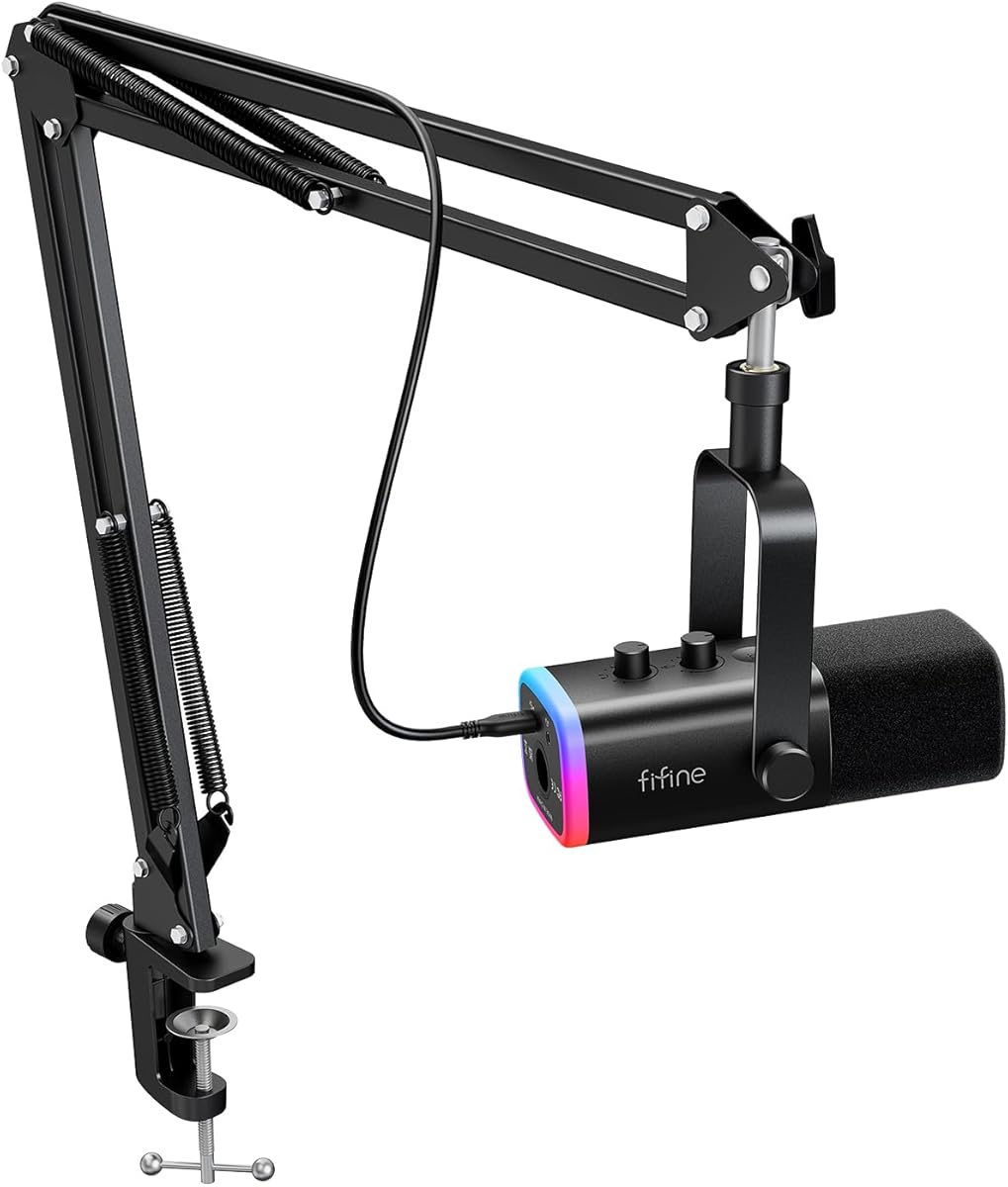
FIFINE AM8T Gaming Microphone Set
4.5Editor score
Dual USB and XLR
Real-time headphone monitoring
Dynamic cardioid microphone
Explore the best cheap boom microphone options for gaming, streaming, podcasts, and calls, with key features, compatibility, and setup compared in detail.
A useful boom microphone can improve voice clarity without requiring a complex studio setup. The right model should fit your device, suit your room, and place your voice close enough for a strong, consistent signal. Important distinctions include USB versus XLR connectivity, condenser versus dynamic capture, and added controls for gain, monitoring, muting, and noise reduction.
The ten products in this guide cover desktop boom-arm kits, USB gaming microphones, and portable 3.5mm boom-mic adapters. We compared their supplied specifications, connectivity, included accessories, control options, platform compatibility, and intended uses. This is a feature-based expert guide, so the recommendations reflect the available product information rather than claims of personal hands-on testing.
Each review identifies the strongest reason to consider a microphone and also explains important limitations. The top selections highlight a complete budget gaming setup, a flexible USB-and-XLR microphone, and a straightforward multi-device podcasting package. Retail listings, bundle contents, and compatibility details can change, so confirm the current listing and manufacturer instructions before ordering.
4.5Editor score
4.5Editor score

4.3Editor score
The table below compares all ten microphones by capture style, connection method, core controls, and best-suited activity, making it easier to identify the model that matches your equipment and recording goals.


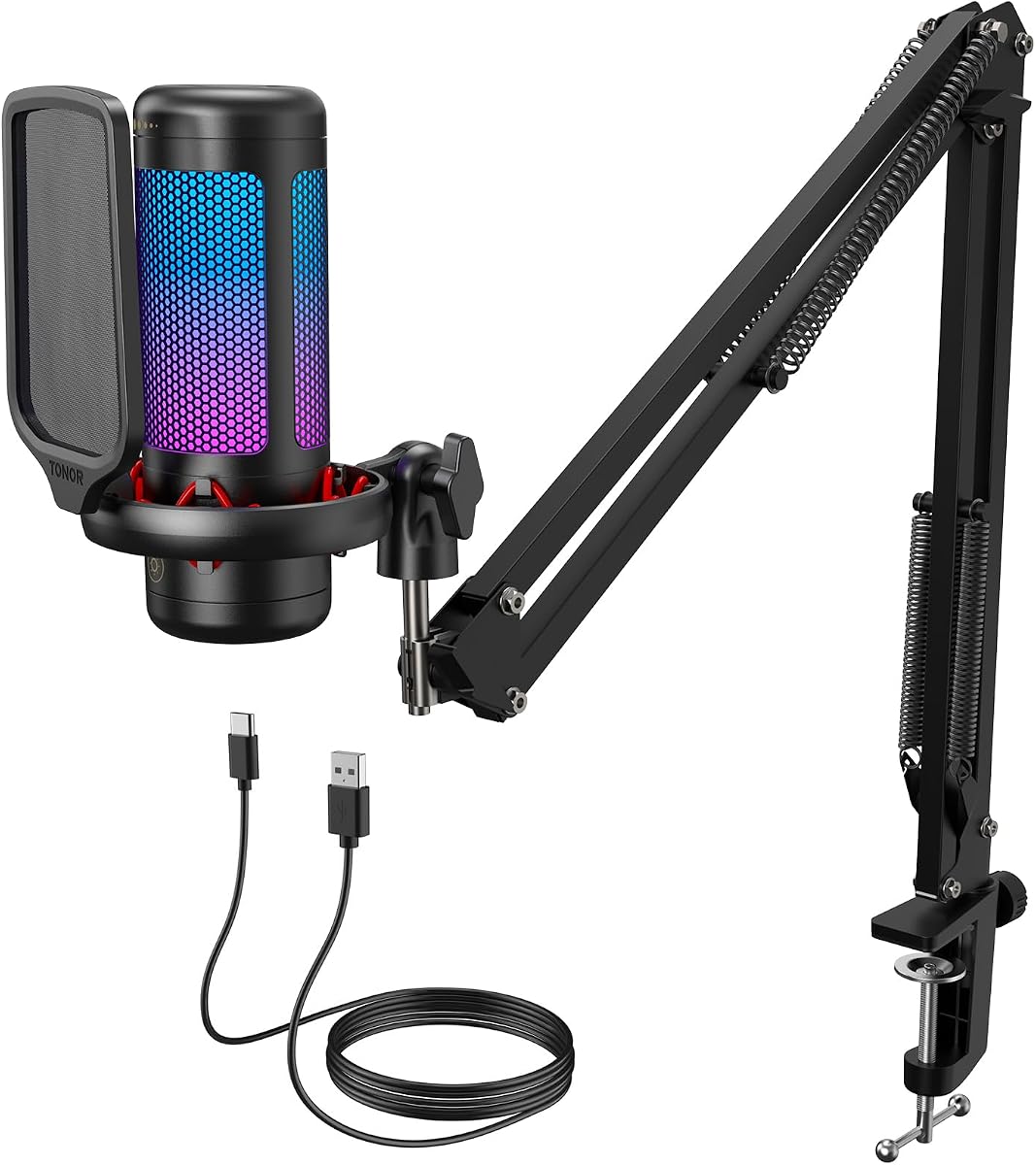
The TONOR TC310+ earns the leading position as the best overall cheap boom microphone because it combines a USB condenser microphone, an adjustable metal boom arm, a desk clamp, and essential onboard controls in one coherent package. Its 4.5 customer rating reflects a broadly favorable response, while the supplied feature set makes it particularly appealing to streamers and gamers who want a functional desktop setup without assembling every component separately.
We may earn a commission when you buy through this link, at no additional cost to you.
The microphone uses a USB connection intended for straightforward use with a computer, and the product information emphasizes premium chips, expert tuning, and high-fidelity reproduction. A tap on top mutes the microphone, while rotating the top adjusts gain. This arrangement keeps essential changes within reach during a stream or gaming session, reducing the need to open software for basic level adjustments.
RGB lighting is another practical differentiator. Four modes cover static color, single-color gradient, breathing, and mixed-color gradients, and the lighting brightness can also be adjusted. The boom assembly uses metal construction, a sturdy clamp, and multiple adjustable joints, allowing the microphone to sit closer to the speaker without taking up desk space in the same way as a large desktop stand.
The main limitation is its reliance on USB rather than XLR, which means it is not intended for users who want to connect through an external sound card. The desk clamp also fits only desks up to 2.36 inches thick. Even so, for PC gaming, livestreaming, video calls, and straightforward content creation, the TC310+ offers an unusually balanced combination of recording hardware, positioning hardware, lighting, and controls.
This is the strongest recommendation for most buyers seeking an affordable boom-microphone package for a computer. It is particularly useful for someone who wants a recognizable gaming appearance, a close microphone position, and simple physical controls. The small desk-space limit and lack of XLR are worth checking, but they do not outweigh the convenience of the complete package for the intended PC setup.
Tap-to-mute and top-mounted gain adjustment let a creator respond quickly during a stream. These controls are especially helpful when software menus would interrupt the task or when background sound needs to be removed immediately.
The included metal boom arm, clamp, and multiple joints create a stable place for the microphone without requiring a separate full-size stand. The stated clamp thickness limit should be checked before installation.
We may earn a commission when you buy through this link, at no additional cost to you.
The FIFINE AM8T is the best premium choice in this guide because it combines a dynamic gaming microphone with both USB and XLR connectivity. It carries a 4.5 rating and is aimed at users who can begin with a direct computer connection but may later move to an audio interface. That flexibility makes it more future-conscious than a microphone limited to a single connection method.
We may earn a commission when you buy through this link, at no additional cost to you.
In USB mode, the microphone supports plug-and-play operation for PC streaming and recording without additional drivers. The included boom arm, C-clamp, and 8.2-foot USB-to-USB-C cable provide the essentials for a desktop setup. Dynamic capture and a cardioid pattern focus attention on the speaker at the front, helping the microphone avoid some of the background noise that tends to challenge condenser microphones.
The control set is unusually complete. A mute button, gain knob, headphone jack, and separate headphone volume control allow monitoring and level changes without leaving the recording application. RGB lighting can be changed or disabled with the RGB button. In XLR mode, the microphone can connect to a mixer or sound card, which is useful for users building a more permanent recording configuration.
The included boom arm uses metal construction and strong springs, while an anti-scratch pad protects the desk contact point. However, the clamp is intended for desktops less than 2 inches thick. Also, an XLR cable is not included, so buyers choosing that route must plan to obtain the necessary cable separately.
Overall, the AM8T is ideal for gamers, streamers, and podcasters who want a polished microphone and boom arm now but may want an interface later. It suits users who understand the distinction between USB convenience and XLR expandability. For anyone strictly needing a USB-only product, the simpler TC310+ or A04 may offer a more direct path.
USB operation removes the need for extra hardware in a basic setup, while XLR output opens a path to a mixer or sound card. That makes the microphone practical for creators whose recording setup may evolve over time.
The headphone jack and independent monitoring volume let users hear their voice and identify clipping or level changes. These are useful features for recording, streaming, and voice chat where delayed monitoring would be disruptive.
We may earn a commission when you buy through this link, at no additional cost to you.
The MAONO A04 is a strong choice for podcasters, voice-over artists, and streamers who want a complete USB condenser microphone kit. Its 4.5 rating reflects a well-regarded package that combines a microphone, adjustable scissor arm, metal shock mount, pop filter, foam windscreen, base, cable, and manual. The inclusion of so many vocal accessories is the major reason it stands out.
We may earn a commission when you buy through this link, at no additional cost to you.
Its professional sound chipset supports 192kHz and 24-bit recording, while the 16mm electret condenser transducer is designed to provide a strong bass response and clear vocal reproduction. The product information specifically recommends a best range of two to six inches, reinforcing the value of positioning the microphone close to the speaker when possible.
Setup is refreshingly straightforward. The USB data connection works with computers without extra driver software or an external sound card, and the included cable supports USB-A or USB-C devices. It is also listed for use with many PCs, laptops, PS4, PS5, and mobile devices, along with applications such as Discord, Twitch, and Zoom.
One important software limitation is that the AU-A04 is not used with Maono Link; the manufacturer recommends considering the A04 Gen2 if Maono Link is required. The microphone is also not compatible with Xbox. The desk clamp is intended for surfaces less than 2.1 inches thick, so buyers should verify their desk before ordering.
The A04 is best for a creator who wants a traditional condenser recording kit with several useful accessories already included. It offers more recording-specific equipment than a basic gaming microphone and a simpler setup than a separate studio. Its strongest audience is a new podcaster or video creator who values high-resolution capture and a pop filter.
The included pop filter, foam windscreen, and shock mount help manage plosives, breath noise, and mechanical vibration. Together, they can produce a cleaner starting point than an unprotected desk microphone.
The 192kHz and 24-bit specification provides ample detail for voice recording. Because it connects directly by USB, the microphone also avoids the extra setup required by many conventional studio microphones.
We may earn a commission when you buy through this link, at no additional cost to you.
The InnoGear Gaming Mic is a visually coordinated USB boom microphone aimed at gamers who want clear voice communication, RGB lighting, and straightforward controls. It has a 4.4 rating and a 4.56-foot USB-C cable, giving users some freedom in where the boom arm is positioned. The package is particularly relevant for Windows, macOS, PS4, and PS5 setups.
We may earn a commission when you buy through this link, at no additional cost to you.
Its standout feature is claimed advanced noise cancellation, which is designed to reduce distracting background sounds such as keyboard and room activity. The upgraded cardioid condenser capsule focuses on speech from the front while also offering sensitivity described as being able to amplify clarity. A large gain knob and touch-sensitive mute button make routine changes easy during play.
The RGB lighting includes solid color, multicolor gradient, single-color gradient breathing, and single-color gradient transitions. A zero-latency monitoring function lets users connect headphones and hear playback without an obvious delay, helping with level checks and communication. The result is a feature set oriented heavily toward game streaming and team interaction.
The major caveat is compatibility: the manufacturer explicitly says the condenser microphone is not compatible with Xbox. Condenser microphones can also pick up more room noise than dynamic models, so the stated noise-cancellation feature should not be treated as a substitute for careful gain control and microphone placement.
This microphone is a compelling choice for a colorful PS4, PS5, or PC gaming station where the user values monitoring and easy controls. It is less suitable for Xbox owners or users who need XLR connectivity. For those who want a similar gaming presentation but a different capture approach, the AM8T offers dynamic capture and dual outputs.
The listed support for PS4, PS5, Windows, and Mac makes the microphone relevant beyond desktop PCs. Console buyers should still confirm the current connection and software requirements before recording or streaming.
Four RGB modes and zero-latency monitoring make the microphone visually consistent with a gaming setup while providing an immediate way to check voice levels. Both features add convenience without requiring dedicated desktop software.
We may earn a commission when you buy through this link, at no additional cost to you.
The V-MODA BoomPro is the best budget choice for someone who wants to add voice communication to compatible headphones without buying a complete USB desktop microphone. It has a 4.3 rating and uses a universal 3.5mm plug, allowing it to work with smartphones, tablets, PCs, notebooks, and gaming consoles such as PlayStation 4, PlayStation Vita, and Xbox One.
We may earn a commission when you buy through this link, at no additional cost to you.
The boom microphone is detachable, and the flexible boom can be positioned near the mouth. A clip-on controller places a mute button and volume wheel directly on the cable. This arrangement is useful for calls and gaming because the essential controls can be reached without opening an application or adjusting a computer menu.
Construction is designed for regular use, with a reinforced but lightweight cable and a 24-carat gold-plated connector. The boom mic is also broadly compatible with V-MODA Crossfade-series headphones and other headsets that accept 3.5mm headphone input, subject to the manufacturer's compatibility lists.
The key limitation is that the final recording quality depends heavily on the headset and its microphone position. This is an analog accessory rather than a self-contained recording system, and compatibility can vary among headphone models and versions. Users should verify the relevant headset specifications before purchasing.
For a traveler, student, or casual gamer, the BoomPro provides a simple way to improve headset communication. It is less appropriate for a polished podcast or livestream where a dedicated USB microphone, boom arm, and direct level controls are more important. Its portability and universal-style connection make it a useful backup microphone as well.
The 3.5mm connection means the BoomPro can move between compatible phones, laptops, consoles, and tablets. That makes it especially handy for travel or a shared-device setup where a permanently installed desktop microphone is unnecessary.
The detachable controller provides quick access to mute and volume. These physical controls are useful during calls and games because they remain available even when the connected device is not easily reachable.
We may earn a commission when you buy through this link, at no additional cost to you.
The FIFINE T669 has the highest listed customer rating in this roundup at 4.6, making it a confident choice for PC recording, podcasting, voice-over, and dubbing. It combines a USB condenser microphone with a steel boom arm, studio-grade shock mount, double pop filter, and an 8.2-foot cable, offering the visual appearance and accessory set of a compact home studio.
We may earn a commission when you buy through this link, at no additional cost to you.
The cardioid condenser capsule is intended to capture sound from the front while limiting the contribution of ambient noise from the sides and rear. Its wide frequency response and high-SPL capability make it appropriate for project and home-studio applications. Direct USB output means it can connect to a PC or laptop without additional hardware or drivers.
The boom arm provides 180-degree vertical rotation, 135-degree forward and backward extension, a fixed 13-inch horizontal section, and a stated 30-inch reach. Its all-steel construction is complemented by a combo mount containing a C-clamp and detachable desktop base. The double pop filter provides two layers of protection against the rush of air associated with plosive consonants.
The larger adjustable structure may occupy more desk space than a compact arm, and the microphone is explicitly incompatible with Xbox. Its low-profile positioning is intended to keep the microphone from obstructing the creator's face, which is valuable for video work. Users should ensure their desk can accommodate the chosen mounting option.
The T669 is an excellent choice for someone building a small recording area and wanting a polished, accessory-complete setup. It is less suited to a highly mobile user and offers no XLR upgrade path. Compared with the MAONO A04, it offers a more substantial studio-style arm and double pop filter, while the A04 emphasizes high-resolution capture specifications.
The shock mount, double pop filter, and adjustable steel arm cover several common recording needs. USB connectivity keeps the setup approachable while still presenting a more professional appearance than a bare desk microphone.
Multiple adjustment ranges make it easier to move the microphone close to the speaker, clear of the face, and away from reflective desk surfaces. A stable position is especially important for maintaining consistent levels during long sessions.
We may earn a commission when you buy through this link, at no additional cost to you.
The Cable Boom Microphone is the most straightforward option for improving communication with existing 3.5mm headphones at a modest cost. It has a 4.2 rating and uses a male-to-male 3.5mm audio cable with an upgraded flexible, detachable boom microphone, rotary volume control, mute switch, and SteelFlex positioning arm.
We may earn a commission when you buy through this link, at no additional cost to you.
Input compatibility covers devices with a 3.5mm audio output, including PS4, Xbox One, PS5, Xbox Series X/S controllers, PCs, laptops, iPhones, and Android phones. Output compatibility is designed for V-MODA Crossfade models such as the M-100, LP, LP2, M-80, and V-80, as well as many other headphones with a 3.5mm input, including common Beats models.
A dual 3.5mm Y-adapter is included for devices that separate headphone and microphone inputs. This is a valuable inclusion because it allows the accessory to work with equipment that cannot use a single four-pole headset connection. The detachable microphone also makes it easier to reposition the pickup point for a call, game, or recording session.
Its limitations are inherent to the design. It does not provide the signal processing, gain control, or direct digital connection of a USB microphone, and overall sound quality still depends on the connected headset. It also offers no monitoring or broad compatibility with modern USB-C or Lightning devices unless the user supplies an appropriate adapter.
This product makes the most sense for someone who already owns a compatible analog headset and wants a simple communication upgrade. It is a useful travel accessory, a backup for games, and a practical option for older devices with separate audio ports. Users creating polished long-form recordings would be better served by a dedicated USB or XLR microphone.
The included Y-adapter supports equipment with separate headphone and microphone jacks, expanding the types of devices that can use the boom. Buyers should still confirm the port layout and connector format of their equipment.
Mute and rotary volume controls are integrated into the cable, making them accessible during conversations and games. The flexible boom can be moved closer to the mouth for clearer speech pickup.
We may earn a commission when you buy through this link, at no additional cost to you.
The FIFINE AmpliTank K688CT is aimed at podcasters, streamers, and recording users who want a more robust dynamic microphone with both USB and XLR operation. It has a 4.5 rating, a cardioid pattern, and a stated maximum SPL of 130dB. That headroom makes it suitable for loud voices and energetic performance while keeping focus on sound from the front.
We may earn a commission when you buy through this link, at no additional cost to you.
USB mode provides the convenience of direct computer connection, while XLR mode supports a mixer or audio interface. The supplied information recommends recording from two to six inches away for stronger input volume. A metal boom arm, shock mount, and windscreen are included to help manage vibration, plosives, and the harsh low-frequency effects sometimes associated with explosive speech.
On-body controls include tap-to-mute, a gain knob, a headphone monitoring jack, and a headphone volume knob. The controls operate in USB mode. In XLR mode, the function keys are inactive, and level and monitoring must be managed through the connected mixer or audio interface, which is the normal division of responsibility for that signal path.
The desk clamp fits surfaces under two inches thick. The product guidance advises tightening adjustment knobs without forcing them, helping protect the arm and mounting hardware. An XLR cable is not among the listed package components, so users planning to use an interface should include that purchase in their setup.
The K688CT is a compelling choice for a creator who records loudly, wants a dynamic microphone, or plans to move from USB to a professional interface. It offers more headroom and connection flexibility than a typical entry-level condenser. For users wanting an easier all-in-one experience with fewer setup considerations, the AM8T covers similar dual-output needs at a lower tier.
The dynamic capsule and 130dB SPL rating provide room for loud delivery without relying on as much gain. That can be useful in untreated rooms where raising a sensitive microphone also increases unwanted background pickup.
USB makes the microphone approachable, while XLR allows a future move to an interface or mixer. The absence of a bundled XLR cable and inactive onboard controls in that mode should be considered when planning the setup.
We may earn a commission when you buy through this link, at no additional cost to you.
The TONOR Dynamic Gaming Microphone combines a dynamic capsule, AI noise reduction, USB and XLR output, and RGB lighting. Its 4.5 rating and feature set make it a modern option for gamers and streamers who want clearer speech in a noisy environment without committing immediately to a large analog setup.
We may earn a commission when you buy through this link, at no additional cost to you.
The stated triple AI noise-cancellation system is designed to reduce distractions such as keyboard clatter during streams and voice chats. The dynamic capsule is used to produce clear audio, while a cardioid-style front focus keeps the intended voice prominent. A gain control and headphone volume control allow more precise adjustment, and the headphone jack supports real-time monitoring.
USB mode connects directly to computers, PS4, and PS5. XLR mode is intended for sound-card connections, creating a route toward a more advanced setup. RGB lighting adds a customizable gaming appearance without requiring software-based lighting configuration, based on the product description.
The microphone does not include an XLR cable, and Xbox is not supported. Users considering the XLR route will therefore need additional equipment. The supplied description does not indicate that a full boom arm is included, so buyers looking specifically for an attached arm should check the package contents carefully.
This TONOR model is a strong fit for a PC, PS4, or PS5 creator who prioritizes noise control, monitoring, and the option to upgrade. It is particularly relevant for users in shared rooms or busy setups. If the included accessories do not provide a boom arm, the FIFINE AM8T may offer a more immediately complete desktop package.
The AI-assisted noise reduction targets common distractions such as keyboard noise. It should be used alongside sensible gain settings and close microphone placement rather than treated as a substitute for good acoustic practice.
Direct USB operation is convenient for PC and supported PlayStation systems, while XLR offers a path to a sound card. This balance suits a gamer who wants immediate use but may later build a more advanced audio chain.
We may earn a commission when you buy through this link, at no additional cost to you.
The ZealSound K66K is the most versatile multi-device option in this guide. It has a 4.4 rating and combines a USB condenser microphone, a heavy-duty metal boom arm, desk clamp, windscreen, long cable, USB-C adapter, and Lightning-compatible adapter. That package supports podcasting, streaming, video calls, and voice-over work across Windows, macOS, iPhone, iPad, Android, PS4, and PS5.
We may earn a commission when you buy through this link, at no additional cost to you.
The microphone uses a cardioid condenser capsule with an 80Hz to 20kHz frequency response and negative-45dB sensitivity. Built-in noise reduction can be switched on by long-pressing the mute control, allowing the user to compare reduced background sound with the fuller original mode. A foam windscreen adds protection against breath noise and plosive sounds.
Three front knobs control microphone input, headphone monitoring, and echo. The separate monitoring control works with 3.5mm headphones for zero-latency feedback, helping users judge speaking distance, level, reverb, and background sound. A short press of the mute button changes pickup state, with a blue LED indicating active operation and a red LED indicating mute.
The boom arm extends up to 30.8 inches, rotates 360 degrees, and clamps to desks up to 1.8 inches thick. The top-address design works best when the upper pickup area faces the speaker, and the stated ideal distance is six to twelve inches. The thicker desk limit and included platform adapters should be considered when planning installation.
The K66K is ideal for a creator who records on more than one device or wants podcast-style features in a gaming-oriented package. Its main strength is the combination of switchable noise reduction, real-time monitoring, echo, and broad compatibility. It is less convenient for truly mobile work because of the fixed desktop boom, but it offers a remarkably complete desktop bundle.
Switchable noise reduction, a foam windscreen, zero-latency monitoring, and independent level controls cover several common podcasting needs. The included boom arm helps maintain a consistent distance and angle.
USB-C and Lightning-compatible adapters broaden support for phones and tablets, while USB operation covers computers and supported consoles. This makes the kit adaptable to changing workspaces without changing the core microphone.
We may earn a commission when you buy through this link, at no additional cost to you.
The right cheap boom microphone depends less on feature count than on connection, capture style, placement, and the devices you already own. Use the following factors to narrow the field before making a final selection.
Connection method determines where the microphone can be used and how much room exists for future upgrades. USB is the simplest choice for computers because many models connect without extra drivers and can include physical gain, mute, and monitoring controls. XLR is more appropriate when using an audio interface or mixer and generally requires a separate cable. A 3.5mm boom adapter is the most portable choice but normally depends on an existing headset and analog ports. Check the exact connector, whether the device has a combined headset jack, and whether a separate microphone input is required before buying.
Condenser microphones are sensitive and commonly used for speech, podcasting, and studio-style recording. They can capture subtle vocal detail but may also pick up room noise, fans, and keyboard sounds. Dynamic microphones generally handle louder voices and less controlled environments more easily, making them common in gaming and broadcast-style use. A cardioid pattern is the most important directional characteristic in this category because it focuses pickup in front of the microphone. Neither type is universally better; the best choice depends on voice level, room acoustics, and how much processing the recording setup can provide.
A boom arm can place the microphone close to the mouth, where speech is stronger and more consistent, while keeping it clear of the desk and visual frame. Check the maximum reach, vertical and horizontal rotation, arm construction, spring strength, and included mount. Desktop clamps often specify a maximum thickness, and several products in this guide support only around two inches or less. Measure the desk before ordering and consider whether the arm will conflict with a monitor, keyboard, lamp, or gaming accessories. A removable desktop base can provide an alternative mounting method when clamp installation is unsuitable.
Physical controls are valuable because they can be used without opening software or navigating a menu. A top-mounted mute button is convenient during streaming, while a gain control allows the user to react to changes in voice level. Headphone monitoring helps creators hear the microphone directly and identify clipping, excessive room sound, or incorrect speaking distance. A separate headphone-volume knob is more useful than one control that changes both input and playback together. Check whether these controls work in every connection mode, because some XLR-capable microphones intentionally disable onboard functions when operated through an interface.
Noise reduction can make speech easier to hear in a shared or inconsistent room, but the type and amount of processing matter. Some microphones offer a switchable noise-reduction mode, while others rely on a cardioid capsule and software processing. A single polar pattern is less flexible than selectable patterns, but it is usually adequate for a desk setup. Position the microphone close to the speaker and aim it directly at the mouth to improve the signal-to-noise ratio. Before relying heavily on digital cancellation, compare the raw sound with noise reduction enabled to ensure the result remains natural rather than pumping or thin.
Digital specifications help indicate the potential detail available from a USB microphone. The MAONO A04, for example, lists 192kHz and 24-bit capture, while the others do not provide equivalent resolution information in the supplied data. High resolution is useful, but it does not automatically create a better recording than a well-positioned microphone with appropriate gain. Most USB models are designed to work without drivers, while software utilities can provide more control over levels, effects, and monitoring. Check whether the microphone requires a companion application and whether that application is available for the intended operating system.
Speech creates strong bursts of air, particularly on sounds such as P, B, and T. A pop filter helps soften these plosives, while a foam windscreen provides another layer of protection against breath and minor air movement. A shock mount suspends the microphone and reduces the transfer of bumps and desk vibration. These accessories do not change the microphone's compatibility, but they can materially improve usability during long recording sessions. Kits that include a pop filter, windscreen, and shock mount reduce the need for separate purchases, although a simple clip-on filter can also work effectively with a compatible USB microphone.
A microphone described as compatible with a device may still have exceptions related to ports, operating systems, or communication applications. Several condenser models in this guide are not compatible with Xbox, while some offer USB-C and Lightning adapters for mobile use. Older computers and game consoles may use a 3.5mm jack or separate headphone and microphone sockets. Bluetooth-capable devices, adapters, and docking stations introduce another layer of variation. Review the product's current compatibility note and compare it with the exact console, phone, computer, interface, and application you plan to use before completing the purchase.
Begin by checking the desk thickness and installing the included clamp or base on a stable surface. Attach the boom arm and microphone, then turn every adjustment knob only as far as needed to secure the position. Place the microphone close to the speaker, generally around four to eight inches away depending on the model and speaking style, and point the active side of the capsule toward the mouth. Avoid positioning it directly over a keyboard, mechanical hard drive, air vent, or reflective surface. For a 3.5mm boom, connect the microphone to the correct headset or adapter port and check that the device recognizes an external microphone.
After connecting the microphone, set the input level in the computer, console, mixer, or interface before recording. Speak at a natural volume, raise the gain gradually, and leave enough headroom that a loud word does not clip. If the microphone has its own gain control, use it alongside the software level rather than maximizing both. Connect compatible headphones to the monitoring jack when available, listen for echo, hiss, plosives, and room reflections, and adjust the microphone position before adding heavier processing. Use the mute control to confirm that the device truly stops receiving audio rather than assuming the button state is correct.
For care, unplug the microphone before moving the arm or changing its angle. Loosen tension gradually instead of forcing the joints, and wipe the metal arm and microphone body with a soft, dry cloth. Clean removable foam or mesh gently according to the manufacturer's care instructions, and keep liquids away from USB ports, headphone sockets, and control knobs. Store detachable 3.5mm accessories in a protected case to prevent cable damage. Periodically tighten the clamp and inspect the connection, but avoid overtightening small screws or changing the microphone's position without checking that the cable can move freely.
It depends on your console and setup. USB microphones are widely suitable for PC, PS4, and PS5, while several condenser models in this guide do not support Xbox. A 3.5mm boom microphone can serve older or analog devices, but it normally depends on your existing headset and cannot provide the same digital controls or signal flexibility.
A boom arm is useful because it places the microphone close to the mouth while keeping desk space open and the microphone out of the camera frame. Close placement also produces a stronger, more consistent signal than a microphone placed far across the desk. Just confirm that the included clamp fits the thickness of your desk before ordering.
A condenser can provide detailed speech capture and works well in a quiet room, while a dynamic is often more forgiving of loud voices, keyboard noise, and imperfect acoustic treatment. Gaming users in noisy spaces should consider a dynamic model with a cardioid pattern, though gain control and close placement remain important for either type.
Only if you choose to operate the microphone in XLR mode. USB models work directly with a compatible computer, while XLR requires a suitable interface or mixer and usually a separate XLR cable. Some of the listed bundles do not include that cable, so check the package contents before planning the connection.
Low levels often result from too much distance, insufficient gain, or an incorrect input selection in the recording software. Distortion usually indicates that the signal is being amplified too far. Move closer, set the correct input, reduce gain gradually, and leave some headroom for your loudest speaking level.
The ZealSound K66K explicitly includes USB-C and Lightning-compatible adapters and supports major mobile operating systems. Other USB microphones may work through suitable adapters, while 3.5mm products need a compatible headphone output. Confirm the included adapter and the device port before recording, since not every USB microphone is designed for mobile connection.
No. Noise reduction can reduce some steady or predictable background sounds, but it works best when the microphone is close, aimed correctly, and set to a reasonable level. Acoustic treatment, soft furnishings, and careful placement usually remain the foundation of a clean recording.
At minimum, a pop filter and a stable mount are helpful for speech. A foam windscreen adds breath protection, a shock mount reduces vibration, and headphones with a 3.5mm plug can support monitoring. Check compatibility carefully, especially the microphone mount, included cable length, and whether your device needs an adapter.
The TONOR TC310+ is the strongest all-around choice because it arrives as a complete USB condenser and metal boom-arm system with tap mute, gain adjustment, and RGB lighting. The FIFINE AM8T stands out for dynamic capture, monitoring, and both USB and XLR operation, while the V-MODA BoomPro is the most portable budget option for compatible analog headsets.
Prioritize the connection your equipment actually uses, the type of room you will record in, and whether physical controls and monitoring will improve your workflow. A close, stable microphone position and correct gain setting matter more than having the longest feature list. Pay particular attention to desktop-clamp limits, Xbox exclusions, included cables, and whether onboard controls remain active in every operating mode.
Retail listings and bundle contents can change over time, so check the current product page, connection requirements, and manufacturer notes before purchasing. The information in this guide is intended to narrow the field, while the final choice should reflect your device, recording environment, and intended balance between portability, accessories, controls, and future expansion.
buying-guides